
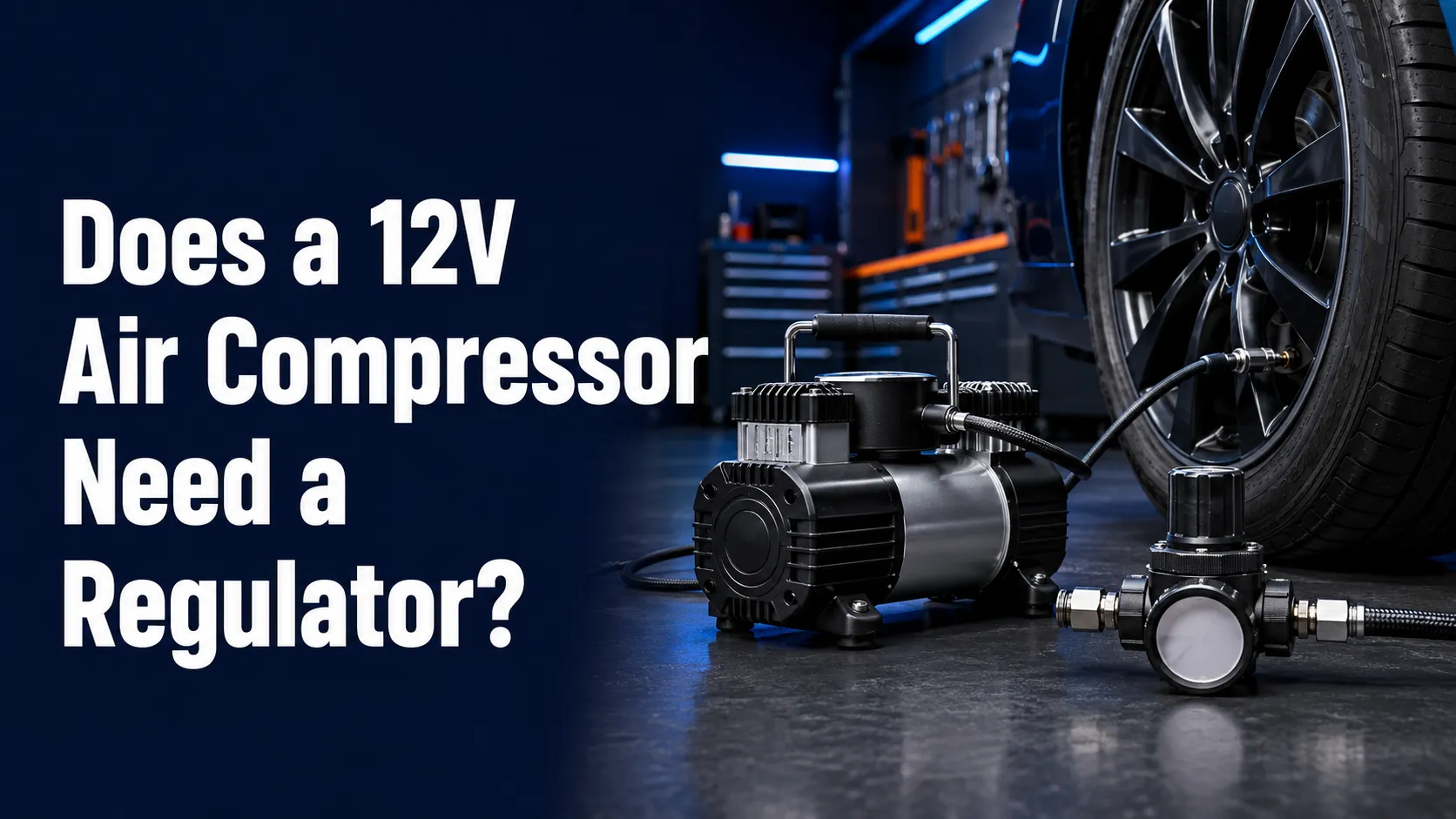
If you are asking, “Does a 12V air compressor need a regulator?” the answer is usually no for ordinary tire inflation. A portable inflator normally sends air directly to the tire while you monitor its gauge and stop at the vehicle manufacturer’s recommended cold-tire pressure.
Control RuleUse a regulator only when the compressor system, accessory, and task are designed for regulated airflow. A regulator does not replace a reliable tire-pressure gauge.
Does a 12V Air Compressor Need a Regulator?
For the most common automotive job—topping up tires with a compact 12V inflator—an added regulator is generally unnecessary. These units are usually tankless. Air moves from the small pump through the hose and into the tire, and the operator stops inflation manually or uses the inflator’s preset automatic shutoff.
A regulator becomes relevant when compressed air is stored in a tank or supplied to equipment that needs a controlled inlet pressure. The regulator reduces the higher upstream pressure to a lower downstream setting. Whether you need one therefore depends on the complete air system and the device being powered, not simply on the compressor using 12-volt electricity.
It also helps to separate pressure from airflow. A regulator can reduce outlet pressure, but it cannot make a small compressor produce the sustained air volume a demanding tool needs. Both pressure and airflow must meet the accessory manufacturer’s requirements.
Regulator vs. Gauge vs. Automatic Shutoff
These three features have different jobs. Confusing them can lead to poor pressure control or incompatible connections.
| Component | What it does | What it does not do | Common use |
|---|---|---|---|
| Pressure gauge | Displays pressure at its sensing point | Does not automatically restrict airflow | Checking tire or tank pressure |
| Pressure regulator | Reduces and controls downstream outlet pressure | Does not confirm final tire pressure by itself | Supplying an air tool or accessory |
| Automatic shutoff | Stops an inflator at a selected pressure | Does not provide continuous regulated airflow | Preset tire inflation |
| Pressure switch | Cycles a compressor to maintain tank pressure | Does not necessarily limit outlet pressure | Tank-based onboard-air systems |
When You Usually Do Not Need a Regulator
Inflating vehicle tires
A purpose-built tankless tire inflator normally connects directly to the valve stem. Monitor pressure and follow the vehicle placard or owner’s manual.
Topping up a spare tire
The same direct-inflation method generally applies, although compact spare tires often require a different pressure from the road tires.
Using a preset inflator
A model with automatic shutoff can stop at the selected value. Verify the result with a dependable gauge after the air settles.
Occasional high-volume inflatables
Use only approved nozzles and settings. Many mattresses and pool inflatables need high volume but very low pressure and may not suit a tire compressor.
Adding a regulator to a basic tire inflator can create more restrictions, fittings, and potential leak points without solving a real problem. It may also reduce airflow and lengthen inflation time. If the manufacturer does not provide or approve a regulated accessory setup, use the inflator as documented.
When a Regulator May Be Necessary
A regulator is more likely to be needed when the compressor feeds a receiver tank and the downstream equipment has a lower maximum inlet pressure. Examples may include an airbrush, a small pneumatic control, an air horn system, or a compatible light-duty air tool. Each device has its own pressure and airflow requirements.
Some onboard-air kits include a manifold, pressure switch, relief valve, gauge, and regulator. Others do not. If the supplied tank pressure can exceed the accessory’s rated working pressure, use the manufacturer-specified pressure-control equipment before operating that accessory.
Six Steps to Decide Whether You Need One
Identify the actual job
Decide whether you are filling a tire, powering a pneumatic device, operating an airbrush, or feeding another system. The end use determines the required pressure control.
Check the compressor design
Confirm whether the unit is tankless or tank-based and whether its manual permits external accessories. Note maximum working pressure, duty cycle, outlet type, and airflow information.
Read the accessory specifications
Find the accessory’s permitted inlet-pressure range and airflow demand. Do not assume that matching fittings mean the equipment is compatible.
Compare source and required pressure
If the source can deliver more pressure than the accessory accepts, a correctly rated regulator or manufacturer-approved control assembly is normally required.
Confirm fittings and flow direction
Regulators have an inlet, outlet, port size, and flow direction. Use pressure-rated hoses and fittings that match the system without unsafe adapters.
Set and verify safely
Begin at the lowest practical setting, adjust with air flowing if the regulator instructions require it, and confirm downstream pressure on an appropriate gauge. Check for leaks before normal operation.
Choosing a Compatible Regulator
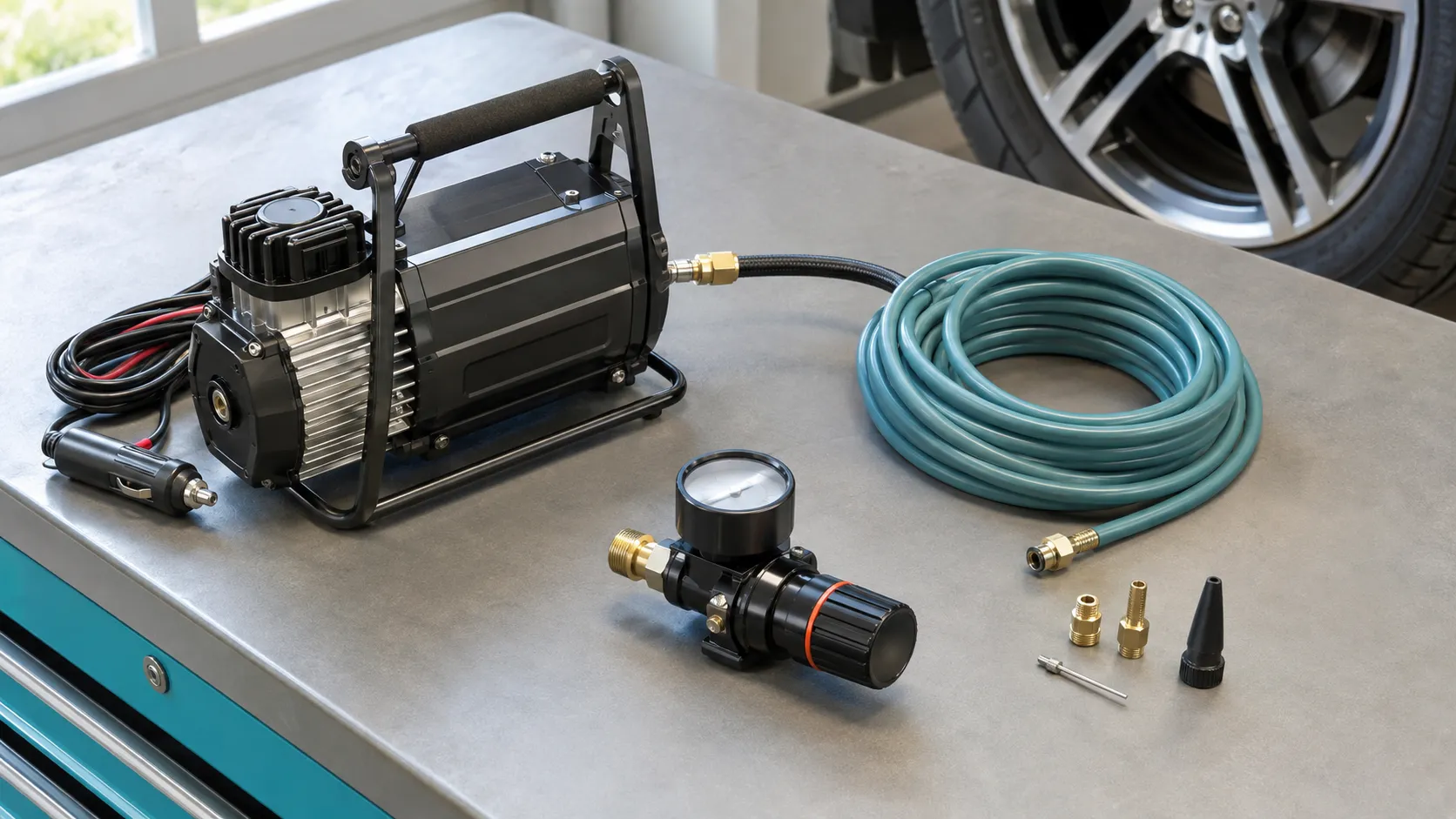
For a system that genuinely needs regulated pressure, do not choose only by thread size. The regulator must tolerate the compressor’s maximum upstream pressure and deliver enough airflow at the downstream pressure required by the tool. Its ports, environmental rating, mounting orientation, and adjustment range must also suit the installation.
- Maximum inlet pressure at least as high as the system’s permitted source pressure
- Useful adjustment range that includes the accessory’s required pressure
- Adequate airflow for the intended tool or device
- Correct pressure-rated port size, hose, couplers, and thread standard
- Downstream gauge positioned where the instructions specify
- Compatibility with moisture, temperature, vibration, and vehicle mounting conditions
- Manufacturer approval for the compressor and accessory arrangement
Common Problems and Solutions
Pressure rises after adjustment
This may indicate regulator creep, incorrect adjustment procedure, contamination, or a failing seat. Stop use and follow the regulator’s service guidance.
Tool feels weak
The regulator, hose, couplers, or compressor may not provide enough airflow. Do not increase pressure beyond the tool’s rating to compensate.
Tire fills very slowly
An unnecessary regulator or undersized fitting can restrict flow. Return to the manufacturer-approved tire-inflation setup and check for leaks.
Gauge readings disagree
Gauges may sense different points or have different tolerances. Check connections and verify final tire pressure with a dependable tire gauge.
Pressure-Control Best Practices
- Use the pressure on the driver-door placard or owner’s manual for road tires, not the tire sidewall’s maximum-pressure marking.
- Check tire pressure when the tires are cold whenever practical.
- Keep people clear of hoses, couplers, and fittings while pressurizing a system.
- Use eye protection when assembling or servicing tank-based pneumatic components.
- Never exceed the lowest-rated component in the air path.
- Follow the compressor’s duty cycle and allow the required cooling time.
- Stop for damaged cords, hot or melting connectors, cracked hoses, air leaks, smoke, or abnormal noise.
Frequently Asked Questions
Does a portable 12V tire inflator need a regulator?
Usually not. A tankless tire inflator normally connects directly to the tire, and you stop it manually or use its automatic shutoff at the target pressure.
Is a pressure gauge the same as a regulator?
No. A gauge displays pressure, while a regulator reduces and controls pressure delivered to downstream equipment.
Do I need a regulator for an onboard-air tank?
You may need one when the tank supplies a tool or accessory rated below the tank pressure. Follow the onboard-air and accessory manufacturers’ instructions.
Can a regulator make tire inflation more accurate?
Not by itself. Tire accuracy depends on the pressure reading and when inflation stops. Verify final pressure with a dependable tire gauge.
Can I use any air-compressor regulator with a 12V compressor?
No. The regulator must match the maximum inlet pressure, adjustment range, airflow, fittings, environment, and approved system configuration.
Why does pressure increase after I set the regulator?
The regulator may be adjusted incorrectly, contaminated, undersized, or experiencing internal seat leakage known as creep. Stop use if it cannot hold the setting.
Does automatic shutoff replace a regulator?
No. Automatic shutoff ends inflation at a selected reading; it does not continuously supply controlled downstream pressure to a pneumatic device.
Related Guides
Conclusion
So, does a 12V air compressor need a regulator? A compact tankless tire inflator generally does not. Its gauge and manual or automatic stopping method handle ordinary tire inflation. A tank-based system or pressure-sensitive pneumatic accessory may require a compatible regulator to reduce and stabilize downstream pressure.
Base the decision on the compressor manual, the accessory’s maximum inlet pressure, and the complete system rating. When in doubt, use the compressor only for its documented purpose or ask the manufacturer or a qualified pneumatic technician to confirm the setup.
Do not add a regulator merely because a compressor runs on 12V. Use one when the downstream device requires controlled pressure and the complete regulated setup is properly rated. For tires, follow the vehicle pressure placard and verify the final reading with an accurate gauge.