
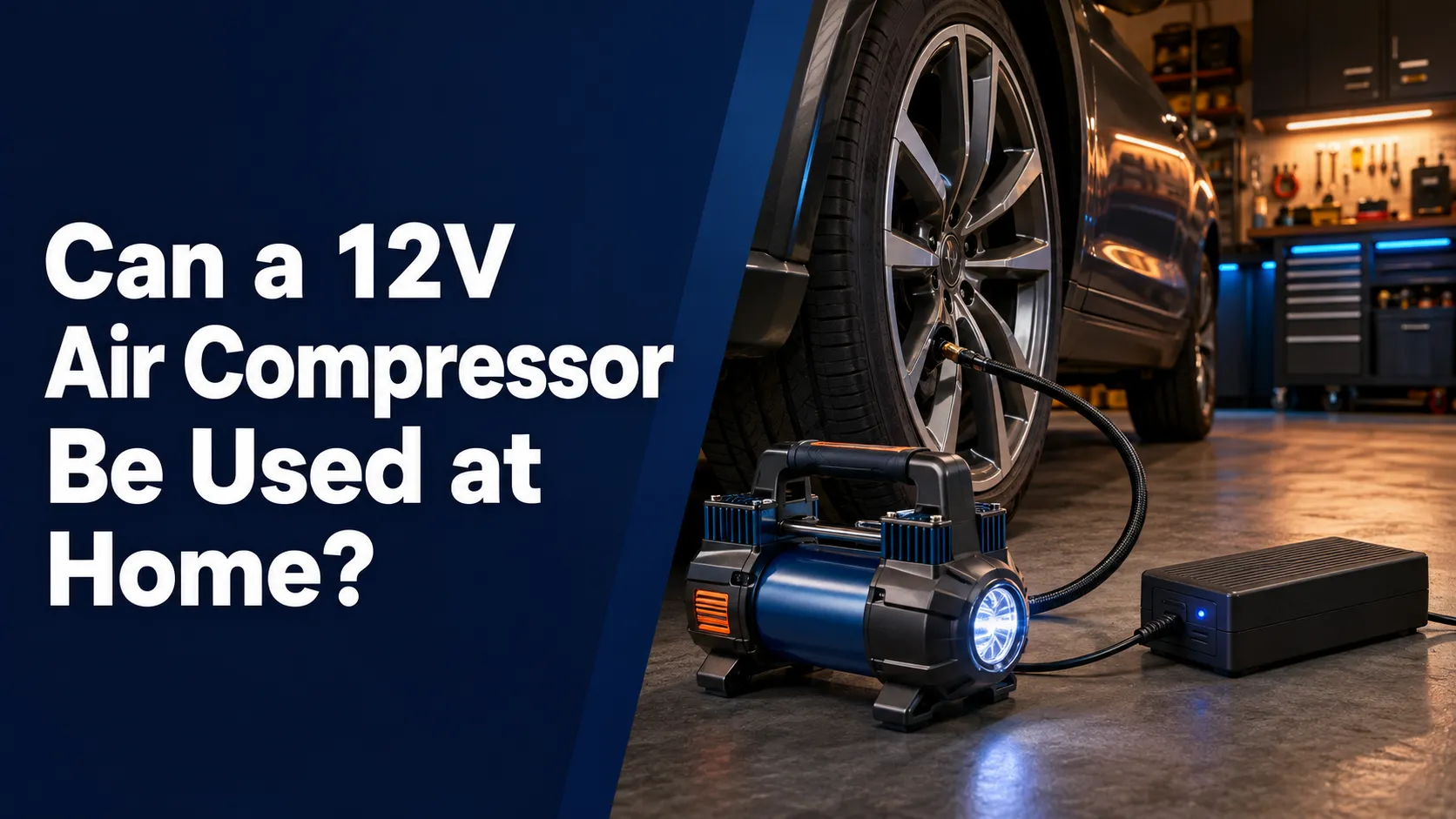
If you are asking, “Can a 12V air compressor be used at home?” the answer is yes. The compressor still needs a compatible 12V DC source that can safely supply its current demand; a standard U.S. wall outlet provides 120V AC and cannot power it directly.
Most important: Never connect a 12V DC plug directly to household AC or rely on an adapter based only on connector shape. Confirm electrical ratings in both manuals.
Can a 12V Air Compressor Be Used at Home Safely?
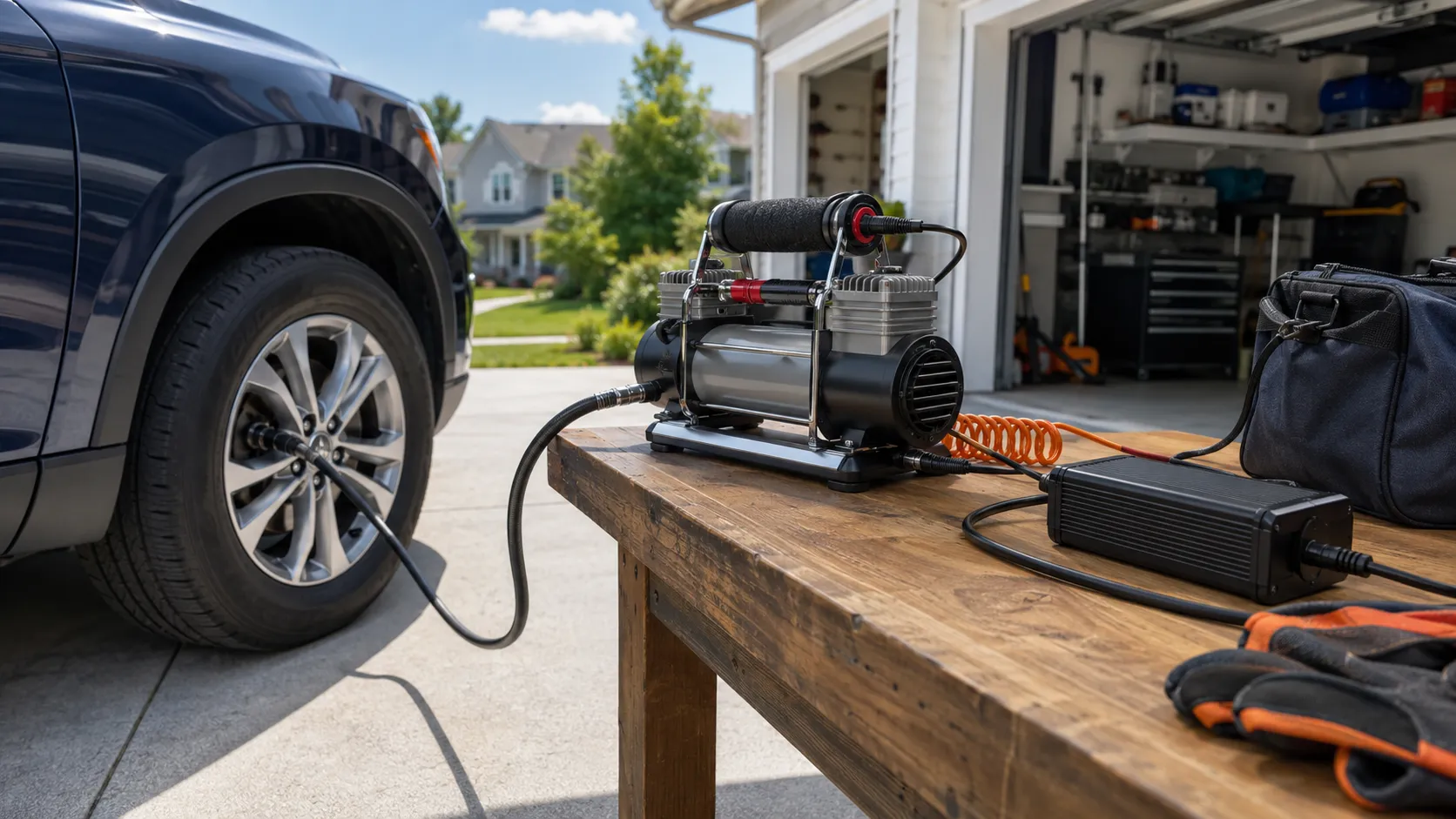
Yes, but “at home” describes the location rather than the electrical setup. Portable 12V compressors are commonly designed around a vehicle accessory outlet or battery connection. In a garage, you must reproduce an approved DC supply without exceeding the compressor’s limits.
Start with the compressor label and manual. Find its input voltage range, rated or maximum current, connection method, fuse requirement, polarity, and duty cycle. Then compare those details with the power source’s 12V output specification. The output should be expressly suitable for the load; a small adapter intended for routers, lights, or electronics is usually not an appropriate substitute.
Home Power Options Compared
| Power option | When it may work | What to verify | Main caution |
|---|---|---|---|
| Approved AC-to-12V DC supply | Stationary garage or workshop use | Output voltage, continuous current, surge capability, polarity, socket, fuse, ventilation | Many light-duty adapters cannot support a compressor motor |
| Portable power station | Driveway, garage, or outage use | 12V port’s continuous limit, connector, battery charge, auto-shutoff behavior | The 12V port may have a much lower limit than the unit’s AC inverter |
| Vehicle accessory outlet | Near a parked vehicle | Outlet fuse/current limit and vehicle-manual instructions | Some compressors exceed dashboard-socket capacity |
| Direct battery clamps | When the compressor is designed for clamps | Polarity, cable condition, inline fuse, safe clamp sequence, battery condition | Sparks, short circuits, and reversed polarity can be hazardous |
| Loose automotive battery indoors | Only in a properly engineered and ventilated setup | Battery type, charging method, terminal protection, ventilation, manufacturer rules | Exposed terminals and improper charging create serious risks |
An AC-to-DC converter is often the simplest stationary option, but it must be sized for the exact compressor. Avoid assuming that every “12V socket adapter” is a power supply; some accessories are only extension sockets or wiring adapters. Likewise, a power station’s marketing wattage may refer to its AC inverter, not its regulated 12V outlet.
Seven Steps for a Safe Home Setup
Read the compressor manual
Confirm its approved power connections, voltage range, current draw, fuse, duty cycle, operating environment, and intended inflation tasks. Do not continue if the label is damaged and specifications cannot be verified.
Choose a suitable DC source
Use a manufacturer-approved supply or a source whose manual explicitly confirms that its 12V output can handle the compressor’s electrical load. Do not connect the compressor directly to a wall receptacle.
Check polarity and connectors
Make sure positive and negative orientation, plug dimensions, socket wiring, and clamp markings match. Never force a plug, reverse clamps, or improvise bare-wire connections.
Inspect every component
Look for cracked plugs, loose terminals, cut insulation, corrosion, swollen batteries, damaged hoses, blocked vents, or a missing fuse. Remove questionable equipment from service.
Set up in a dry, open area
Place the compressor on a stable surface with ventilation around its motor. Keep it away from rain, sinks, flammable materials, children, pets, walkways, and anything that could cover its cooling vents.
Connect the hose before powering
Attach the correct chuck or adapter, check the item’s pressure guidance, and arrange the cord and hose so they cannot be pinched or create a trip hazard. Then connect power as directed.
Monitor pressure, heat, and runtime
Stay with the compressor. Stop at the target pressure, follow its maximum run and cooling schedule, and disconnect power before adjusting attachments. Verify tire pressure with an accurate gauge when appropriate.
What Can You Inflate Around the House?
A 12V unit can be convenient for car, motorcycle, bicycle, lawn-equipment, trailer, or utility tires when those items fall within the compressor’s stated capability and you use the correct valve connection. Some models include adapters for sports balls or selected inflatables.
Do not assume every air-filled item is compatible. High-volume pool floats and air mattresses may take a long time with a tire compressor because they need high airflow at low pressure. Some inflators cannot safely run long enough for that job. Toys, exercise equipment, and sports gear can also be damaged quickly if their recommended pressure is low and the compressor’s gauge is not precise in that range.
Usually practical
Approved vehicle tires, bicycle tires within range, sports balls with the correct needle, and small equipment tires.
Check carefully
Large truck tires, high-volume inflatables, delicate low-pressure items, tubeless tire seating, and anything requiring continuous airflow.
A portable tire compressor is not a general-purpose shop compressor. Unless its manufacturer approves the use, do not connect air tools, spray equipment, cleaning nozzles, a receiver tank, or pneumatic machinery. Maximum PSI does not establish adequate airflow or compatibility.
Common Home-Use Problems and Solutions
Power supply shuts off
The compressor may exceed the port’s current or surge limit, or protection may be reacting to heat or a fault. Disconnect it and verify both manuals; do not bypass protection.
Compressor runs slowly
Low supply voltage, an undersized converter, long wiring, a loose socket, or a poor connection can cause voltage drop. Stop before plugs or cables overheat.
Plug or adapter gets hot
Heat can indicate excessive current, resistance, contamination, or a worn connection. Disconnect power and replace damaged components with approved parts.
Fuse opens repeatedly
The supply, wiring, compressor, or load may have a problem. Never install a larger fuse unless the manufacturer specifies that exact change.
Best Practices for Garage and Driveway Use
- Use the compressor only for applications approved by its manufacturer.
- Keep the power supply and compressor dry and adequately ventilated.
- Use extension cords only if the power-supply manufacturer permits them and specifies the required type.
- Keep 12V leads as short as practical and never modify factory wiring casually.
- Do not leave a running compressor unattended or allow children to operate it.
- Follow tire, vehicle, battery, and inflatable-item pressure instructions.
- Allow the full cooling interval specified after each operating cycle.
- Disconnect immediately for smoke, odor, sparking, melted plastic, abnormal noise, severe vibration, or damaged wiring.
Frequently Asked Questions
Can I plug a 12V air compressor into a wall outlet?
Not directly. A standard U.S. wall outlet supplies 120V AC, while the compressor expects 12V DC. Use only a compatible, properly rated AC-to-DC supply.
What size power supply does a 12V compressor need?
It needs the correct DC voltage, polarity, and enough continuous and startup current for that exact compressor. Use the specifications in both manufacturers’ manuals rather than guessing from wattage alone.
Can a portable power station run a 12V air compressor?
Possibly, if the power station’s specific 12V port supports the compressor’s current demand, connector, and startup behavior. Check the port rating, not only the station’s advertised AC wattage.
Can I use a battery charger as a 12V power supply?
Only if the charger manufacturer explicitly approves power-supply operation for that type of load. Many chargers are designed to charge batteries, not directly operate compressor motors.
Can I use a 12V compressor indoors?
Use it only where the manual permits, in a dry and ventilated area away from flammable materials. Never run a gasoline vehicle indoors to power it.
Can a 12V tire compressor inflate an air mattress?
Only if the compressor and adapter are approved for it. Air mattresses need high-volume, low-pressure airflow, which can be inefficient or unsuitable for a tire compressor.
Why does my 12V compressor keep blowing a fuse at home?
Possible causes include an undersized supply, wrong fuse, poor connection, voltage drop, overheating, or an internal fault. Stop using it and diagnose the cause; never substitute a larger fuse without manufacturer approval.
Related Guides
Conclusion
So, can a 12V air compressor be used at home? Yes—provided you use a safe DC source that matches the compressor’s voltage, polarity, continuous current, connector, fuse, and manufacturer instructions. A compatible AC-to-DC supply or suitably rated power station can make garage use convenient.
Do not connect the compressor directly to household AC, assume a fitting plug guarantees compatibility, or bypass electrical protection. Choose the power source from verified specifications, respect the compressor’s duty cycle, and stop whenever wiring, connectors, or the motor become abnormally hot.
A 12V air compressor can work perfectly well at home, but it still needs automotive-style DC power delivered safely. Match every electrical rating before connecting it, keep the equipment ventilated, and use the compressor only for tasks within its manual.