
If you are wondering, “Can a 12V air compressor run continuously?” the safe answer for most portable tire inflators is no. Run it only for the maximum time or duty cycle stated in its manual, then give it the full specified cooling period.
Runtime RuleThe tire still needing air does not extend the compressor’s safe run time. Stop at the manufacturer’s limit, even when inflation is incomplete.
Can a 12V Air Compressor Run Continuously?
A portable 12V compressor can run only as long as its design permits. Many units intended for occasional tire top-offs operate in short sessions and need cooling breaks. A larger direct-to-battery compressor may offer a longer duty cycle, while a true continuous-duty model must be explicitly rated that way by its manufacturer.
Do not estimate safe runtime from the compressor’s appearance, price, plug type, or voltage. Read the model label and manual. Look for terms such as maximum continuous run time, duty cycle, cool-down time, ambient temperature, and maximum working pressure. The most restrictive applicable limit controls how you should operate it.
What Duty Cycle Means
Duty cycle describes the portion of a defined period during which a compressor may run before it must rest. The manufacturer may express this as a percentage, as minutes on and minutes off, or simply as a maximum run followed by a minimum cool-down. Because the reference period and test conditions can differ, two percentages are not automatically comparable.
For example, if a manual defines a 20-minute cycle and allows 50% operation, that means up to 10 minutes running within that defined cycle under the listed conditions. It does not mean the unit can run for 30 minutes merely because half of an hour is 30 minutes. Always use the manual’s own reference period.
| Manual wording | What it tells you | How to respond |
|---|---|---|
| Maximum run time | The longest permitted single operating session | Stop at or before that time |
| Minimum cool-down | The required rest before another session | Switch off and allow unobstructed cooling |
| Duty-cycle percentage | Allowed running portion of a stated cycle | Calculate only with the stated reference period |
| Continuous duty or 100% | Designed for continuous operation under specified conditions | Still follow pressure, temperature, electrical, and maintenance limits |
| Thermal cutout | Protection that may stop excessive heat | Do not intentionally run until it trips |
Why Continuous Operation Can Damage the Compressor
Motor heat
Electrical resistance and mechanical load create heat. Excessive temperature can degrade insulation, wiring, brushes, bearings, and seals.
Pump heat
Compressing air generates heat in the pump head, cylinder, hose, and fittings. Metal parts may remain hot after shutdown.
Electrical stress
Long high-current operation can heat a marginal plug, accessory socket, cable connection, or battery-clamp contact.
Reduced airflow
Blocked vents, soft surfaces, closed carrying cases, dust, or nearby cargo can prevent the unit from shedding heat.
High ambient temperature compounds these effects. Inflation from very low pressure, large truck or SUV tires, multiple tires, air mattresses, and other high-volume jobs can also extend runtime. A compressor may be capable of the pressure yet still lack the duty cycle or airflow for the job.
Seven Steps for Safe Runtime Management
Read both manuals
Confirm the compressor’s run and cooling limits, approved power connection, operating temperature range, maximum pressure, and compatible applications. Check the vehicle manual for its outlet rating and ignition requirements.
Inspect before switching on
Look for damaged wiring, a loose plug, corroded clamps, cracked hose, blocked vents, missing feet, or melted plastic. Do not operate a visibly damaged unit.
Place it for ventilation
Set the compressor on a firm, stable, dry surface with open space around every cooling vent. Keep it away from loose fabric, dry grass, water, children, pets, and traffic.
Start with a timer
Do not rely on memory during an emergency. Begin timing as soon as the motor starts, and include brief pauses if the manual says the limit is cumulative within a defined cycle.
Monitor pressure and condition
Stay with the compressor. Watch the gauge, listen for a change in motor sound, and observe the power connection and hose. Avoid touching a hot pump head or fitting.
Stop at the stated limit
Switch off even if the tire is not finished. Disconnect only as directed and place the unit where heat can dissipate without creating a burn or fire hazard.
Give it the full cooling period
Do not shorten cooling because the housing feels cooler on the outside. Internal parts can remain hot. Resume only after the complete specified interval and only if the unit shows no warning signs.
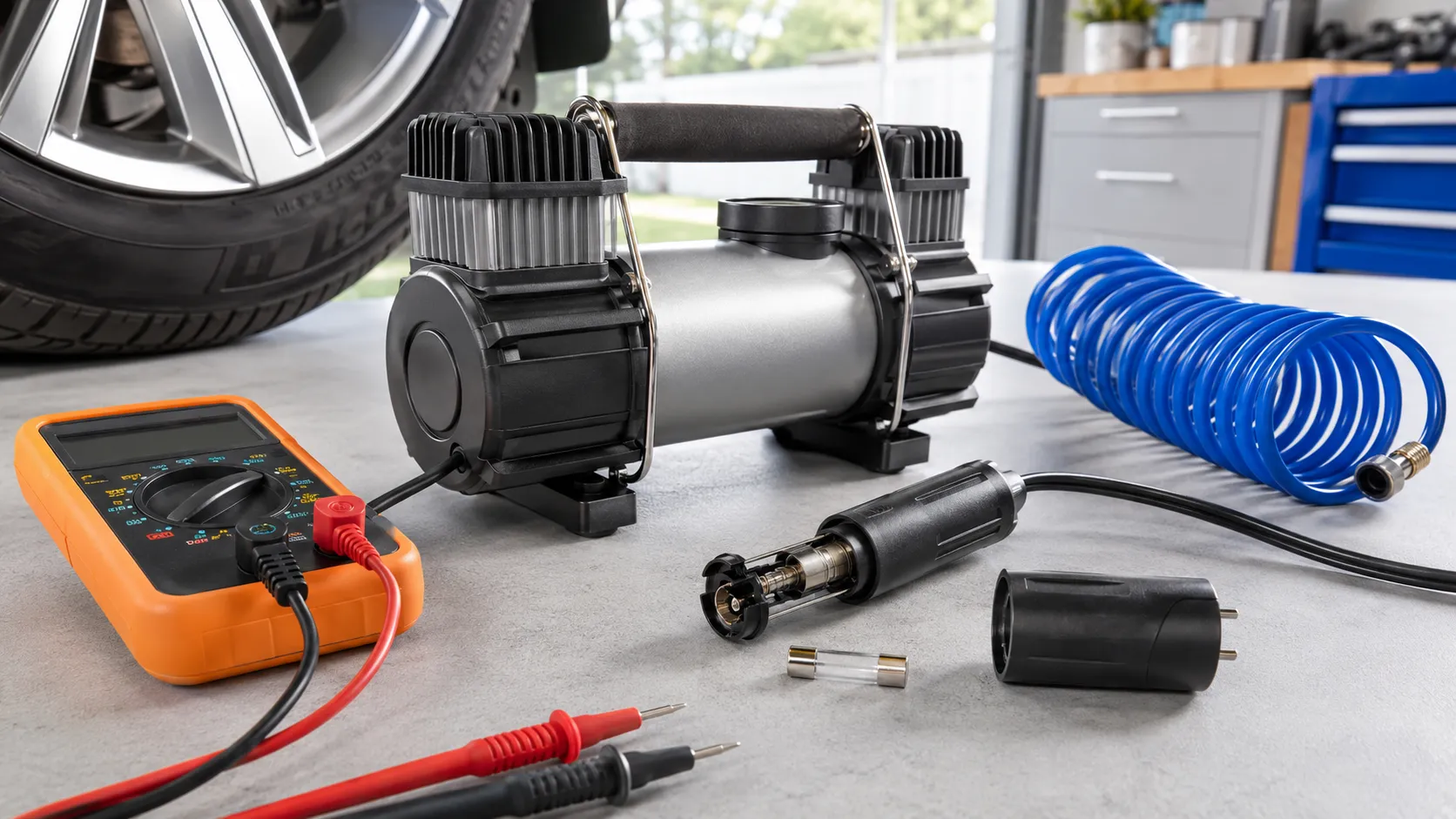
Conditions That Shorten Practical Runtime
Hot weather
High surrounding temperature reduces the difference between the compressor and the air it uses for cooling. Shade may help, but it does not change the manual’s limit.
High target pressure
The compressor often works harder as pressure rises. Never exceed the unit’s rating or the correct pressure for the tire.
Large tire volume
Truck and SUV tires may require much more air than small passenger-car tires, extending the task beyond a compact inflator’s duty cycle.
Air leaks
A poorly seated chuck, damaged hose, or leaking valve makes the compressor run longer without delivering the expected result.
Low supply voltage
A weak power source or poor connection can reduce performance and increase operating time. Follow the manuals rather than improvising a power source.
Blocked cooling vents
Dust, cargo, carpet, or a carrying bag can trap heat. Keep all specified intake and exhaust areas unobstructed.
Can Thermal Protection Make Continuous Running Safe?
No. Thermal protection is an important safeguard, but it is not permission to ignore the duty cycle. A cutout may respond only after internal temperature reaches its trigger point. Repeatedly driving the unit into shutdown can accelerate wear and may leave you without a working compressor when it is needed.
If thermal protection activates, turn the compressor off, disconnect it as the manual directs, and allow the complete cool-down. Investigate blocked vents, an excessive workload, a leaking connection, unusual supply voltage, or operation outside the permitted temperature range. If it trips repeatedly during normal use, stop and seek manufacturer-approved service.
Is a Continuous-Duty 12V Compressor Different?
A compressor marketed and documented as 100% duty cycle can be built with a larger motor, improved cooling, heavier wiring, and a pump designed for sustained work. Even then, “continuous” applies only within its stated pressure, ambient-temperature, voltage, installation, and airflow conditions. It does not eliminate inspection, power-circuit limits, or safe tire-pressure practices.
For frequent inflation of large tires, air suspension, pneumatic accessories, or repeated fleet use, select equipment whose documented airflow and duty cycle match the job. Do not assume a cigarette-lighter-style plug can supply a higher-demand compressor; many heavy-duty models require approved direct-to-battery wiring.
Best Practices for Multiple Tires
- Check and adjust tires when they are cold whenever practical.
- Measure each tire before starting so you can prioritize a seriously low tire.
- Use a timer and observe the exact duty-cycle window.
- Stop at the runtime limit even between tires.
- Keep the compressor and its vents in open air while cooling.
- Verify final PSI with a suitable gauge.
- Investigate a tire that repeatedly loses pressure instead of continually topping it off.
- Do not continue driving on a visibly damaged or severely underinflated tire; seek roadside assistance when necessary.
Frequently Asked Questions
How long can a 12V air compressor run continuously?
There is no universal runtime. Use the exact maximum run time or duty cycle in the model’s manual, including its stated pressure and temperature conditions.
What happens if I run a 12V compressor too long?
Excessive operation can overheat the motor, pump, wiring, plug, hose, and seals. Thermal protection may stop the unit, but damage can occur if limits are ignored.
Can I restart the compressor as soon as it feels cool?
Not necessarily. Internal components can remain hot after the housing cools. Wait for the complete minimum cooling period specified by the manufacturer.
Does a 100% duty-cycle compressor never need to stop?
A 100% rating applies only under the manufacturer’s stated pressure, temperature, voltage, ventilation, and installation conditions. Other operating and safety limits still apply.
Why does my compressor shut off while inflating?
It may have reached a thermal limit, lost power, encountered low voltage, or developed a connection or internal fault. Switch it off, cool it fully, and follow the manual’s checks.
Can I use a fan to extend compressor runtime?
External airflow does not change the published duty cycle unless the manufacturer explicitly provides that operating method. Never use water or improvised cooling on electrical equipment.
Can I inflate four tires without a cooling break?
Only if the entire job remains within the compressor’s documented duty-cycle and operating limits. Tire size, starting pressure, target pressure, leaks, and weather all affect runtime.
Related Guides
Conclusion
So, can a 12V air compressor run continuously? Most portable models cannot. Unless the manufacturer explicitly rates your compressor for continuous duty under the conditions you are using, follow its limited runtime and full cool-down schedule.
Matching the compressor’s duty cycle to the tire size and task protects the equipment, power circuit, and user. When the job regularly exceeds the limit, the correct solution is a properly rated compressor—not longer operation of an undersized one.
Voltage alone does not determine runtime. Read the model-specific duty cycle, time every session, keep vents clear, and complete the full cooling interval. Stop immediately for abnormal heat, odor, smoke, sparks, melting, or electrical damage.