
If you are wondering, “Do 12V air compressors need oil?” the answer is usually no for compact portable tire inflators. Their pumps are commonly sealed and oil-free, but larger 12V compressor systems may have model-specific lubrication requirements.
Oil RuleDo not add oil unless the manufacturer explicitly identifies the pump as oil-lubricated and specifies the correct lubricant, quantity, and service method.
Do 12V Air Compressors Need Oil?
Most 12V compressors sold as portable tire inflators are oil-free and require no oil changes or top-offs. Lubrication is built into their design, so normal owner care consists of inspection, cleaning, cooling, and dry storage.
However, 12V describes electrical supply—not pump construction. A larger onboard-air or serviceable piston unit may use crankcase oil. Never decide from size, sound, price, or connector alone. Find the model number and consult its manual.
How to Identify Your Compressor Type
Begin with the owner’s manual or manufacturer support page for the exact model number. An oil-lubricated unit normally has an identified oil-fill plug, dipstick, drain, or sight glass. An oil-free inflator normally has none of these user-service points.
| Clue | Oil-free portable inflator | Oil-lubricated compressor |
|---|---|---|
| Manual | Says oil-free or lists no oil service | Specifies oil type, level, and interval |
| Hardware | No labeled fill or drain point | May have fill cap, dipstick, drain, or sight glass |
| Normal care | Cleaning, inspection, dry storage | Those tasks plus prescribed oil checks |
| Owner action | Do not add oil | Use only the specified product and amount |
Six Safe Steps to Check Oil Requirements
Identify the exact model
Read the label on the compressor, not only the box or online listing. Similar-looking versions can have different maintenance requirements.
Read the maintenance section
Search the manual for oil, lubrication, crankcase, fill, drain, and service interval. If oil is not listed as owner maintenance, do not invent a procedure.
Inspect only when cool and unplugged
Look for clearly labeled service hardware without dismantling guards or housings. A screw in the case is not automatically an oil plug.
Confirm the lubricant specification
For a documented oil-lubricated model, note the exact grade or part number, capacity, checking position, and acceptable level.
Check at the required interval
Follow the manufacturer’s hours-of-use or calendar schedule. More oil is not better; both low and excessive levels can cause problems.
Record the service
Write down the date, operating hours if available, lubricant used, and any leak or noise observed. This prevents accidental over-service.
Why Most Portable 12V Inflators Are Oil-Free
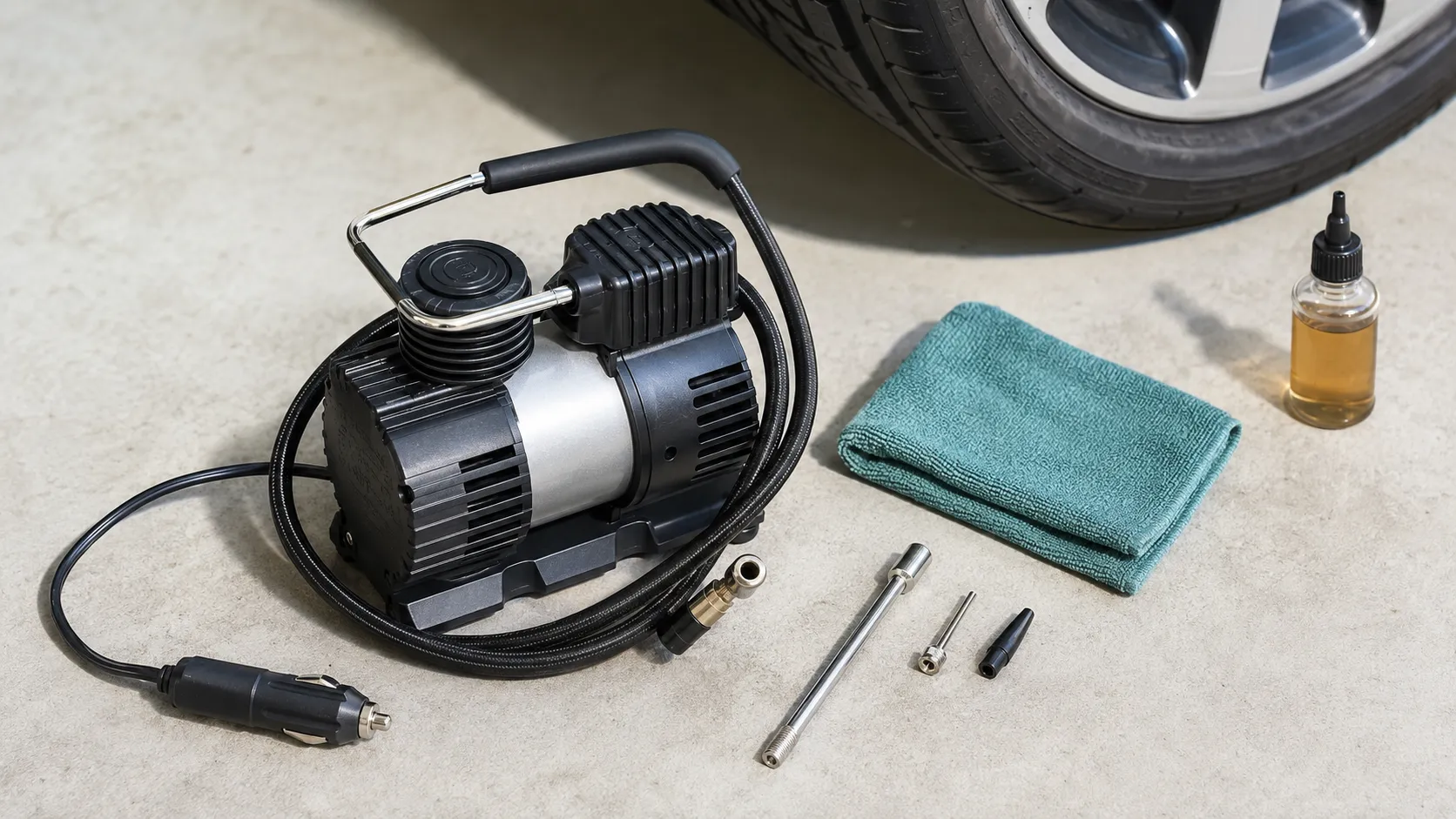
Compact tire inflators are designed for portability, short operating sessions, and storage in a vehicle. An oil-free pump avoids a reservoir that could leak when the unit is carried or stored in different orientations. It also reduces routine maintenance for occasional users.
Oil-free does not mean maintenance-free. Heat, dust, moisture, damaged power connections, hose leaks, and running beyond the duty cycle can still shorten service life. Keep cooling openings clear, inspect the cord and hose, follow run-and-cool limits, and store the unit dry.
When an Oil-Lubricated 12V Compressor Needs Service
If the manual confirms an oil sump, check the level exactly as directed. Some machines must sit level and cool; others specify a particular position. Use only the listed compressor lubricant. Viscosity and additive requirements vary, so leftover motor oil or an unverified “universal” oil is not a safe substitute.
Common Oil-Related Mistakes
Oiling the air inlet
This can contaminate valves, seals, hose, tire, and pressure sensor components unless the manual explicitly requires it.
Using engine oil
Automotive oil is not automatically suitable for a compressor pump. Use the documented specification only.
Overfilling
Excess oil may foam, leak, increase drag, or enter the compressed-air path.
Opening a sealed housing
This can damage seals, expose electrical parts, and complicate warranty or service support.
Care That Every 12V Compressor Needs
- Follow the published duty cycle and full cooling period.
- Inspect the plug, clamps, cable, fuse, hose, and chuck before use.
- Keep ventilation openings clear and operate on a firm, dry surface.
- Do not use a compressor with melted plastic, exposed wire, fluid leakage, or unusual noise.
- Coil cords and hoses loosely after the unit cools.
- Store it dry and protected from crushing cargo and extreme contamination.
- Use only manufacturer-approved replacement parts and service procedures.
Frequently Asked Questions
Do most portable 12V air compressors need oil?
No. Most compact portable tire inflators are oil-free and do not require owner-added oil, but confirm this in the exact model manual.
How can I tell if my 12V compressor is oil-free?
Check the manual and model label. Oil-free units generally have no identified oil-fill cap, dipstick, drain, sight glass, or oil-service schedule.
Can I add motor oil to a 12V compressor?
Not unless the manufacturer explicitly specifies that exact oil. Automotive motor oil is not a universal substitute for compressor lubricant.
Should I put oil into the compressor air inlet?
No, unless the model instructions expressly require it. Oil can contaminate an oil-free pump, hose, valves, and the item being inflated.
What happens if an oil-lubricated compressor runs low on oil?
Lubrication may become inadequate, increasing heat and wear. Stop the unit and follow the manual’s level-check and service procedure.
Why is oil leaking from my 12V compressor?
Possible causes include overfilling, incorrect storage orientation, a loose service plug, damaged seal, or internal fault. Stop using it and obtain approved service.
Does an oil-free compressor require maintenance?
Yes. It still needs cord and hose inspection, clean vents, proper cooling, dry storage, and use within its electrical, pressure, and duty-cycle limits.
Related Guides
Conclusion
So, do 12V air compressors need oil? Most compact tire inflators do not, while some larger serviceable models do. The exact manual—not voltage or appearance—determines the answer.
Never add oil as preventive guesswork. Identify the model, follow only its documented maintenance schedule, and stop for leakage, abnormal noise, overheating, smoke, or electrical damage.
Treat a 12V compressor as oil-free unless its manufacturer clearly documents an oil reservoir and owner-service procedure. For an oil-lubricated model, use only the specified lubricant, amount, checking method, and interval.