
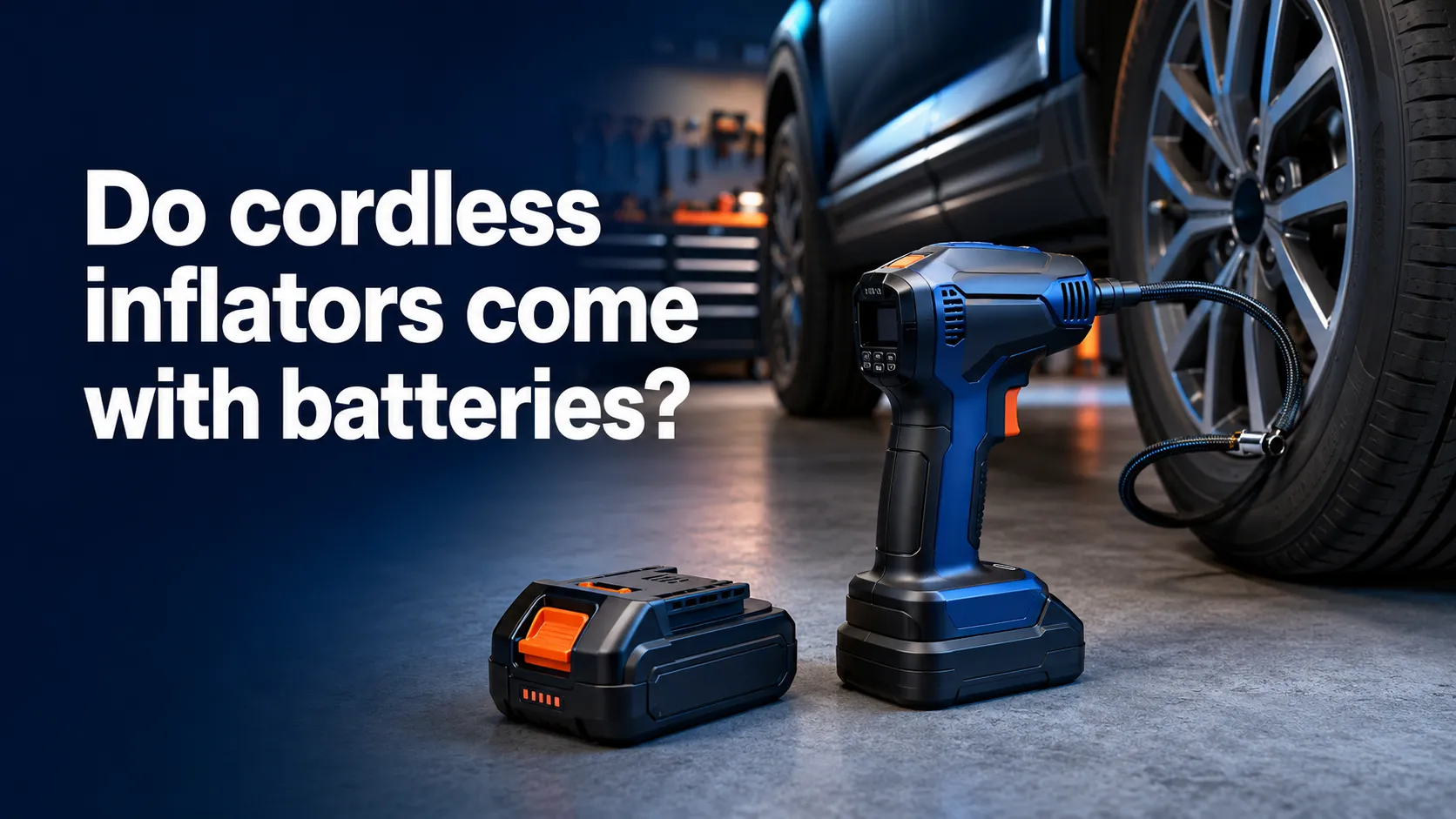
Do cordless inflators come with batteries? It depends on the package. An inflator may have a built-in rechargeable battery, include a removable battery and charger, or arrive as a tool-only unit that requires a compatible battery purchased separately. “Cordless” describes how the inflator can operate, not necessarily what comes in the box.
Never assume a cordless inflator includes everything needed to run. Read the package description and confirm whether the battery, charger, charging cable, and any required power adapter are included. If the inflator uses a removable tool battery, verify the exact battery system instead of matching by voltage alone.
Do Cordless Inflators Come With Batteries?
Some cordless inflators arrive ready to charge and use, but others require an additional battery or charger. This difference matters because a low-priced tool-only listing can cost more once the missing power equipment is added.
In this guide, I will explain the common package types, how to check battery compatibility, what labels such as “tool only” usually mean, and how to use and store the battery safely. The product manual and package contents always take priority because designs vary.
What Battery Packages Are Common?
Cordless inflators are sold in several configurations. The product title may look similar across listings, so the included-items section is often more useful than the main photo.
| Package Type | Battery Status | Charger Status | What to Check |
|---|---|---|---|
| Built-in battery model | Battery is inside the tool | Cable or adapter varies | Included charging equipment |
| Battery kit | Usually included | May be included | Exact package list |
| Tool-only unit | Usually not included | Usually not included | Compatible battery system |
| Hybrid inflator | Included or separate | Varies by package | Every supported power source |
| Vehicle-powered unit | No internal battery | Not applicable | Required vehicle outlet |
Built-in rechargeable battery
A built-in battery stays inside the inflator. This design can be simple for beginners because there is no separate tool battery to match. However, the internal battery may not be designed for user replacement.
Confirm whether the package includes only a charging cable or both the cable and power adapter. Also check whether the inflator can operate while connected to vehicle power if the internal battery becomes low.
Removable battery and charger kit
A kit may include the inflator, a removable battery, and a compatible charger. Some packages include more than one accessory, but the word “kit” alone is not a guarantee. Read the complete package list.
Tool-only cordless inflator
A tool-only inflator is designed for shoppers who already own a compatible battery and charger. The lower package price can make sense when the tool belongs to an existing battery system.
If you do not own that system, include the required battery and charger when comparing the total cost. Do not attach an unfamiliar battery because it appears to fit.
Does “Cordless” Mean a Battery Is Included?
No. “Cordless” means the inflator is capable of operating without a power cord during use. It does not promise that the retail package includes the battery needed for cordless operation.
This labeling is common with tools that share removable batteries. A manufacturer may sell the same inflator as a bare tool, a starter kit, or part of a larger bundle. Photos may also show a battery for demonstration even when it is not included.
How Are Cordless Inflators Powered?
The battery arrangement affects convenience, storage, backup power, and replacement options. It can also determine whether the inflator fits equipment you already own.
| Power Arrangement | Main Advantage | Main Limitation | Useful For |
|---|---|---|---|
| Built-in rechargeable battery | Simple portable setup | Replacement may be limited | Glove box or road-trip kit |
| Removable battery pack | Battery can be swapped | Exact system must match | Existing tool-battery owners |
| Battery plus 12-volt backup | A second power option | Vehicle outlet must be suitable | Long drives and emergencies |
| Battery plus AC input | Home and portable use | Accessories may be separate | Garage and travel use |
| 12-volt cord only | No battery charging needed | Not truly cordless | Vehicle-based tire care |
A hybrid inflator supports more than one approved power source. That can be helpful if its rechargeable battery is low, but you must use only the inputs and accessories listed by the manufacturer.
How Do You Check Battery Compatibility?
Battery compatibility involves more than finding the same voltage number. The physical connection, electronics, charger, battery chemistry, and manufacturer-approved system must all match.
Verify the complete battery and charging system before using a removable pack.
Product requirements can vary by model, package, market, and production version. The inflator, battery, and charger instructions take priority.
Why voltage alone is not enough
Two batteries can display similar voltage markings and still use different connections or control electronics. Do not modify a battery, tool housing, terminal, or adapter to make an unsupported combination fit.
Can you use a larger-capacity battery?
A higher-capacity pack within the exact approved battery platform may provide longer operating time, but it may add weight and size. Confirm approved battery options in the inflator manual. Do not assume that every pack in a product family works with every tool.
What about third-party batteries and chargers?
Use only battery and charger combinations approved by the relevant manufacturer. An unapproved pack or charger may not communicate correctly with the tool’s protection system. It may also create charging, heat, fit, or warranty concerns.
Included Battery vs. Tool-Only Inflator
- Usually provides a simpler first purchase.
- Reduces battery compatibility questions.
- May be ready to use after proper charging.
- Can suit drivers without an existing tool platform.
- A battery and charger may cost extra.
- The correct battery platform must be confirmed.
- It may be poor value without compatible equipment.
- Package photos can cause confusion about included items.
A tool-only unit is not automatically a bad purchase. It may be the practical option for someone who already owns approved batteries and a charger. A battery-included model can be easier for a first-time buyer.
Cordless Inflator Battery Buying Checklist
How to Check Whether a Battery Is Included
-
Read the complete product title
Look for terms such as “tool only,” “bare tool,” “battery included,” or “kit.” Continue checking because titles may be shortened.
-
Open the package-contents section
Find a written list of everything supplied. The list should clarify whether the battery, charger, cable, adapters, and carrying case are included.
-
Check the model or package number
Similar-looking packages may contain different accessories. Match the listing number to the package information from the manufacturer.
-
Inspect the battery specification
Determine whether the battery is built in, removable, or sold separately. For a removable system, identify the exact approved battery family.
-
Confirm the charging equipment
Check whether the package supplies a dedicated charger, a charging cable, a wall adapter, or none of these items.
-
Verify before opening the package
When the description is unclear, ask the seller or manufacturer for the included-items list. Keep the answer with your order records.
-
Inspect the delivered contents
Compare the box contents with the manual and order description. Do not operate or charge damaged, incorrect, or unidentified equipment.
Battery Charging and Vehicle Safety
Most rechargeable cordless inflators use a battery system that needs protection from heat, moisture, physical damage, and incorrect charging. Battery and charger problems can involve overheating, fire, electrical shock, or burns, as noted in the U.S. Consumer Product Safety Commission’s battery guidance.
Use the approved charging system
Follow the inflator, battery, and charger instructions. Place the charger on a stable surface with ventilation and keep it away from water, direct heat, bedding, and flammable clutter. Do not cover the charger or inflator while charging.
A vehicle USB port or adapter should be used only when its output matches the manufacturer’s requirements. If the inflator uses a 12-volt accessory outlet, check the vehicle owner’s manual for outlet location, operating conditions, and fuse information.
Do not bypass vehicle safeguards
Park safely, set the parking brake, and keep the hose and power cord away from moving or hot parts. Switch off the vehicle and remove the key before examining a connection when appropriate.
Never replace a fuse with a larger one, connect the inflator to exposed wiring, or touch a leaking vehicle battery. Stop and contact a qualified automotive technician for repeated fuse failure, scorched connectors, exposed wiring, sparks, smoke, or problems involving a hybrid or EV high-voltage system.
Traveling with an inflator battery
Air travel rules depend on the battery type, watt-hour rating, whether it is installed, and airline requirements. The Federal Aviation Administration’s power-tool guidance states that spare lithium batteries must be carried in carry-on baggage and protected against short circuits. Check current FAA, TSA, and airline rules before flying.
Troubleshooting Cordless Inflator Battery Problems
| Common Symptom | Likely Cause | Safe First Check | When to Stop |
|---|---|---|---|
| Inflator will not start | Low charge, loose battery, or wrong power mode | Turn it off and review the battery installation instructions | Stop for damage, heat, odor, or exposed contacts |
| Battery will not charge | Wrong charger, temperature protection, or battery fault | Use the approved charger in the stated temperature range | Stop if the pack swells, leaks, smokes, or overheats |
| Runtime seems short | Low charge, cold battery, demanding tire, or aging pack | Fully charge it and inspect the tire and hose for leaks | Stop after repeated abnormal shutdowns |
| Inflator stops during use | Low battery or thermal protection | Switch it off and allow the stated cooling period | Never bypass the thermal cutoff |
| Battery does not lock in | Wrong platform, debris, or damaged connection | Remove it and compare the approved model information | Do not force or modify the connection |
| 12-volt fuse fails again | Possible overload, plug damage, or vehicle circuit fault | Unplug the inflator and check both manuals | Seek a qualified automotive technician |
A battery that no longer performs normally may need manufacturer evaluation or replacement. Do not open the pack, replace individual internal cells, or defeat a protection circuit.
How Should You Maintain and Store the Battery?
Good storage helps keep an inflator ready for tire-pressure corrections and roadside use. The exact charging schedule and storage temperature vary, so follow the product manual instead of using a universal interval.
- Let the inflator and battery cool before charging or storage.
- Keep the battery, charger, and contacts clean and dry.
- Protect removable batteries from loose metal objects and impact.
- Store the inflator where cargo cannot crush or activate it.
- Avoid long-term storage in extreme vehicle temperatures unless permitted.
- Check the charge before road trips and seasonal weather changes.
- Inspect the battery, charger, hose, and connectors before use.
- Follow the manual for long-term battery storage and charging.
Frequently Asked Questions
Do all cordless tire inflators include a battery?
No. Some include a built-in or removable battery, while tool-only packages require a compatible battery purchased separately. Check the written package contents before buying.
What does tool only mean on a cordless inflator?
Tool only usually means the inflator is supplied without a removable battery or charger. The package may still include hoses or adapters, so review the complete included-items list.
Can I use any battery with a cordless inflator?
No. Use only a battery platform approved for the exact inflator. Similar voltage labels do not guarantee that the connection, electronics, or charging system is compatible.
Do cordless inflators come with a charger?
Some do, but others include only a charging cable or no charging equipment. Confirm whether the battery, cable, charger, and wall adapter are separately listed as included.
Is a built-in battery better than a removable battery?
Neither design is always better. A built-in battery offers a simple compact setup, while a removable battery can be swapped and may work with other approved tools in the same system.
Can a cordless inflator also run from a car outlet?
Some hybrid inflators can use an approved 12-volt vehicle connection, but others are battery-only. Check the inflator manual and the vehicle owner’s manual before using the outlet.
How long does a cordless inflator battery last?
Runtime varies with battery capacity, tire size, pressure change, temperature, and pump workload. Use the manufacturer’s test conditions when comparing runtime claims.
Should I keep a cordless inflator battery in my car?
You can store it in the vehicle only when the manufacturer allows the expected temperature and storage conditions. Protect it from direct sun, moisture, impact, loose metal, and accidental activation.
Related Guides
- How Do Cordless Tire Inflators Work?
- How Long Do Cordless Inflator Batteries Last?
- Are Cordless Inflators Safe to Keep in a Car?
- Can You Use a Cordless Inflator While It Is Charging?
- Cordless vs. 12-Volt Tire Inflators: What Is the Difference?
Conclusion
So, do cordless inflators come with batteries? Some include a built-in or removable battery, but tool-only models may include neither the battery nor charger. “Cordless” describes possible operation, not guaranteed package contents.
Before buying, check the included-items list, battery design, approved battery platform, charging equipment, and backup power options. Beginners should first look for clear “battery included” or “tool only” wording. Use only approved batteries and chargers, and stop using any pack that is swollen, leaking, damaged, smoking, or unusually hot. Your inflator instructions and vehicle owner’s manual take priority whenever requirements differ.
Read the written package contents before ordering a cordless inflator. Confirm the battery, charger, cable, and approved battery platform separately. Never force an incompatible pack, modify a connector, bypass a protection system, or charge a damaged battery.