
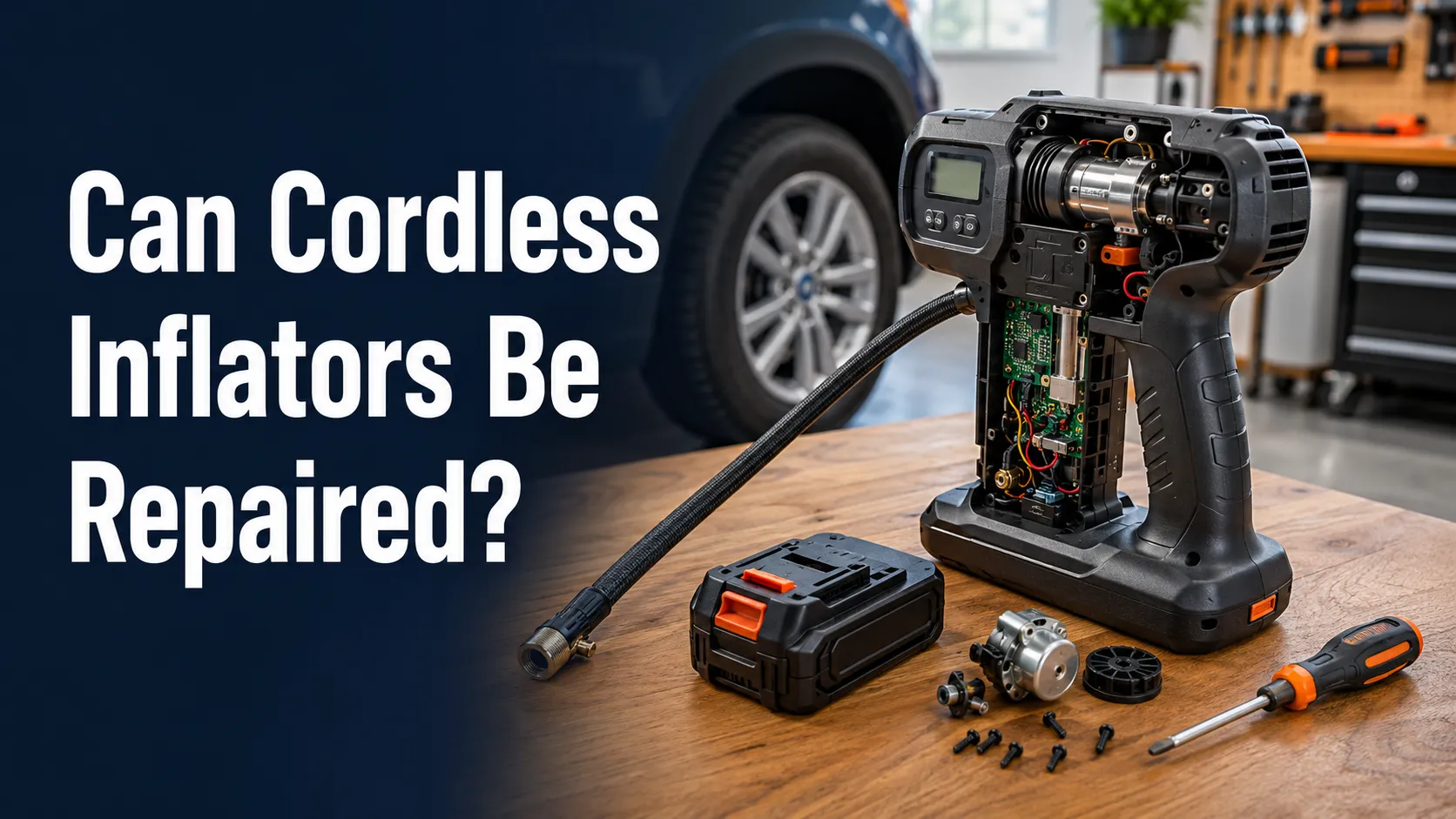
Yes, many cordless inflators can be repaired, but the right choice depends on the failed part, product design, warranty, and repair cost. Simple external parts may be replaceable at home, while damaged batteries, motors, circuit boards, and pressure controls usually need professional service.
Repair makes sense when the problem is easy to identify, an approved replacement part is available, and the repair does not cost close to the price of a new inflator.
Stop using the unit if its battery is swollen, leaking, unusually hot, or giving off an odor. Do not open, puncture, rebuild, or bypass the protection system in a lithium-ion battery pack.
Why Cordless Inflator Repairs Are Not Always Simple
A cordless inflator combines a small air compressor, electric motor, battery, pressure sensor, display, hose, valves, and control electronics. A problem in any one of these parts can cause the entire unit to stop working.
Some inflators are designed with removable hoses and batteries. Others have sealed housings and built-in batteries that are difficult to service safely. Before opening anything, I recommend checking the manual, warranty terms, and manufacturer support page.
Repairing a simple air leak is very different from working on a damaged battery or circuit board. The first task is to identify the symptom without creating another hazard.
Which Cordless Inflator Problems Can Be Repaired?
Repairability depends on the failed component and whether the maker sells approved parts. External components are normally easier and safer to replace than internal electrical parts.
| Problem | Possible Repair | Recommended Approach |
|---|---|---|
| Loose or damaged nozzle | Replace the nozzle or adapter | Use an approved compatible part |
| Leaking removable hose | Replace the complete hose | Match its thread and pressure rating |
| Worn sealing washer | Replace the approved seal | Check the manual or parts list |
| Removable battery will not charge | Test with an approved charger or replace it | Do not open the battery pack |
| Built-in battery failure | Professional battery service may be possible | Contact the manufacturer first |
| Broken display or controls | Control assembly may need replacement | Use an authorized repair provider |
| Motor or compressor failure | Internal assembly replacement | Compare professional repair with replacement |
| Incorrect pressure readings | Sensor inspection or calibration | Stop relying on the unit until checked |
A hose that looks fine may still leak around its connector or valve chuck. Apply a small amount of soapy water to the external connection while the unit is operating. Growing bubbles can reveal an air leak. Keep liquid away from the motor, vents, display, charging port, and battery.
When Is a Cordless Inflator Worth Repairing?
A repair is usually reasonable when the inflator is otherwise in good condition and the failed part can be replaced without opening a sealed battery or compressor assembly. Warranty coverage can also make repair or replacement much easier.
Before spending money, check the product’s age, part availability, expected labor, and overall condition. A heavily worn inflator with several problems may not be a good repair candidate.
- The product is still under warranty.
- Only the hose, nozzle, seal, or removable battery has failed.
- An approved replacement part is available.
- The housing and charging system are undamaged.
- The repair can restore safe, dependable operation.
- The battery is swollen, leaking, or heat-damaged.
- The motor and control board have both failed.
- The housing is melted, cracked, or badly damaged.
- Parts and service are unavailable.
- The repair would cost close to a suitable new unit.
Find the model number before contacting support. It may appear on the bottom label, battery slot, original packaging, receipt, or owner’s manual. The exact model helps the manufacturer identify compatible parts.
How to Diagnose a Cordless Inflator Safely
Start with simple checks that do not require opening the unit. Work in a dry, ventilated area away from fuel, flames, and other combustible materials.
- Read the inflator’s manual and warranty conditions.
- Remove the inflator from the tire or other inflatable.
- Turn it off and let hot parts cool.
- Inspect the housing, battery, hose, and charging port.
- Use only the specified battery and charger.
- Keep water and metal objects away from electrical contacts.
- Do not continue if you notice smoke, swelling, leakage, or melting.
Check the Battery Charge
Charge the battery with the approved charger in the conditions stated by the manufacturer. If the inflator uses a removable battery, make sure it is fully seated and its contacts are clean and dry.
Inspect the Hose and Nozzle
Look for cuts, crushed sections, loose fittings, damaged threads, and missing seals. Make sure the nozzle fits the tire valve without being forced.
Review the Controls
Confirm the selected pressure unit and target setting. Some inflators will not start if the preset is below the pressure already detected.
Allow the Unit to Cool
An inflator may stop after a long run because of thermal protection. Follow the manual’s duty cycle and cooling instructions before trying it again.
Test It Briefly
If no damage is visible, run the inflator for a short test according to its manual. Listen for unusual grinding, clicking, or rattling and watch for unstable pressure readings.
Contact the Manufacturer
Provide the model number, purchase date, symptom, and any error code. Ask whether the unit is covered by warranty and whether an approved repair part or service center is available.
Troubleshooting Common Cordless Inflator Problems
The table below covers safe first checks. It does not replace the product’s service manual or professional testing.
| Symptom | Likely Cause | Safe First Check | When to Stop |
|---|---|---|---|
| Will not turn on | Empty battery, poor connection, or electrical fault | Charge it and reseat an undamaged removable battery | Stop if the battery or port is damaged or hot |
| Runs but adds little air | Hose leak, loose nozzle, or internal seal wear | Check the external hose and valve connection | Stop if the motor strains or smells hot |
| Stops during use | Low charge or thermal protection | Follow the required cooling time | Stop if shutdowns continue during short, normal use |
| Pressure reading jumps | Poor valve connection or sensor fault | Reconnect the hose and compare with a dependable gauge | Stop if readings remain inaccurate |
| Battery will not charge | Charger, battery, contact, or temperature issue | Use the approved charger in the permitted temperature range | Stop for swelling, leakage, odor, or extreme heat |
| Grinding or rattling noise | Internal motor or compressor damage | Turn the inflator off | Seek service before using it again |
| Burning smell or smoke | Serious electrical or mechanical failure | Disconnect power only if it is safe | Move away and follow emergency guidance |
A tire valve, rather than the inflator, can sometimes be the source of slow air loss. If the inflator works normally but the tire keeps losing pressure, have the tire and valve inspected instead of assuming the pump is faulty.
Can You Repair a Cordless Inflator Battery?
A removable battery can sometimes be replaced as a complete manufacturer-approved pack. Rebuilding the pack by replacing individual lithium-ion cells is not a safe beginner repair.
Battery packs may contain protective electronics that control charging, temperature, and current. Using incorrect cells, wiring, or chargers can create overheating and fire risks.
Do not open, crush, puncture, modify, or attempt to rebuild a lithium-ion battery pack. The U.S. Consumer Product Safety Commission warns about hazards linked to loose lithium-ion cells and incompatible battery use. Review the CPSC battery safety warning for more information.
If a built-in battery has failed, ask the manufacturer whether it offers factory service. If it does not, replacement of the complete inflator is often safer than an unofficial battery modification.
Can You Replace the Hose, Nozzle, or Seal?
These are often the most practical parts to replace. The new component must match the inflator’s connector, airflow requirements, and rated pressure.
Do not force a hose with the wrong threads onto the inflator. A poor match can leak, damage the fitting, or disconnect while the pump is running.
Universal-looking adapters are not automatically universal. Compare the connector type, size, seal, pressure rating, and manufacturer guidance before installing one.
Can You Repair the Motor or Compressor?
A failed motor, piston, gear, bearing, or compressor seal normally requires the housing to be opened. These repairs can involve tightly fitted parts, electrical wiring, and pressure-related components.
If the inflator is under warranty, opening its housing may affect coverage. Contact the manufacturer before removing screws or seals.
For an older unit, ask for an estimate before approving an internal repair. The technician should also verify that the pressure sensor and automatic shutoff work correctly after service.
The inflator makes grinding noises, produces very little airflow with a sealed hose, gives unreliable pressure readings, repeatedly overheats, has damaged wiring, or requires its sealed housing to be opened.
Cordless Inflator Repair Safety
Keep the inflator away from gasoline, solvents, open flames, wet surfaces, and hot vehicle parts. Turn it off, remove the key from the vehicle when appropriate, and disconnect external power before inspecting an accessory.
Never bypass a fuse, temperature control, pressure sensor, battery protection circuit, or automatic shutoff. These features help protect the inflator, battery, tire, and user.
Do not work on high-voltage hybrid or electric-vehicle wiring. A portable inflator usually does not require access to that system. If a task would bring you near orange high-voltage cables or damaged vehicle wiring, stop and consult a qualified technician.
Stop if you see smoke, sparks, melted plastic, exposed wiring, battery swelling, fluid leakage, or severe heat. Move away from the unit if there is a fire risk and contact emergency services when necessary.
What to Do With a Damaged Battery
Do not place a lithium-ion battery in household trash or curbside recycling. The U.S. Environmental Protection Agency says these batteries should go to a separate battery recycling or household hazardous-waste collection point.
Follow local collection instructions and protect the terminals as directed. The EPA provides more guidance on its used lithium-ion battery page.
How to Maintain an Inflator and Prevent Repairs
Good storage and sensible operating habits can reduce hose, battery, and compressor wear. Always follow the product’s specified run time and cooling period.
| Maintenance Task | When to Do It | What to Check |
|---|---|---|
| Visual inspection | Before each use | Housing, hose, cable, battery, and nozzle |
| Battery check | Before a trip | Charge level, fit, damage, and unusual heat |
| Connection cleaning | When dirt is visible | Use a dry method approved by the maker |
| Accuracy comparison | If readings seem unusual | Compare with a dependable tire gauge |
| Storage inspection | After long storage | Moisture, corrosion, swelling, and hose cracks |
| Cooling break | During extended inflation | Follow the manual’s duty cycle |
Store the inflator where it will not slide around or sit under heavy cargo. Avoid extreme vehicle-cabin heat when the manufacturer requires a cooler storage range, and recharge the battery according to the manual.
Frequently Asked Questions
Some external parts, such as approved nozzles, hoses, seals, and removable batteries, may be replaceable at home. Internal battery, motor, sensor, and circuit-board repairs are better handled by the manufacturer or a qualified technician.
The hose may be leaking, the nozzle may not seal, or an internal compressor part may be worn. Check the external connections first and stop using the unit if the motor strains, overheats, or makes unusual sounds.
You may replace a removable battery with an approved compatible pack. Do not open or rebuild a lithium-ion battery, and ask the manufacturer about service for a failed built-in battery.
Repair may be worthwhile when the inflator is under warranty or needs only an available external part. Replacement may be more sensible when the battery, motor, housing, and electronics have major damage.
A low battery, overheating protection, a poor electrical connection, or an internal fault may cause shutdowns. Let the unit cool according to its manual and seek service if it repeatedly stops during short, normal use.
Tape is not a dependable permanent repair for a pressurized hose. Replace the complete hose with an approved part that matches the connector and required pressure rating.
Reconnect the hose and compare the reading with a dependable tire gauge. Stop relying on the inflator’s automatic shutoff if readings remain inaccurate, and arrange professional inspection or replacement.
Take it to a battery collection site or household hazardous-waste facility that accepts lithium-ion batteries. Do not put it in household trash or curbside recycling, and follow local instructions for protecting its terminals.
Related Guides
- How Do Cordless Tire Inflators Work?
- How Long Do Cordless Inflator Batteries Last?
- Are Cordless Inflators Safe to Use?
- Why Does a Tire Inflator Keep Shutting Off?
- How to Store a Cordless Inflator in Your Vehicle
Conclusion: Can Cordless Inflators Be Repaired?
Yes, cordless inflators can be repaired in many cases. Start by checking the battery charge, hose, nozzle, seals, settings, cooling requirements, warranty, and available replacement parts.
A simple external part may be easy to replace. However, a damaged lithium-ion battery, motor, pressure sensor, circuit board, or melted housing requires professional attention or complete product replacement.
The most important step is knowing when to stop. Do not open a battery pack, bypass a safety control, or keep running an inflator that overheats, smokes, leaks, or gives unreliable pressure readings. When in doubt, contact the manufacturer with the exact model number.
Check the warranty and manual first. Replace only approved serviceable parts, keep liquid away from electrical components, and leave internal battery and compressor work to a qualified repair provider.
A repair is worthwhile only when it restores safe and reliable operation. If the battery is damaged, the pressure reading cannot be trusted, or several internal parts have failed, replacing the inflator is usually the safer practical choice.