
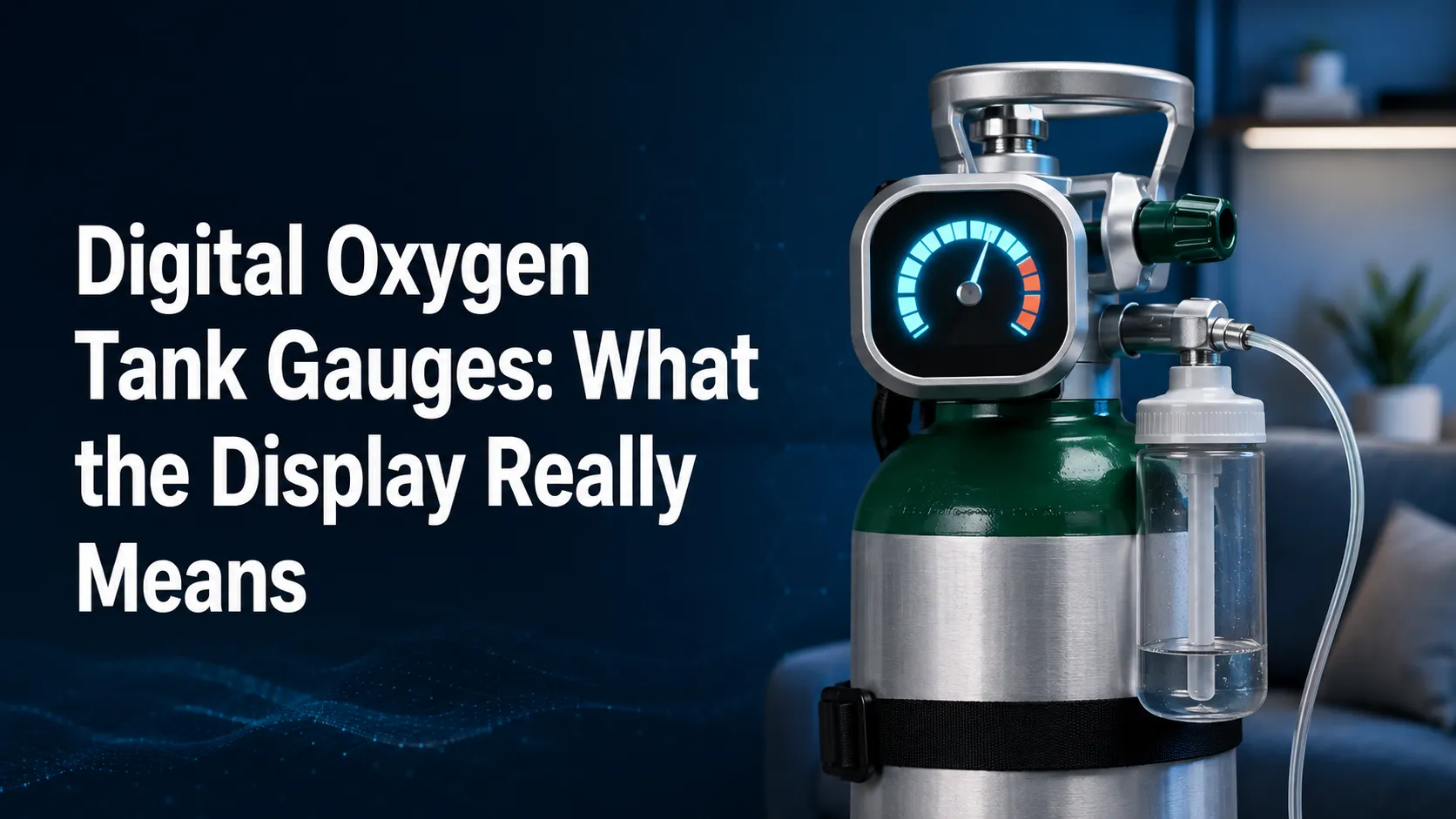
Understanding Your Oxygen Tank Display
Learn what pressure, remaining-level estimates, battery symbols and warning indicators mean—and when a reading requires immediate attention.
Digital oxygen tank gauges display cylinder pressure and may estimate the amount of usable oxygen remaining. Depending on the equipment, the screen may also show battery status, flow information, warning symbols or an approximate time-remaining value.
The display can make oxygen management easier, but it should not be interpreted like a car fuel gauge. Cylinder size, prescribed flow rate, temperature, regulator condition and the way the system calculates remaining time can all affect what the user sees.
What Do Digital Oxygen Tank Gauges Display?
The exact screen varies by manufacturer, regulator and cylinder system. Basic digital gauges may show only pressure, while more advanced systems can translate pressure into a simplified remaining-level estimate.
| Display item | What it generally means | What the user should know |
|---|---|---|
| PSI or bar | Pressure inside a compressed oxygen cylinder | Compare it with the full-pressure range specified for that cylinder and regulator. |
| Percentage | An estimated portion of cylinder contents remaining | It may be calculated from pressure rather than measured as a literal liquid level. |
| Time remaining | Estimated operating time at a particular flow setting | The estimate can change when the prescribed flow rate changes. |
| Battery icon | Power remaining in the electronic gauge | A low gauge battery does not necessarily mean the oxygen cylinder is empty. |
| Warning icon | Low pressure, low battery, system fault or another alert | Check the specific product manual because symbols differ among manufacturers. |
| Flow value | The selected or delivered flow setting on compatible equipment | Do not change a prescribed flow setting unless directed by a qualified clinician. |
How Do Digital Oxygen Tank Gauges Work?
A compressed-gas cylinder stores oxygen under high pressure. The regulator reduces that pressure to a usable level, while the cylinder pressure gauge measures pressure on the tank side of the system.
A digital gauge converts the pressure sensor’s signal into numbers or graphical indicators. If the product shows a percentage or remaining time, its electronics calculate that estimate using pressure and other programmed information.
The U.S. Department of Veterans Affairs notes that pressure-gauge readings are the most effective way to determine how much gas remains in a compressed oxygen cylinder. However, it also warns that a gauge can display pressure trapped between the cylinder valve and regulator when the cylinder valve is closed. This is one reason the equipment manual and provider training matter.
How to Read a Digital Oxygen Tank Gauge
Always follow the instructions supplied with your particular cylinder, regulator and gauge. The general process below helps explain what to review without replacing product-specific training.
What Do Full, Low and Empty Readings Mean?
There is no single pressure threshold that applies to every cylinder and every digital gauge. A system may show a number, a percentage, colored segments or a warning message. Treat the manufacturer’s documentation as the controlling reference.
| General status | Typical display behavior | Recommended response |
|---|---|---|
| Full or high | High pressure, full bars or a high percentage | Confirm that the reading matches the supplier’s expected filled range. |
| Partially full | Reduced pressure, fewer bars or a lower percentage | Estimate whether the supply is sufficient for the planned use. |
| Low | Low-pressure alert, red zone, flashing indicator or warning sound | Arrange a replacement or move to the prescribed backup supply before oxygen runs out. |
| Empty or near empty | Zero or very low pressure, empty symbol or persistent alarm | Follow the provider’s replacement procedure; do not depend on the cylinder. |
| Fault or unknown | Error code, blank screen or implausible reading | Use the approved backup plan and contact the equipment supplier. |
Why the Display May Not Match the Oxygen Left
The cylinder valve may be closed
Pressure can remain trapped in the regulator after the main cylinder valve is closed. The gauge may therefore show some pressure even though the cylinder is not actively supplying oxygen.
Temperature can affect pressure
Gas pressure changes with temperature. A cylinder moved between a cold vehicle and a warm room may show a different pressure even when no meaningful amount of oxygen has been used. Allow the equipment to remain in an approved environment and follow supplier instructions.
The time estimate depends on flow
A remaining-time estimate is only meaningful at the flow rate used for that calculation. A higher continuous-flow setting normally consumes the available supply faster. Pulse-dose and continuous-flow systems should not be treated as equivalent.
The gauge battery may be weak
Electronic displays need power even though the cylinder contains compressed gas. A low battery can cause a blank, dim or unreliable display. Replace or recharge the battery only according to the product manual.
The sensor or regulator may need service
Impact damage, contamination, age or internal faults can affect a gauge. Do not attempt to dismantle, lubricate or repair medical oxygen equipment unless you are qualified and authorized to do so.
How Is Remaining Oxygen Time Estimated?
For some compressed-gas cylinders, a trained provider can estimate duration using the cylinder pressure, a cylinder-specific conversion factor, a safe residual pressure and the prescribed flow rate. The exact calculation depends on the cylinder and equipment.
This is only an estimate. Do not use a generic online formula as the sole basis for medical travel or emergency planning. Use the chart supplied with your cylinder or ask the oxygen provider to calculate the expected duration for your prescribed setting.
Digital Tank Gauge vs. Pulse Oximeter
| Feature | Digital oxygen tank gauge | Pulse oximeter |
|---|---|---|
| Measures | Cylinder pressure or estimated supply remaining | Estimated blood oxygen saturation and pulse rate |
| Common unit | PSI, bar, percentage or estimated time | SpO2 percentage and beats per minute |
| Location | Attached to or integrated with oxygen equipment | Usually clipped to a fingertip |
| Main purpose | Monitor the available oxygen supply | Estimate a person’s blood oxygen saturation |
The FDA explains that pulse oximeters use light beams to estimate blood oxygen saturation and pulse rate. A pulse oximeter reading does not tell you how much oxygen remains in a cylinder. Similarly, a full tank does not prove that a person’s blood oxygen level is adequate.
Essential Oxygen Cylinder Safety
- Keep oxygen equipment away from flames, smoking materials, sparks and heat sources.
- Secure cylinders upright or in the position specified by the manufacturer.
- Use only compatible regulators, gauges, tubing and accessories.
- Keep oil, grease and petroleum-based products away from oxygen valves and fittings.
- Open and operate the cylinder only as instructed by the supplier.
- Do not change the prescribed flow rate without clinical direction.
- Check the gauge before travel and maintain the recommended backup supply.
- Do not use a cylinder with an unreadable label, damaged valve or suspected leak.
When to seek urgent help
If a person has severe shortness of breath, bluish lips or face, confusion, chest pain, loss of consciousness or another medical emergency, contact emergency services immediately. Follow the patient’s emergency oxygen plan and do not spend critical time troubleshooting a gauge.What to Do When the Gauge Looks Wrong
Frequently Asked Questions
What does a digital oxygen tank gauge measure?
It generally measures pressure inside a compressed oxygen cylinder. Some gauges use that pressure to estimate the percentage or operating time remaining.
Does the gauge show oxygen purity?
A standard cylinder pressure gauge does not normally measure oxygen purity. It measures pressure or calculates supply remaining. Consult the equipment documentation for the exact functions of your model.
Is the percentage on a digital gauge exact?
It should be treated as an estimate unless the manufacturer states otherwise. Temperature, sensor accuracy, cylinder specifications and system configuration can affect the displayed value.
Why does the gauge show pressure when the valve is closed?
Pressure may remain trapped between the cylinder valve and the regulator. Follow the manufacturer’s shutdown and pressure-release instructions instead of assuming the cylinder is still open.
Is an oxygen tank gauge the same as a pulse oximeter?
No. A tank gauge monitors the oxygen supply, while a pulse oximeter estimates oxygen saturation in a person’s blood.
When should an oxygen cylinder be replaced?
Replace or refill it according to the low-pressure threshold, warning level and instructions established by the equipment supplier. Do not wait until the cylinder reaches zero if continuous oxygen is medically required.
Final Takeaway
Digital oxygen tank gauges make cylinder monitoring easier by displaying pressure and, on some systems, estimated percentage or operating time. The pressure reading is usually the most important indicator, but it must be interpreted using the specifications for the exact cylinder and regulator.
Check the display before use and travel, understand every warning symbol, maintain the prescribed backup supply and contact the oxygen provider whenever a reading appears unreliable. Most importantly, never confuse a tank-supply reading with a person’s blood oxygen saturation.