
How Do Cordless Inflators Inflate Tires?
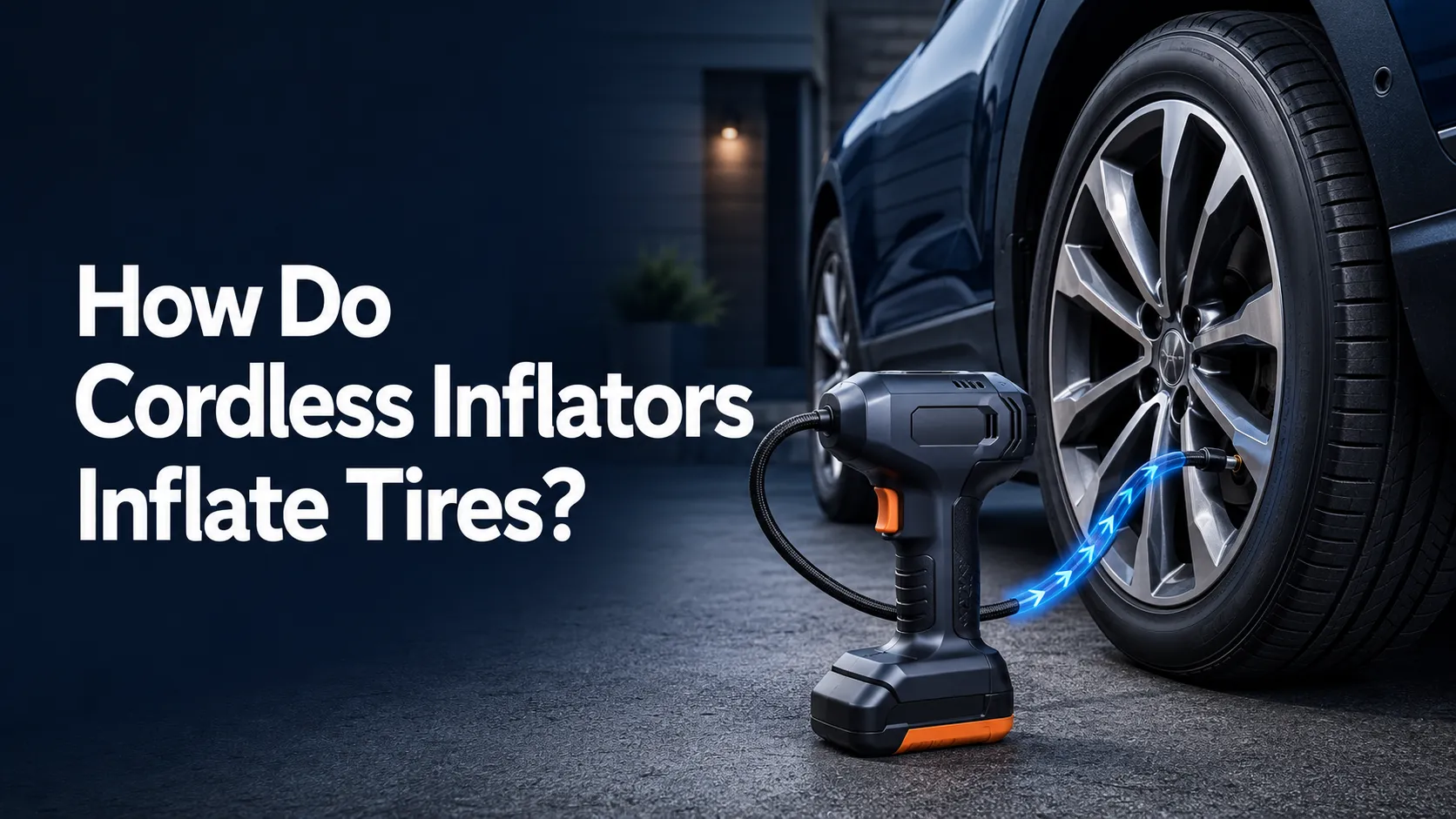
A cordless inflator uses a rechargeable battery, electric motor, miniature compressor, hose, and pressure sensor to push outside air into a tire.
Cordless inflators inflate tires by using battery power to run an electric motor. The motor drives a small compressor that draws in outside air, compresses it, and pushes it through a hose and tire valve. Digital models may monitor the tire pressure and stop automatically when the preset target is reached.
A cordless tire inflator may look simple, but several parts work together inside it. Its battery supplies electricity, its motor creates movement, and its compressor turns that movement into pressurized airflow.
In this guide, I will explain the process in plain language, show you how to use an inflator correctly, and cover common reasons it may run without filling the tire. You will also learn when to stop and have the tire or tool inspected.
How Do Cordless Inflators Inflate Tires Step by Step?
The process begins when you press the trigger or start button. Although internal designs vary, most cordless tire inflators use the same basic sequence.
- The battery supplies power
A rechargeable battery sends direct-current electricity to the inflator’s motor. The battery may be built into the tool or removable.
- The electric motor starts turning
The motor converts electrical energy into rotating mechanical movement. Internal gears or a crank transfer that movement to the compressor.
- The compressor draws in outside air
Air enters through an intake opening. A small piston, diaphragm, or similar pumping mechanism creates suction during part of its operating cycle.
- The compressor squeezes the air
The pumping mechanism reduces the space available to the trapped air. This raises its pressure so it can move into a tire that already contains pressurized air.
- Valves control airflow
Small one-way valves help air enter the compressor and then move toward the outlet while reducing backward flow.
- The hose carries air to the tire
Compressed air travels through the outlet hose. A threaded or lever chuck holds the hose against the tire valve.
- Air enters through the tire valve
The connector opens the valve core when correctly attached. Air enters while the inflator’s outlet pressure is higher than the pressure inside the tire.
- The inflator monitors pressure
A sensor or gauge measures connected pressure. On auto-stop models, the control system stops the motor when the preset target is reached.
What Parts Make a Cordless Tire Inflator Work?
Each component has a separate job. A problem with any one of them can reduce airflow, cause incorrect readings, or prevent the unit from starting.
| Component | Main Job | What You May Notice | Basic Check |
|---|---|---|---|
| Battery | Supplies electrical power | Unit will not start or runs slowly | Charge and seat it correctly |
| Motor | Creates mechanical movement | Unusual noise or no pumping action | Stop if it grinds or smells hot |
| Compressor | Compresses incoming air | Weak or missing airflow | Inspect external connections first |
| Hose and chuck | Deliver air to the valve | Hissing or slow inflation | Look for leaks and loose fittings |
| Pressure sensor | Measures connected pressure | Unstable or incorrect reading | Reconnect and compare with a gauge |
| Control board | Manages display and settings | Error, blank screen, or failed shutoff | Follow the manual’s reset guidance |
How Does the Inflator Build Pressure Inside a Tire?
Air naturally moves from an area of higher pressure toward an area of lower pressure. A cordless inflator must therefore produce outlet pressure higher than the pressure already inside the tire.
Each compressor cycle sends a small amount of compressed air through the valve. As more air enters the fixed space inside the tire, its pressure rises. The job becomes more demanding as the tire approaches its target because the compressor must work against greater resistance.
Why does the inflator become warm?
Compressing air creates heat, and the motor also produces heat while working. The hose fitting and nearby compressor area may therefore become warm during use.
Heat is why manufacturers specify a duty cycle—the permitted operating and cooling pattern. It differs by model, so follow the instructions supplied with your inflator.
How Does a Cordless Inflator Know When to Stop?
Many digital models use an electronic pressure sensor. It measures pressure in the connected hose and sends that information to the display and control system.
When you enter a target, an auto-stop model compares the measured pressure with that setting and may cut power to the motor when the target is reached. Not every inflator has this function, and readings can be affected by a poor connection or pressure pulses while the pump runs.
Let the reading settle and check the final pressure as directed by the manual. If accuracy is uncertain, compare it with a dependable handheld tire gauge.
How Do You Use a Cordless Inflator Correctly?
Park on a stable surface away from traffic. If possible, check pressure when the tires are cold because driving creates heat and can raise the reading.
Pre-inflation checklist
- Find the recommended cold-tire pressure on the vehicle label or in the owner’s manual.
- Inspect the tire for exposed cords, cuts, bulges, or other major damage.
- Check the inflator, battery, hose, and connector for visible damage.
- Confirm that the battery has enough charge.
- Select the correct pressure unit, such as PSI.
- Read the inflator’s duty-cycle and cooling instructions.
- Keep the unit on a stable, dry surface with its vents clear.
- Remove the valve cap
Place it somewhere clean and safe.
- Attach the hose connector
Connect it straight and firmly. Do not force mismatched threads or bend the valve stem.
- Check the initial reading
Allow the display to settle. Reconnect the hose if the reading appears unstable.
- Set the recommended pressure
Use the vehicle’s specified cold-tire pressure.
- Start the inflator
Keep hands, clothing, and loose objects away from vents and moving parts.
- Respect the duty cycle
Stop for the required cooling period when the unit reaches its operating limit.
- Verify the final pressure
Let the reading stabilize and use a separate gauge if accuracy is uncertain.
- Disconnect and replace the cap
Remove the connector carefully because nearby metal parts may be warm.
What Are the Advantages and Limits of Cordless Inflators?
- No wall outlet or running vehicle is normally needed.
- Compact and convenient for garages and road trips.
- Digital presets can simplify routine pressure correction.
- A compatible battery may work with other tools in the same system.
- Some models include a useful work light.
- A discharged battery leaves the tool unavailable.
- Small compressors need cooling breaks.
- Large truck tires may take longer.
- An inflator cannot safely repair tire damage.
- Displayed pressure may still need verification.
Why Is My Cordless Inflator Not Filling the Tire?
A running motor does not always mean air is entering the tire. Begin with safe external checks and never open the tool or defeat a safety feature.
| Symptom | Possible Cause | Safe First Check | When to Stop |
|---|---|---|---|
| Will not start | Low charge or poor battery connection | Charge and reseat an undamaged battery | Battery is hot, swollen, leaking, or damaged |
| Runs but adds no air | Loose chuck, blocked hose, or internal fault | Reconnect and inspect the external hose | Motor grinds, strains, or smells burned |
| Pressure rises slowly | Leak, low charge, or large tire volume | Check the hose and valve connection | Tire has visible damage or cannot hold air |
| Reading jumps | Poor seal or pressure pulses | Stop and reconnect the chuck | Reading stays unreliable after verification |
| Stops while running | Low battery or thermal protection | Allow the specified cooling time | Repeated shutdown occurs during normal use |
| Tire loses pressure again | Puncture, valve, rim, or tire leak | Have the tire and valve inspected | Sidewall is damaged or tire is unsafe |
Cordless Tire Inflator Safety
A portable inflator can correct pressure, but it cannot make a damaged tire roadworthy. Do not inflate a tire with exposed cords, major sidewall damage, severe bulging, or unclear structural damage. Arrange professional tire service instead.
Keep the tool dry and away from gasoline, solvents, open flames, and hot vehicle parts. Keep its cooling vents open. Never bypass a fuse, pressure control, thermal cutoff, battery protection, or automatic shutoff.
Do not open or rebuild a lithium-ion battery pack. Use only the manufacturer-approved battery and charging equipment. For general guidance, review the U.S. Consumer Product Safety Commission battery information.
How Should You Maintain and Store a Cordless Inflator?
- Inspect the hose, chuck, housing, vents, and battery before use.
- Wipe away dry dirt using a manufacturer-approved method.
- Keep water and cleaning liquid away from the motor, charging port, and contacts.
- Do not wrap the hose so tightly that it becomes kinked.
- Store adapters where they will not be lost.
- Protect the tool from loose cargo and direct impact.
- Recharge and store the battery according to its manual.
- Do not keep a damaged, swollen, leaking, or recalled battery in service.
Frequently Asked Questions
How do cordless inflators inflate tires?
A rechargeable battery powers a motor that drives a small compressor. The compressor draws in outside air, raises its pressure, and sends it through a hose and tire valve.
Where does a cordless tire inflator get its air?
It draws air from the surrounding atmosphere through an intake opening. It does not store a large supply of compressed air like an air tank.
How does auto-stop work on a cordless inflator?
A pressure sensor measures connected pressure. On supported models, the control system compares the reading with the selected target and stops the motor when the target is reached.
Can a cordless inflator fill a completely flat tire?
It may add air if the tire, bead, and valve can hold pressure and the tool is suitable. Seek professional service if the tire has serious damage or became completely flat.
Why does a cordless inflator get hot?
The motor produces heat, and compressing air also raises temperature. Follow the stated operating limit and cooling period.
Should I use the PSI number on the tire sidewall?
Do not assume the sidewall maximum is the everyday target. Use the vehicle manufacturer’s cold-tire pressure from the placard or owner’s manual.
Why does my inflator run without increasing tire pressure?
The connection may leak, the chuck may not open the valve correctly, the tire may be losing air, or the tool may have an internal fault. Check the external connection first.
Can I leave a cordless inflator in my car?
Only if its manual permits the expected storage conditions. Protect it from impact, moisture, loose cargo, and temperatures outside its stated range.
Conclusion: How Do Cordless Inflators Inflate Tires?
Cordless inflators use battery power to operate a motor and miniature compressor. The compressor draws in outside air, compresses it, and pushes it through the hose and valve. A pressure sensor may display the current pressure and stop supported models at a selected target.
Before starting, find the vehicle’s recommended cold-tire pressure and inspect the tire, hose, connector, and battery. Connect the chuck firmly, follow the tool’s duty cycle, and verify the final reading when necessary.
Stop if the tire has serious damage or the inflator produces smoke, sparks, extreme heat, or a burning smell. An inflator can add air, but it cannot replace a proper tire inspection or repair.
A cordless inflator is a compact battery-powered compressor designed to correct tire pressure. Use the pressure listed by the vehicle manufacturer, maintain a secure valve connection, respect the tool’s duty cycle, and stop when the tire or inflator shows unsafe damage.