
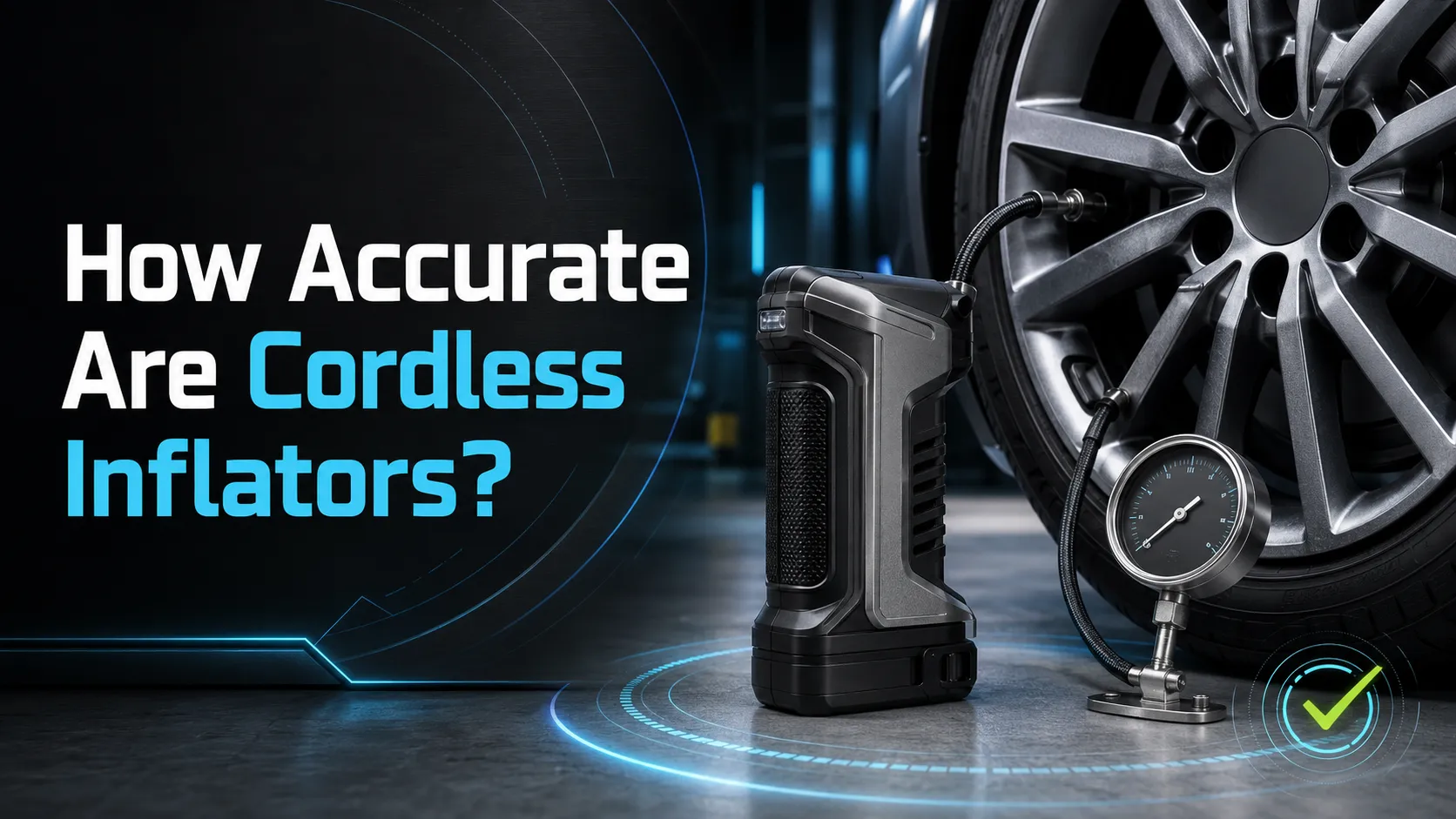
How accurate are cordless inflators? Many built-in digital gauges are accurate enough for routine tire top-ups when the unit is in good condition and used correctly. However, accuracy varies by model, and airflow, temperature, valve connection, sensor quality, and calibration can all change the reading.
Important LimitA display that shows tenths of a PSI is not automatically accurate to one-tenth PSI. Display resolution, sensor accuracy, repeatability, and calibration are different things.
Cordless inflators can be accurate enough for everyday car-tire inflation, but there is no universal accuracy level. Read the manufacturer’s stated tolerance, check pressure after the pump stops, and periodically compare the built-in gauge with a trusted separate tire gauge. If the difference is consistent and small, you can account for it; if it changes from test to test or falls outside the stated tolerance, do not rely on the inflator’s automatic shutoff.
How Accurate Are Cordless Inflators in Real Use?
A built-in gauge has two jobs: show the current pressure and, on equipped models, tell the controller when to stop the pump. A well-designed inflator can handle those jobs reliably for normal top-ups. Still, the number on the screen should be treated as a measurement from a compact tool—not as a laboratory reference.
The only defensible model-specific answer comes from its manual or technical documentation. Some manufacturers publish a pressure tolerance; others provide only display units and maximum pressure. Maximum PSI does not describe gauge accuracy, and extra decimal places do not prove better measurement.
Accuracy means closeness to the true pressure. Repeatability means getting nearly the same result during repeated checks. Resolution is the smallest change shown on the display. An inflator can have fine display resolution yet still have a meaningful offset from a trusted reference gauge.
Why the Reading Can Change
Pressure While Air Is Flowing
The sensor may see changing pressure in the hose while the pump runs. Pulses from the pump and restriction at the valve can make the live number jump or briefly read above the settled tire pressure.
Tire Temperature
Driving warms the tire and the air inside it, which raises pressure. A warm-tire reading should not be compared directly with the cold pressure on the vehicle placard.
Valve Connection
A loose, angled, cross-threaded, or leaking connector may let air escape and create unstable results. A short hiss during attachment can be normal, but continuous leakage means the connection needs attention.
Sensor and Calibration
Manufacturing tolerance, calibration, age, impact, contamination, and electronic drift can affect a pressure sensor. A tool that was accurate when new should still be checked periodically.
Hose Heat
Long inflation runs warm the pump and hose. The pressure displayed immediately after a demanding fill may settle differently after airflow stops and temperatures begin to equalize.
Different Gauges
Two consumer gauges can disagree because each has its own tolerance. Use one dependable reference consistently instead of comparing several unknown gauges and assuming the average is correct.
Find the recommended cold tire pressure on the driver-side door placard or in the owner’s manual—not on the tire sidewall. Bridgestone’s tire-pressure guidance also recommends checking with the tires cold and using the vehicle manufacturer’s specified PSI.
How to Test Your Inflator’s Accuracy at Home
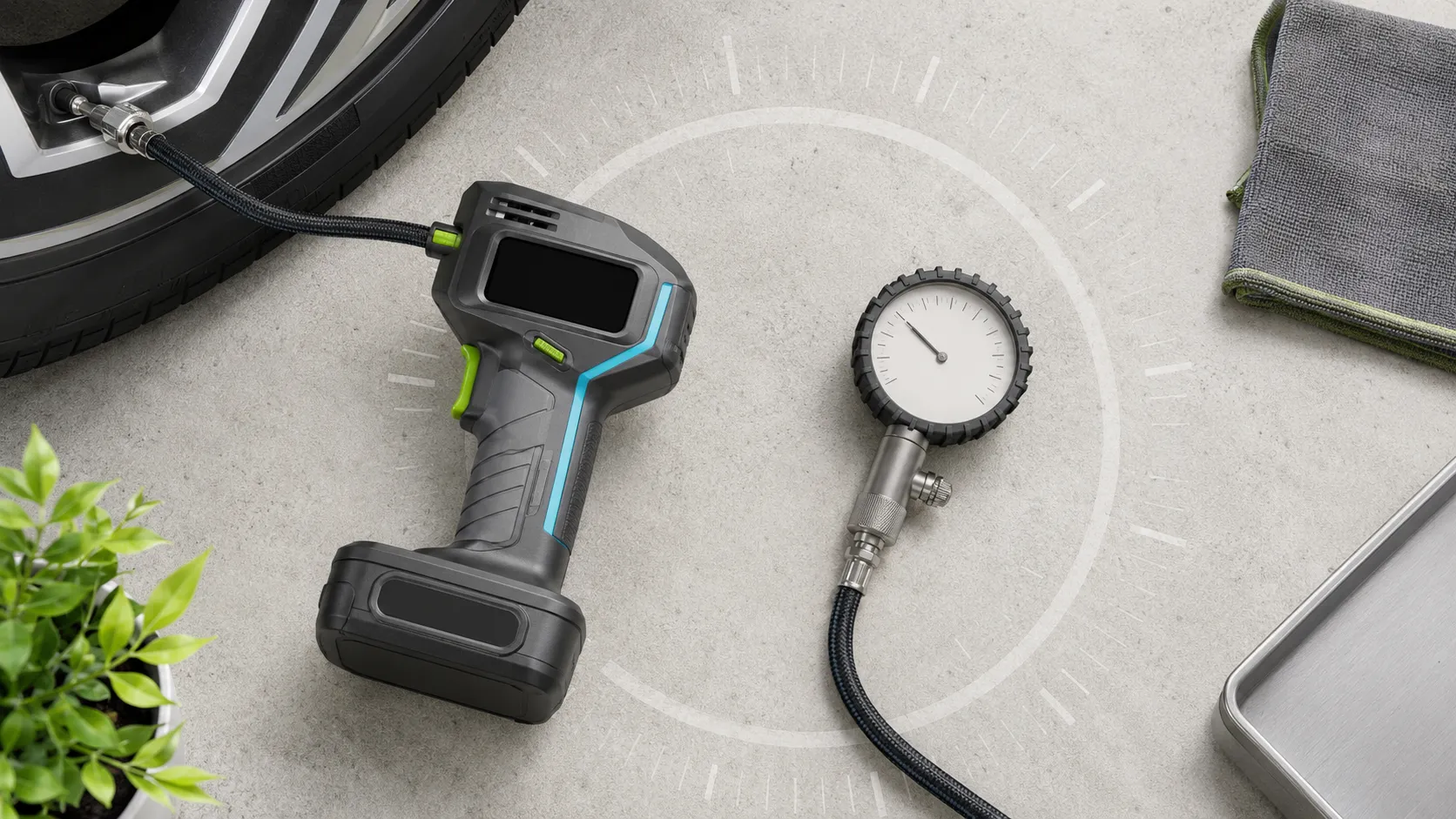
You do not need special equipment for a useful comparison. You need a sound tire, a dependable separate pressure gauge, stable conditions, and a repeatable process. This check does not certify the inflator, but it can reveal a consistent offset or an unstable sensor.
- Your cordless inflator with a charged, undamaged battery
- A separate tire-pressure gauge you trust
- The correct cold PSI from the vehicle placard or owner’s manual
- A sound tire with no visible damage or rapid leak
- A safe, level location away from moving traffic
-
Start With Cold Tires
Park long enough for the tires to reach cold-check conditions described by the tire or vehicle manufacturer. Avoid testing immediately after highway driving, heavy braking, or direct heating from the sun when possible.
-
Inspect the Tire and Valve
Look for a bulge, deep cut, exposed cord, damaged wheel, bent valve, or rapid air loss. Do not use an accuracy test as a reason to inflate a structurally unsafe tire.
-
Take a Reference Reading
Press the separate gauge squarely onto the valve until hissing stops. Record the reading. Remove it and repeat once or twice to confirm that the reference itself is giving consistent results.
-
Connect the Inflator Firmly
Attach the hose straight and securely without forcing the threads or lever. If air continues to hiss, switch off the tool and reseat the connector before trusting any pressure reading.
-
Read With the Pump Off
Note the inflator’s pressure before starting. If you add air, let automatic shutoff operate only while you supervise it. Stop the pump and allow the display to settle before recording the final number.
-
Cross-Check Immediately
Disconnect carefully, minimize air loss, and check again with the separate gauge. Compare the settled inflator reading with the new reference reading rather than with a warm reading taken much later.
-
Repeat and Look for a Pattern
Repeat the comparison on more than one tire under similar conditions. A consistent difference is easier to understand than a reading that varies widely. Use the manufacturer’s stated tolerance as the pass-or-fail standard when one is provided.
Write a small dated note in the inflator case showing how its settled reading compared with your reference gauge. Recheck after a hard drop, hose replacement, long storage period, or any time automatic shutoff begins stopping noticeably early or late.
How to Interpret the Comparison
| What You Observe | What It May Mean | Practical Response |
|---|---|---|
| Readings repeatedly match or remain within the published tolerance | The built-in gauge is behaving consistently under those conditions | Continue periodic cross-checks and verify after inflation |
| The inflator is consistently higher or lower by a similar amount | A repeatable offset may be present | Confirm against the manual; use the reference gauge for final pressure |
| The difference changes substantially between repeated checks | Poor connection, airflow effects, a leak, sensor instability, or an unreliable reference may be involved | Reseat the connector and repeat; stop relying on auto-stop if results remain unstable |
| The display jumps only while the motor runs | Pump pulsation and hose pressure may be affecting the live reading | Judge the settled pump-off reading instead |
| The reading changed after driving | The tire warmed during use | Recheck when cold; do not bleed a hot tire to the cold target |
| Auto-stop repeatedly overshoots or stops early | The target setting, unit, connection, or pressure control may be unreliable | Stop using automatic mode and contact the manufacturer or authorized service provider |
Keep the hose connector and valve area clean, protect the inflator from drops and moisture, and store it according to its manual. Do not attempt to “calibrate” a sealed consumer inflator unless the manufacturer provides an approved procedure. Opening or modifying the unit can damage the sensor or safety controls.
Built-In Gauge vs. Separate Gauge vs. TPMS
| Pressure Source | Best Use | Main Limitation | How to Use It Wisely |
|---|---|---|---|
| Inflator’s built-in gauge | Setting a target and monitoring inflation | Reading can be affected by airflow, connection, sensor tolerance, and condition | Check after the pump stops and cross-check periodically |
| Separate tire-pressure gauge | Independent verification before and after inflation | It also has its own tolerance and can be damaged or inconsistent | Use one trusted gauge consistently and handle it carefully |
| Vehicle TPMS display | Ongoing in-vehicle monitoring and low-pressure warnings | Updates may be delayed, rounded, position-dependent, or designed mainly as a warning system | Follow the owner’s manual and verify with a physical gauge |
| Tire sidewall marking | Identifying tire construction and maximum-load information | It is not normally the vehicle’s everyday cold-pressure target | Use the vehicle placard or owner’s manual for the target |
A TPMS warning is valuable, but it should not replace routine manual checks. The vehicle manufacturer determines how the system reports pressure and when it warns. Consult the owner’s manual if readings appear delayed, tires have been rotated, or a sensor has been replaced.
Tire pressure rises as the tire warms during driving. Michelin’s inflation guidance recommends checking pressure when tires are cold and rechecking later under cold conditions if an adjustment had to be made while warm.
Common Accuracy Problems and Solutions
The Reading Jumps Around
Turn off the pump and let the pressure settle. Check for a leaking connector, damaged valve, kinked hose, or rapidly leaking tire. If the pump-off reading remains unstable, use a separate gauge and stop relying on auto-stop.
Auto-Stop Overshoots
Confirm the selected unit and target. Some systems stop after sensing pressure in a pulsing air path, so a small settled difference may occur. Repeated or large overshoot needs manufacturer guidance or service.
Inflator and TPMS Disagree
Check all tires cold with the same separate gauge, then allow the vehicle’s specified update process. Verify sensor positions and reset instructions in the owner’s manual rather than assuming the inflator is wrong.
Accuracy Changed Over Time
Inspect for impact damage, moisture, debris, hose leakage, and connector wear. Repeat the cold-tire comparison. A persistent new error or erratic auto-stop behavior calls for approved service or replacement.
Never keep adding air just to test a gauge, and never use the tire sidewall number as the normal target. Stop inflation if the tire shows a bulge, split, exposed cord, damaged bead, unusual shape, or rapid pressure loss. Follow the tire, vehicle, inflator, and battery manuals, and have a questionable tire inspected by a qualified tire professional.
Best Practices for More Reliable Readings
- Check tires cold and under similar conditions whenever possible.
- Use the driver-door placard or owner’s manual for the correct target.
- Confirm that PSI, bar, or kPa is selected correctly before starting.
- Attach the connector straight and firmly so air does not leak.
- Stay beside the tool and observe pressure, sound, hose, and temperature.
- Judge the final reading after the pump stops and the display settles.
- Cross-check periodically with one dependable separate gauge.
- Recheck after a drop, repair, hose change, long storage period, or abnormal behavior.
- Replace the valve cap after checking and watch for recurring pressure loss.
- Stop using automatic shutoff if the system behaves inconsistently.
The safest target remains the one specified by the vehicle maker. NHTSA’s tire safety guidance directs drivers to use the recommended pressure shown on the tire information label and to check pressure regularly, including before long trips.
Frequently Asked Questions
Are cordless tire inflator gauges accurate?
Many are accurate enough for routine tire top-ups, but accuracy varies by model, condition, temperature, and connection. Check the manufacturer’s tolerance and periodically compare the settled reading with a trusted separate tire gauge.
Why does my inflator show a different PSI than my tire gauge?
The difference may come from airflow in the hose, tire temperature, a leaking connector, sensor tolerance, or the separate gauge’s own error. Compare both gauges on the same cold tire immediately after the pump stops.
Should I trust the automatic shutoff on a cordless inflator?
Automatic shutoff is convenient, but verify the final pressure after airflow stops. If the unit repeatedly stops early, overshoots, or disagrees inconsistently with a trusted gauge, stop relying on automatic mode and follow the manufacturer’s service guidance.
Does a display showing 0.1 PSI mean the inflator is accurate to 0.1 PSI?
No. That number describes display resolution, not guaranteed accuracy. The actual tolerance must come from the manufacturer’s documentation, and real-world readings should be checked for consistency against a dependable reference gauge.
Should tire pressure be checked when tires are cold?
Yes. The pressure on the vehicle placard is normally a cold-tire target. Driving warms the tire and raises pressure, so a warm reading should be rechecked under cold conditions before making a final comparison.
Can cold weather affect cordless inflator accuracy?
Cold weather changes tire pressure and can affect battery performance. The sensor may also have an approved operating-temperature range. Let the tool operate only within its manual’s limits and compare readings under stable cold-tire conditions.
What should I do if my inflator gauge is inaccurate?
Confirm the pressure unit, reseat the hose, test with the pump off, and compare several times with a trusted gauge. If the error is unstable or outside the published tolerance, do not rely on auto-stop; contact the manufacturer or replace the unit.
Related Guides
Conclusion: How Accurate Are Cordless Inflators?
How accurate are cordless inflators? A good unit can provide a useful and repeatable reading for everyday tire top-ups, but accuracy is model-specific and can change with temperature, airflow, connection quality, impact, wear, and calibration. A detailed digital display alone is not proof of precision.
Use the vehicle’s cold-pressure target, read the inflator after the pump stops, and compare it with one trusted separate gauge from time to time. If the difference becomes inconsistent or automatic shutoff no longer produces a reliable final pressure, stop depending on the built-in gauge and seek manufacturer-approved service or replacement.
A cordless inflator is most trustworthy when its settled readings are repeatable and remain within the manufacturer’s stated tolerance. Verify it under cold-tire conditions, keep a dependable separate gauge available, and treat recurring disagreement as a reason to stop using automatic shutoff—not as a reason to guess.

1 thought on “How Accurate Are Cordless Inflators? Accuracy Guide”