
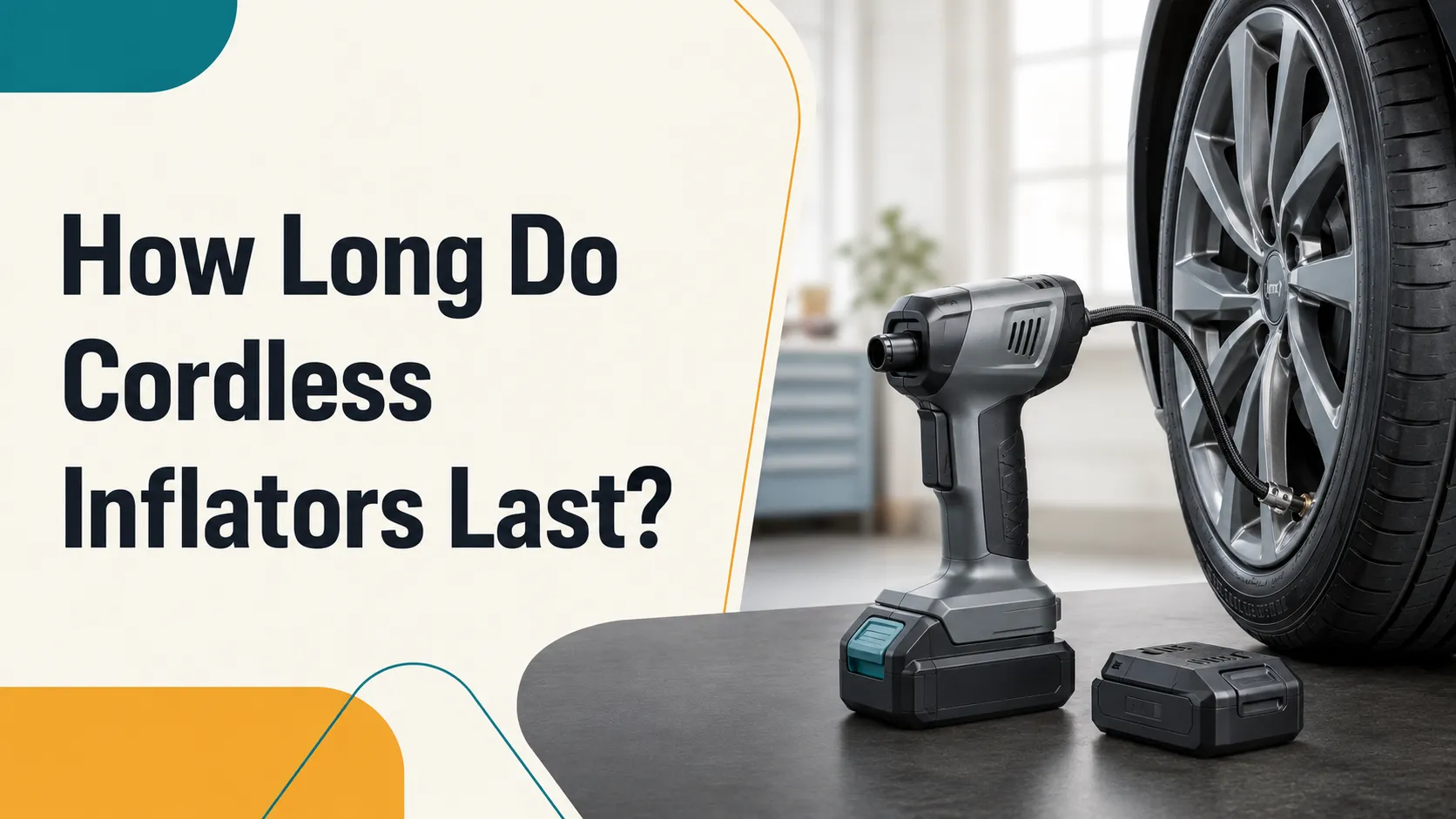
How long do cordless inflators last? A well-cared-for unit can remain useful for several years, but there is no universal lifespan. Battery age, pump heat, tire size, storage conditions, and duty-cycle habits all affect how long it works.
Important DistinctionRun time on one charge, maximum continuous run time, and the number of years the tool remains serviceable are three different measurements. Check the manual for each one.
Most cordless inflators are intended for short tire top-ups rather than nonstop compressor work. One charge may handle several small pressure corrections, while a large or nearly flat tire can consume much more energy. The complete tool may remain useful for years if it stays dry, cool, clean, and within its duty cycle. The rechargeable battery often loses useful capacity before the motor or pump fails.
How Long Do Cordless Inflators Last in Real Use?
A practical answer starts by asking what “last” means. Shoppers often use the word for three separate questions. They may want to know how many tires one charge can top up, how long the pump can run before cooling, or how many years the tool should remain dependable.
Runtime per Charge
This is how long the battery can power the inflator before recharging. It changes with battery capacity, charge level, air temperature, target pressure, airflow demand, and tire size.
Continuous Run Limit
This is the duty-cycle limit. It tells you when the pump needs a cooling break, even if the battery still has energy. Exceeding it can overheat the tool.
Total Service Life
This is the useful life of the complete inflator. Battery aging, motor wear, pump seals, hose condition, switches, sensors, and charging electronics all play a role.
Standby Readiness
This describes whether the stored inflator is charged and ready months later. Rechargeable batteries gradually lose charge, so an emergency tool still needs routine checks.
Adding 2 PSI to four small car tires is a much lighter job than filling one large SUV tire from very low pressure. Air leakage at the connector, cold weather, battery age, and required pressure also change the result. Use the manufacturer’s stated test conditions when comparing runtime claims.
What Determines Runtime on One Charge?
The battery label alone cannot predict real-world runtime. The pump must work harder as pressure rises, and a larger tire contains more air. The following factors usually matter most.
| Factor | Effect on Runtime | Practical Response |
|---|---|---|
| Battery capacity | A higher compatible capacity can provide more stored energy | Use only batteries approved for the inflator |
| Starting pressure | A very low tire needs more air and more pump time | Inspect a severely low tire before inflation |
| Tire volume | Large SUV and pickup tires require more air than small car tires | Confirm supported tire sizes in the manual |
| Temperature | Cold can temporarily reduce useful battery output; heat can trigger protection | Operate and charge only within approved limits |
| Hose connection | A poor seal wastes air and makes the pump run longer | Turn off the unit and reseat the connector |
| Battery age | An older battery may deliver shorter runtime under load | Compare performance after a full, normal charge |
Test the inflator at home when your tires need only a small top-up. This confirms that the battery, hose, connector, display, and pump work without turning an emergency into the first trial run.
How Duty Cycle Affects Inflator Life
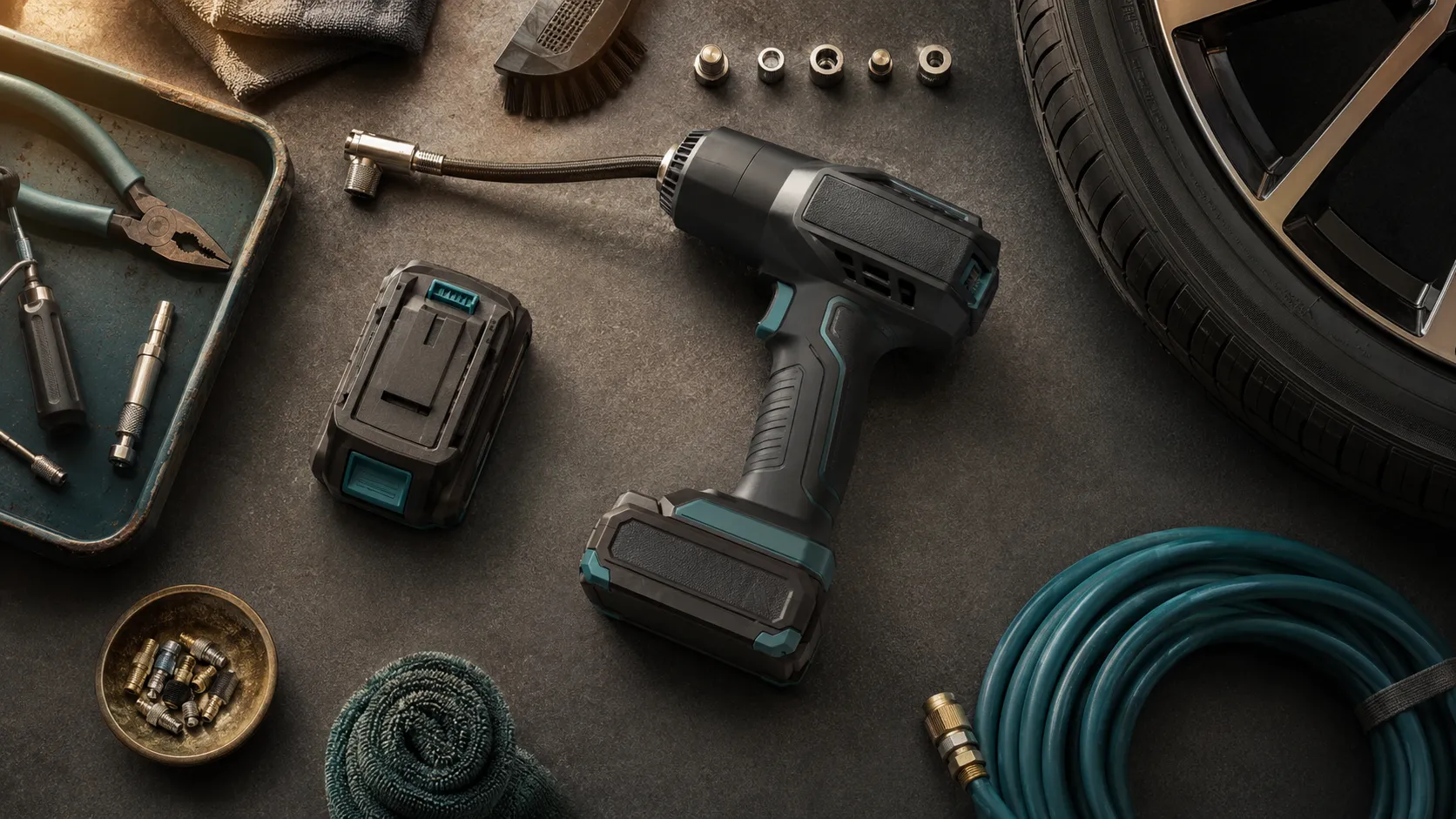
Compact inflators create heat while compressing air. Their housings have limited room for cooling, so manufacturers set maximum run and rest periods. The battery can still show charge when the pump reaches its heat limit.
Duty cycles are model-specific. For example, one Ryobi inflator manual requires five minutes of use followed by five minutes of cooling and warns that routinely exceeding the duty cycle can reduce tool life. That rule applies to the model covered by that manual, not every inflator. Read your own manual before deciding how long to run yours.
A battery capable of 20 minutes of total work does not automatically mean the pump can run for 20 uninterrupted minutes. Required cooling breaks protect the motor, pump, seals, electronics, and surrounding plastic.
Switch off the inflator if you notice smoke, sparks, melting, a burning smell, severe vibration, unusual noise, battery swelling, leakage, or extreme heat. Do not charge or reuse a damaged battery. Contact the manufacturer or a qualified service provider.
Which Parts Usually Wear Out First?
An inflator does not age as one piece. A replaceable battery may decline while the pump remains healthy. A damaged hose or worn valve connector can also make a sound motor appear weak because air escapes before reaching the tire.
| Part | Common Sign of Aging | Can It Be Addressed? |
|---|---|---|
| Battery pack | Shorter runtime, early shutdown, slow charging, or failure to hold charge | A manufacturer-approved replacement may restore usefulness |
| Hose and chuck | Cracks, looseness, hissing, or difficulty sealing at the valve | Use only an approved replacement hose, seal, or connector |
| Pump and motor | Reduced airflow, unusual noise, repeated overheating, or strong vibration | Internal repair should go to qualified service |
| Pressure sensor | Reading remains far from a trusted gauge after airflow stops | Check the manual and request calibration or service guidance |
| Charger or cable | Intermittent charging, damaged insulation, excessive heat, or loose connection | Stop using it and obtain the specified replacement |
| Housing and vents | Cracks, blocked airflow, impact damage, or melted areas | Do not operate a structurally damaged or overheated unit |
Do not open the battery pack or bypass thermal protection, fuses, sensors, wiring, or automatic shutoff. Internal electrical and pump repairs require the manufacturer or a qualified technician.
How to Make a Cordless Inflator Last Longer
Good care cannot prevent normal aging, but it can reduce avoidable heat, moisture, impact, and battery damage.
-
Match the Pump to the Tire
Confirm that the manufacturer supports your tire size, pressure, and intended use. A small pump forced to fill large tires repeatedly may spend more time near its heat limit.
-
Follow Every Cooling Break
Stop at the stated run-time limit even when the battery still has charge. Keep vents open, and never cover the inflator while it runs.
-
Use the Correct Battery and Charger
Recharge only with the equipment specified by the manufacturer. A connector that physically fits is not proof of electrical compatibility.
-
Let the Unit Cool Before Storage
Do not put a hot pump directly into a closed case or vehicle compartment. Cooling first helps heat escape and prevents nearby items from touching hot fittings.
-
Keep It Dry and Secure
Store the inflator away from moisture, direct sun, fuel vapor, and loose cargo. Protect the hose, battery, display, and connectors from crushing and impact.
-
Check the Charge Before Trips
Do not assume a tool stored for months is ready. Follow the manual’s storage-charge schedule and test the unit before a road trip.
-
Fix Air Leaks Instead of Running Longer
If the valve connection hisses, stop and reseat it. If the tire keeps losing air, arrange a tire inspection rather than repeatedly refilling it.
-
Clean Without Damaging the Tool
With the unit off and battery removed when directed, clear loose dirt from vents and wipe the housing. Do not spray liquid into the motor, controls, or charging port.
OSHA’s lithium-ion battery guidance recommends following manufacturer instructions for charging, use, storage, and maintenance, and keeping batteries in a cool, dry location. Always give your product manual priority because approved temperatures and charging procedures vary.
Simple Maintenance Schedule
| When | Check | Action |
|---|---|---|
| Before each use | Battery, hose, chuck, housing, vents, and display | Do not use damaged parts |
| After each use | Heat, dirt, moisture, and hose position | Cool, wipe, coil gently, and store securely |
| Before a long trip | Charge level, adapters, gauge response, and manual | Perform a brief home function check |
| During long storage | Battery charge and storage conditions | Follow the maker’s check and recharge schedule |
| If readings seem wrong | Built-in gauge versus a reliable separate gauge | Stop relying on an inaccurate display and request service |
| If runtime drops | Battery age, temperature, connector seal, and tire demand | Test safely after a normal full charge; replace only approved parts |
Why Has My Inflator’s Runtime Become Shorter?
The Battery Has Aged
Rechargeable batteries gradually lose capacity. If runtime falls across similar jobs after normal charging, the battery may be nearing replacement.
The Tool Is Too Hot or Cold
Temperature can reduce output or trigger protection. Move the unit to an approved environment and follow the manual before charging or using it again.
Air Is Escaping
A loose chuck, damaged hose, leaking valve, or punctured tire makes the pump work longer. Stop and inspect the connection rather than forcing more runtime.
The Tire Is a Bigger Job
A larger tire or lower starting pressure needs more air. Compare only similar inflation jobs when judging whether performance has changed.
Heat Protection Is Activating
Early shutdown may be normal protection after a long run. Let the tool cool for the full required period. Repeated shutdown during light work needs service guidance.
The Pump Is Wearing
Unusual noise, vibration, heat, or weak airflow can indicate mechanical wear. Stop using the tool and contact qualified service instead of opening it.
When Should You Replace the Inflator?
A shorter battery runtime does not always mean the whole tool needs replacement. If the battery is removable, a compatible manufacturer-approved pack may restore normal use. Replace or retire the complete inflator when it is unsafe, cannot complete its supported task, or costs more to repair than a suitable replacement.
- The battery is swollen, leaking, cracked, unusually hot, or damaged by impact.
- The housing, power cord, charger, hose, or connector is melted or badly damaged.
- The pump repeatedly overheats during light, approved use.
- The motor makes grinding sounds or produces severe vibration.
- The pressure reading remains clearly unreliable after basic checks.
- The automatic control behaves unpredictably or fails to stop as designed.
- Approved replacement parts or service are no longer available.
Do not place a lithium-ion battery in household trash or ordinary recycling. Follow the manufacturer’s instructions and local battery-recycling rules. Protect exposed terminals as directed during transport.
Frequently Asked Questions
How long does a cordless inflator last on one charge?
There is no universal runtime. Battery capacity, age, temperature, tire size, starting pressure, air leakage, and pump design all change the result. One charge may handle several small top-ups but far fewer large or nearly flat tires.
How many years should a cordless tire inflator last?
A well-cared-for inflator can remain useful for several years, but manufacturers do not provide one lifespan that fits every model. Frequency of use, heat, storage, battery care, moisture, impact, and replacement-part availability all matter.
Does the battery wear out before the inflator?
It often can. Rechargeable batteries naturally lose capacity, while the motor and pump may still work. If the model uses a removable battery, an approved replacement pack may extend the inflator’s useful life.
Does running an inflator continuously shorten its life?
Running beyond the model’s duty cycle can create excess heat and accelerate wear. Stop at the stated maximum run time and allow the full cooling period, even when battery charge remains.
Can I keep a cordless inflator in my car all year?
Only if the manufacturer allows the expected storage temperatures. Vehicle interiors can become very hot or cold. Protect the inflator from moisture, direct sun, impact, and loose cargo, and check its charge before trips.
Why does my inflator stop before the battery is empty?
Heat protection, a low battery under load, a blocked vent, an incorrect preset, or an internal fault may stop the tool. Switch it off, inspect the setup, let it cool, and follow the manual. Repeated unexpected shutdown needs qualified service.
When should I replace a cordless inflator?
Replace it or seek qualified service when it has battery damage, melting, severe vibration, grinding noise, repeated overheating, unreliable pressure readings, or failure during supported tasks. Never bypass its safety systems.
Related Guides
Conclusion: How Long Do Cordless Inflators Last?
How long do cordless inflators last? A properly matched and well-maintained unit can provide useful service for several years, but its battery runtime and total service life depend on the model and the job. Large tires, low starting pressure, cold batteries, loose connections, and frequent overheating can shorten each operating session or accelerate wear.
The best approach is to follow the manufacturer’s duty cycle, use only approved charging equipment, keep the inflator dry and secure, and test it before long trips. If a battery is damaged, the pump repeatedly overheats, or the gauge becomes unreliable, stop using the tool and request qualified service.
Think of inflator life as three clocks: battery runtime, pump duty cycle, and total years of service. Protect all three by matching the tool to the tire, allowing cooling breaks, caring for the battery, preventing air leaks, and storing the unit within its approved conditions.