
Yes, a well-matched cordless tire inflator can reliably handle routine pressure checks and small top-ups. Its real-world dependability depends on battery condition, tire size, gauge accuracy, proper maintenance, and using the tool within its stated limits.
Quick Answer
Are cordless inflators reliable? Yes, most are reliable for maintaining tire pressure in cars, crossovers, and many SUVs when properly charged and used as directed. They are less suitable for repairing leaks, filling damaged tires, or handling large truck tires unless the manufacturer confirms that use.
Practical Verdict
A cordless inflator is a dependable convenience tool, but it should not be your only roadside plan. Keep it charged, check its reading with a separate tire gauge, and inspect any tire that repeatedly loses air. For long trips, I recommend carrying a backup power option or confirming that roadside help is available.
Why Inflator Reliability Matters
A low tire often appears at an inconvenient time. You may notice it before work, during a family trip, or far from a service station. A reliable inflator can restore the correct pressure without an outlet or air compressor.
This guide explains what affects reliability, how cordless models compare with other options, and how to check one before a trip. I will also cover common failures, safe use, maintenance, and signs that the tire needs professional attention.
3Core checks: battery, hose, and gauge
1Vehicle placard sets the pressure target
0Tire damage repaired by adding air
Are Cordless Inflators Reliable for Everyday Use?
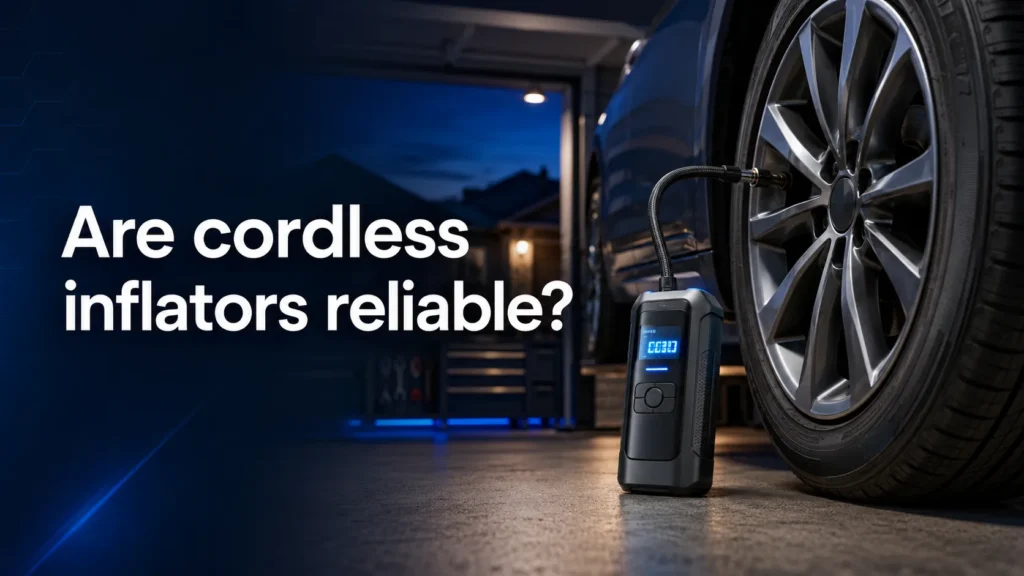
Cordless inflators are generally dependable for topping up a sound tire that is slightly low. They work well for routine care because they are portable, simple to connect, and independent of the vehicle’s 12-volt outlet while the battery has enough charge.
Reliability changes with the job. A compact unit may fill a passenger-car tire with no trouble but work much harder on a large pickup tire. Cold weather, battery age, long run times, blocked vents, and air leaks at the connector can also affect performance.
What reliable means here: A reliable inflator starts when needed, connects without major air loss, delivers steady airflow, provides a useful pressure reading, and completes its supported task without overheating or stopping early.
Correct tire pressure also matters for safe vehicle use. The National Highway Traffic Safety Administration advises drivers to use the pressure specified by the vehicle manufacturer and check tires when they are cold.
What Makes a Cordless Inflator Dependable?
No single feature proves that an inflator will be reliable. I look at the complete setup, including the battery, pump, controls, hose, connector, gauge, and operating limits.
A Healthy and Charged Battery
The battery is often the first point of concern. A cordless inflator cannot help if its battery is empty, damaged, or too cold to deliver normal power.
Recharge it as directed and check it before long trips. Never use or charge a battery that is swollen, cracked, leaking, unusually hot, or giving off an odd smell.
A Secure Hose and Valve Connection
A loose connector can let air escape and make the pressure reading unstable. The hose should reach the valve without sharp bends or heavy pulling.
Check the hose for cracks, cuts, worn seals, and heat damage. Replace damaged parts only with parts approved for that inflator.
A Gauge You Can Verify
The built-in gauge helps you track pressure, but readings can vary between tools. Airflow may also cause the displayed number to move while the pump is running.
Let the reading settle after the pump stops. From time to time, compare it with a separate tire gauge that you trust.
A Pump Matched to the Tire
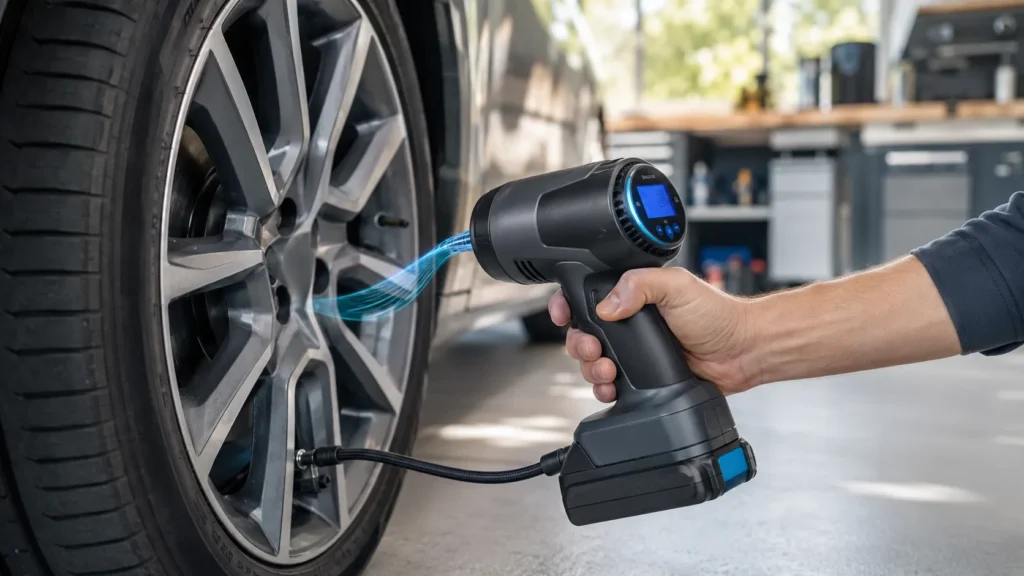
Maximum pressure alone does not tell you how well a pump will handle a large tire. Air volume matters because an SUV or pickup tire may need much more air than a small car tire.
Check the inflator manual for supported tire types, operating pressure, run-time limit, and cooling period. Vehicle and tool requirements vary, so their manuals should take priority over general advice.
Pro Tip
Test your inflator at home while the tires are already close to their correct pressure. This simple check confirms that the battery, hose, connector, display, and controls work before an emergency.
Cordless vs. 12-Volt and Manual Inflators
Each type has a different strength. The most reliable option is the one that matches your vehicle, trip, and access to power.
| Inflator Type | Main Strength | Main Limitation | Good Fit |
|---|---|---|---|
| Cordless | Portable and quick to set up | Depends on battery charge | Routine top-ups and travel |
| 12-volt plug-in | Uses vehicle power | Needs a suitable outlet and cord reach | Roadside backup use |
| Manual pump | No battery or outlet needed | Slow and tiring for car tires | Small adjustments or backup |
| Garage compressor | Handles frequent and larger jobs | Less portable | Home garage use |
Good to Know
Some cordless inflators can also use another approved power source. If a model offers that option, follow its manual and use only the specified power connection, cable, fuse, and adapter.
Which Vehicles Can Use a Cordless Inflator?
Many cordless models can maintain tires on cars and crossovers. Some can support SUVs, pickup trucks, compact spare tires, bicycles, and recreational equipment, but compatibility is never automatic.
Applications to Confirm in the Inflator Manual
Passenger carsCrossoversSUVsPickup trucksCompact spare tiresBicycle tires
Large truck tires may require more airflow and longer operation than a compact inflator can provide. High-pressure compact spares may also have different requirements from the vehicle’s regular tires.
| Vehicle or Tire Type | Expected Suitability | What to Check |
|---|---|---|
| Passenger car | Commonly suitable | Target pressure and tire size |
| Crossover | Often suitable | Airflow and run-time limit |
| Large SUV | Model dependent | Supported tire volume |
| Pickup truck | Model dependent | Tire size, load, and cooling needs |
| Compact spare | Check carefully | Pressure listed by the vehicle maker |
| RV or trailer tire | Special requirements may apply | Tire rating and inflator support |
Jake’s Practical Check
When I assess this type of accessory, I do not rely only on a large pressure number printed on the package. I check the supported tire size, airflow needs, hose reach, battery system, run-time limit, and ease of use beside the vehicle.
When Should You Not Depend on an Inflator?
An inflator adds air. It does not repair a puncture, leaking valve, damaged wheel, broken bead seal, or internal tire damage.
Do not depend on inflation alone when a tire has a sidewall bulge, deep cut, split, exposed cord, damaged bead, or severe impact damage. A tire driven while flat may also have hidden damage even if it accepts air.
Stop and Inspect
Do not continue inflation if the tire changes shape, develops a growing bulge, makes cracking sounds, or has visible structural damage. Move away from the tire and arrange service from a qualified tire technician.
Repeated Pressure Loss Is Not Normal Maintenance
A tire that becomes low again may have a puncture or a leak at the valve, wheel, or bead. Adding air may help you identify the problem, but repeated top-ups should not replace an inspection.
Stop driving if the tire loses air quickly or cannot support the vehicle safely. A qualified technician should inspect it before normal driving continues.
Reliability Checklist Before a Trip
Pre-Trip Inflator Check
- Charge the battery according to its manual.
- Check the battery for cracks, leaks, swelling, or unusual heat.
- Inspect the hose and connector for wear.
- Turn on the inflator and confirm that the display works.
- Confirm that the correct pressure unit is selected.
- Compare the gauge with a separate tire gauge.
- Find the tire-pressure placard in the driver-door area.
- Check the stated run-time and cooling limits.
- Confirm that all needed adapters are present.
- Store the tool where cargo cannot crush it.
Did You Know? PSI means pounds per square inch. It is the pressure unit commonly shown on tire placards and inflator displays in the United States.
How to Use a Cordless Inflator Reliably
1
Park in a safe place
Choose firm, level ground away from moving traffic. Apply the parking brake and use hazard lights when conditions call for them.
2
Find the correct pressure
Read the vehicle placard or owner’s manual. Use the cold pressure listed for the correct tire position and vehicle load.
3
Inspect the tire and wheel
Look for cuts, bulges, exposed cords, a bent wheel, or a damaged valve. Do not inflate a tire that appears structurally unsafe.
4
Check the inflator
Confirm that the battery, hose, connector, and vents are in good condition. Place the unit on stable ground with the vents clear.
5
Attach the hose
Remove the valve cap and secure the connector. Turn off the unit and reseat the connector if air keeps leaking around it.
6
Set the pressure target
Select PSI and enter the pressure from the vehicle maker. Do not use the number on the tire sidewall as the normal target.
7
Watch while it runs
Stay beside the tool. Watch the pressure, tire, hose, sound, battery, and temperature throughout the process.
8
Verify the final reading
Let the display settle after airflow stops. Use a separate tire gauge if you need to confirm the result.
9
Disconnect and inspect
Turn off the inflator before removing the hose. Replace the valve cap, check for air loss, and let hot parts cool before storage.
Pro Tip
Check tire pressure when the tires are cold when possible. Driving heats the tires and can raise the reading, making it harder to compare with the vehicle’s cold-pressure specification.
Pros and Cons of Cordless Tire Inflators
Pros
- Portable and easy to carry
- No outlet needed during cordless use
- Quick setup for routine top-ups
- Built-in gauge on many models
- Useful at home and on trips
- Automatic shutoff may simplify use
Cons
- Depends on battery condition
- Cannot repair a tire leak
- Small pumps may become hot
- Large tires may take longer
- Gauge readings can vary
- Run-time limits may require cooling breaks
Why Do Cordless Inflators Sometimes Fail?
Many apparent failures come from a low battery, poor hose connection, blocked vent, incorrect setting, or a tire leak. Start with basic checks that do not require opening the tool.
Never bypass battery protection, wiring, fuses, sensors, or other manufacturer safeguards. Internal repair of a rechargeable tool should be handled by the manufacturer or a qualified repair service.
| Common Symptom | Likely Cause | Safe First Check | When to Stop |
|---|---|---|---|
| Will not start | Low charge or loose battery | Check charge and battery seating | Battery is hot, swollen, or leaking |
| Stops too soon | Low charge or heat protection | Let it cool and check the battery | Shutdown keeps happening |
| Slow inflation | Air leak or large tire | Check the hose connection | Tire or valve looks damaged |
| Reading jumps | Poor seal or active airflow | Stop and reconnect the hose | Gauge remains unreliable |
| Tire becomes low again | Puncture, valve, bead, or wheel leak | Verify pressure with another gauge | Pressure loss is fast |
| Tool gets very hot | Long run time or blocked vent | Turn it off and let it cool | Smoke, odor, or melting appears |
Why Does the Battery Drain While Stored?
Rechargeable batteries can lose charge over time. Temperature, battery age, storage length, and electronics inside the tool may affect how quickly this happens.
Check the charge at regular intervals and before each trip. Follow the manufacturer’s storage and charging schedule rather than leaving the battery connected to an unapproved charger.
Why Is Inflation Taking So Long?
The tire may be larger than the pump handles well, or the battery may be low. Air may also be escaping through a loose connector, damaged hose, leaking valve, or tire puncture.
Stop the tool before checking the connection. Follow its cooling instructions if the pump reaches its operating limit.
Why Does the Pressure Reading Seem Wrong?
Check that the display is set to PSI and the connector is firmly seated. Let the pressure settle after the pump stops, then compare it with a separate gauge.
Do not depend on an inflator with a reading that remains far from a trusted gauge. Contact the manufacturer or a qualified service provider.
Good to Know
Automatic shutoff is useful, but it does not remove the need for supervision. An incorrect target, wrong pressure unit, poor connection, or faulty sensor can still produce an unwanted result.
Vehicle and Personal Safety
Reliability is not only about whether the pump starts. The tire, work area, battery, and vehicle must also be safe.
- Move away from traffic before working when possible.
- Park on stable ground and apply the parking brake.
- Keep your face and body away from the tire sidewall.
- Keep children and pets clear of the work area.
- Do not leave the inflator running unattended.
- Keep the hose away from hot exhaust parts and moving components.
- Do not use the tool near fuel vapor or flammable material.
- Never crawl under a vehicle supported only by a jack.
- Allow the pump and hose to cool before touching hot areas.
- Follow both the vehicle manual and inflator manual.
Electrical and Vehicle Warning
Turn off the vehicle and remove the key before handling accessories when the applicable manual calls for it. Do not touch damaged wiring, leaking batteries, hot components, fuel systems, airbags, or high-voltage hybrid and EV parts.
Tasks involving brakes, steering, airbags, fuel systems, major electrical work, or high-voltage hybrid and EV systems require a qualified mechanic or technician. Do not treat a tire inflator as a diagnostic or repair tool for those systems.
How to Maintain and Store a Cordless Inflator
Simple maintenance improves the chance that the inflator will work when needed. Always follow the manufacturer’s instructions because battery types, charging needs, and temperature limits differ.
| Item | When to Check | Recommended Care |
|---|---|---|
| Battery charge | Before trips and routine checks | Recharge as directed |
| Battery condition | Before use and charging | Check for heat, leaks, and swelling |
| Hose and connector | Before each use | Inspect for cracks and wear |
| Air vents | After dusty use | Clear loose dirt with power off |
| Pressure gauge | From time to time | Compare with a trusted gauge |
| Storage area | After every use | Keep it dry, secure, and cool |
Let the pump cool before placing it in a case or vehicle compartment. Secure it so that tools, luggage, or groceries cannot crush the hose or battery.
Do not store or charge the battery outside the temperature limits in its manual. Never charge a battery that is cracked, swollen, leaking, unusually hot, or otherwise damaged.
Pro Tip
Add the inflator to your normal tire-pressure check. A short home test can reveal a low battery, damaged hose, missing adapter, or confusing setting before you depend on it beside the road.
When Should a Tire Technician Inspect the Vehicle?
Professional help is needed when the problem is more than a small pressure adjustment. An inflator cannot determine whether a tire has hidden structural damage.
Arrange a Tire Inspection If:
- The tire loses pressure soon after inflation.
- The tire was driven while fully or severely flat.
- You see a bulge, deep cut, split, or exposed cord.
- The valve stem or wheel appears damaged.
- The tire will not accept or hold air.
- The pressure warning returns often.
- The vehicle pulls, shakes, or handles differently.
- You are unsure whether the tire is safe to drive on.
Jake’s Reliability Rule
I treat a cordless inflator as a maintenance and pressure-adjustment tool. If a tire quickly becomes low again, I stop relying on the inflator and recommend having the tire, valve, wheel, and bead seal inspected.
Frequently Asked Questions
Are cordless tire inflators reliable in an emergency?
A charged cordless inflator can reliably correct minor pressure loss in a sound, supported tire. It cannot repair a puncture or structural damage, so keep a wider roadside plan and seek professional help when the tire will not hold air.
How long does a cordless inflator battery hold its charge?
Storage life varies with the battery type, age, temperature, tool design, and battery condition. Check the charge at regular intervals and before every long trip rather than assuming it is ready.
Can I rely on the gauge built into a cordless inflator?
A built-in gauge is useful, but accuracy can vary. Let the reading settle after inflation and compare it with a separate trusted tire gauge from time to time.
Are cordless inflators reliable for SUVs and pickup trucks?
They can be reliable if the manufacturer supports the tire size, pressure, and intended use. Larger tires need more air and may require a stronger pump, longer run time, or cooling breaks.
Why does my cordless inflator stop before the tire is full?
A low battery, overheating protection, incorrect target, blocked vent, or air leak may cause an early stop. Turn it off, inspect the setup, let it cool, and follow the troubleshooting steps in its manual.
Can a cordless inflator fix a slow tire leak?
No. It can replace lost air, but it cannot repair a puncture, valve leak, bead leak, damaged wheel, or sidewall damage. A tire that repeatedly loses pressure needs a professional inspection.
Should I keep a cordless inflator in my car all year?
You can keep one in the vehicle if its manual allows the expected storage conditions. Protect it from moisture, impact, and temperatures outside its approved range, and check its battery often.
Is a cordless inflator better than a 12-volt inflator?
Neither type is always better. A cordless model offers easier setup, while a 12-volt model does not depend on a separate charged battery but needs a suitable vehicle outlet and enough cord reach.
Related Guides
- How Do Cordless Tire Inflators Work?
- Are Cordless Inflators Safe to Use?
- Cordless vs. 12-Volt Tire Inflators
- How to Find the Correct Tire Pressure for Your Car
- Why Does a Car Tire Keep Losing Air?
Conclusion: Are Cordless Inflators Reliable?
Are cordless inflators reliable? Yes, they can be dependable for routine tire-pressure adjustments when the battery is healthy, the pump matches the tire, and the tool is used within its limits.
Beginners should first check the vehicle placard, inspect the tire, charge the battery, examine the hose, and test the gauge. Stay with the inflator while it runs and follow the required cooling period.
The most important point is that adding air does not repair tire damage. If a tire has a bulge, deep cut, fast leak, damaged valve, or repeated pressure loss, stop and arrange an inspection by a qualified tire technician.
Quick Recap
- Cordless inflators are dependable for small, routine top-ups.
- Battery condition has a major effect on reliability.
- The pump must support the vehicle’s tire size and pressure.
- Use the pressure on the vehicle placard or in the owner’s manual.
- Compare the built-in gauge with a separate gauge.
- Follow all run-time and cooling instructions.
- Have tires with repeated pressure loss inspected.
Final Key Takeaway
A cordless inflator is most reliable when you test it before you need it, keep its battery charged, and use it only for a tire it can support. Treat it as a pressure-maintenance tool rather than a tire repair, and never use added air to hide visible damage or a recurring leak.