
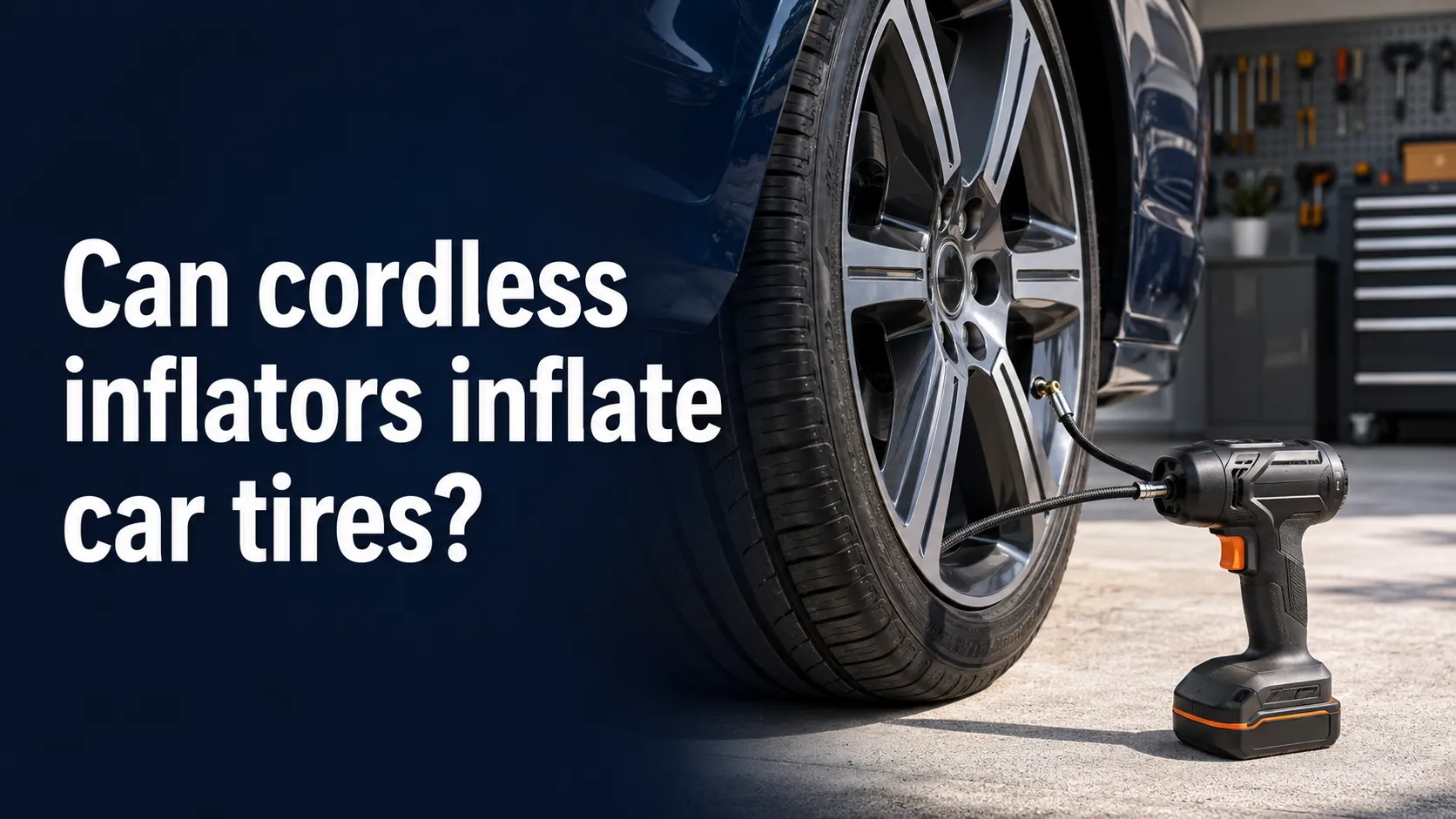
Yes, cordless inflators can inflate car tires and handle routine pressure top-ups when the tool supports the tire’s size and pressure needs. They work well for most passenger cars, but larger SUV and pickup tires may need a more capable inflator or longer cooling breaks.
Quick Answer
Can cordless inflators inflate car tires? Yes. A compatible cordless tire inflator can add air to a low car tire without a wall outlet or vehicle power cord. Check the vehicle’s recommended cold tire pressure, inspect the tire for damage, and follow the inflator’s run-time and cooling limits.
Practical Verdict
A cordless inflator is useful for routine tire care and minor pressure loss. It is not a tire repair tool. If a tire is flat, damaged, or losing air again soon after inflation, have it inspected by a qualified tire technician.
Why This Question Matters
A low tire can appear before work, during a family trip, or far from an air pump. A cordless inflator gives you a portable way to add air without searching for a gas-station compressor.
In this guide, I will explain which tires these tools can handle, how to choose the correct pressure, and how to inflate a tire safely. I will also cover common problems, storage, maintenance, and signs that you should stop and call a professional.
1Vehicle placard for the correct pressure
3Parts to inspect: battery, hose, and connector
0Tire damage repaired by adding air
Can Cordless Inflators Inflate Car Tires Effectively?
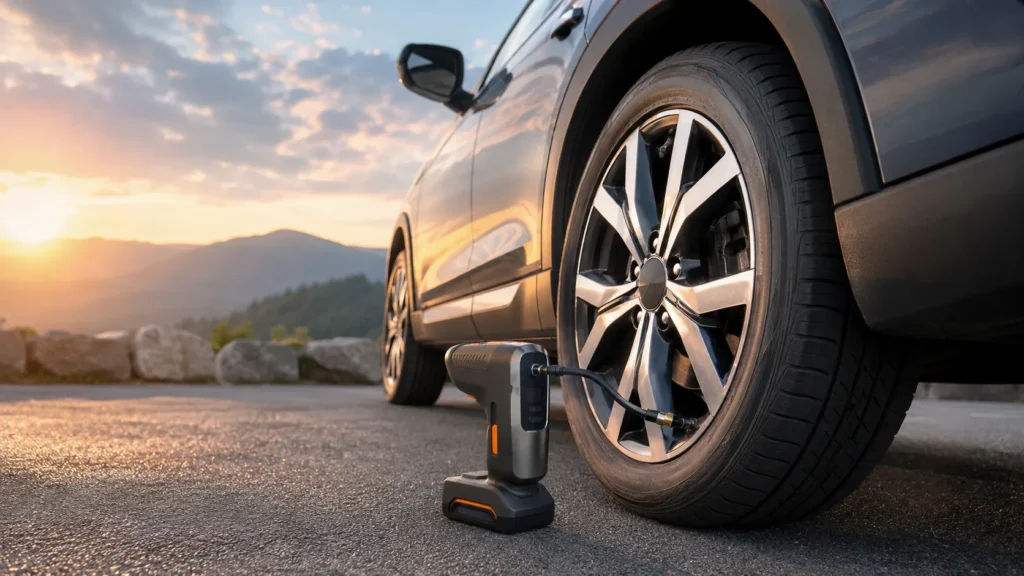
Most cordless tire inflators made for vehicle use can add air to passenger-car tires. They are especially practical when a tire is only a few PSI below the vehicle maker’s recommended pressure.
PSI means pounds per square inch. It is the pressure unit commonly used for vehicle tires in the United States.
A compact inflator may take longer when a tire is very low. It may also struggle with a large SUV or light-truck tire if the pump has low airflow or a short duty cycle.
What is a duty cycle? It is the amount of time an inflator can run before it needs to cool. Never keep the pump running beyond the limit stated in its manual.
The owner’s manual and tire-information placard take priority when pressure specifications differ. The National Highway Traffic Safety Administration tire guidance also directs drivers to use the vehicle manufacturer’s recommended tire pressure.
What Jobs Can a Cordless Inflator Handle?
The answer depends on tire volume, target pressure, battery condition, and pump design. Tire volume is the amount of air space inside the tire. A large pickup tire contains more air than a small sedan tire.
| Inflation Job | Typical Suitability | What to Confirm |
|---|---|---|
| Small pressure top-up | Well suited | Correct PSI setting |
| Moderately low car tire | Usually suitable | Battery charge and run time |
| Very low tire | Use caution | Tire condition and air leaks |
| Large SUV tire | Model dependent | Supported tire size and airflow |
| Pickup-truck tire | Model dependent | Capacity and cooling needs |
| Damaged or separated tire | Not suitable | Professional inspection needed |
Pro Tip
Test the inflator at home while your tires are close to their correct pressure. This confirms that the battery, hose, gauge, controls, and valve connector work before you need the tool beside the road.
Which Vehicles Are Compatible?
Many cordless inflators work with passenger cars and crossovers. Some also support larger SUVs, pickup trucks, compact spare tires, motorcycles, bicycles, and recreational inflatables.
Compatibility should never be assumed. Vehicle requirements vary by make, model, trim, tire option, load, and model year.
Applications to Check in the Inflator Manual
Passenger carsCrossoversSUVsPickup trucksCompact sparesBicycle tires
| Vehicle Type | Likely Use | Main Check | Possible Limitation |
|---|---|---|---|
| Small car | Routine top-ups | Target pressure | Battery charge |
| Midsize sedan | Routine tire care | Tire size | Run-time limit |
| Crossover | Often compatible | Pump airflow | Longer fill time |
| Large SUV | Model dependent | Supported tire volume | Heat buildup |
| Pickup truck | Model dependent | Tire and load needs | Several cooling breaks |
| RV or trailer | Special requirements | Tire rating and tool support | Compact pump may be unsuitable |
Good to Know
A high maximum-pressure claim does not always mean fast inflation. Large tires also need enough airflow. Check the supported tire sizes, run time, and intended uses instead of judging the pump by one pressure number.
Where Do You Find the Correct Tire Pressure?
Look for the tire-and-loading placard near the driver’s door, door frame, or door pillar. You can also check the vehicle owner’s manual. Use the pressure listed for the correct tire position and vehicle load.
Do not use the pressure molded onto the tire sidewall as your normal target. That sidewall number is not the vehicle maker’s recommended operating pressure. Goodyear’s tire-pressure guidance explains this difference.
Did You Know? Front and rear tires may require different pressures. A compact spare may also need a different pressure from the four regular tires.
Why Should You Check Tires When They Are Cold?
Driving creates heat, and heat can raise tire pressure. A cold reading gives you a better match to the pressure shown on the vehicle placard.
Check pressure before driving when possible. If you must check a warm tire, follow the vehicle maker’s guidance and recheck it after the tire cools.
Important Pressure Warning
Do not release air from a warm tire just to match a cold-pressure number unless the vehicle manufacturer tells you to do so. The pressure may become too low after the tire cools.
What Should You Check Before Inflation?
Pre-Inflation Checklist
- Park on firm, level ground away from traffic.
- Apply the parking brake.
- Find the recommended cold tire pressure.
- Inspect the tire for cuts, bulges, cracks, and exposed cord.
- Check the wheel and valve stem for visible damage.
- Confirm that the inflator supports the tire.
- Check the battery charge.
- Inspect the hose and connector for wear.
- Make sure the air vents are clear.
- Select the correct pressure unit, usually PSI in the USA.
- Review the stated run-time and cooling limits.
Do not inflate a tire with serious visible damage. A tire that was driven while flat may also have internal damage that you cannot see from outside.
Jake’s Practical Check
When I check this type of accessory, I look beyond portability. I check whether the connector seals well, the hose reaches each valve, the display is easy to read, and the pump is intended for the vehicle’s tire size.
How to Inflate a Car Tire With a Cordless Inflator
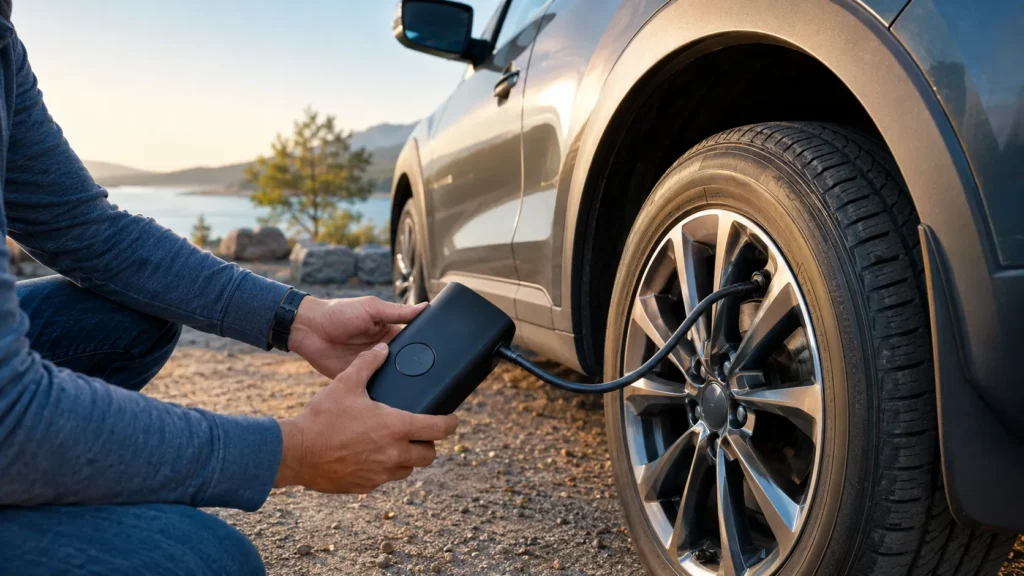
1
Park safely
Move away from traffic when possible. Park on stable ground, apply the parking brake, and switch on the hazard lights if needed.
2
Find the target pressure
Read the tire placard or owner’s manual. Note whether the front and rear tires use different pressures.
3
Inspect the tire
Look for bulges, deep cuts, splits, exposed cords, wheel damage, or a broken valve. Stop if the tire appears unsafe.
4
Prepare the inflator
Check the battery, hose, connector, and vents. Place the unit on firm ground where it cannot tip over or touch a hot exhaust part.
5
Connect the hose
Remove the valve cap and attach the connector firmly. If you hear constant air loss, turn off the tool and reseat the connector.
6
Set the pressure
Select PSI and enter the vehicle maker’s target if the inflator supports a preset. Double-check the unit and number before starting.
7
Start and supervise inflation
Stay beside the tool. Watch the pressure reading, hose, tire shape, sound, and temperature while the pump runs.
8
Observe the run-time limit
Stop when the manual requires a cooling break. Do not cover the vents or force the pump to continue after a heat-related shutdown.
9
Verify the final pressure
Let the reading settle after the pump stops. Check it with a separate tire gauge if the built-in reading seems uncertain.
10
Disconnect and inspect
Switch off the inflator before removing the hose. Replace the valve cap and check that the tire is holding air.
Pro Tip
Keep a separate tire gauge in your vehicle. It gives you a simple way to check the inflator’s display and confirm the pressure after the airflow stops.
Cordless vs. Other Tire Inflation Options
Cordless models offer fast setup and easy movement around a vehicle. Other inflation methods may be more suitable when you need longer run time or greater airflow.
| Inflator Type | Main Benefit | Main Limitation | Useful For |
|---|---|---|---|
| Cordless inflator | No cord during use | Depends on battery charge | Home checks and travel |
| 12-volt inflator | Uses vehicle power | Needs a suitable outlet | Roadside backup |
| Manual pump | No electrical power | Slow and tiring | Small adjustments |
| Garage compressor | Higher air volume | Not very portable | Frequent garage use |
Pros and Cons of Using a Cordless Inflator
Pros
- Portable and easy to carry
- No wall outlet needed during use
- Quick setup for routine top-ups
- Useful at home and on road trips
- Built-in gauge on many models
- Can reach every tire without a long power cord
Cons
- Will not work with an empty battery
- Cannot repair a leak or damaged tire
- Compact pumps may inflate slowly
- Large tires can cause more heat
- Gauge readings may vary
- Some jobs require cooling breaks
What Can a Cordless Inflator Not Do?
A cordless inflator adds air. It cannot seal a puncture, repair a leaking valve, straighten a damaged wheel, restore a broken bead seal, or fix internal tire damage.
It also cannot prove that a tire is safe after it has been driven while flat. A qualified tire technician may need to remove the tire from the wheel to inspect its interior.
Stop Inflation Immediately
Stop if you see a growing bulge, exposed cord, deep split, severe wheel damage, smoke, melting, or a damaged battery. Move away from the tire and arrange professional help.
When Is a Flat Tire Too Damaged to Inflate?
Do not attempt routine roadside inflation when the tire has obvious structural damage or has separated from the wheel. Inflation can place stress on an already weak tire.
If the tire cannot support the vehicle, loses air quickly, or changes shape while filling, stop. Use roadside assistance or have the vehicle taken to a qualified tire service location.
Troubleshooting Common Inflation Problems
Start with safe external checks. Do not open the tool, bypass its protection system, bridge a fuse, or modify the battery.
| Common Symptom | Likely Cause | Safe First Check | When to Stop |
|---|---|---|---|
| Inflator will not start | Low charge or loose battery | Check charge and battery seating | Battery is swollen, hot, or leaking |
| Air leaks at the valve | Loose connector or worn seal | Turn off and reconnect the hose | Valve stem looks damaged |
| Inflation is very slow | Air leak, low charge, or large tire | Check the connection and compatibility | Tool overheats or tire looks damaged |
| Tool stops early | Heat protection or low battery | Let it cool and check the charge | Repeated shutdown continues |
| Gauge reading jumps | Poor seal or active airflow | Stop and let the reading settle | Gauge remains unreliable |
| Tire becomes low again | Puncture, valve, bead, or wheel leak | Verify pressure with another gauge | Air loss is fast or repeated |
Why Is the Inflator Running but Not Adding Air?
The valve connection may not be sealed. The hose may also be damaged, or air may be leaving through a tire puncture or faulty valve.
Turn off the tool before touching the connector. Reattach it once, then stop if the tire still will not accept or hold air.
Why Does the Inflator Become Hot?
A small pump creates heat as it compresses air. Longer run times and large tires can increase that heat.
Follow the stated cooling period and keep the vents open. Stop using the tool if you notice smoke, a burning smell, melting, unusual noise, or heat that continues to rise.
Why Does the Tire Lose Pressure Again?
The tire may have a puncture, damaged valve, wheel leak, or poor seal where the tire meets the wheel. Temperature changes can also affect pressure, but quick or repeated loss needs inspection.
Do not make repeated inflation your normal solution. A qualified technician should inspect a tire that will not hold its recommended pressure.
Good to Know
An automatic shutoff feature can be helpful, but you should still supervise the pump. A wrong pressure unit, incorrect preset, leaking connection, or faulty reading can lead to an incorrect final pressure.
Vehicle and Personal Safety
Safe inflation starts with the work area. Move away from traffic, use stable ground, apply the parking brake, and keep children and pets away.
- Read the vehicle manual and inflator manual first.
- Keep your face and body away from a damaged sidewall.
- Do not leave the running inflator unattended.
- Keep the hose away from moving parts and hot exhaust components.
- Do not use the tool near fuel vapor or flammable materials.
- Do not inflate a visibly damaged tire.
- Never crawl beneath a vehicle supported only by a jack.
- Let hot pump parts cool before handling or storage.
- Stop if the tire changes shape or makes unusual sounds.
Electrical Safety
Turn off the vehicle and remove the key before handling accessories when the applicable manual calls for it. Do not touch damaged wiring, leaking batteries, hot components, fuel systems, airbags, or high-voltage hybrid and EV parts.
Inflating a tire normally does not require work on the vehicle’s brakes, steering, airbags, fuel system, or high-voltage components. If your task involves any of these systems, stop and consult a qualified mechanic or technician.
How to Maintain and Store a Cordless Inflator
Basic care improves the chance that the inflator will work when you need it. Battery care is especially important because a cordless pump depends fully on stored power.
| Item | When to Check | Safe Care |
|---|---|---|
| Battery charge | Before trips and routine use | Recharge as directed |
| Battery condition | Before use or charging | Check for swelling, leaks, and heat |
| Hose and connector | Before each use | Inspect for cracks and worn seals |
| Air vents | After dusty use | Clear loose dirt with power off |
| Pressure gauge | From time to time | Compare with a trusted gauge |
| Storage area | After every use | Keep dry, cool, and secure |
Let the inflator cool before placing it in a case or cargo area. Secure the tool so groceries, luggage, or garage equipment cannot crush its hose or battery.
Store and charge the battery only within the temperature range in its manual. Do not charge a battery that is cracked, swollen, leaking, unusually hot, or giving off an odd smell.
Pro Tip
Add a short inflator check to your monthly vehicle routine. Turn it on, inspect the hose, confirm the battery charge, and make sure the correct adapters are still in the case.
When Should You Call a Tire Technician?
Seek professional help when the problem is more than a small pressure adjustment. A tire can have hidden internal damage even when its outside surface looks normal.
Arrange an Inspection If:
- The tire loses pressure again soon after inflation.
- The tire was driven while severely low or flat.
- You see a bulge, deep cut, split, or exposed cord.
- The wheel or valve stem appears damaged.
- The tire will not accept or hold air.
- The low-pressure warning returns often.
- The vehicle pulls, shakes, or handles differently.
- You are not sure whether the tire is safe.
Jake’s Safety Rule
I treat a cordless inflator as a pressure-maintenance tool, not a repair. If the same tire keeps becoming low, I recommend having the tire, valve, wheel, and bead seal checked instead of continuing to add air.
Frequently Asked Questions
Can a cordless inflator fully inflate a flat car tire?
It may inflate an undamaged tire if the pump supports its size and has enough battery power. Do not inflate a tire with a bulge, deep cut, exposed cord, damaged wheel, or other signs of structural damage.
How long does a cordless inflator take to inflate a car tire?
Inflation time varies with the tire size, starting pressure, airflow, battery condition, hose seal, and pump design. Check the tool’s stated capabilities and follow every run-time and cooling limit.
Can a cordless inflator handle SUV and pickup-truck tires?
Some can, but compatibility depends on the tire’s size, required pressure, and air volume. Confirm that the inflator manufacturer supports your tire and expect large tires to need more time and cooling.
What PSI should I set on a cordless tire inflator?
Use the cold tire pressure shown on the vehicle’s tire-information placard or in its owner’s manual. Do not use the maximum pressure printed on the tire sidewall as the normal target.
Can I trust the pressure gauge on a cordless inflator?
The built-in gauge is useful, but readings can vary between tools. Let the reading settle after the pump stops and compare it with a separate trusted tire gauge from time to time.
Can a cordless inflator repair a slow tire leak?
No. It can replace lost air, but it cannot repair a puncture, leaking valve, damaged wheel, bead leak, or sidewall damage. A tire that repeatedly loses pressure needs professional inspection.
Should I keep a cordless inflator in my car?
You can keep one in the vehicle if its manual allows the expected storage conditions. Protect it from moisture, impact, and extreme temperatures, and check the battery before long trips.
Why does my cordless inflator stop while filling a tire?
A low battery, heat protection, blocked vent, incorrect preset, or air leak may cause it to stop. Turn it off, let it cool, inspect the setup, and follow the troubleshooting guidance in its manual.
Related Guides
- How Do Cordless Tire Inflators Work?
- Are Cordless Inflators Safe to Use?
- Are Cordless Inflators Reliable?
- Cordless vs. 12-Volt Tire Inflators
- Why Does a Car Tire Keep Losing Air?
Conclusion: Can Cordless Inflators Inflate Car Tires?
Yes, cordless inflators can inflate car tires when the pump supports the tire and its battery has enough charge. They are most useful for routine pressure checks, small top-ups, and minor pressure loss.
Start by reading the vehicle placard, checking the tire for damage, and confirming that the inflator supports your tire size. Follow the pump’s run-time limit and verify the final pressure.
Most importantly, do not use added air to hide a recurring leak or visible damage. Stop and contact a qualified tire technician if the tire will not hold air, was driven while flat, or shows a bulge, deep cut, split, or exposed cord.
Quick Recap
- Cordless inflators can handle many passenger-car tires.
- Large SUV and pickup tires need more airflow.
- Use the pressure on the vehicle placard.
- Check the battery, hose, valve connector, and vents.
- Observe every run-time and cooling limit.
- Verify the final pressure with a reliable gauge.
- Have recurring leaks and damaged tires inspected.
Final Key Takeaway
A cordless inflator is a convenient way to add air to a compatible car tire, but it cannot repair damage. Keep it charged, test it before a trip, use the vehicle maker’s recommended pressure, and stop if the tire cannot safely hold air.