

Affiliate disclosure. As an Amazon Associate I earn from qualifying purchases. Best Auto Products may also earn a commission through Walmart links.
Paint correction · Corded dual-action polisher
A versatile polisher if you buy the right pad setup
The MT300 makes sense if you regularly polish your own cars and want one corded tool for gloss enhancement and occasional correction. The buying decision hinges on the backing plate and pads. Check what is in the box before comparing prices, especially if you’re starting from scratch.
8 mm orbit · 3,000–7,500 OPM · Removable D-handle
Compare MT300 offers
Compare the same model, seller and box contents. A tool-only offer can cost more overall once you add a plate, pads and polish.
Amazon
Open the MT300 product page. Check the current seller and whether the selected offer includes any pads or a plate.
Walmart
Open the matching MT300 listing. Review the shipped total, seller and return terms for your ZIP code.
Availability and checkout prices vary. Compare like-for-like packages before ordering.
This Meguiar’s MT300 review uses manufacturer documentation and retailer listings to assess the tool and the cost of getting started. Best Auto Products did not conduct hands-on tests of correction speed, vibration or durability. The practical examples below explain how to pick a setup for the job you actually want to do.
Meguiar’s MT300 specifications
| Feature | Why it matters |
|---|---|
| 8 mm orbit | A short-throw format for general polishing and work around some tighter contours. |
| 3,000–7,500 OPM | Orbits per minute describe the oscillation rate. Use the speed guidance for the tool, pad and liquid rather than selecting a setting by the maximum number. |
| Soft start | The tool ramps up on startup, which helps you establish control before it reaches the selected speed. |
| Electronic torque management | The controller adjusts torque to help maintain speed under load. Pad rotation can still slow on curves or under excess pressure. |
| Removable D-handle | The handle can be positioned for your grip or removed if you prefer holding the tool body, following the manual. |
| Plate options | Meguiar’s documents compatible DA backing plates including DBP3, DBP5 and DBP6. Check the box contents and match the disc to the plate. |
Manufacturer references. Meguiar’s automotive catalog and Meguiar’s professional catalog.
What the MT300 can realistically correct
The first question is whether you’re trying to improve the gloss or remove visible defects. On a well-maintained daily driver with light wash marks, a mild finishing polish and a compatible foam pad are a reasonable starting point. Check the result under a light from several angles. A panel that looks good in diffuse garage light can still show marks outdoors.
Compounding is a separate step for paint that needs more correction. It removes more material and may leave haze that calls for a finishing pass. Reserve that extra work for areas that need it. A hood with scattered swirls and a trunk lid with a single deeper mark can call for different decisions, even on the same vehicle.
Know when to leave a mark alone. A mark that catches a fingernail, exposes another layer or sits beside failing clear coat deserves inspection before correction. Polishing can improve the appearance of some marks, but chasing complete removal can take off more clear coat than you intend. Take extra care on edges, body lines and repainted panels.
Build the pad setup before you order
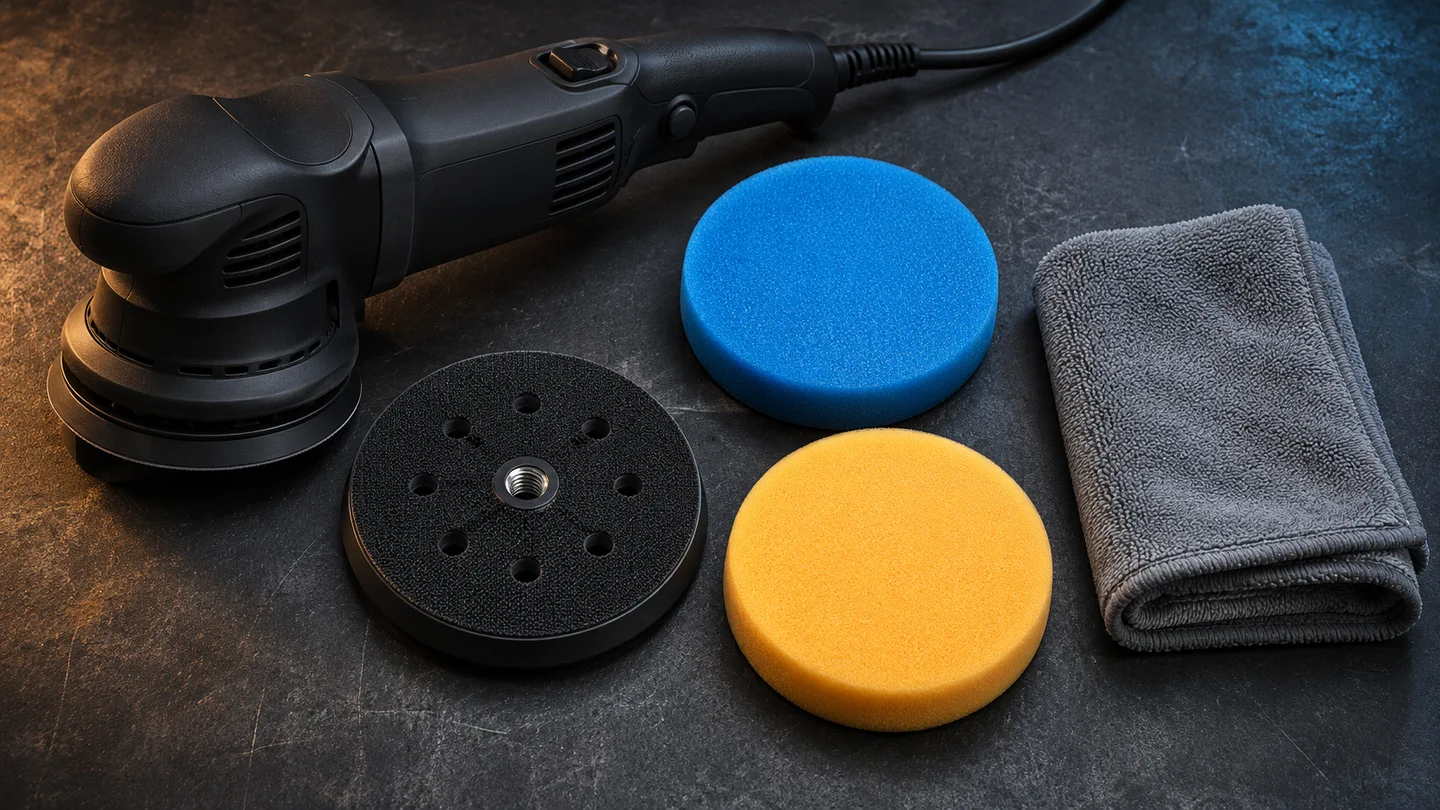
The backing plate threads onto the machine and holds the pad. The pad contacts the paint. Read both manufacturers’ sizing guidance. A pad listing may name its working-face diameter or its hook-and-loop attachment diameter, so matching the numbers on the front of two packages is insufficient. Confirm the intended plate-and-pad pairing.
| Setup | Where it fits |
|---|---|
| 5-inch plate system | A practical starting point for a mixed-size vehicle with hoods, doors and curved panels. Check that the pad is made for that plate. |
| 6-inch plate system | Worth comparing for broad, flatter panels. Consider how comfortably you can keep it flat and away from trim. |
| 3-inch plate system | An option for suitably sized tight areas. Check model compatibility and keep the smaller pad clear of sharp edges. |
| Polishing foam and mild polish | A sensible first test for gloss enhancement and light wash marks. |
| Cutting pad and compatible compound | A step up only after a test spot shows that the milder combination falls short. |
Plan for several clean pads if you’re tackling a whole vehicle. A pad loads up with spent polish and residue as you work. Compare the complete basket price for the tool, matching plate, pads, polish and clean microfiber towels. If you already own compatible pads and a plate, check their condition and fit before ordering duplicates.
Your first polishing session
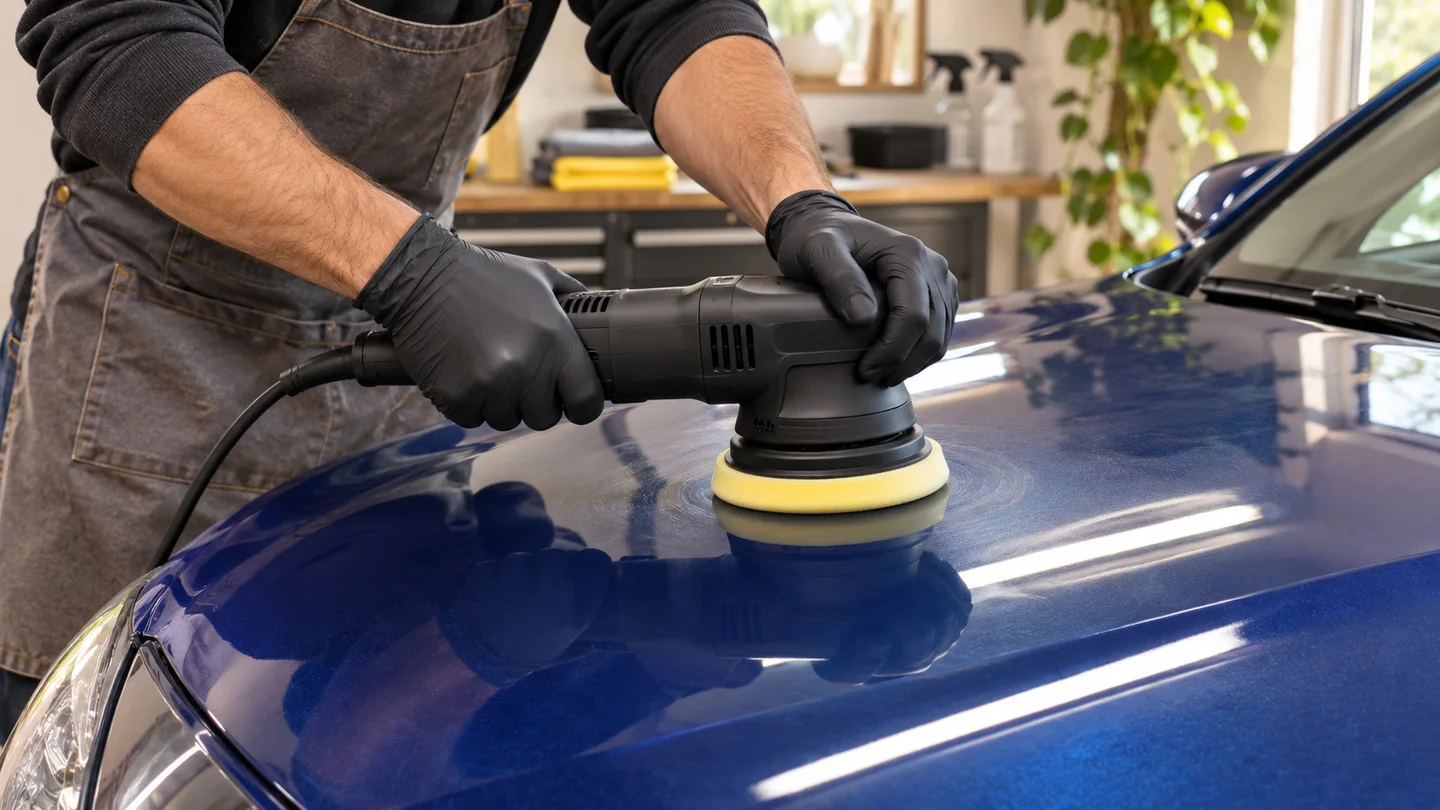
- Prepare the surface. Wash and dry the car, inspect it in good light and deal with bonded contamination where needed before bringing a pad to the paint. Work on a cool panel and follow the tool and product directions.
- Pick a representative test spot. Use a small area with defects similar to the rest of the panel. Start with a mild polish and a compatible foam pad. Put the pad on the paint before starting and keep it controlled through the pass.
- Check the result before changing anything. Wipe the residue as directed and look at the spot from different angles. If the paint looks better with no obvious haze, that combination can be enough for the job.
- Track pad rotation on curves. A temporary mark on the outer edge of the backing plate can help you see whether it is rotating. If it stalls, adjust the angle and ease off pressure before reaching for a higher speed.
- Clean or change pads as you work. Follow the pad maker’s cleaning instructions. Switch off and unplug the tool before changing the backing plate or fitting accessories.
If one area needs a more aggressive step, run a separate test there. This makes it easier to tell whether an improvement came from the liquid or from the pad. It also keeps you from repeating a cutting step on every panel after a single difficult test spot.
Three jobs to plan before buying
Refresh a daily driver over a weekend
Start by deciding whether you want the finish to look better in normal daylight or whether you want to correct every visible mark under an inspection light. The first goal is easier to reach with a light polishing pass. Budget enough time to wash, dry, test and complete one section at a time. If the test spot meets your goal, spend the rest of the session on consistency rather than moving to a stronger compound.
Work on a large SUV or pickup
A big hood and doors favor a setup you can keep flat and control over several passes. The roof edges, pillars and shaped tailgate may need a different approach. Before buying a second plate, decide which small areas you are comfortable finishing by hand. Also plan where the power cord will run so it stays off the paint and out of the area where you walk.
Maintain a car with a recent paint repair
Check with the repairer about cure time and suitable products for that panel. A repainted panel can respond differently from adjacent factory paint. Even if the first test spot on the car looks good, test the repaired panel separately once the repairer says it is ready. If your main concern is a visible defect left by the repair, let the shop assess it before attempting correction yourself.
Meguiar’s MT300 vs Griot’s Garage G9
| Decision | How the two compare |
|---|---|
| Orbit | MT300 uses an 8 mm orbit. Griot’s lists a 9 mm orbit for the G9. |
| Published speed | MT300 is rated at 3,000–7,500 OPM. Griot’s lists 2,000–6,400 OPM for the G9. |
| Backing plate | Griot’s lists a 6-inch vented plate in the G9 package and offers an optional 5-inch plate. Confirm the selected MT300 package before budgeting for pads. |
| Which setup makes sense? | Consider the MT300 if you want to build around Meguiar’s plate and pad system. Consider the G9 if you want to start with its included 6-inch plate and that size suits your work. |
If most of your work will be on a small car with curved bodywork, price the plate and pad sizes you’ll actually use on both machines. If you’re mainly doing broad truck or SUV panels, compare a full 6-inch setup. Griot’s G9 specifications and our Griot’s G9 buying guide.
How to compare Amazon and Walmart prices
Start with the delivered cost for the same ZIP code. Compare new with new and check who sells and ships the tool. A cheaper listing may leave you buying a plate or replacement pad set separately. A more expensive bundle is only a better value if the accessories fit your planned work.
- Match the model. Look for MT300 in the listing details. Check that you selected the polisher itself, rather than a related accessory or different regional model.
- Confirm the items in the box. Verify the backing plate, any pads and any liquids by item name. Product photos can show examples of equipment that is sold separately.
- Compare the full first-job cost. Add shipping, tax and anything missing from your setup. If you only want to apply wax, price that simpler job before buying a correction kit.
- Check returns before opening a bundle. Look for the return window, any condition requirements and whether a marketplace seller handles the return. Keep the order receipt for warranty questions.
Frequently asked questions
Is the MT300 a good first dual-action polisher?
It can be, especially if you plan to learn on light defects with a matched foam pad and mild polish. A complete starter kit can be easier to budget for if you have no pads or backing plate yet. Compare the entire setup before choosing.
Does every MT300 package include pads or a backing plate?
Check the itemized contents of the exact offer. Retailers can sell the same model by itself or bundle it with accessories. A compatibility claim for a plate tells you what can fit the tool, so confirm separately whether the plate comes in the box.
Can the MT300 remove deep scratches?
It can reduce the visibility of some defects in suitable paint, depending on the pad, polish and finish. Deep scratches, exposed color or primer, and failing clear coat require evaluation before you try to correct them.
Is the MT300 useful for applying wax?
Yes, when the wax or sealant is suitable for machine application. Use a dedicated finishing or application pad and follow the product directions. Keep that pad separate from pads used with a cutting compound.
Should you buy it?
Shortlist the MT300 if you expect to polish regularly, have a suitable outlet where you work and can verify a compatible plate and pad setup. If you mainly want to apply wax once or twice a year, compare how much a simpler application setup would cost first.
For the wash stage, see our Active 2.0 pressure washer buying guide.
Editorial detailing photo by Bulat843 on Pexels. The image illustrates the task.