
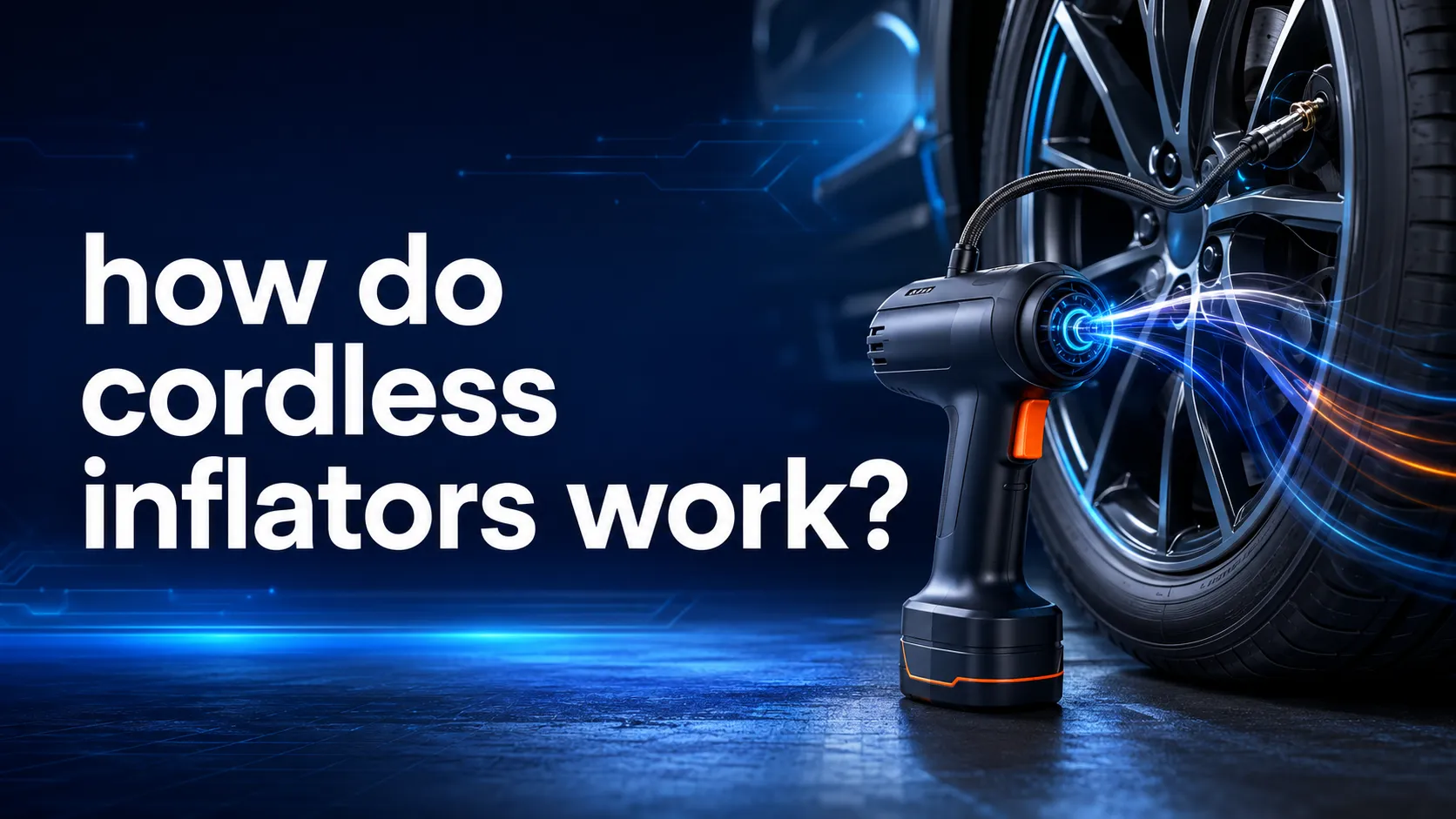
How do cordless inflators work? A rechargeable battery powers a small motor and pump. The pump pulls in outside air, compresses it, and sends it through a hose into the tire. A pressure sensor tracks the result, and many models stop at the target you select.
What It Cannot DoA cordless inflator adds air, but it cannot repair a puncture, damaged valve, bent wheel, broken bead seal, or unsafe tire. Repeated pressure loss needs a proper tire inspection.
A charged battery sends electricity to a direct-current motor. The motor moves a piston or another compact pump mechanism. That pump draws in air, squeezes it to a higher pressure, and pushes it through the hose and valve stem. A built-in gauge displays tire pressure. On models with preset shutoff, the control board stops the motor when the sensor reaches your chosen target.
How Do Cordless Inflators Work Inside?
Most cordless tire inflators combine their power source, pump, controls, and gauge in one portable housing. Although shapes and features vary, the basic process is similar across many models.
The Battery Supplies Power
The rechargeable battery stores electrical energy. Pressing the start button sends that energy to the motor and control board. A low charge may slow the motor, reduce useful run time, or cause the tool to shut down under load.
The Motor Creates Motion
The motor turns a crank, gear, or similar drive. This changes the motor’s spinning motion into the repeated movement needed by the compact air pump.
The Pump Compresses Air
As a piston moves one way, the pump pulls in outside air. As it returns, the pump squeezes that air into a smaller space. The pressure rises enough to move air toward the tire.
The Hose Delivers Air
Compressed air leaves the pump through a hose. The chuck or connector seals against the valve stem. Air enters the tire when pump pressure is higher than the pressure already inside it.
The Sensor Measures Pressure
A sensor reads pressure near the pump outlet or hose. The display converts that reading into PSI, bar, kPa, or another unit. Many U.S. vehicle placards show PSI.
The Control Board Stops the Pump
On preset models, the control board compares the sensor reading with your target. It turns off the motor when the target is reached. You should still check the final pressure after airflow stops.
Pressure at the hose can pulse while air is flowing. The display may rise, fall, or briefly overshoot. Stop the pump and let the reading settle before deciding whether the tire needs more air. A separate reliable tire gauge can provide another check.
Cordless, 12-Volt, AC, and Shop Inflators Compared
The air-compression principle is similar, but the power source and working capacity differ. Choose the type that fits where and how you plan to use it.
| Inflator Type | Power Source | Best Fit | Main Limitation |
|---|---|---|---|
| Cordless | Rechargeable battery | Portable top-ups at home or on trips | Charge and heat limit working time |
| 12-volt | Vehicle power socket | Travel and emergency use | Needs a compatible vehicle outlet |
| AC portable | Wall outlet | Driveway or garage use | Cannot work far from mains power |
| Shop compressor | Wall power and air tank | Frequent, larger, or tool-based jobs | Heavy, costly, and less portable |
Some inflators accept both a rechargeable battery and a wired power source. Use only the batteries, chargers, cords, and outlets approved by the manufacturer.
What Should You Check Before Inflation?
Start with the vehicle and tire, not the inflator. The recommended cold pressure is normally listed on a placard in the driver-door area. It may also appear in the owner’s manual.
Do not use the maximum pressure molded into the tire sidewall as the normal target. Front, rear, spare, and loaded-vehicle pressures may differ. Follow the value for your vehicle, tire position, and load.
- Park on firm ground away from moving traffic.
- Check the placard or owner’s manual for the cold pressure.
- Inspect the tread and sidewall for cuts, bulges, or exposed cords.
- Look for a damaged wheel or bent valve stem.
- Confirm that the battery is charged and undamaged.
- Check the hose and connector for cracks or looseness.
- Select the correct pressure unit, such as PSI.
- Review the inflator’s run-time and cooling instructions.
I look beyond the maximum pressure printed on the package. Tire size and air volume matter too. A compact unit that handles quick passenger-car top-ups may take much longer on a large SUV or pickup tire.
Will a Cordless Inflator Work with Your Vehicle?
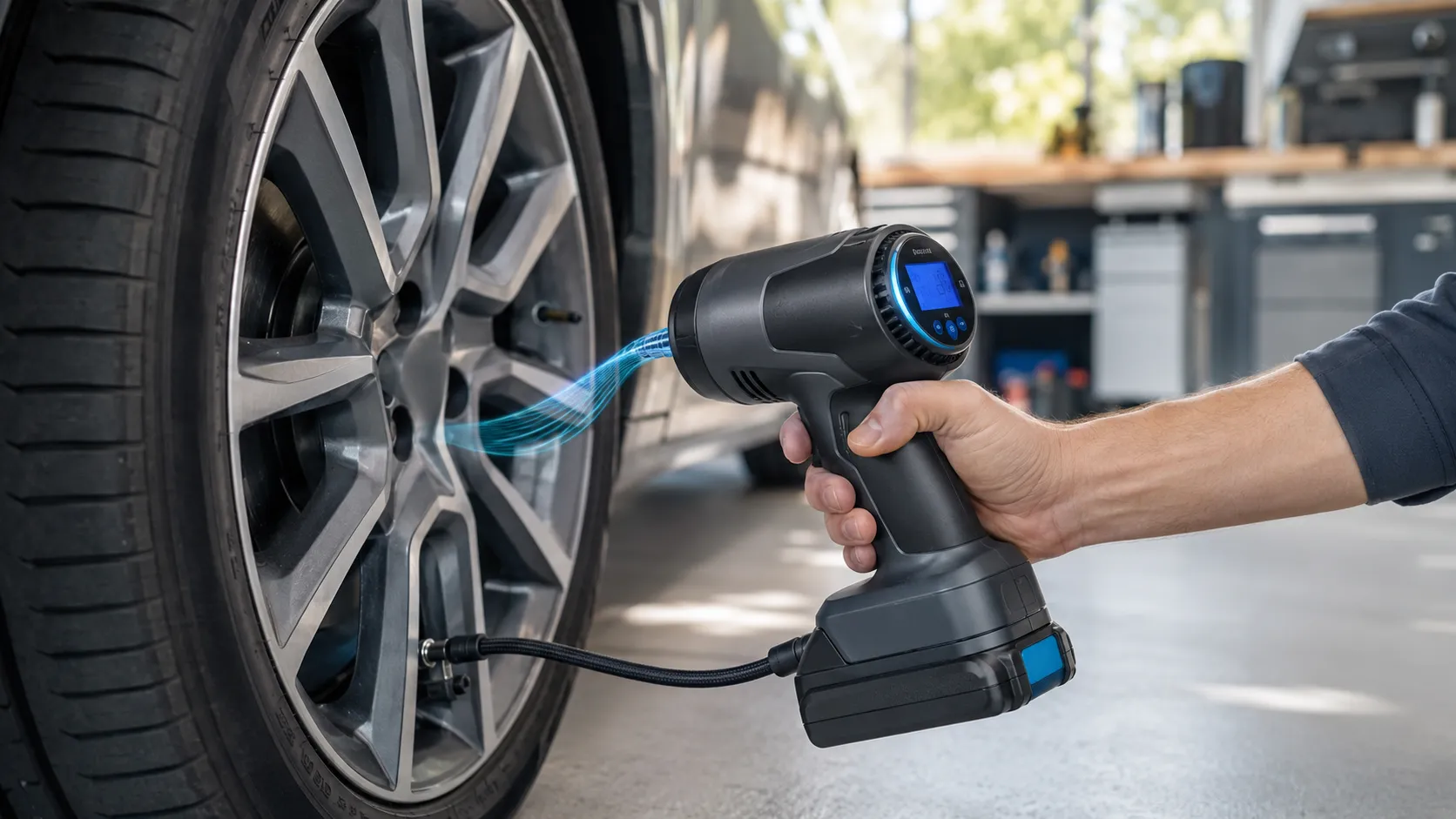
Battery operation does not require a connection to the vehicle’s electrical system. Tire compatibility still matters because larger tires hold more air and may need longer pump runs.
| Vehicle or Task | What Matters Most | What to Confirm |
|---|---|---|
| Passenger car | Easy storage and quick top-ups | Target PSI, hose reach, and battery charge |
| Crossover or SUV | Higher tire air volume | Supported tire size and cooling breaks |
| Pickup truck | Larger or higher-pressure tires | Manufacturer-approved tire range and duty cycle |
| Compact spare | Often a different pressure target | Spare-tire label and owner’s manual |
| Bicycle or sports gear | Different valve or low air volume | Correct adapter and safe pressure range |
A high maximum-PSI claim does not prove that a small inflator can quickly fill a large tire from nearly empty. Check the listed tire applications, air-delivery information, run time, and cooling requirements.
How to Use a Cordless Inflator Step by Step
Find the Correct Pressure
Read the driver-door placard or owner’s manual. Use the cold pressure listed for the correct tire position and vehicle load.
Inspect the Tire and Wheel
Look for a sidewall bulge, deep cut, split, exposed cord, damaged valve, or bent wheel. Do not inflate a tire that appears structurally unsafe.
Place the Inflator Safely
Set the unit on stable ground with its vents clear. Keep the hose away from hot exhaust parts, sharp edges, belts, and fans.
Attach the Hose
Remove the valve cap and connect the chuck firmly. If hissing continues, switch off the tool and reseat the connector.
Select the Target
Choose the same unit shown on the placard and enter the vehicle maker’s value. Check that you did not select bar or kPa by mistake.
Start and Watch the Pump
Stay beside the tool. Watch the tire, hose, display, sound, and temperature. Follow the maximum run time in the manual.
Stop and Verify
Let the preset function stop the motor or turn it off manually. Check the pressure again after airflow has stopped.
Disconnect and Recheck
Remove the connector carefully because fittings may be warm. Replace the valve cap and recheck the tire soon if it was unusually low.
Never leave the inflator running by itself. Stop for smoke, sparks, a burning smell, severe vibration, unusual noise, battery swelling, or excessive heat. Move away if the tire bulges, cracks, or changes shape during inflation.
Why Cold Tire Pressure Matters
Driving heats the tires and raises the pressure reading. A cold reading gives a more consistent comparison with the vehicle placard. The National Highway Traffic Safety Administration advises drivers to use the pressure recommended by the vehicle manufacturer and check tires regularly.
If you must add air to a warm tire during a trip, do not release air only because the warm reading is above the cold target. Follow the vehicle maker’s guidance. Check the pressure again when the tire is cold.
The driver-door placard and owner’s manual set the target. The tire sidewall does not normally show your vehicle’s everyday recommended pressure.
Why Do Cordless Inflators Get Hot?
Compressing air creates heat. The motor, pump, cylinder, hose fitting, and battery can warm while the tool works. Compact housings also provide less room for heat to escape.
Manufacturers use a duty cycle or maximum continuous run time to control heat. There is no one safe run time for every inflator. Tire size, starting pressure, battery condition, and outside temperature can all affect the load.
Keep vents clear, follow the stated run and cooling periods, and stop sooner if the tool behaves abnormally. Let it cool on a safe surface before placing it in a case or vehicle compartment.
Pros and Cons of Cordless Tire Inflators
Advantages
- No outlet is needed during battery use.
- Compact size makes vehicle storage easier.
- Many models include a built-in gauge.
- Preset shutoff can simplify top-ups.
- The tool can move easily between tires.
Limitations
- An empty battery makes the tool unavailable.
- Compact pumps can become hot.
- Large tires may take longer.
- Gauge accuracy varies by model.
- The inflator cannot repair tire damage.
Cordless Inflator Troubleshooting
Begin with simple checks that do not require opening the tool. Do not bypass a fuse, sensor, battery-protection feature, or other safeguard.
| Symptom | Likely Cause | Safe First Check | When to Stop |
|---|---|---|---|
| Will not start | Low charge or loose battery | Check the charge and battery seating | Battery is swollen, leaking, or hot |
| Runs but adds little air | Loose connector or tire leak | Switch off and reseat the hose | Tire or valve has visible damage |
| Stops before target | Low battery or heat protection | Let it cool and check the charge | Shutdown repeats or odor appears |
| Reading jumps | Airflow or a poor connection | Stop the pump and reconnect the hose | Gauge remains clearly unreliable |
| Tire becomes low again | Puncture, valve, bead, or wheel leak | Verify with a separate gauge | Pressure loss is fast |
| Unit becomes very hot | Long run or blocked vent | Turn it off and allow cooling | Smoke, melting, or battery damage appears |
What If the Tire Will Not Hold Air?
Repeated pressure loss points to a leak or damage. The problem may involve the tread, valve, wheel, bead seal, or internal tire structure. Do not keep driving and refilling a tire that loses pressure quickly. A tire driven while flat may have hidden damage even if the outside looks normal.
What If the Tire-Pressure Warning Stays On?
Check every tire required by the vehicle manual. Some vehicles need a short drive or a manufacturer reset process before the tire-pressure monitoring system updates. If the light flashes, stays on after correct inflation, or returns often, arrange an inspection.
Cordless Inflator and Tire Safety
- Move away from traffic whenever conditions allow.
- Park on stable ground and apply the parking brake.
- Use hazard lights and warning equipment when appropriate.
- Keep your face and body away from the tire sidewall.
- Never crawl under a vehicle supported only by a jack.
- Keep the hose away from hot or moving vehicle parts.
- Keep children and pets away from the tire and tool.
- Do not operate near fuel vapor or flammable material.
- Allow hot parts to cool before touching or storing them.
Do not inflate or drive on a tire with a growing bulge, exposed cord, split sidewall, badly damaged wheel, or rapid pressure loss. Seek tire service if the tire was driven flat, will not hold air, or needs repeated inflation. An inflator adds air; it does not prove that the tire is safe.
How to Maintain and Store the Inflator
Small checks help keep the tool ready for a roadside need. Follow the manufacturer’s charging and storage instructions because battery systems and temperature limits differ.
| Item | When to Check | What to Do |
|---|---|---|
| Battery charge | Before trips and routine checks | Recharge with the approved charger |
| Battery condition | Before use and charging | Check for heat, cracks, leaks, or swelling |
| Hose and connector | Before each use | Look for cracks, wear, and looseness |
| Air vents | After dusty use | Clear loose dirt with the power off |
| Pressure reading | From time to time | Compare it with a reliable tire gauge |
| Storage area | After each use | Keep the cooled unit dry and secure |
Before leaving, confirm the battery charge, hose condition, pressure unit, adapters, and location of your vehicle’s tire placard. Store the inflator where cargo cannot crush it or make it slide around.
Frequently Asked Questions
Can a cordless inflator fill a completely flat car tire?
It may add air, but a fully flat tire could have a puncture, broken bead seal, damaged sidewall, or hidden internal damage. Inspect it first. Seek tire service if it was driven flat or will not hold pressure.
Do cordless tire inflators stop automatically?
Many models stop at a preset pressure, but not all do. Read the manual, stay with the tool while it runs, and verify the final pressure after airflow stops.
How long can a cordless inflator run continuously?
Run time depends on the design, battery, tire size, starting pressure, and temperature. Follow the duty cycle and cooling period in your inflator’s manual.
Can I use a cordless inflator on an SUV or pickup truck?
Possibly. Confirm that the maker supports the tire size, pressure, and intended use. Larger tires require more air and may need longer runs with cooling breaks.
Should I use the PSI printed on the tire sidewall?
No, not as the normal target. Use the recommended cold pressure on the vehicle placard or in the owner’s manual. The sidewall number serves a different purpose.
Why does my cordless inflator get hot?
The motor and pump create heat while compressing air. Some warmth can be normal. Follow the stated run-time limit and stop for excessive heat, smoke, melting, or a burning smell.
How accurate is a cordless inflator gauge?
Accuracy varies by model and condition. Check the reading after the pump stops, and compare it from time to time with a reliable separate tire gauge.
Can a cordless inflator repair a tire leak?
No. It only adds air. It cannot repair a puncture, damaged valve, bent wheel, broken bead seal, sidewall damage, or internal tire damage.
Related Cordless Inflator Guides
Conclusion: How Do Cordless Inflators Work?
A rechargeable battery powers the motor. The motor drives the pump, which compresses outside air and sends it through the hose into the tire. A sensor displays the pressure, and a control board may stop the motor at the target you selected.
For safe use, find the correct cold pressure, inspect the tire, connect the hose firmly, and watch the inflator while it runs. Follow the duty cycle and verify the final reading. If the tire has visible damage or quickly loses air again, stop and arrange a professional inspection.
A cordless inflator is a practical pressure-adjustment tool when it matches your vehicle and remains charged. Use the vehicle maker’s target, respect the tool’s heat limits, and remember that adding air does not repair the cause of a leak.