
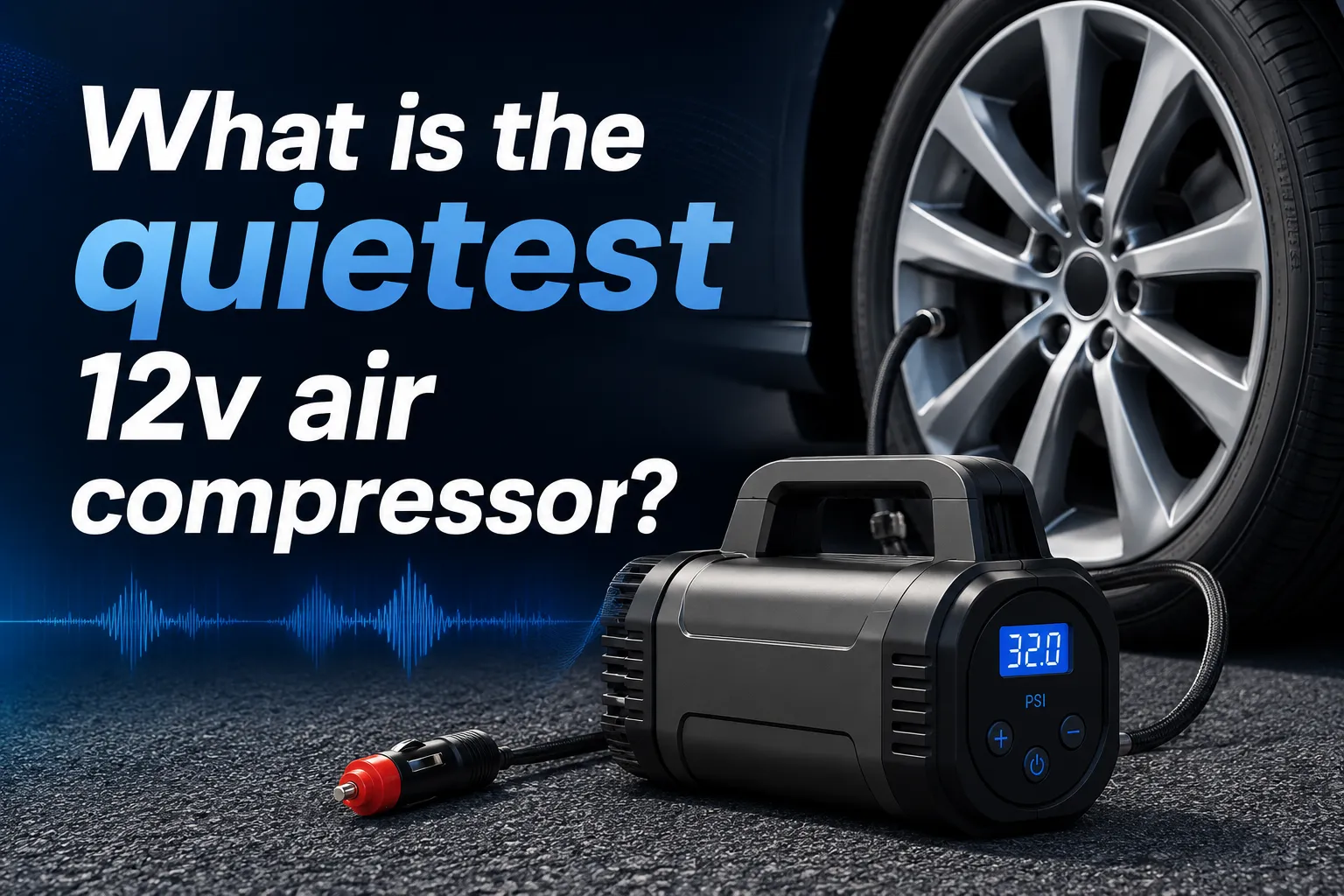
The quietest 12V air compressor is usually a well-built portable inflator with a low-noise motor, vibration damping, and a stable housing. In real use, the quietest models are often not the fastest, but they make less harsh buzzing and rattling while still filling tires safely.
If you want one for roadside tires, camping, or regular top-offs, I look for lower decibel claims, a solid base, and a design that does not shake itself across the pavement. The “quietest” option depends on how you plan to use it, because a small inflator, a dual-cylinder unit, and a hardwired compressor can all sound very different.
In this guide, I break down what quiet really means, which features matter, and how to choose a 12V compressor that fits your vehicle and your patience level.
What “Quietest 12V Air Compressor” Really Means for Real-World Use
How compressor noise is measured in decibels
Compressor noise is usually measured in decibels, or dB. The lower the number, the quieter the unit should be. But there is a catch: brands do not always test noise the same way, so one company’s 70 dB rating may not match another company’s 70 dB rating.
That is why I treat decibel numbers as a guide, not a promise. The sound can also change depending on whether the compressor is on concrete, gravel, carpet, or the trunk floor of an SUV.
A difference of just 10 dB is often heard as roughly twice as loud to people, even though the math is more complex than that. That is why a small drop in noise can feel like a big improvement.
Why 12V compressors are usually louder than larger shop compressors
Most 12V compressors are built to be compact and portable, not quiet. They use smaller motors and pumps, and those parts often spin faster to move enough air. That usually creates more whine, vibration, and fan noise than a bigger shop compressor sitting in a garage.
Shop compressors also tend to have heavier tanks and better sound isolation. A 12V unit is often designed to live in a glove box, cargo area, or tool bag, so noise control is only one part of the design.
Milwaukee’s M18 inflator page is a good example of how manufacturers present portable inflator specs, while the U.S. Department of Energy’s air compressor efficiency guidance is helpful background on compressor basics and efficiency.
What counts as “quiet” for car, truck, and off-road inflators
For a car tire inflator, “quiet” usually means the compressor sounds steady instead of shrill, and it does not rattle badly on the ground. For trucks and off-road tires, quiet often means the unit is less punishing during longer fill times.
As a rough real-world guide, many portable 12V compressors feel quiet enough if they stay around the lower end of the portable range and do not produce a loud metal buzz. The best choice is the one you can use at night or in a campsite without feeling like you are waking up the whole area.
The Quietest 12V Air Compressor Features to Look For
Low-decibel motor and pump design
- Look for published dB ratings when available
- Prefer units with enclosed motors and balanced pumps
- Check for smoother startup and less high-pitched whine
The motor and pump design matter more than almost anything else. A smoother-running compressor with better internal balance usually makes less harsh noise than a cheaper unit that vibrates and squeals under load.
Rubber feet, vibration damping, and stable housing
Noise is not only about the motor. A compressor that sits on hard plastic feet can amplify vibration and make the whole case buzz. Rubber feet, foam pads, and a heavier housing can cut down on that annoying rattling sound.
I also like a design that stays planted while running. If the compressor walks across the floor or cargo mat, it will sound louder than it really is.
Dual-cylinder vs. single-cylinder noise differences
Dual-cylinder compressors can move more air, which is great for larger tires. But they are not always quieter. Some dual-cylinder designs run smoother because each cylinder shares the load, while others sound louder because they are simply more powerful and have more moving parts.
Single-cylinder units are often simpler and lighter. They can be quieter in some compact categories, but they may take longer to fill a tire, which means the noise lasts longer.
Duty cycle and heat management
A compressor that handles heat well tends to sound better over time. When a unit gets hot, it may strain, slow down, or change pitch. That is usually a sign that it is working harder than it should.
Duty cycle matters if you inflate more than one tire or run larger truck tires. A compressor that needs frequent cool-down breaks may seem quiet at first, but the total job can take much longer.
Hose length, airflow, and fill time tradeoffs
A longer hose can help move the noise source away from you, which can make the compressor feel quieter. But hose length and airflow can also affect fill speed. If the hose is too long or too restrictive, the compressor may work harder and sound less relaxed.
That is the tradeoff with many quiet compressors: they are built to be easier to live with, not always the fastest on the market.
Quietest 12V Air Compressor Types Compared
Compact portable inflators
| Type | Noise level | Best for | Common tradeoff |
|---|---|---|---|
| Compact portable inflators | Usually moderate | Cars, bikes, emergency kits | Can be slower on larger tires |
| Heavy-duty tire inflators | Often moderate to loud | Frequent tire inflation | More size and vibration |
| Dual-cylinder emergency compressors | Varies widely | Trucks and off-road use | Can be heavier and louder |
| Built-in tank and hardwired units | Can be quieter in use | Regular use, overlanding, onboard systems | More complex install |
Heavy-duty tire inflators
Heavy-duty inflators are made to handle more pressure and longer duty cycles. They are useful, but they are not always the quietest because they often prioritize airflow over sound control. If you need one for larger vehicles, I would expect more noise than a compact top-off unit.
Dual-cylinder emergency compressors
Dual-cylinder emergency compressors can be a good middle ground. They often fill tires faster than basic single-cylinder models, which can reduce the total time you spend listening to them. Still, the actual sound level depends on build quality, mounting, and how hard the unit is working.
Built-in tank and direct-battery hardwired units
Hardwired systems and units with a small tank can feel quieter in practice because the compressor may not cycle constantly in the same way as a tiny plug-in inflator. They are often used in overlanding and vehicle setups where the compressor stays mounted and isolated better than a loose portable unit.
Which type is usually the quietest in practice
In everyday use, the quietest 12V air compressor is often a well-designed compact or hardwired unit with good vibration control. If I had to choose based on sound alone, I would usually favor a unit that is stable, enclosed, and not forced to run at full blast for too long.
What to Expect From the Quietest 12V Air Compressor Brands and Models
Noise levels commonly seen in top-rated 12V compressors
Top-rated 12V compressors often sit in a middle noise range rather than being truly silent. That is normal. Portable compressors need moving parts, cooling airflow, and enough power to push air into a tire, so some noise is part of the job.
What sets better models apart is the quality of the sound. A good one usually has a steadier hum. A poor one may have a sharp buzz, more rattling, or a rough vibration that makes it seem louder than the numbers suggest.
Best use cases for quiet models
Quiet models are best when you need to inflate near other people, in a garage with thin walls, or late at night. They also make sense if you use a compressor often and want less fatigue from the noise.
Where quieter models may sacrifice speed or portability
Lower noise often comes with tradeoffs. A quieter compressor may be slower, heavier, or more expensive. Some models also use more metal, more insulation, or a stronger base, which can improve sound control but add bulk.
- Stable hum instead of harsh buzzing
- Rubber feet and solid housing
- Clear dB rating from the maker or tester
- Fast enough fill time for your tire size
- Rattling case or loose panels
- Extreme vibration on hard surfaces
- Noisy fan plus loud pump whine
- Specs that hide testing conditions
How to compare product specs without being misled
Compare like with like. If one compressor lists noise at idle and another lists noise under load, the numbers are not truly comparable. I also watch for whether the brand explains the test distance, surface, and operating condition.
⚠️ Warning
A very low noise claim is not useful if the compressor cannot actually fill your tire size. Always check pressure, airflow, and duty cycle before you buy.
Pros and Cons of Choosing a Quieter 12V Air Compressor
Pros: less disturbance, better nighttime use, easier roadside inflation
A quieter compressor is easier to use at home, on the shoulder of the road, or at a campsite. It is less stressful when you are already dealing with a flat tire, and it is nicer for anyone nearby.
Cons: slower inflation, higher cost, larger size, or lower peak pressure
The main downside is that quiet usually costs something. You may pay more, carry more weight, or accept slower fill times. Some of the quietest designs are also not the most compact.
When quietness matters more than speed
If you inflate tires?”>inflate tires often at night, live in a shared building, or use your compressor around kids or pets, quietness may matter more than shaving a minute off the fill time. For me, that is especially true for camping and apartment parking lots.
- Choose a compressor that fits your tire size first
- Read real user feedback about noise and vibration
- Use a stable surface when inflating
- Buy only by decibel number
- Ignore duty cycle and cooling limits
- Assume all 12V compressors sound the same
- Place the compressor on a rubber mat or folded towel to reduce vibration noise.
- Keep the hose untangled so the motor does not strain while filling.
- Check tire pressure before you start so the compressor runs only as long as needed.
- If you use it often, store it where it will not rattle against tools or cargo.
How to Make Any 12V Air Compressor Quieter
Inflate on softer surfaces to reduce vibration
Concrete and metal can amplify vibration. Grass, rubber mats, carpet, or even a folded blanket can help absorb some of the noise. This does not change the motor, but it can make the compressor sound less harsh.
Keep the compressor secured and level
A loose compressor often sounds louder because it shakes, slides, and hits the ground. If you keep it level and stable, it usually runs smoother and feels less aggressive.
Use a longer hose to move the noise source away
If the hose allows it, place the compressor a little farther from where you are standing. That simple move can make a big difference in how loud it feels, especially during longer inflation jobs.
Maintain filters, fittings, and seals for smoother operation
Dirty filters, leaking fittings, and worn seals can make a compressor work harder. When that happens, the sound often gets rougher. A little maintenance can keep the unit running more smoothly and reduce unnecessary strain noise.
Avoid overworking the compressor to reduce strain noise
If the compressor is near its limit, it will usually sound stressed. Give it breaks when the maker recommends them. That helps with noise, heat, and long-term durability.
Your compressor gets unusually loud, starts making grinding noises, or trips fuses often. That can point to a failing motor, a blocked hose, or an electrical problem that needs a closer look.
Best Scenarios for the Quietest 12V Air Compressor
Nighttime roadside tire inflation
If you have a flat or low tire at night, a quieter compressor is easier on you and everyone nearby. You are already dealing with stress, so a calmer sound profile helps.
Camping and overlanding
At camp, noise matters. A quiet compressor lets you air up tires without turning the whole area into a workshop. That is a big reason many overlanders care so much about sound.
Neighborhood or apartment use
If you live near neighbors, a quieter compressor is simply more considerate. It is also a better fit for apartment parking lots, where loud tools can draw unwanted attention fast.
Motorcycle, bicycle, and small tire top-offs
Small tire inflation jobs do not need a huge compressor. A compact, quieter unit is often a better fit because it is easier to carry and less annoying to use for short bursts.
Emergency kits for family vehicles
For a family emergency kit, I like a compressor that is easy to use, not too loud, and dependable. If your spouse or teen driver has to use it on the roadside, a simpler and quieter unit is usually a better choice.
The quietest 12V air compressor is usually the one that balances low vibration, stable construction, and enough airflow for your tires. I would rather have a slightly slower compressor that sounds smooth and controlled than a fast one that rattles and screams the whole time.
What to Check Before Buying a Quiet 12V Air Compressor
Decibel rating and whether it is manufacturer-tested or independent
Start with the noise rating, but check who measured it. Manufacturer numbers can be useful, but independent testing or detailed reviews often give a clearer picture of real-world sound.
PSI and CFM requirements for your tires
Make sure the compressor can handle your tire size and pressure needs. A quiet unit that cannot keep up with your vehicle is not a good buy. For larger truck or off-road tires, airflow matters just as much as noise.
Power source: cigarette lighter plug vs. direct battery clips
Plug-in units are convenient, but direct-battery clips often provide better power for stronger compressors. If a model is underpowered, it may take longer and sound strained. That can cancel out the benefits of a quiet design.
Hose quality, gauge accuracy, and auto shutoff
A good hose and accurate gauge make the whole job easier. Auto shutoff is especially useful because it prevents overinflation and lets the compressor stop without constant attention.
Warranty, durability, and
Warranty support and build quality matter because a compressor that fails early is never a good value, quiet or not. I also look for solid materials, clear instructions, and a brand that stands behind the product.
Do not run any 12V compressor in a closed area with poor ventilation. Heat buildup can damage the unit, and you should always follow the maker’s safety instructions.
In practice, a well-built compact or hardwired compressor with vibration control is often the quietest. The exact winner depends on how much air you need and how the unit is mounted.
There is no single universal number, but quieter portable compressors usually sit at the lower end of the portable range. I care more about how smooth and steady the sound is than the number alone.
Not always. Dual-cylinder units can be louder because they move more air, but some are designed well and run smoothly. Build quality matters more than cylinder count by itself.
Yes. Use a soft surface, keep it secured, maintain the hose and fittings, and avoid overworking it. Those small changes can reduce vibration and harsh noise.
No. If it is too slow or underpowered for your tires, the lower noise may not be worth it. The best choice balances sound, airflow, and reliability.
- The quietest 12V air compressor is usually one with low vibration and a stable housing.
- Decibel ratings help, but they are not always tested the same way.
- Quieter models often trade speed, size, or price for better sound control.
- Soft surfaces, secure placement, and good maintenance can reduce noise.
- Match the compressor to your tire size and use case before you buy.