
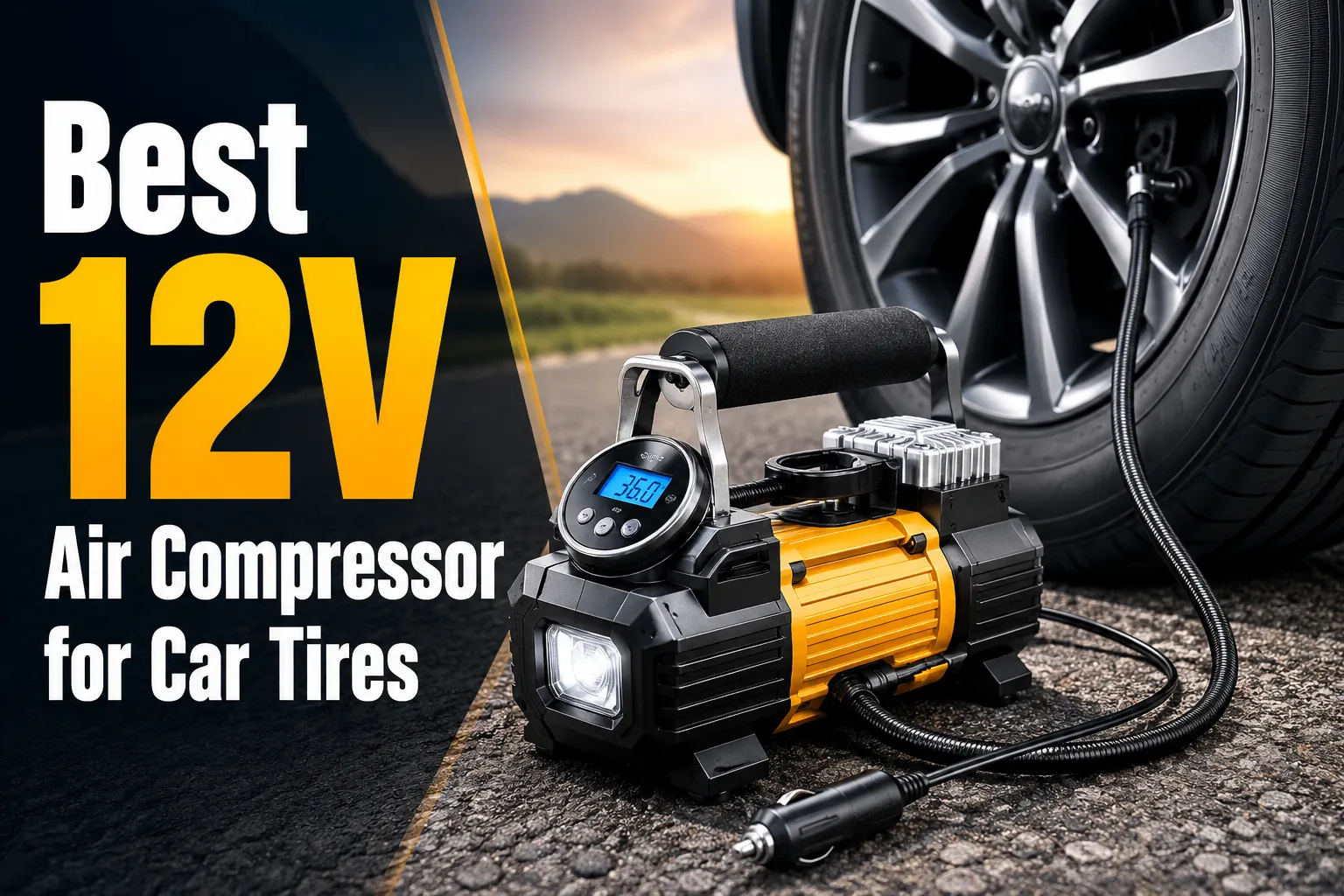
The best 12V air compressor for car tires is the one that balances fast inflation, accurate pressure control, and reliable power delivery for your vehicle. For most drivers, a digital auto-stop model with a decent airflow rating, a long cord, and a clear gauge is the safest all-around choice.
If I were buying one today, I’d focus less on big PSI claims and more on real-world tire fill speed, hose length, and how easy it is to use in the dark or on the shoulder of a road. The right compressor should fit your car, your tires, and the kind of inflation job you actually need.
In this guide, I’ll break down what matters, how different compressor types compare, and how to use one the right way. I’ll keep it practical so you can choose with confidence.
What Makes the Best 12V Air Compressor for Car Tires?
Why 12V power matters for roadside and home tire inflation
A 12V air compressor plugs into your car’s power outlet or connects to the battery, which makes it handy when you’re away from home. That matters if you pick up a slow leak, need to top off tires before a trip, or want a backup tool in the trunk.
For many drivers, the biggest advantage is convenience. You do not need a wall outlet, and you do not need to wait for a service station.
Even a small drop in tire pressure can affect fuel economy, tire wear, and handling. The U.S. Department of Energy notes that properly inflated tires help reduce rolling resistance and improve efficiency. You can see their tire pressure guidance at Energy.gov’s tire maintenance page.
Key differences between budget, mid-range, and premium portable compressors
Budget compressors can be fine for emergency top-offs, but they often run slower and get louder. They may also have shorter cords, simpler gauges, and less durable housings.
Mid-range models usually give the best balance for most drivers. They tend to inflate faster, offer better accuracy, and include useful features like auto shutoff and LED lights.
Premium portable compressors are usually built for speed, heavier use, and better control. They often cost more, but they can save time if you drive larger vehicles or check tires often.
Which car tire situations this type of compressor is best for
A 12V compressor works well for everyday passenger cars, SUVs, crossovers, and many small trucks. It is also useful for topping off tires after temperature changes, which can make pressure readings drop in colder weather.
It is a smart choice for emergency use, road trips, and home garage maintenance. If you want a tool that lives in the trunk and earns its keep several times a year, this is a strong fit.
Best 12V Air Compressor for Car Tires: Features That Matter Most
| Feature | Why it matters | What to look for |
|---|---|---|
| Maximum PSI | Shows the top pressure the unit can reach | Enough headroom above your tire’s target PSI |
| Airflow rating | Helps determine how fast a tire fills | Higher CFM or L/min for quicker inflation |
| Duty cycle | Limits how long it can run before cooling | Longer duty cycle for larger tires |
| Cord and hose length | Affects reach to all four tires | Long enough for your vehicle layout |
| Gauge and auto shutoff | Improves accuracy and prevents overinflation | Digital display with preset pressure |
Maximum PSI and real-world inflation speed
Maximum PSI is useful, but it does not tell the whole story. A compressor can list a high PSI rating and still fill tires slowly if its airflow is weak.
For car tires, you usually care more about how quickly it can take a tire from low pressure to the proper range. That is why inflation speed matters more than a flashy max number.
Airflow rating and how it affects tire fill time
Airflow is one of the best clues to real performance. It is often shown as CFM or liters per minute, and higher numbers usually mean faster inflation.
If you have larger tires, you will feel the difference right away. A small compressor may still work, but it will take longer and may need more rest time.
Duty cycle, overheating protection, and continuous-use limits
The duty cycle tells you how long the compressor can run before it needs a break. This matters because many compact units are not designed for long continuous use.
Overheating protection is a useful safety feature. It can help prevent damage if the compressor gets pushed too hard during repeated inflation.
If you plan to inflate several tires in a row, or if your tires are larger than average, a stronger duty cycle can save time and stress.
Hose length, cord length, and ease of reaching all four tires
Short cords are one of the most annoying problems with cheap compressors. If the unit cannot comfortably reach the rear tires, it becomes far less useful.
Look for enough hose and power cord length to reach each tire without moving the compressor every time. That small detail makes a big difference in daily use.
Gauge accuracy, auto shutoff, and preset pressure controls
A good gauge helps you avoid guesswork. Digital displays are often easier to read than small analog dials, especially at night.
Auto shutoff is one of my favorite features because it stops inflation at the pressure you set. That lowers the chance of overfilling and makes the job simpler.
LED light, carrying case, adapters, and emergency extras
An LED light is a small feature that becomes very useful when you are parked in the dark. A carrying case helps keep cords and adapters organized.
Some compressors include extra nozzles for sports gear or inflatables. Those are nice additions, but I would still put inflation performance first.
How to Choose the Best 12V Air Compressor for Your Car Tires
Match the compressor to your tire size and vehicle type
Smaller sedan tires are easier to inflate than large SUV or light truck tires, so choose a compressor that matches your real use.
If you only need emergency top-offs, a compact unit may be enough. If you check tires often, speed and durability matter more.
Decide whether you need compact emergency use or faster inflation
Some people want a tiny compressor that takes up very little space. Others want a faster unit that can handle all four tires without a long wait.
There is no single best choice for everyone. The right one depends on whether you value size, speed, or a little of both.
Check plug type, fuse protection, and vehicle power outlet compatibility
Most 12V compressors plug into a standard accessory outlet, but some also offer battery clamps. Battery clamps can be useful if your outlet is limited or hard to reach.
Fuse protection is worth checking too. It helps protect your vehicle’s electrical system if the compressor draws too much power.
Not every car power outlet is built for heavy compressor loads. If a unit keeps blowing fuses or trips the outlet, it may be too powerful for that socket or not a good match for your vehicle.
Compare noise level, build quality, and portability
Portable compressors are rarely quiet, but some are less harsh than others. If you will use one in a driveway or parking lot, noise may matter more than you expect.
Build quality is easy to overlook until a hose cracks or a connector fails. I like sturdy fittings, solid switches, and a case that can handle trunk storage.
Look for inflation speed claims that are backed by tire-size examples
Good brands often show how long the compressor takes to inflate a specific tire size from one pressure to another. That is much more useful than a vague “fast inflation” claim.
If the product page gives real tire examples, that is a better sign than a big PSI number alone.
Best 12V Air Compressor for Car Tires: Pros and Cons by Compressor Type
Compact plug-in compressors
- Small and easy to store
- Good for emergency top-offs
- Usually affordable
- Slower inflation
- Shorter cords and hoses
- Less comfortable for repeated use
Heavy-duty portable compressors
- Better for larger tires
- Faster fill times
- Often more durable
- Bigger and heavier
- Usually more expensive
- May draw more power
Digital auto-stop inflators
- Easy to use
- Reduces overinflation risk
- Clear pressure display
- Can cost more than basic models
- Electronics may be less simple to repair
- Still limited by airflow
Cordless-style alternatives with 12V charging support
- Very portable
- Good for quick top-offs
- Some models can charge from 12V
- Battery life limits runtime
- May be slower than plug-in units
- Battery aging can reduce performance
How to Use a 12V Air Compressor to Inflate Car Tires Correctly
Find the correct tire pressure on the door jamb sticker
Most vehicles list the recommended cold tire pressure on a sticker inside the door frame.
The sidewall shows the tire’s maximum rating, not the correct daily pressure for your car.
Connect the compressor safely to the 12V outlet or battery clamps
Turn the car on if your owner’s manual recommends it for accessory power use. That can help avoid draining the battery during inflation.
If the compressor uses battery clamps, attach them carefully and follow the polarity markings. Good electrical contact matters for safe operation.
Attach the chuck and set the target PSI
Make sure the chuck is seated firmly on the valve stem. A loose connection can leak air and give you an inaccurate reading.
Set the target PSI before you start if your compressor has a preset function. That makes the process simpler and more consistent.
Inflate in short checks to avoid overfilling
Even with auto-stop, I like to pause and check the pressure if the tire was very low. Short checks give you more control and help you avoid overshooting the target.
Verify pressure with the built-in gauge or a separate tire gauge
Built-in gauges are convenient, but I still like to confirm with a separate tire gauge when accuracy matters. That is especially useful if the compressor has been used a lot or if the display is hard to read.
Best 12V Air Compressor for Car Tires: Safety Tips and Common Mistakes
Avoid running the compressor too long without cooling
Many portable compressors are not meant for nonstop operation. If the housing feels very hot, let it cool before using it again.
Don’t rely on PSI ratings without checking airflow performance
High PSI numbers can look impressive, but they do not guarantee fast inflation. Airflow and duty cycle tell you more about how the compressor will perform on real tires.
Prevent fuse blowouts and power outlet overloads
Use the correct outlet and check the fuse rating in your vehicle. If the compressor repeatedly blows a fuse, stop and reassess the match between the tool and the car.
Avoid inflating hot tires to the wrong pressure
For the most accurate reading, check tire pressure when the tires are cold or have only been driven a short distance. Heat can raise pressure and throw off the reading.
If you want a deeper look at tire pressure basics, the Tire Industry Association has helpful consumer education on tire care and inflation best practices. I like that kind of source because it keeps the advice practical and grounded.
Store the unit properly to protect hoses, seals, and cords
After use, coil the cord loosely and store the compressor in a dry place. Sharp bends and crushed hoses can shorten the life of the unit.
- Check tire pressure monthly
- Let the compressor cool between uses
- Keep a separate tire gauge in the car
- Ignore the vehicle placard pressure
- Run the compressor nonstop for too long
- Assume every outlet can handle every compressor
- Keep the compressor in the trunk with gloves and a tire gauge.
- Test it at home before you need it on the roadside.
- Check the outlet and fuse setup before buying.
- Choose a model with a bright display if you drive at night.
- For larger tires, prioritize airflow over compact size.
Your tire keeps losing air after inflation, the valve stem looks damaged, or the compressor cannot reach normal pressure without overheating. That can point to a leak, a valve issue, or a compressor that is not suited to your vehicle.
How Much the Best 12V Air Compressor for Car Tires Costs and What You Get
Budget models and what they can realistically do
Budget compressors can handle top-offs and light emergency use. They are a practical buy if you only need basic support and do not mind slower fill times.
Mid-range models with better speed and durability
For many drivers, this is the sweet spot. You usually get better build quality, more useful features, and enough speed to make routine tire care less of a chore.
Premium models with faster fill times and better accuracy
Premium units are often worth it if you want quicker inflation, better gauges, and a more durable feel. They can be especially useful for SUVs, pickups, or frequent use.
Value comparison: price versus inflation speed and
When I compare value, I look at time saved, accuracy, and how often the compressor will actually get used. A cheaper model can be a good value if it sits in the trunk for emergencies, but a mid-range or premium model may be smarter if you use it regularly.
The best 12V air compressor for car tires is not the one with the biggest PSI number. It is the one that inflates your tires at a useful speed, fits your vehicle’s power setup, and gives you accurate pressure control without making the job frustrating.
FAQ
The best one is usually a digital auto-stop compressor with solid airflow, a clear gauge, and enough cord length to reach all four tires. The right model depends on your tire size and how often you plan to use it.
Yes, many are. Just make sure the compressor has enough airflow and duty cycle for larger tires, because small emergency units can be slow on SUVs and trucks.
It depends on the compressor and how low the tire is. Small units may take several minutes per tire, while stronger models can be noticeably faster.
I would not assume that is safe unless the manufacturer specifically says it is designed for that use. Most people use these compressors while parked and monitoring the inflation process.
That is common with portable compressors, especially smaller ones. Heat builds up when the motor works hard, so you should follow the duty cycle and give it cooling breaks.
If you want maximum portability, a cordless model can be handy. If you want longer runtime and dependable roadside power, a 12V plug-in compressor is usually the safer everyday pick.
- Choose airflow and duty cycle over PSI alone.
- Make sure the cord and hose reach all tires.
- Auto shutoff and a clear gauge make inflation easier.
- Check your vehicle’s tire pressure sticker before inflating.
- Match the compressor to your tire size and use case.