
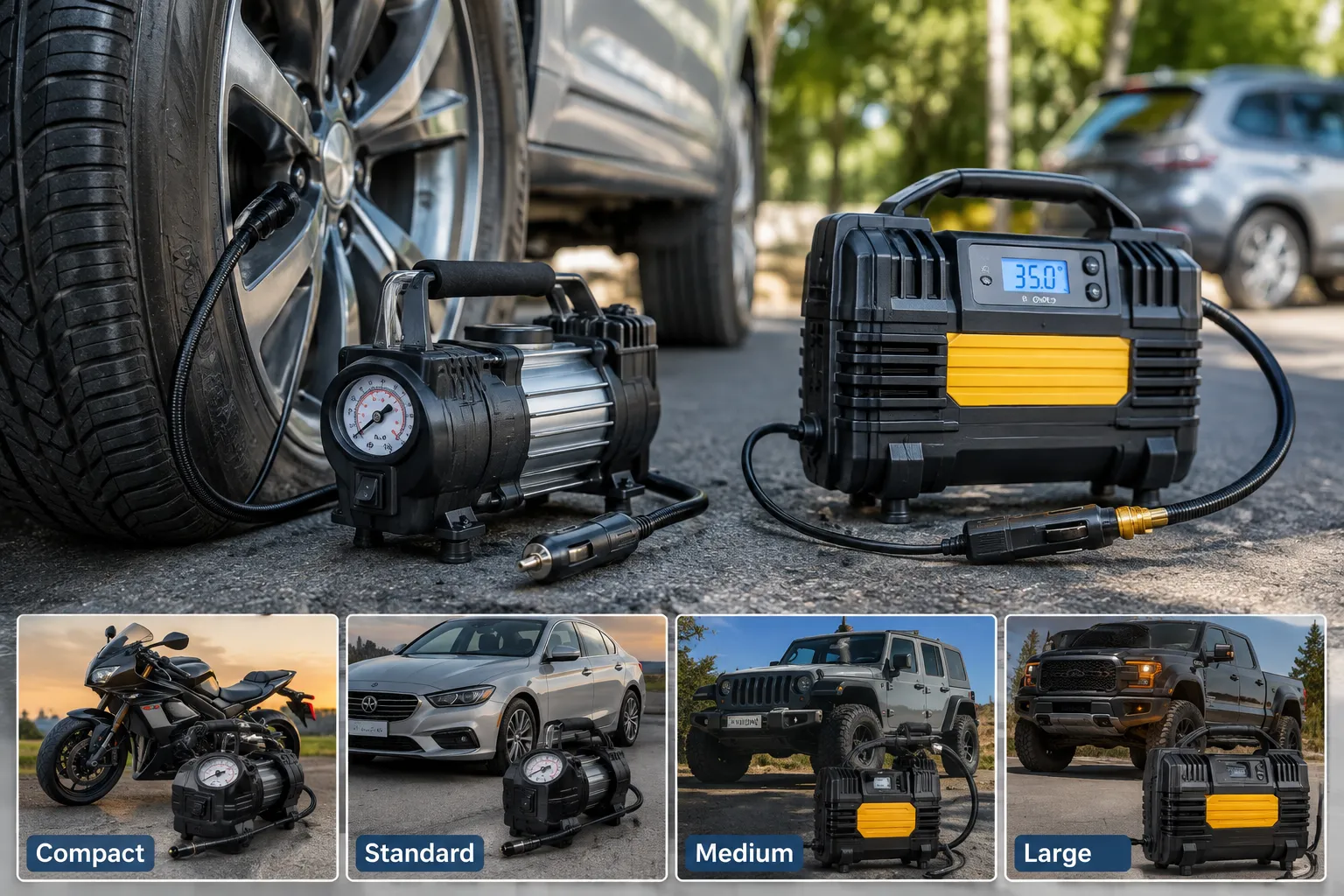
For most drivers, a 12V air compressor that delivers at least 1.0 to 2.0 CFM and can handle your tire’s target PSI is enough for top-offs and roadside use. If you run larger SUV, truck, or off-road tires, I’d look for higher airflow, a solid duty cycle, and battery-clamp power instead of a basic cigarette-lighter model.
If you’ve been asking, “what size 12v air compressor do i need,” the real answer depends on your tire size, how often you’ll use it, and how fast you want it to work. I’ll walk you through the numbers in plain English so you can choose a compressor that fits your vehicle and your needs.
I’ve seen a lot of people buy a compressor based only on PSI, then wonder why it inflates so slowly. The better way is to match PSI, CFM, duty cycle, and power source to the job you actually need it to do.
What “Size” Means When Choosing a 12V Air Compressor
CFM, PSI, duty cycle, and tank size explained
When people talk about compressor “size,” they usually mean output, not the physical box size. The main numbers are PSI and CFM. PSI tells you the maximum pressure the unit can reach, while CFM tells you how much air it can move over time.
Duty cycle matters too. That’s how long the compressor can run before it needs a break. A compressor with a short duty cycle may work fine for one tire top-off, but it can struggle if you’re airing up several large tires back to back.
Tank size is less common on portable 12V units, but some larger systems do use a small tank. A tank can help with short bursts of air, but for most portable inflators, the motor output matters more than the tank.
A compressor can show a high PSI rating and still be slow if its CFM is low. For tire inflation, airflow matters just as much as pressure.
Why 12V compressors are sized differently than shop compressors
Shop compressors plug into household power and can move a lot more air. A 12V compressor runs from your vehicle’s electrical system, so it has a smaller power budget. That’s why portable units are built for convenience, not nonstop heavy-duty shop work.
If you want a good reference point for tire pressure and vehicle recommendations, I like checking the vehicle maker’s own info first. For example, many manufacturers publish tire and maintenance guidance on their sites, and tire safety basics are also covered by the National Highway Traffic Safety Administration tire safety page.
What Size 12V Air Compressor Do I Need for My Use Case?
| Use case | What I’d look for | Why it fits |
|---|---|---|
| Car and motorcycle tires | About 1.0 CFM or more, 120 PSI, portable plug-in model | Good for top-offs and light roadside inflation |
| SUV and light truck tires | 1.5 to 2.0 CFM, better duty cycle, battery clamps preferred | Handles larger tire volume with less waiting |
| 33–35 inch off-road tires | 2.0 CFM or higher, strong duty cycle, direct battery connection | Better speed and less overheating |
| Small air tools or accessories | Higher-output portable compressor or onboard system | Most tiny inflators are not ideal for tools |
| Emergency roadside use | Compact, easy to store, simple controls | Fast access matters more than maximum output |
Top off car tires and motorcycle tires
For compact cars, sedans, and motorcycles, a smaller 12V compressor is usually fine. I’d aim for at least 1.0 CFM if you want reasonable speed, but even lower-output units can work if you only need occasional top-offs.
These jobs don’t need huge airflow because the tire volume is modest. If you’re only correcting pressure by a few PSI, a compact inflator can be a smart buy.
Inflate SUV and light truck tires
SUV and light truck tires hold more air, so a small compressor may feel slow. For this use, I’d look for something in the 1.5 to 2.0 CFM range, with a duty cycle that lets it keep going long enough to finish the job.
If you regularly drive with heavier loads or higher tire pressures, a stronger unit is worth it. It saves time and usually runs cooler.
Air up 33–35 inch off-road tires
For larger off-road tires, size matters a lot more. A basic cigarette-lighter inflator can work in a pinch, but it will often be slow. I’d look for a compressor with higher CFM, direct battery clamps, and a better cooling design.
Note: If you air down frequently on trails, a strong portable compressor becomes less of a luxury and more of a practical tool. That’s especially true if you need to refill multiple tires after every off-road trip.
Run small air tools or occasional inflation accessories
Most 12V compressors are not made to run air tools the way a shop compressor does. Some higher-output models can handle short bursts for light tasks, but I would not buy a small portable unit expecting it to power impact tools or long spray sessions.
For accessories like air mattresses, balls, or small inflatables, almost any decent 12V compressor will do. The main thing is having the right nozzle and enough runtime.
Emergency roadside use versus regular garage use
If the compressor is for emergencies, I’d prioritize compact size, simple setup, and reliable power connection. You want something you can grab fast and use at the shoulder of the road.
If you plan to use it in the garage every week, go bigger. A higher-output compressor is usually the better long-term choice because it saves time and handles repeated use more comfortably.
Do not assume every 12V compressor can handle a fully flat tire quickly. If the tire is very low, damaged, or leaking, inflation may be slow or unsafe. Check the tire for punctures before driving far.
How to Match Compressor Size to Tire Size and Inflation Needs
Check your tire size and target PSI
Start with the tire size on the sidewall and the recommended pressure on the driver’s door placard. That placard is the number I trust most for normal driving. It tells you the pressure the vehicle maker designed for your load and handling balance.
Estimate how much air volume your tires need
A tire that needs a 2 PSI top-off is a very different job from one that’s 15 PSI low. Bigger tires also take more time because they hold more air. That’s why the same compressor can feel fine on a sedan and frustrating on a lifted truck.
Choose a compressor with enough CFM at the pressure you need
Always check the CFM rating at a realistic pressure, not just the best-case number in the box. Some compressors look strong on paper but slow down a lot once pressure climbs.
Tip: If the product listing only gives a huge PSI number and barely mentions CFM, I’d be cautious. For tire inflation, CFM is usually the more useful number.
Factor in how fast you want inflation to be
Speed is personal. Some drivers don’t mind waiting a few minutes per tire. Others want to air up four tires after trail use without sitting around forever. If you value speed, move up one size class from the minimum.
Fast inflation usually means more heat and more power draw. That’s normal. It’s one reason many stronger 12V compressors use battery clamps instead of a lighter socket.
Minimum 12V Compressor Specs You Should Look For
PSI rating: how much is enough
For most passenger vehicles, a compressor rated to 100 to 120 PSI is enough. You do not need a massive PSI number just to inflate road tires. What matters more is whether the compressor can reach your target tire pressure without struggling.
CFM rating: the most important sizing number
If I had to pick one number to focus on, it would be CFM. Higher CFM usually means faster inflation, especially for larger tires. For small cars, about 1.0 CFM can be workable. For SUVs and trucks, I’d aim higher.
Duty cycle: how long it can run before overheating
Duty cycle is easy to overlook, but it matters a lot. A compressor with a 50% duty cycle may need rest periods during longer inflation jobs. If you’re airing up multiple tires, a better duty cycle can make the whole process smoother and safer.
Power draw and clamp-to-battery vs cigarette-lighter models
Cigarette-lighter models are convenient, but they’re usually limited in power. Battery-clamp compressors can draw more current, which often means better performance. If you want stronger output or plan to use the compressor often, clamps are usually the better choice.
You can also check product guidance from well-known manufacturers such as VIAIR portable air compressor specifications to compare real-world output and power connection styles.
Best 12V Air Compressor Size by Vehicle Type
Compact car and sedan recommendations
For a compact car or sedan, a small portable inflator is usually enough. I’d look for easy storage, a decent gauge, and enough power to top off tires without taking forever.
SUV and crossover recommendations
SUVs and crossovers benefit from a step up in output. A mid-range 12V compressor with better airflow and a longer run time will feel much more useful over time.
Half-ton and heavy-duty pickup recommendations
Pickups often need more compressor than people expect, especially if the tires are larger or the truck is used for towing. I’d lean toward a higher-output model with battery clamps and a stronger cooling setup.
Off-road and overland setup recommendations
For off-road use, I want a compressor that can handle repeated inflation without overheating too fast. That usually means better CFM, a solid duty cycle, and a package that is easy to mount or store with recovery gear.
RV, trailer, and dual-battery considerations
RVs and trailers can add more inflation work, and some setups have dual batteries or more flexible power options. If that sounds like your rig, I’d pay attention to cable length, current draw, and whether the compressor can run without stressing the vehicle’s electrical system.
Signs Your 12V Air Compressor Is Too Small
Slow inflation time
If it takes forever to add a few PSI, the compressor is probably undersized for your needs. Slow speed is one of the first signs you’ve outgrown a small unit.
Overheating or thermal shutoff
If the compressor gets very hot or shuts off to protect itself, that’s a clear clue it’s working too hard. A little warmth is normal. Frequent shutdowns are not.
Struggling to reach higher PSI
Some compressors can start fine but bog down as tire pressure rises. If it has trouble getting to your target PSI, it’s not a good match for the job.
Short duty cycle and frequent rest periods
If you keep having to stop and wait, the compressor is probably too small for repeated use. That becomes annoying fast when you have several tires to fill.
- Inflates your tires in a reasonable time
- Reaches target PSI without strain
- Stays within its duty cycle
- Feels easy to use on the road
- Takes too long for simple top-offs
- Shuts off from heat
- Needs long cooldown breaks
- Can’t keep up with your tire size
Pros and Cons of Smaller vs Larger 12V Air Compressors
Benefits of compact portable compressors
Compact compressors are easy to carry, store, and use in a hurry. They’re usually cheaper, lighter, and simple enough for everyday drivers who only need occasional tire top-offs.
Downsides of compact portable compressors
The tradeoff is speed and endurance. Smaller units may be slow on larger tires and may not love repeated use. They’re convenient, but they are not the best fit for heavy-duty jobs.
Benefits of higher-output compressors
Higher-output compressors save time and handle larger tires better. They’re a smarter choice if you air up often, drive off-road, tow, or want something that feels less strained during use.
Downsides of higher-output compressors
They cost more, take up more space, and often need battery clamps or a more permanent setup. They can also be louder and may pull more current from your vehicle.
- Buy for your largest tire, not your smallest one.
- Check the compressor’s CFM at a real working pressure, not just the headline PSI.
- Keep valve caps, a tire gauge, and a repair kit with the compressor.
- Test the unit before you need it on the roadside.
- Let the compressor cool if the housing gets very hot.
What Features Matter Most Besides Size?
Hose length and chuck type
A short hose can make inflation awkward, especially on larger vehicles. I also like a chuck that locks securely onto the valve stem so you’re not fighting air leaks while you work.
Built-in gauge accuracy
A gauge that’s easy to read and reasonably accurate saves time. If the gauge is hard to trust, you’ll end up checking pressure with a separate tool anyway.
Automatic shutoff and digital controls
Automatic shutoff is handy because it helps prevent overinflation. Digital controls can make it easier to set the target PSI and walk away while the compressor does the work.
Thermal protection and cooling design
A compressor that manages heat well is usually more reliable over time. Look for cooling features, venting, and a design that doesn’t trap heat around the motor.
Accessories, carrying case, and storage
The little things matter. A good case, extra nozzles, spare fuse, and a clean storage setup make the compressor easier to keep in the vehicle and easier to use when you need it.
Your tire keeps losing pressure after inflation, the compressor trips electrical fuses, or the tire sidewall looks damaged. A compressor can add air, but it cannot fix a leak or a tire safety problem.
The right 12V air compressor is the one that matches your tire size, target PSI, and how often you plan to use it. For small cars, a compact inflator is often enough. For SUVs, trucks, and off-road tires, I’d move up to a higher-CFM unit with better duty cycle and battery-clamp power.
FAQ: What Size 12V Air Compressor Do I Need?
Yes, many can, but it depends on the compressor and the tire size. A fully flat tire takes much longer than a simple top-off, and some small inflators may overheat or struggle. If the tire is very low, I’d check for damage first.
For tire inflation, CFM is usually more important. PSI tells you the maximum pressure the compressor can reach, but CFM tells you how quickly it can move air. That speed difference is what you really feel in use.
Cigarette-lighter plugs are fine for smaller inflators and light use. If you want more output, faster inflation, or better performance on larger tires, battery clamps are usually the better choice.
I’d usually aim for at least around 2.0 CFM, and more can be better if you air up often. The exact need depends on tire pressure, how much air you’re adding, and how fast you want the job done.
Not usually. A tank can help with short bursts, but most portable 12V inflators are designed to work without one. For tire inflation, a good motor and enough airflow matter more.
If it inflates slowly, overheats, shuts off often, or struggles to reach your target PSI, it’s probably too small for your needs. That’s especially true if you use larger tires or fill multiple tires in a row.
- Match the compressor to your tire size and how often you use it.
- CFM matters more than PSI for real inflation speed.
- Small cars can get by with compact inflators.
- SUVs, trucks, and off-road tires usually need more output and better duty cycle.
- Battery clamps are often better than cigarette-lighter plugs for stronger compressors.