
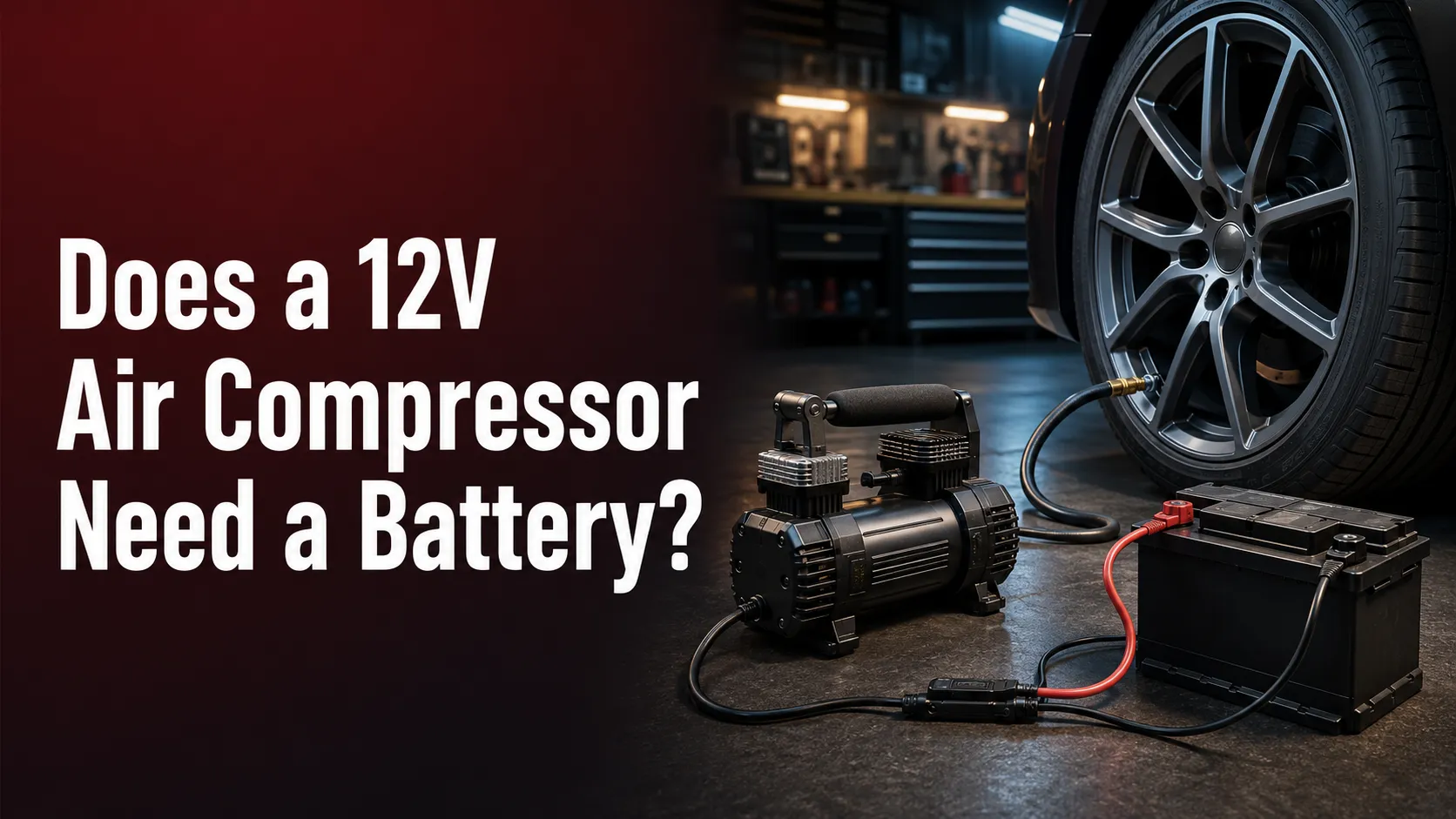
Does a 12V air compressor need a battery? It needs a suitable 12-volt DC power source, but it does not always need its own battery. A plug-in compressor can draw power from a compatible vehicle outlet. A clamp-style unit connects to the vehicle’s 12V battery, while a cordless model uses a built-in rechargeable battery.
The correct setup depends on the compressor’s connector, current draw, and instructions. It also depends on the limits of your vehicle’s electrical system. Matching those details is more important than the word “12V” printed on the box.
Why a 12V Compressor Needs Electrical Power
An air compressor uses an electric motor to move a piston or another pumping mechanism. The pump draws outside air, compresses it, and pushes it through the hose. A 12V model is designed for a nominal 12-volt DC supply rather than a household wall outlet.
The motor may draw substantial current while starting and working under pressure. That is why a thin adapter, weak socket, damaged plug, or undersized power source can become hot or fail. The compressor manual should state how it must be connected and whether the engine should run during use.
A power source also has to remain stable while the tire pressure rises. The motor works harder against increasing pressure, so a connection that seems adequate at first may show weakness later. Slow operation, dim vehicle lights, repeated shutdowns, or a warm plug can signal low voltage, excess resistance, or an overloaded circuit. Turn the compressor off before investigating these signs.
Does a 12V Air Compressor Need a Battery for Every Design?
| Compressor design | Usual power source | Separate battery needed? | Important check |
|---|---|---|---|
| 12V plug-in unit | Vehicle accessory outlet | No, if an approved outlet is available | Socket fuse/current limit and plug fit |
| Direct-clamp unit | Vehicle 12V battery | It uses the vehicle battery | Polarity, clamp condition, and connection order |
| Cordless inflator | Internal rechargeable pack | Yes, the compatible charged pack | Charge level, battery condition, and temperature |
| Dual-power model | Battery pack or 12V cord | Not always | Use only supported power methods |
| Portable power source | Regulated 12V DC outlet | The power source contains a battery | Outlet output must meet compressor demand |
Three Common Power Arrangements
1. Vehicle accessory outlet
This is the familiar plug often called a cigarette-lighter plug. It is convenient for normal passenger-car tire top-ups. Its main limitation is the outlet’s fuse and current rating. A high-draw compressor may require more current than the socket can provide.
2. Direct battery clamps
These units bypass the accessory socket and connect near the battery terminals. They are common on larger portable compressors. Correct polarity is essential: red normally connects to positive and black to the manufacturer-specified negative point.
3. Rechargeable battery
A cordless inflator stores power in its own pack. It can work away from the vehicle, but runtime and output may fall when the pack is low, cold, old, or overheated. Use only the battery and charger approved for that model.
Dual-power flexibility
Some models accept both a battery pack and a 12V cord. This provides a backup option, but the two modes may not perform identically. Follow the manual instead of combining or modifying power inputs.
How to Check Power Compatibility
Read the compressor label
Confirm that the input is 12V DC. Note its current or wattage requirement, connector type, recommended fuse, and any engine-running instruction.
Check the vehicle manual
Find the accessory-outlet section. Identify which socket may power accessories and its fuse, current, or wattage limit. Do not assume the front and cargo-area outlets have the same rating.
Match the connection
Use the plug or clamps supplied by the manufacturer. Do not substitute a light-duty extension, household adapter, or improvised connector.
Inspect before use
Look for cracked insulation, bent plug contacts, loose clamps, corrosion, damaged hoses, or a hot smell. Stop if any part appears unsafe.
Follow the operating sequence
Park safely, set the brake, and connect the hose securely. Apply power in the order given by the manual. Stay with the compressor while it runs.
Verify the final pressure
Use the cold-tire PSI on the driver-door placard or vehicle manual. Recheck with a dependable gauge and replace the valve cap.
Can It Drain the Car Battery?
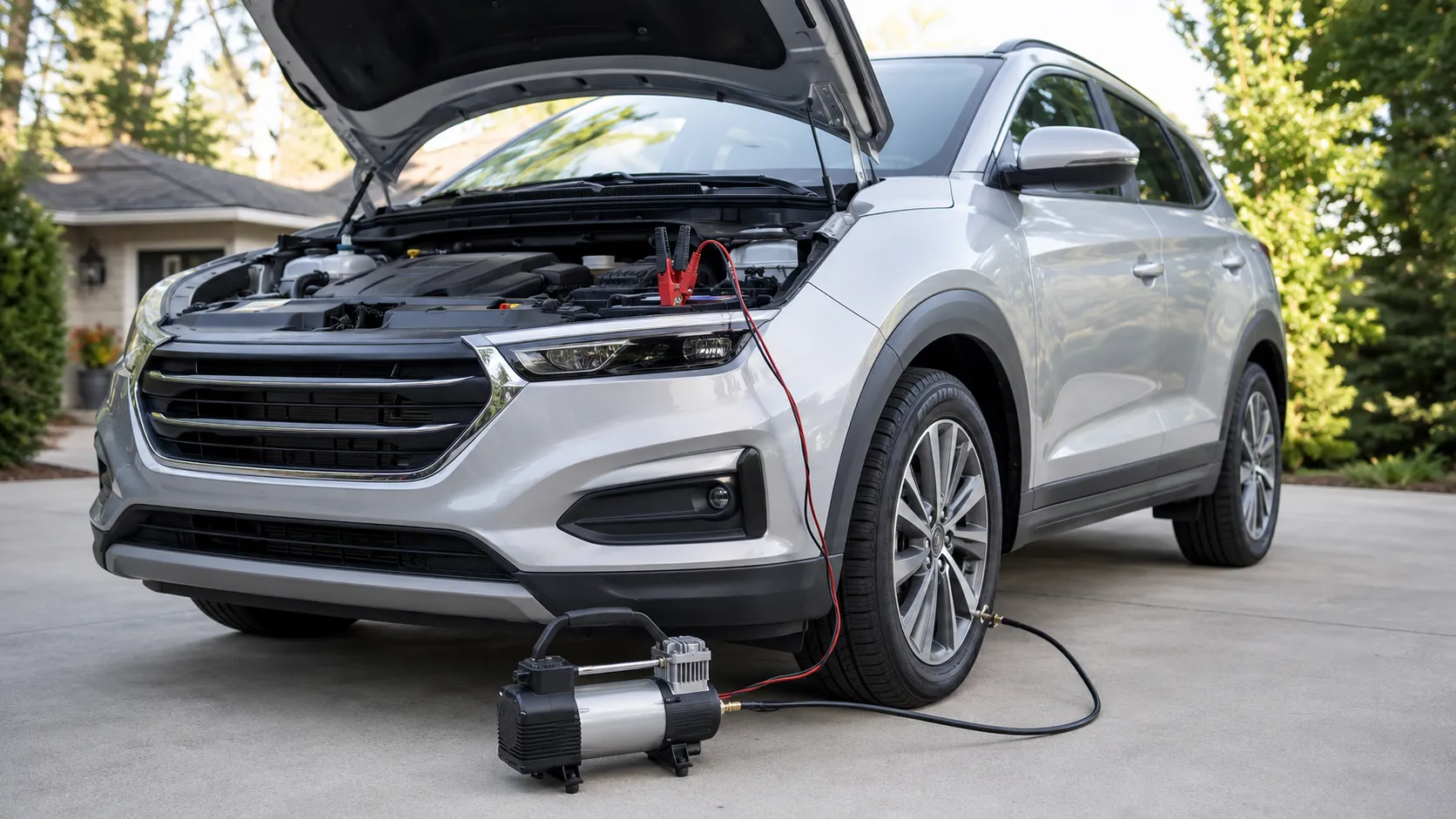
Yes. A compressor takes energy from the vehicle battery when it uses the outlet or battery clamps. A healthy battery may handle a short top-up, but extended operation with the engine off can reduce the energy available for starting. Risk rises with an old battery, cold weather, repeated inflation, or a large tire.
Some manufacturers instruct users to run the engine. Others specify a different sequence or warn against operation in enclosed spaces. Follow the exact compressor and vehicle instructions. Never run an engine inside a garage or another poorly ventilated area because exhaust gases can be deadly.
What About Hybrid and Electric Vehicles?
Hybrids and EVs still use a low-voltage system for many accessories, but their procedures differ by vehicle. Do not connect a portable compressor to the high-voltage traction battery or any orange high-voltage cable. Use only an approved 12V outlet or connection point described in the owner’s manual.
Some vehicles must be in a specific operating mode to support accessory loads. The low-voltage battery may also be located away from the engine compartment. If the manual does not clearly approve direct clamps, use the specified outlet or ask the vehicle manufacturer or a qualified technician.
The same caution applies to vehicles with start-stop systems and batteries that use special monitoring sensors. An unapproved clamp location can bypass the vehicle’s intended current path. Use the documented positive terminal and ground point when direct connection is permitted. Do not remove covers or reach near high-voltage equipment merely to obtain a shorter cable route.
Common Power Problems and Solutions
Nothing happens
Check whether the vehicle outlet is active, the plug is fully seated, and the compressor switch is on. Inspect the appropriate vehicle fuse only as the manual directs.
The fuse blows
Stop retrying. The compressor may exceed the socket limit, or the circuit may have a fault. Never install a larger fuse than the vehicle manufacturer specifies.
Motor slows or cuts out
The voltage may be low, the battery may be weak, or thermal protection may have activated. Turn the unit off and follow its cooling and restart instructions.
Plug or clamps get hot
Switch off and disconnect safely. Heat can indicate a loose, dirty, damaged, or overloaded connection. Do not continue until the cause is corrected.
Best Practices for Reliable Use
- Match the compressor’s input demand to the approved power source.
- Use only the supplied or manufacturer-approved cord, clamps, battery, and charger.
- Keep cords uncoiled, dry, and away from sharp, hot, or moving parts.
- Observe the compressor’s duty cycle and required cooling time.
- Inflate in a safe location away from moving traffic.
- Do not leave the compressor running unattended.
- Use the vehicle placard PSI for road tires, not the tire sidewall maximum.
- Repair a puncture or damaged tire properly; inflation alone is not a permanent fix.
Frequently Asked Questions
Can a 12V air compressor run without a battery?
It can run without its own battery if it receives suitable 12V DC power from an approved vehicle outlet, direct battery connection, or compatible regulated power source.
Can I plug a 12V compressor into any car outlet?
No. The outlet must support the compressor’s current or wattage demand. Check both manuals because socket ratings vary by vehicle and outlet position.
Should the engine run while using a 12V compressor?
Follow the compressor and vehicle instructions. Some models recommend a running engine, but never run an engine in an enclosed or poorly ventilated space.
Will a 12V compressor drain my car battery?
It can reduce battery charge, especially during long use with the engine off or when the battery is old, weak, or cold.
Can I connect a compressor directly to the car battery?
Only if the compressor is designed with battery clamps and the vehicle manual permits that connection. Follow the stated polarity and connection sequence.
Can I use a portable power station for a 12V compressor?
Only when its regulated 12V outlet can supply the compressor’s required current and starting load. Confirm compatibility in both product manuals.
Does a cordless air compressor need charging before every use?
Not necessarily, but checking and topping up its battery before a trip helps ensure enough power. Follow the maker’s charging and storage guidance.
Related Guides
Conclusion
So, does a 12V air compressor need a battery? It needs a correct 12V DC power source, but not necessarily a separate battery of its own. Outlet-powered models use the vehicle’s electrical supply. Clamp models use its low-voltage battery directly. Cordless models depend on their rechargeable pack.
The safest choice is the connection the manufacturer designed. Confirm voltage, current demand, connector type, outlet rating, and operating instructions before use. A properly matched power source helps the compressor run reliably without overstressing the vehicle circuit.
A “12V” label describes voltage, not universal compatibility. Match the compressor to an approved 12V power source, follow both manuals, and stop if the connection overheats or repeatedly blows a fuse.

6 thoughts on “Does a 12V Air Compressor Need a Battery?”