
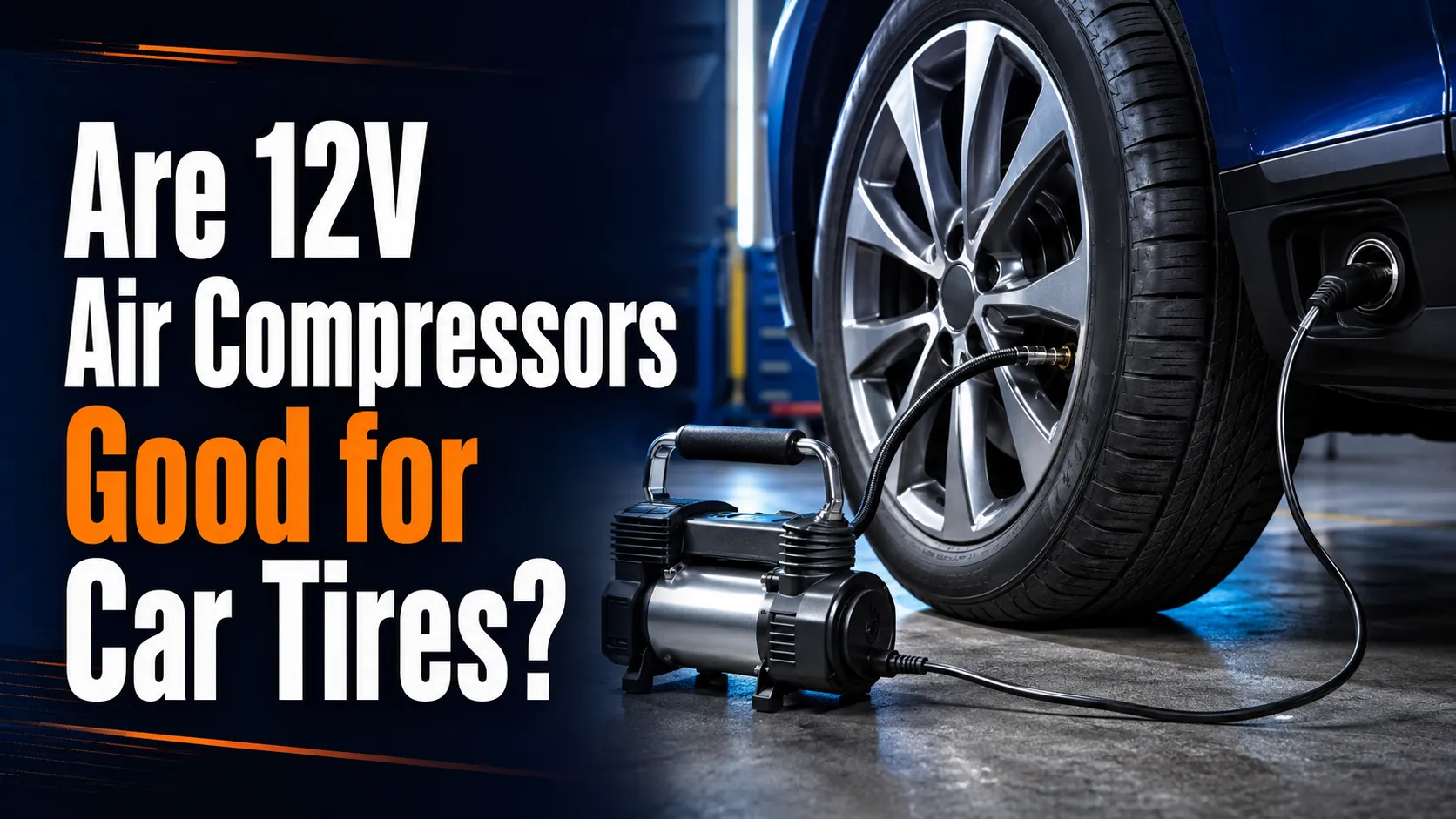
Are 12V air compressors good for car tires? Yes. The right 12V pump is a handy tool for tire top-ups and road use.
It draws power from a car outlet or battery link. It can work with no wall plug or charged tool pack. The best results come from matching the pump to the tire, power source, and job.
Are 12V air compressors good for car tires? Yes, most of all for car tires that need a small top-up. Choose a unit made for your tire size and car power source. Follow its duty cycle. Use the cold PSI on the door placard, not the top PSI marked on the tire wall.
Topping up a sound passenger-car tire that is a few PSI low.
A compatible 12V accessory outlet or direct battery clamps.
Small pumps may need cool-down breaks during long fill jobs.
A pump adds air. It does not fix a leak or tire damage.
Are 12V Air Compressors Good for Car Tires in Daily Use?
For most drivers, the answer is yes. A 12V pump can raise low tire pressure at home, in a parking lot, or on a trip. It is small enough for a trunk. It also uses a power source that is in the car.
These pumps work well for day-to-day pressure changes. A tire may read low on a cold day. It may also need a small top-up before a long drive. The pump can add air while you plan tire service.
The right model may fill a very low tire too. That job makes more heat and takes more time. A flat tire may have a hole, bad tire wall, or loose bead seal. Check it first.
“12V” tells you how the pump gets power. It does not tell you how fast it moves air. Top pressure, airflow, tire-size fit, and duty cycle are each key facts.
Why a 12V Compressor Works Well for Car Tires
A car tire holds air under force, but it may lose a small amount with time. Heat and cold can also change the reading. A small pump lets you reach the car maker’s target with no trip to an air station.
You do not need a wall outlet. Some models plug into the right car socket. Pumps that draw more power may use battery clamps.
Many 12V units fit beside other emergency gear. A storage case can protect the hose, gauge, cable, and accessories.
Many models have a gauge. Some let you set a target and stop on their own. Features vary, so check the manual.
Many small units are made for cars. Large SUV and truck tires need more air and may need a stronger pump.
A wired 12V pump also avoids one cordless-tool flaw: a dead tool battery. It can work as long as the car power source is a good match. The cable and hose must still reach all four tires.
Power needs vary by model. Never assume each 12V outlet can run each pump. Match the pump’s power draw to the car outlet rating. Check both manuals first.
Use the cold PSI on the driver-door placard or in the owner’s manual. NHTSA says the number on the tire wall is not the normal target for the car. Read the NHTSA TireWise guide for more tire-care tips.
When a 12V Compressor Is a Good Match
The right match depends on the tire volume, target pressure, starting pressure, and expected use. A small sedan tire is usually an easier job than a large light-truck tire. Filling one tire by a few PSI is also easier than filling several nearly empty tires.
| Vehicle or Task | How Well It Fits | What to Confirm |
|---|---|---|
| Passenger-car top-up | Usually a strong fit | Tire support, gauge, cable reach, and outlet rating |
| Compact spare tire | Often a good fit | Its own PSI target and the pump’s working range |
| Crossover or small SUV | Can be a good fit | Supported tire size, airflow, and cooling breaks |
| Large SUV or pickup | Model-dependent | Heavy-duty use, tire size, duty cycle, and power link |
| Several low tires | Possible with limits | Total run time and required cooling period |
| Damaged or rapidly leaking tire | Not a safe solution | Professional tire inspection and repair |
A high max-PSI claim does not prove a fast fill. It only shows a pressure limit under set terms. Airflow and duty cycle show how well the pump may work on a large tire.
Duty cycle sets the run and rest time. It can change with pump load and pressure. VIAIR’s compressor FAQ shows why duty cycle matters. Use the limits in your own manual.
Choose for your hardest normal task, not just the top PSI claim. For a large SUV or truck, check tire-size fit, airflow, cable reach, and duty cycle.
What to Check Before Using One
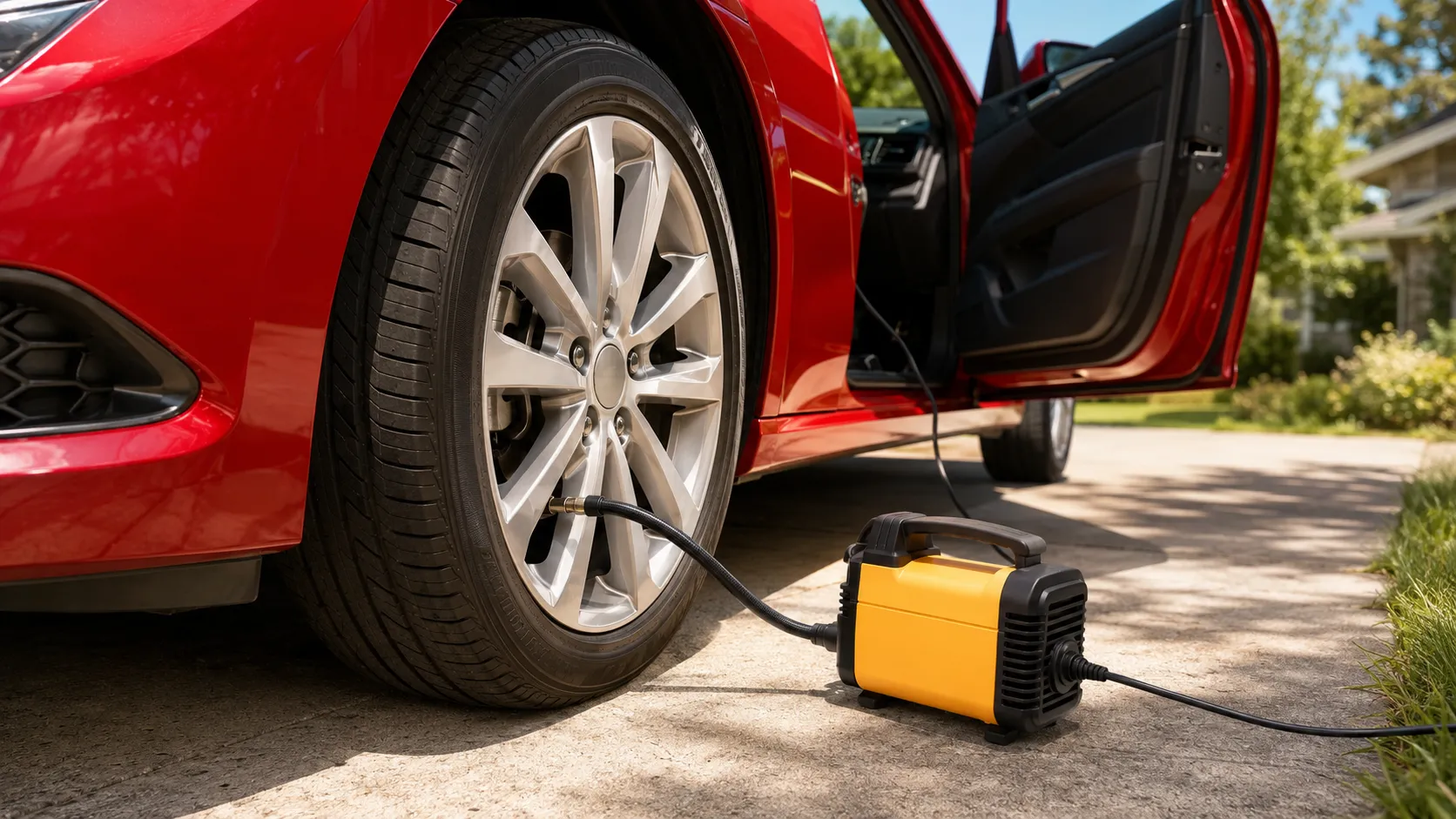
A short check can stop a loose plug, blown fuse, or wrong PSI target. Keep the pump off while you set it up, unless its manual says more.
- Vehicle tire-pressure placard
- Compressor instruction manual
- Compatible 12V power source
- Sound cord and air hose
- Valve chuck that fits securely
- Reliable separate tire gauge
- Safe, stable parking location
- Required cooling time
Check the pump’s plug, fuse, power draw, and link type. Then check the car outlet’s limits. Some pumps must link right to a battery. Do not add an adapter or larger fuse to force a bad match to work.
Read the manual for engine steps. Some brands call for the engine to run while the pump works. Other brands may not. Never run an engine in a closed garage or a space with poor air flow. Car exhaust can kill.
Do not use the pump on a tire with a bulge, bare cord, deep cut, split tire wall, bad bead, or bent wheel. Stop if the tire shifts shape, leaks fast, or will not hold air. Ask a tire shop to check it.
How to Inflate a Car Tire with a 12V Compressor
These steps cover a common small pump. Your pump and car manuals come first. Plug types, switches, and engine steps can vary.
-
Park in a Safe Place
Use firm, level ground away from moving traffic. Apply the parking brake. Use hazard lights when roadside conditions call for them.
-
Find the Correct Pressure
Read the driver-door placard or owner’s manual. Note the cold target for the correct tire position. Front and rear values may differ.
-
Inspect the Tire and Equipment
Look for tire, wheel, valve, cable, plug, clamp, and hose damage. Stop if anything appears unsafe.
-
Connect the Power
Use the right outlet or battery link. Follow the set order. Keep cords far from belts, fans, hot parts, and sharp edges.
-
Attach the Air Hose
Remove the valve cap. Secure the chuck without bending the valve stem. If air keeps hissing, switch off and reconnect it.
-
Start and Watch the Compressor
Stay beside the unit. Watch the gauge, hose, tire shape, sound, and temperature. Keep all air vents clear.
-
Stop at the Target
Use auto shutoff if the pump has it, but keep watch. Stop by hand if the PSI gets too high or the pump acts in an odd way.
-
Verify and Store
Check pressure after airflow stops. Disconnect carefully because fittings may be hot. Replace the valve cap and let the unit cool before storage.
Check the cord, plug, fuse, clamps, hose, chuck, and gauge before trips. Keep the air port clean. Store the cool pump in a dry case where bags cannot crush it.
12V Compressor vs. Other Tire Inflators
No one pump type is best for all drivers. A 12V unit draws steady power from the car. A cordless unit has no cord in use. A shop pump can do more work but is hard to move.
| Inflator Type | Best Use | Main Advantage | Main Limitation |
|---|---|---|---|
| 12V portable compressor | Travel and roadside tire care | Uses car power | Cord reach and power limits |
| Cordless inflator | Fast top-ups around the car | No power cable during use | Battery must remain charged |
| Dual-power inflator | Drivers who want a backup source | More power options | Extra cost, size, or complexity |
| Garage air compressor | Frequent shop or home use | More air flow on the right models | Large and not roadside-friendly |
A 12V unit is a simple pick for a driver who wants a pump in the trunk. A cordless unit may feel quick and neat. A pump with battery clamps may suit large tires better than a small plug-in model. The specs still set the real fit.
Common Problems and Safe First Checks
Start with safe checks. Do not open the pump, bypass its fuse, change the car wires, or block a heat guard.
Switch it off. Check the plug or clamp link and the right fuse. Stop if the wires, outlet, or battery look bad.
Turn the pump off and reseat the chuck. Check the hose and valve for a leak. Seek service if the tire loses air quickly.
Heat protection or a power issue may be involved. Let it cool for the full stated period. Check the manual before restarting.
Stop the pump and let the gauge settle. Fit the hose once more. Check the result with a sound hand gauge.
Switch off and unplug it when safe. Do not use a hot, melted, loose, or dark plug.
The tread, valve, bead, wheel, or tire may have a fault. Ask a tire shop to check it. Do not keep adding air.
Stop for smoke, sparks, a burnt smell, melted parts, hard shakes, odd noise, high heat, or more blown fuses. Unplug it only when safe. Call the brand or a trained repair shop.
Best Practices for Reliable Tire Inflation
- Check pressure when the tires are cold when possible.
- Use the placard value for the correct tire position.
- Make sure the power source can run the pump.
- Uncoil the cord and hose as the manual directs.
- Keep the pump dry and its vents open.
- Stay with the unit for the full fill.
- Follow each run-time and cool-down limit.
- Verify the final pressure after airflow stops.
- Recheck a tire that was unusually low.
- Seek tire service when pressure loss continues.
Cold tire PSI gives the best match with the placard. A drive warms the tire and may raise the gauge reading. If you add air on a trip, follow the car maker’s guide. Check it once more when cold.
Frequently Asked Questions
Can a 12V air compressor inflate a completely flat car tire?
The right model may add air, but a flat tire can have a hole, loose bead seal, or hidden harm. Check it first. Seek tire service if it was driven flat, looks bad, or will not hold air.
Will a 12V air compressor drain my car battery?
It draws power and can drain a car battery on a long run. Follow the pump and car manuals for the right link and engine steps. Never run the engine in a closed space or one with poor air flow.
Can I plug any air compressor into my car’s 12V outlet?
No. The pump’s volts and power draw must match the outlet rating. Some strong units need battery clamps. Check both manuals. Never fit a larger fuse to force a bad match.
Are 12V air compressors suitable for SUV and truck tires?
Some are, but large tires hold more air and can need long pump runs. Check the tire-size fit, airflow, duty cycle, target PSI, cord reach, and power link first.
How long can a 12V air compressor run continuously?
There is no universal run time. Every model has its own duty cycle and cooling period. Follow the manual and stop sooner for extreme heat, smoke, odor, melting, or unusual operation.
Should I use the PSI shown on the tire sidewall?
No, not as the normal car target. Use the cold PSI on the driver-door placard or in the owner’s manual. The PSI on the tire wall has a different use.
Can a 12V compressor fix a slow tire leak?
No. It can add lost air for a short time, but it cannot fix a hole, valve leak, bead leak, bent wheel, or harm in the tire. Air loss that comes back needs a tire shop check.
Related Guides
Conclusion: Are 12V Air Compressors Good for Car Tires?
Are 12V air compressors good for car tires? Yes. The right model is a great tool for top-ups, trips, and road needs. It uses car power and fits in many trunks.
Match the pump to your tire size and power source. Check cold PSI on the car placard. Follow the duty cycle and stay by the pump. Check the last gauge reading. If a tire looks bad or keeps losing air, stop and call a tire shop.
A 12V compressor is a strong tire tool when it fits the tire, outlet, and job. Use it to set the right PSI—not to hide a leak or make a bad tire safe.