
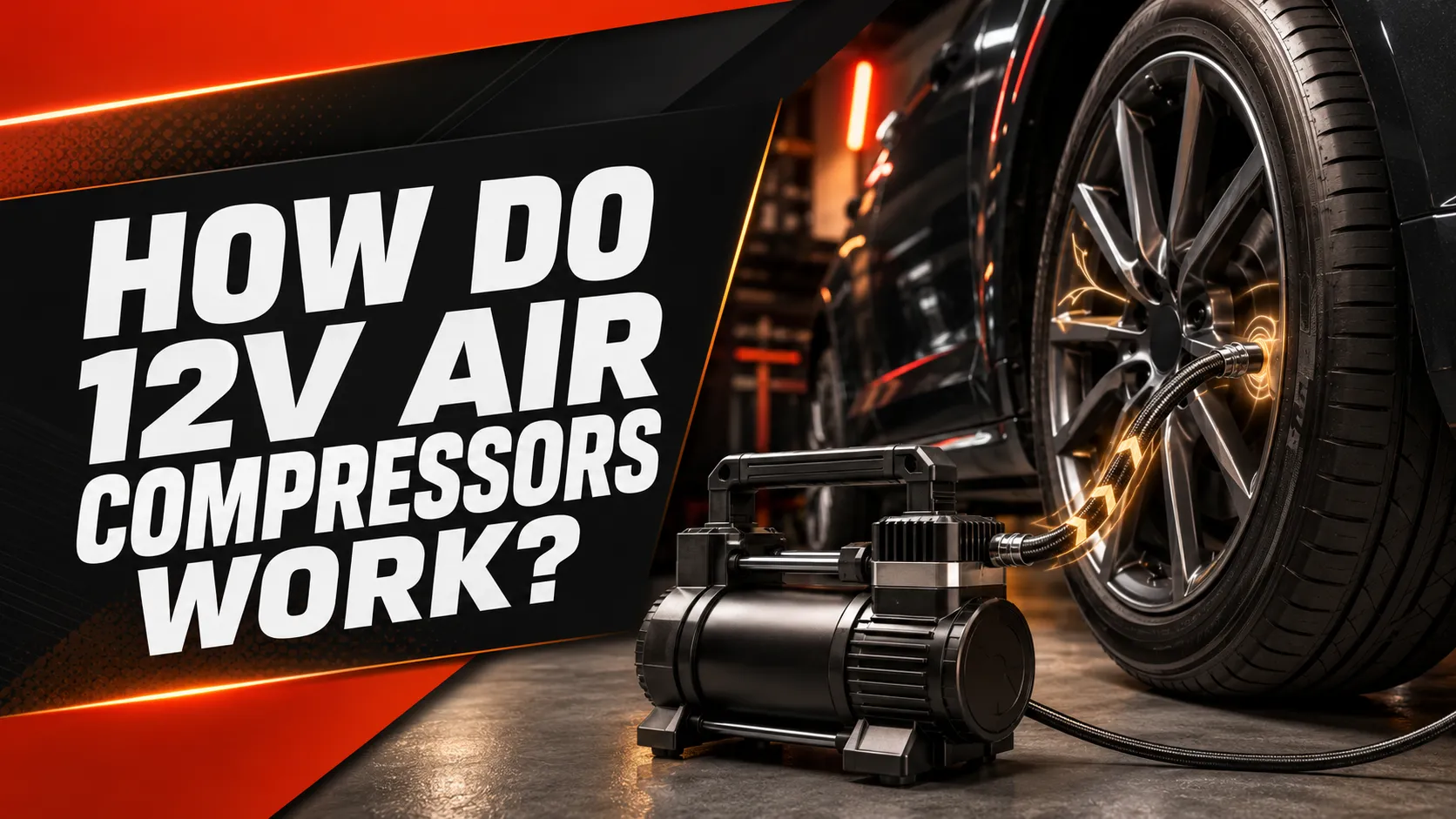
How do 12V air compressors work? They use power from your car to run a small motor and air pump.
The pump pulls in air and squeezes it. A hose then sends that air into the tire. The built-in gauge shows the tire pressure as the unit runs.
Most models use a car outlet or battery clamps. They do not need a charged tool battery. This makes them useful for tire care at home or on the road.
How do 12V air compressors work? Power flows from the car to a DC motor. The motor moves a piston inside a small pump. The pump draws in air and presses it into the hose. One-way valves keep the air moving toward the tire. You stop the unit at the right pressure. Some digital models stop on their own.
The label tells you what powers the unit. It does not tell you its fill speed.
A small piston puts air into less space. This raises the air pressure.
Small units may use a car outlet. Stronger units often use battery clamps.
Many small pumps cannot run for long periods. Check the stated duty cycle.
What Is a 12V Air Compressor?
A 12V air compressor is a small electric air pump. It runs from a car’s 12-volt power system. Most units plug into a car outlet. Some connect to the battery with clamps.
The unit does not make new air. It pulls in the air around it. It then puts that air under pressure. The hose carries the air to the tire valve.
Voltage shows the power source. PSI shows air pressure. Airflow shows how much air the pump can move. A high PSI number does not always mean a fast fill.
How Do 12V Air Compressors Work Inside?
The basic process is simple. Car power turns the motor. The motor drives the pump. The pump moves air into the tire.
Parts can differ by model. Yet most small 12V units use the same main parts.
The cord brings power from the car. The fuse helps guard the circuit.
The motor turns electric power into movement. That movement runs the pump.
The piston moves back and forth. It pulls in air and then squeezes it.
One valve lets air enter. The other sends it toward the hose.
This part checks pressure. A screen or dial shows the reading.
The hose moves the air. The chuck locks onto the tire valve.
-
Power reaches the motor
You connect the plug or clamps and switch on the unit. Current then flows to the motor. A plug-in model uses the car outlet and its fuse. A clamp model draws power from the car battery.
-
The motor turns a crank
The DC motor starts to spin. A crank changes this spin into a back-and-forth motion. That motion drives the piston.
-
The pump pulls in air
The piston moves down and makes more room in the cylinder. The inlet valve opens. Air from outside then enters the pump.
-
The piston squeezes the air
The piston moves back up. The space inside the cylinder gets smaller. Air pressure rises, and the outlet valve opens.
-
Air moves through the hose
The pressed air enters the hose. It then passes through the chuck and tire valve. The pump keeps adding air while it runs.
-
The gauge shows pressure
The gauge checks pressure in the air path. The number may jump while air flows. Stop the pump for a steadier reading.
-
The pump stops at the target
You may stop a basic unit by hand. Some digital units stop at a set PSI. Check the final result with a good tire gauge.
Test the unit at home before a long trip. Make sure the cord reaches every tire. Check that the chuck seals well. Also confirm that the plug or clamps match your car.

Car Outlet or Battery Clamps?
The power connection often hints at the unit’s power needs. Small pumps often use a car outlet. Larger portable pumps may draw more current. They often connect right to the battery.
| Connection | How It Gets Power | Main Benefit | What to Check |
|---|---|---|---|
| 12V car plug | Uses the car’s fused outlet | Fast and easy setup | Outlet amps, fuse size, and cord reach |
| Battery clamps | Connects to battery posts | Works with higher-draw units | Correct poles, firm clamps, and inline fuse |
| Hardwired unit | Uses a fixed power line | Good for an onboard air setup | Safe wiring, fuse, mount, and airflow |
Use the power link named in the product guide. Check the unit’s amp draw. Compare it with your car manual. Keep cords away from belts, fans, sharp edges, and hot parts. Never fit a larger fuse to stop a fuse from blowing.
What Controls Fill Speed?
The 12V label does not show how fast a pump will work. It also does not prove that the pump fits every tire. These points have a bigger effect.
| Spec | What It Means | Why It Matters |
|---|---|---|
| Maximum PSI | The top pressure claimed for the unit | It must cover your tire’s needs |
| Airflow | How much air moves in a set time | More flow can fill a large tire faster |
| Duty cycle | How long the unit can run and rest | It tells you when a cool-down is due |
| Current draw | How many amps the motor needs | It must suit the outlet or battery link |
| Cord and hose reach | The full reach from power to valve | Both must reach all four tires safely |
| Tire size | The tire sizes listed by the maker | Large tires need more air and run time |
Truck and SUV tires hold more air than many car tires. A tiny pump may reach the needed PSI. Yet it may take too long or get too hot. Check the tire sizes listed by the maker.
Use the cold tire pressure on the door placard or in the car manual. Do not use the sidewall number as your normal target. NHTSA TireWise shows where to find the right pressure.
How to Use a 12V Air Compressor Safely
- Read the car guide and the product guide.
- Find the cold PSI on the door placard.
- Check the tire, wheel, valve, hose, and cord.
- Make sure the unit supports your tire size.
- Check the power link and maximum run time.
- Park on firm ground, away from traffic.
-
Find the right PSI
Read the pressure shown on the car placard. The front and rear tires may use different values. The spare may also need more air.
-
Check the tire
Look for a split, bulge, exposed cord, or bent wheel. Do not add air to a tire with clear damage. Get tire service instead.
-
Place the pump safely
Set it on firm, flat ground. Keep its air vents open. Keep the hose and cord away from hot or moving car parts.
-
Connect the power
Use the plug or clamps as shown in the guide. Check the clamp poles before you switch on the unit. Follow the guide on engine use.
-
Lock on the chuck
Remove the valve cap. Fit the chuck without bending the valve. If you hear a leak, switch off the pump and fit it again.
-
Watch the pump
Stay with the unit as it runs. Watch the gauge, hose, cord, and tire. Stop at the run-time limit and let the pump cool.
-
Stop and check
Turn off the pump at the target PSI. Let the gauge settle. Check the tire again with a separate gauge.
-
Cool and store
Remove the chuck and replace the valve cap. Let hot parts cool. Then coil the cord and hose without tight bends.
Stop for smoke, sparks, a burnt smell, melted wire, harsh shakes, or odd sounds. Also stop if the tire starts to change shape. Move away from a tire with a new bulge or deep crack. Ask a trained tire shop for help.
12V, Cordless, and 120V Units Compared
| Type | Power Source | Best Use | Main Limit |
|---|---|---|---|
| 12V portable unit | Car outlet or clamps | Road trips and tire top-ups | Needs a car power link |
| Cordless inflator | Tool battery | Fast use with no long cord | The battery can run flat |
| 120V portable unit | Home wall outlet | Home and garage tire care | Needs an AC power outlet |
| Tank air compressor | AC power and air tank | Shop work and some air tools | Large, heavy, and hard to carry |
Most small 12V units are tire pumps. They are not shop air systems. They often lack the steady airflow that air tools need.
Why Does a 12V Compressor Get Hot?
The motor makes heat as it works. The piston and cylinder also get warm. Pressed air adds more heat. A small case has little room for that heat to leave.
This is why the duty cycle matters. It tells you how long the pump can run. It may also state a cool-down time. There is no safe run time that fits every model.
Keep the air vents clear. Check the cord and hose before each use. Let the pump cool before you pack it. Do not add oil unless the product guide tells you to do so.
Common Problems and Quick Checks
The outlet may be off. The plug may be loose. A fuse may be blown. Heat control may also stop the motor.
The unit may draw too many amps. It may also have a fault. Do not fit a larger fuse.
Check for a loose chuck, bad hose, blocked inlet, or tire leak. Stop if the tire looks damaged.
The pump may be hot. Supply power may be low. Let it cool and follow the product guide.
Readings can move while air flows. Stop the pump. Let the number settle, then check it again.
The tire or valve may leak. Adding more air is not a repair. Ask a tire shop to inspect it.
Fuses and heat cutoffs guard the pump and car wires. If a safety part trips more than once, stop using the unit. Find the cause before you try again.
Basic Care and Storage
- Check the plug, clamps, wire, hose, and chuck.
- Keep air vents clean and open.
- Let the unit cool before you store it.
- Keep the cord and hose free of sharp bends.
- Store the pump in a clean, dry place.
- Test it before a long road trip.
Stop using a unit with split wire, melted parts, or loose power links. A bad gauge also needs care. Have the unit checked before its next use.
Frequently Asked Questions
Does a 12V air compressor need the car engine running?
It depends on the car and pump guides. Some brands tell you to run the engine for steady power. Others tell you to keep it off during setup. Follow both guides. Use the pump outdoors, and never run a car in a closed garage.
Can I plug any 12V compressor into my car’s outlet?
No. Check the pump’s voltage and amp needs. They must fit the outlet and fuse limits in the car manual. A pump with a high amp draw may need battery clamps.
Why does a 12V compressor need a fuse?
A fuse helps guard the wires and pump when too much current flows. Use only the fuse type and size named by the maker. Never fit a larger fuse or bypass it.
Can a 12V air compressor inflate a flat tire?
Some models can add air to a flat tire. First check for a split, bulge, bad valve, or broken bead seal. Get tire service if the tire was driven flat, looks damaged, or will not hold air.
How long can a 12V air compressor run?
There is no single safe time for every model. Check the stated duty cycle and cool-down time. Stop sooner if you notice high heat, smoke, a bad smell, or an odd sound.
Can a 12V compressor run air tools?
Most small tire pumps cannot run air tools. They do not move enough air for long tool use. Use the pump only for jobs listed by its maker.
Should I use the PSI shown on the tire sidewall?
Use the cold tire pressure on the car placard or in the car manual. The sidewall number is not the normal pressure set by the car maker.
Related Guides
Conclusion: How Do 12V Air Compressors Work?
How do 12V air compressors work? Car power runs a DC motor. The motor moves a piston, and the piston presses air into a hose. The hose then sends the air into your tire.
Choose a unit that fits your car and tire size. Check its amp draw, airflow, cord reach, and duty cycle. Use the cold PSI on the car placard. Stay with the pump while it runs.
A 12V air compressor is a useful tire care tool. Yet the 12V label alone does not prove a good fit. Check the plug, amp draw, tire size, airflow, and run time before use. Treat repeat air loss as a tire fault, not a pump problem.

1 thought on “How Do 12V Air Compressors Work? Simple Driver’s Guide”