
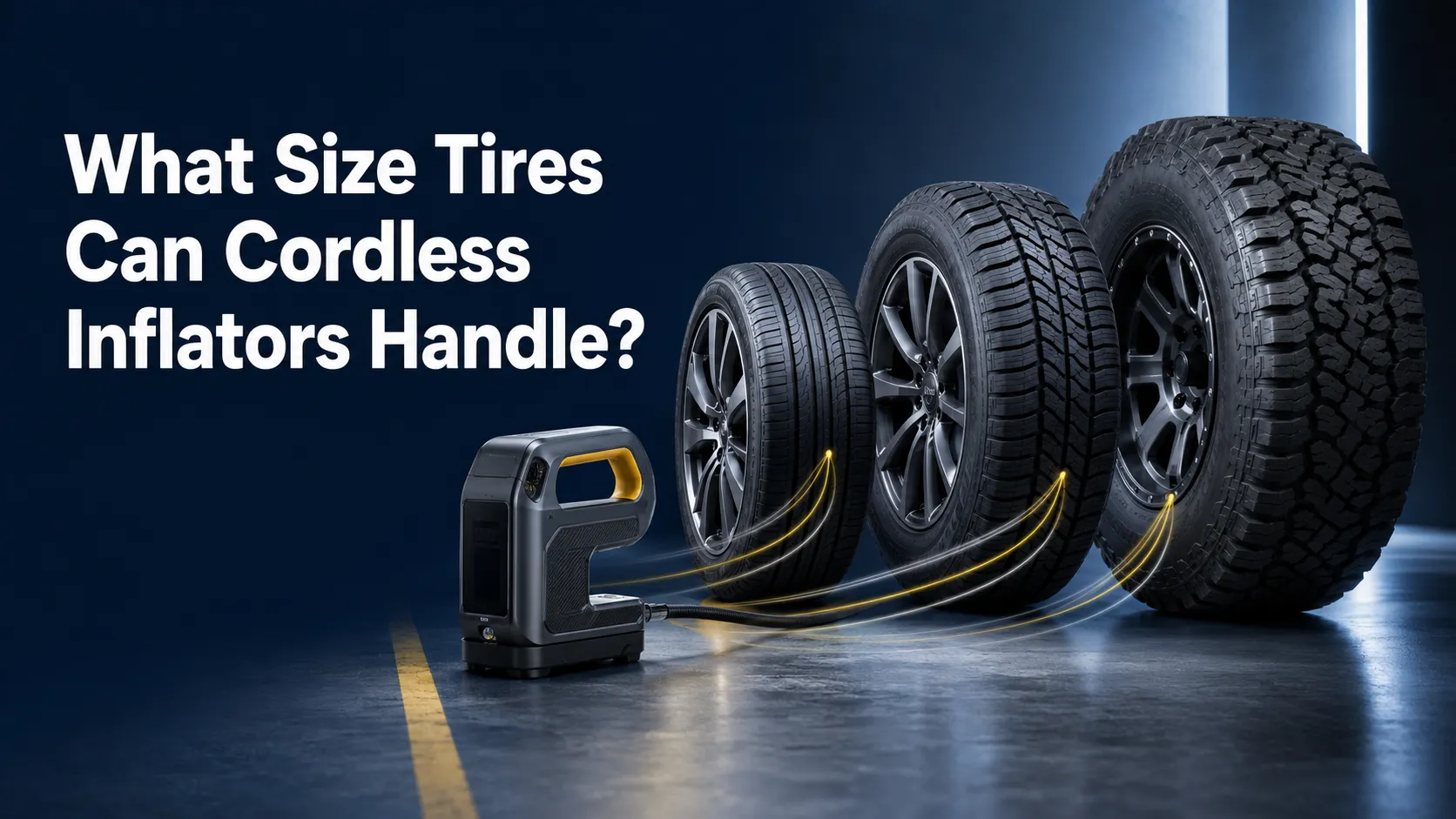
What size tires can cordless inflators handle? Most compact models are intended for passenger-car tires, crossovers, bicycles, and similar routine top-ups. Some higher-output cordless inflators also support standard SUVs and light-duty pickup tires, but the manufacturer’s stated tire class, airflow, duty cycle, battery, and starting pressure determine the real limit.
Important LimitA high maximum-PSI claim does not prove that a compact inflator can fill a large truck or off-road tire efficiently. Pressure capability and air-delivery capacity are different specifications.
A typical cordless inflator can usually top up passenger-car and crossover tires, while stronger models may handle many standard SUV and light-truck tires. Large LT, flotation, off-road, RV, trailer, agricultural, or commercial tires require explicit manufacturer approval. Never choose by rim diameter alone: a 20-inch low-profile car tire may contain less air than a 17-inch tall-sidewall truck tire. Check the tool manual for supported tire type, maximum tire dimensions, duty cycle, airflow, and whether the stated performance applies to topping up or filling from flat.
What Size Tires Can Cordless Inflators Handle in Real Use?
There is no universal tire-size limit for cordless inflators. A small handheld unit and a larger tool-platform inflator may both display a high maximum pressure, yet move very different amounts of air. The compact unit may be convenient for a sedan tire that is a few PSI low, while the larger pump may be better suited to a pickup tire or repeated inflation work.
For ordinary drivers, the safest starting assumption is that a compact cordless model is a pressure-adjustment tool for the applications named in its manual. Passenger-car tires are commonly within scope. Crossovers and many regular SUVs may also be suitable. Pickup and larger off-road tires need closer checking because their greater internal volume can extend run time, increase heat, and consume more battery charge.
“Can reach 150 PSI” and “can fill a large truck tire” are not equivalent claims. Maximum pressure describes the upper pressure the system is designed to produce or display. It does not tell you how quickly the pump moves air, how long it may run, or how much battery energy is available.
Why Tire Diameter Alone Can Be Misleading
Drivers often describe a tire as 16-inch, 18-inch, or 20-inch, but that number normally identifies the wheel diameter in the tire-size code. It does not identify the complete tire volume. Two tires made for the same wheel can have different widths, aspect ratios, load constructions, and overall diameters.
For example, a low-profile performance tire on a large wheel may have a shorter sidewall and less internal air volume than a taller SUV tire fitted to a smaller wheel. This is why a universal statement such as “every cordless inflator handles tires up to 20 inches” is incomplete unless the manufacturer defines exactly what it means.
Overall Tire Volume
A taller, wider tire generally needs more air than a smaller, narrower tire. More air usually means a longer run and greater battery demand.
Starting Pressure
Correcting a tire from slightly low is easier than filling one from nearly empty. A flat tire may also have damage that must be inspected first.
Target Pressure
The vehicle placard supplies the correct cold target for road tires. Higher pressure requires the pump to work against greater resistance.
Airflow Rate
Airflow indicates how much air the pump can deliver under stated conditions. Compare figures only when units and test conditions match.
Duty Cycle
The duty cycle limits continuous operating time and sets the required cooling period. Larger fills may need more than one cycle.
Battery Capacity
Battery voltage, capacity, state of charge, temperature, and age can affect how long the inflator performs under load.
Practical Compatibility by Tire Type
The table below is a decision guide, not a substitute for the inflator manual. “Often suitable” means many products in the category may perform the task when the tire is sound and only needs air. It does not mean every cordless model is approved for every tire listed.
| Tire or Vehicle Type | General Suitability | What to Verify |
|---|---|---|
| Road bicycle | Often suitable with the correct valve adapter and supported pressure | Presta/Schrader compatibility, low-volume control, and gauge range |
| Mountain bike, stroller, or utility cart | Often suitable | Correct adapter and low-pressure accuracy |
| Passenger car | Common intended use | Supported tire size, target PSI, run time, and battery charge |
| Crossover or compact SUV | Often suitable for routine top-ups | Actual tire dimensions, inflation time, and duty cycle |
| Standard SUV or light-duty pickup | Model-dependent | Explicit manufacturer support, airflow, battery capacity, and cooling period |
| Large LT or off-road tire | Specialized high-output model may be required | LT/flotation approval, overall diameter, width, duty cycle, and fill-time documentation |
| RV, trailer, agricultural, or commercial tire | Do not assume compatibility | Manufacturer approval for the tire class, pressure, volume, valve, and service conditions |
The correct everyday target is normally the cold pressure on the driver-side door placard or in the owner’s manual—not the maximum number molded into the tire sidewall. NHTSA’s tire guidance recommends checking tires cold and using the vehicle manufacturer’s specified pressure.
How to Check Whether Your Inflator Fits Your Tires
Use a compatibility check before relying on an inflator for a road trip or emergency. Product advertising may emphasize maximum PSI, so the manual and technical documentation are more useful for discovering the intended application and operating limits.
-
Read the Full Tire-Size Code
Record the code from the sidewall, such as the width, aspect ratio, construction, and wheel diameter. For LT or flotation tires, record the complete marking rather than only the rim size.
-
Find the Correct Cold Pressure
Check the vehicle’s tire placard and owner’s manual for the correct tire position and loading condition. Front, rear, spare, and fully loaded pressures may differ.
-
Check the Inflator’s Intended Applications
Look for clear support for passenger cars, SUVs, pickups, bicycles, or other tire classes. If your tire type is not named, ask the manufacturer instead of assuming.
-
Review Airflow and Performance Notes
If an inflation time is published, confirm the exact tire size, starting pressure, target pressure, battery, and temperature used. A time measured for a small car tire does not predict a large truck tire accurately.
-
Compare the Duty Cycle With the Job
Check maximum continuous run time and required cooling time. If the expected fill exceeds one operating cycle, confirm that the manufacturer permits staged inflation for that tire.
-
Confirm Battery Readiness
Use the specified, undamaged battery and charger. A low, cold, overheated, aged, or undersized battery may reduce performance or trigger an early shutdown.
-
Test at Home Before Depending on It
On a sound, slightly low tire, time a supervised top-up and observe heat, battery use, connection quality, and final gauge accuracy. Stop if the tool exceeds its limits or behaves abnormally.
Evaluate the hardest realistic task, not the easiest one. If your vehicle has large tires, test one normal top-up at home, then check how much charge remains and how warm the tool becomes. This gives you a more useful readiness check than reading maximum PSI on the package.
Top-Up Versus Filling a Nearly Empty Tire
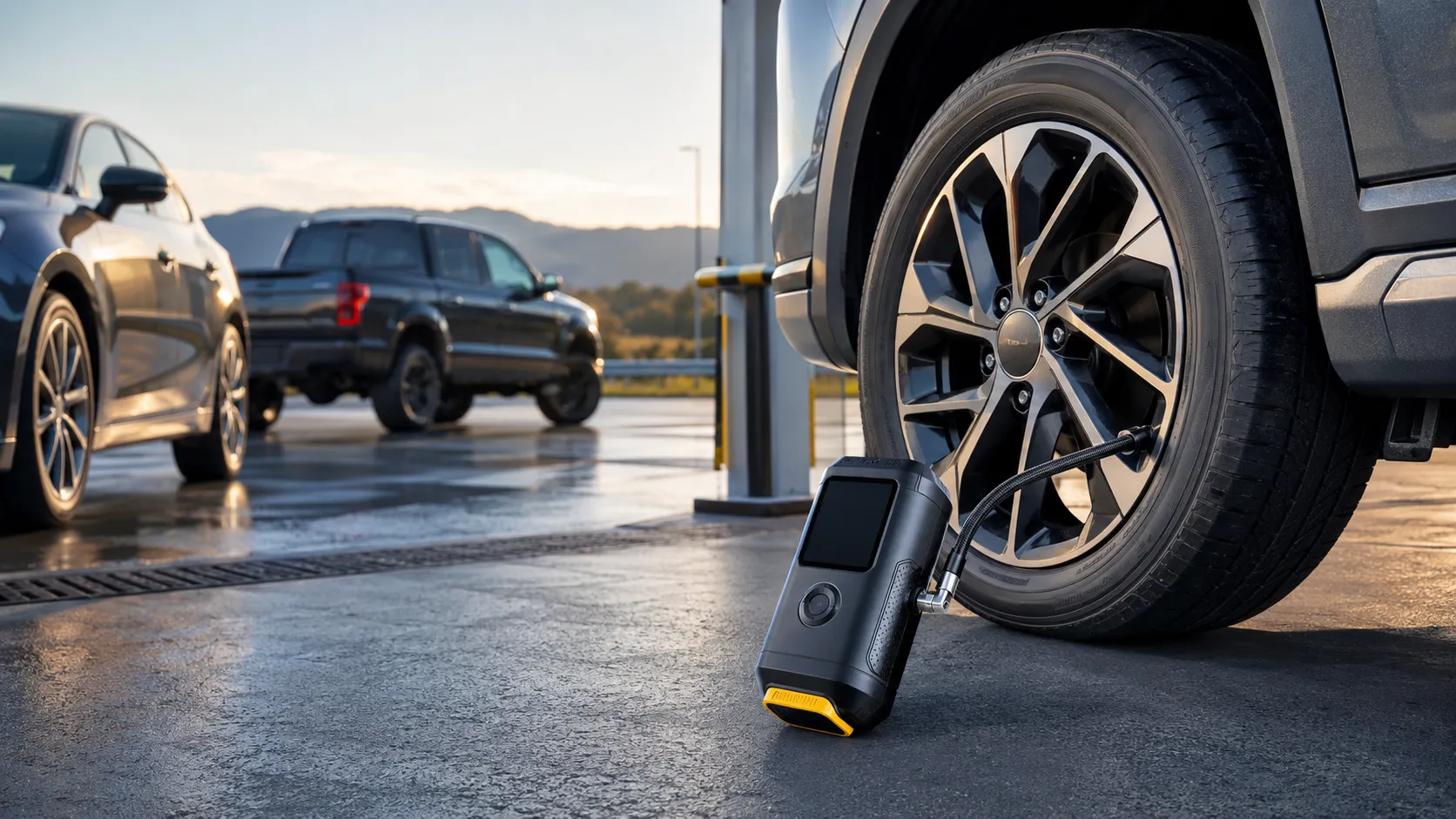
A tire that is three or four PSI below its target contains most of its normal air. The inflator only replaces a relatively small amount. A nearly empty tire requires much more air, a longer run, and more battery energy. This difference explains why a compact inflator may handle weekly pressure corrections well but struggle with a large tire from flat.
A completely flat tire also creates a safety question. It may have a puncture, sidewall damage, a broken bead seal, valve damage, or internal injury from being driven without pressure. Adding air cannot prove the tire is roadworthy or repair the cause of air loss.
Do not inflate a tire with a bulge, split, exposed cord, badly damaged valve, deformed wheel, or other visible structural damage. Stop if the tire changes shape, cracks, will not hold air, or makes unusual noises. A tire driven while fully or severely flat should be inspected by a qualified tire technician before normal driving.
Signs the Tire Is Too Demanding for the Inflator
Very Slow Pressure Gain
Confirm the hose is sealed and the tire is not leaking. If pressure still rises extremely slowly, the tire volume may exceed the pump’s practical capacity.
Repeated Thermal Shutdown
Allow the full cooling period. Repeated shutdown on a supported, undamaged setup may indicate that the task is too demanding or the unit needs service.
Battery Empties Early
A large fill can consume substantial energy. Recharge only as directed and do not substitute an unapproved battery or bypass battery protection.
Unstable Hose or Connector
Stop and reseat the connector. Do not force a fitting that does not match the tire valve or continue while air leaks steadily.
Pressure Stops Increasing
The pump may be at its practical limit, the battery may be weak, or the tire may have a significant leak. Do not continue beyond the manual’s limit.
Excess Heat, Odor, or Noise
Switch off immediately for smoke, sparks, melting, a burning smell, severe vibration, or unusual mechanical noise. Do not use a damaged tool or battery.
Keep the hose, valve connector, vents, battery contacts, and storage case clean and dry as directed by the manual. Periodically compare the settled inflator reading with a dependable tire gauge. Let the pump cool before storage, and never charge a swollen, leaking, cracked, or unusually hot battery.
Best Practices for Large Tires
- Choose an inflator whose manufacturer explicitly names your tire class or dimensions.
- Use the full tire code and overall dimensions, not only wheel diameter.
- Start with a fully charged, approved, undamaged battery.
- Keep ventilation openings clear and place the unit on a stable surface.
- Stay with the inflator and follow every run-time and cooling instruction.
- Check the settled pressure with a reliable gauge after airflow stops.
- Do not use the sidewall maximum as the vehicle’s normal target pressure.
- Do not treat repeated top-ups as a repair for a puncture, valve leak, wheel issue, or bead leak.
- Use professional tire or roadside service when the tire is damaged, will not hold air, or exceeds the tool’s supported application.
Frequently Asked Questions
Can a cordless inflator handle 20-inch tires?
Possibly, but 20 inches usually describes the wheel diameter, not total tire volume. Check the complete tire size, target pressure, and the inflator manufacturer’s supported applications, airflow, and duty cycle.
Can a cordless inflator fill SUV tires?
Many cordless inflators can top up crossover and standard SUV tires, but capability varies. Confirm the exact tire dimensions, starting pressure, battery requirement, run-time limit, and manufacturer approval.
Can a cordless inflator fill pickup-truck tires?
Some higher-output models can handle standard light-duty pickup tires. Large LT or off-road tires may require a specialized inflator, so use one that explicitly supports the tire class and size.
Does maximum PSI tell me the largest tire an inflator can handle?
No. Maximum PSI does not show air-delivery speed, duty cycle, battery endurance, or supported tire volume. Review the complete specifications and intended applications.
Can a small cordless inflator fill a completely flat tire?
It may add air if the manufacturer supports the tire, but a completely flat tire may be damaged or leaking. Inspect it first, follow the run-time limit, and seek tire service if it was driven flat or will not hold pressure.
Can the same cordless inflator handle car and bicycle tires?
Often yes, if it includes the correct valve adapter and supports both the car tire’s air volume and the bicycle tire’s pressure range. Use careful control on low-volume bicycle tires.
Why does a large tire take longer to inflate?
A larger tire generally requires more air. Starting from a lower pressure also increases the amount of work, which extends run time, creates more heat, and uses more battery energy.
Related Guides
Conclusion: What Size Tires Can Cordless Inflators Handle?
What size tires can cordless inflators handle? Most compact units are practical for routine top-ups on passenger cars, crossovers, bicycles, and similar tires. Selected higher-output models may also support standard SUVs and light-duty pickups. Large off-road, LT, RV, trailer, agricultural, or commercial tires should only be attempted when the manufacturer explicitly approves the tire class, dimensions, pressure, and operating conditions.
Do not rely on wheel diameter or maximum PSI by itself. Compare the full tire size, starting pressure, target cold pressure, airflow, battery, duty cycle, and documented inflation performance. If the tool becomes excessively hot, repeatedly shuts down, cannot raise pressure, or the tire will not hold air, stop and use an appropriate higher-capacity inflator or qualified tire service.
The right cordless inflator is the one whose manufacturer supports your complete tire type and size—not merely its wheel diameter. For dependable roadside use, confirm compatibility in the manual, test a supervised top-up at home, respect the duty cycle, and remember that an inflator adds air but cannot make a damaged tire safe.