
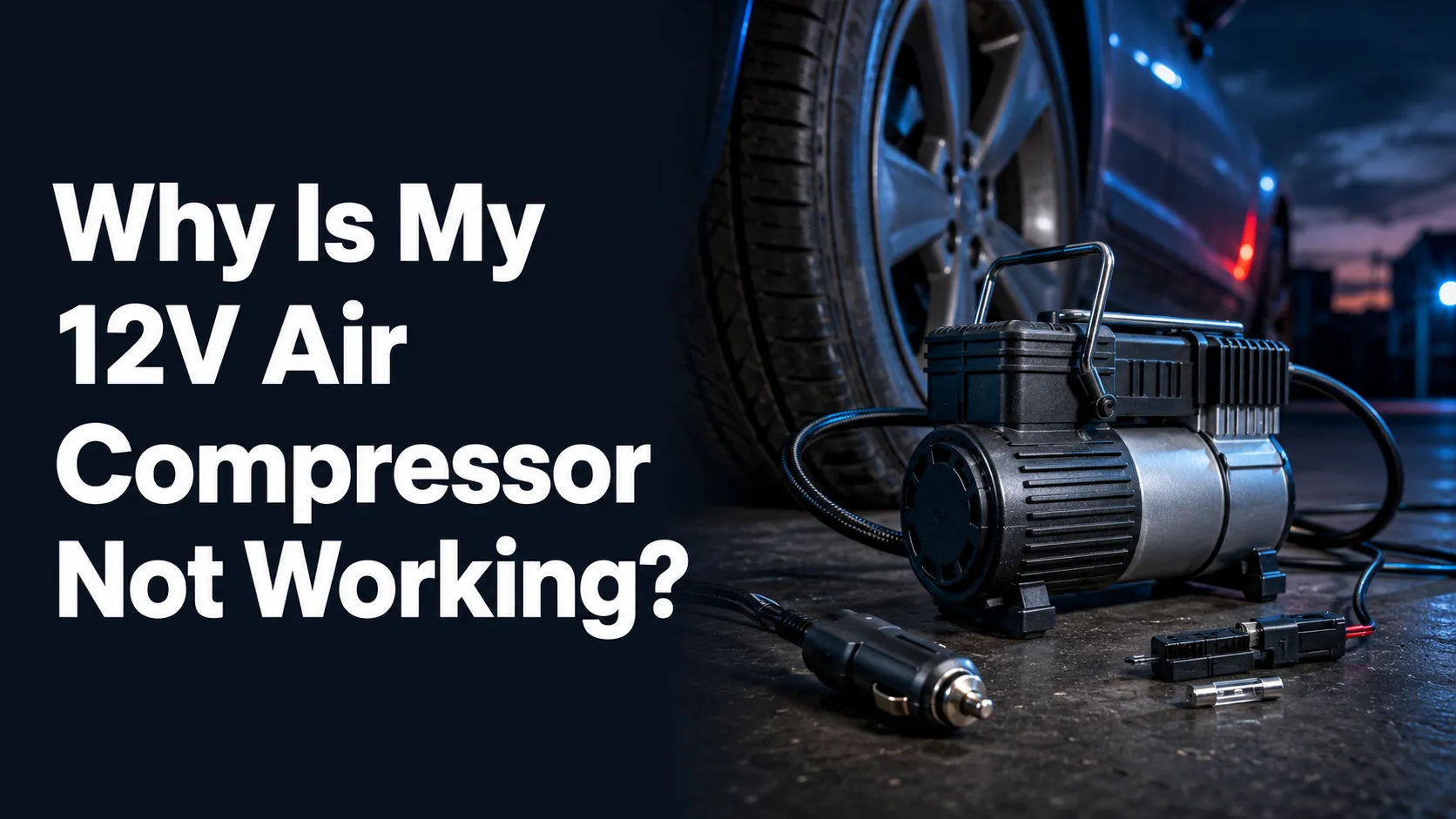
If you are asking, “Why is my 12V air compressor not working?” start with the power source, fuse, plug, cable, and heat protection. A dead outlet or poor connection is often easier to correct than an internal motor fault.
Diagnostic RuleTest one part of the power path at a time. Never bypass a fuse, install a higher-rated fuse, or open an energized or sealed compressor housing.
Why Is My 12V Air Compressor Not Working?
The cause depends on what the compressor does when you switch it on. A completely silent unit points first toward the power path. A motor that starts and stops may indicate low voltage, overheating, a poor connection, or excessive load. A motor that runs normally without raising tire pressure points toward the chuck, hose, valve, or internal pump.
Begin with the manuals for the compressor and vehicle. Confirm the required power connection, outlet current limit, ignition position, run time, cool-down time, compatible tire size, and user-serviceable fuse. Model-specific instructions take priority over general troubleshooting.
What the Symptom Usually Means
| Symptom | Likely area to inspect | First safe action |
|---|---|---|
| No light, sound, or movement | Outlet, ignition position, fuse, plug, cable, or switch | Disconnect it and verify the power source |
| Clicks or starts briefly | Low voltage, loose contact, heat protection, or excessive load | Stop, cool it, and inspect the connection |
| Motor runs but tire does not fill | Chuck seal, valve, hose leak, adapter, or pump | Reconnect the chuck squarely and listen for leaks |
| Inflation is unusually slow | Leak, blocked vent, low supply voltage, high tire load, or wear | Compare conditions with the manual’s limits |
| Fuse opens repeatedly | Short circuit, seized motor, damaged lead, or overloaded circuit | Stop using the compressor and seek approved service |
9-Step 12V Air Compressor Troubleshooting Routine
Move to a safe location
Park away from traffic on firm, level ground, apply the parking brake, and use hazard lights when appropriate. Do not diagnose electrical equipment while exposed to moving traffic.
Switch off and inspect
Unplug the compressor. Check the housing, lead, plug or clamps, hose, and chuck for cuts, crushing, corrosion, looseness, melting, or exposed wire. Physical or heat damage is a stop-use condition.
Confirm the correct power source
Check whether the unit needs an accessory socket or direct battery connection. Confirm the circuit’s voltage and current capacity. Do not use an adapter or extension unless the compressor maker approves it.
Check the ignition requirement
Some vehicle outlets are live only with the ignition in ACC or ON. Follow the vehicle manual. Never run a gasoline engine in a garage or other enclosed area to support compressor operation.
Verify that the outlet works
Use the vehicle’s prescribed check or a known compatible low-power accessory. A nonworking outlet shifts attention to its circuit fuse or vehicle electrical system, not automatically to the compressor.
Inspect accessible fuses
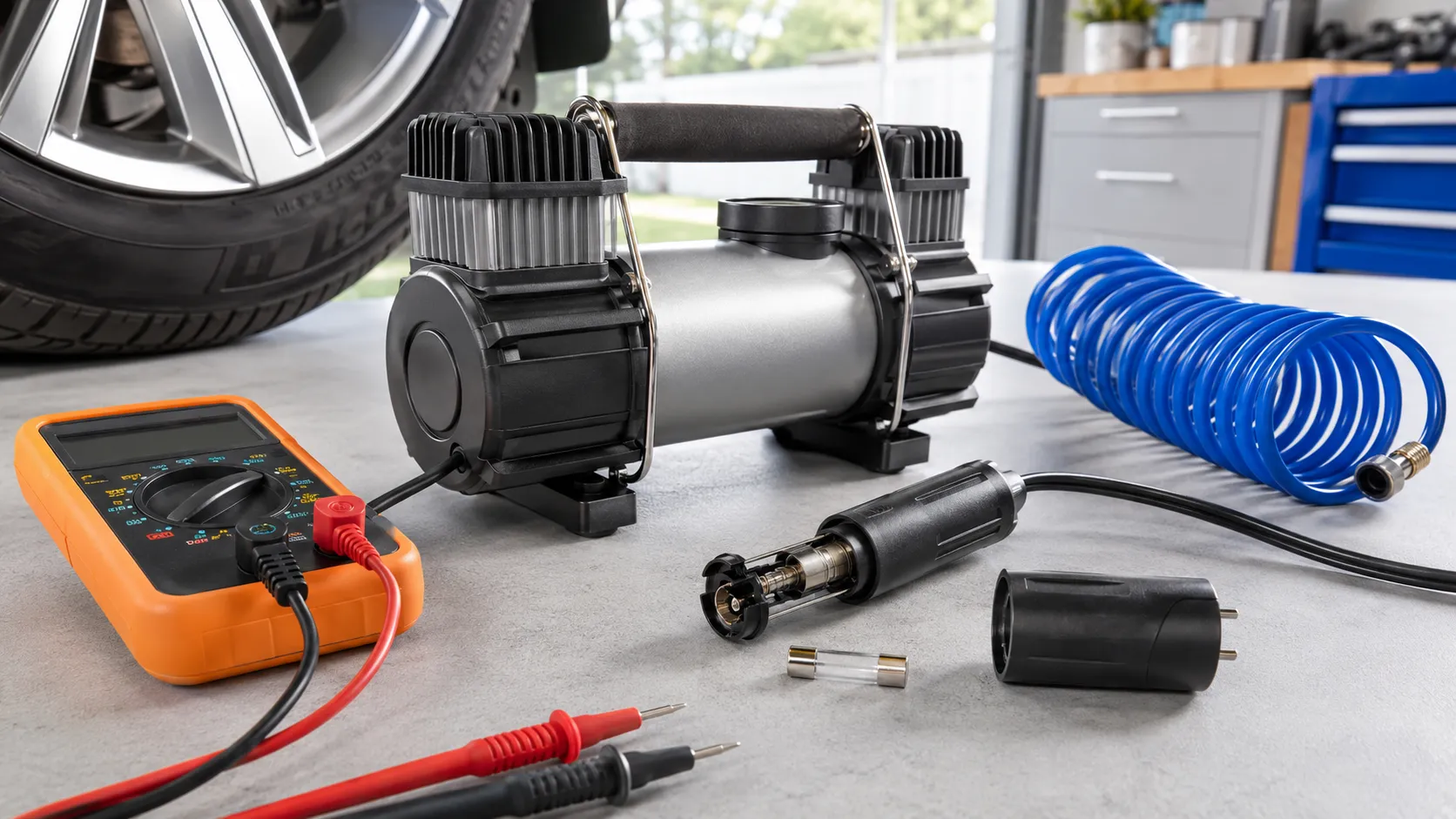
Locate the vehicle outlet fuse from the owner’s manual and any user-serviceable compressor fuse from its manual. Replace only with the specified size, type, and rating. Never bridge a fuse with foil or wire.
Allow a complete cool-down
If the unit stopped during use, switch it off and wait for the exact cool-down period. Keep vents uncovered. Repeated thermal shutdown suggests excessive run time, poor airflow, a leak, heavy load, or a fault.
Reconnect the air chuck
Attach it straight and fully to the tire valve. Listen for continuous escaping air. Inspect the hose and fitting externally, but keep liquids away from the motor and electrical parts.
Perform one controlled test
Operate the compressor only as the manuals permit and watch its sound, gauge, cord, plug, and hose. Stop if it strains, heats rapidly, smells unusual, or still fails to build pressure.
When to Stop Troubleshooting
| When | What to check | Why it matters |
|---|---|---|
| Before every use | Cord, plug or clamps, hose, chuck, vents, and correct power source | Find visible damage before the motor starts |
| After every use | Cooling, exterior cleaning, loose coiling, dryness, and accessory count | Prevents heat and storage damage |
| Monthly if carried in the vehicle | Case moisture, cargo damage, connector corrosion, and cable kinks | Vehicle storage can expose it to vibration and temperature swings |
| Before a long trip | Brief functional test, gauge comparison, reach to all tires, fuse and adapters | Confirms the complete setup works before an emergency |
| After unusual operation | Hot plug, odor, sparks, repeated shutdown, slow motor, or air leaks | These symptoms may require service rather than routine cleaning |
This is a practical general schedule, not a replacement for the manufacturer’s intervals. A compressor used weekly on work vehicles needs more frequent checks than one kept only for emergencies.
Why the Compressor Starts and Then Stops
Every compressor has a limit on continuous operation. The manual may state a duty cycle, a maximum run time, a required cool-down period, or all three. The exact numbers vary, so do not copy the schedule from another model.
Place the compressor on a stable surface with open space around its vents. Keep it away from dry grass, loose fabric, standing water, and traffic. Do not place it inside a closed bag while running. If the motor slows, the housing becomes excessively hot, or thermal protection stops the unit, switch it off and follow the cooling instructions.
Check the Plug, Fuse, and Power Cable
Electrical maintenance should remain non-invasive unless the manual identifies a user-serviceable part. Keep the plug clean and dry. Do not sand plated contacts aggressively or spray liquid cleaner into the connector. A plug that fits loosely in the vehicle outlet can create resistance and heat.
Some compressors have a replaceable fuse inside the plug or an inline holder. Others use internal protection. If replacement is permitted, match the exact amperage, voltage class, physical size, and fuse type listed for that model. Never install a higher-rated fuse simply because the original keeps opening.
Confirm that the compressor’s current demand does not exceed the vehicle outlet’s rating. If the model uses battery clamps, follow the prescribed connection order and approved under-hood connection points. Hybrid and electric vehicles may have special low-voltage procedures, so the vehicle manual is essential.
When It Runs but Does Not Build Pressure
Keep it dry
Store the compressor only after it has cooled and dried. Moisture can corrode contacts, fittings, fasteners, and internal components.
Prevent crushing
Place the case where luggage, tools, or cargo cannot flatten the hose, crack the gauge, or force a sharp bend into the cable.
Avoid extreme heat
A parked vehicle can become very hot. Follow the product’s storage-temperature limits and inspect the unit more often when it lives in a trunk.
Keep the kit complete
Store the gauge, adapters, manual, gloves, flashlight, and approved spare fuse in one organized kit.
If the compressor has a built-in rechargeable backup battery, battery care adds another layer. Use the specified charger, follow the storage-charge guidance, and inspect the battery for swelling, leakage, damage, or unusual heat. Do not treat a rechargeable model exactly like a cord-only unit.
Common 12V Compressor Problems and Solutions
Compressor runs hotter than before
Check for blocked vents, an excessive run time, poor airflow, a leaking connection, or an unsuitable workload. Stop and cool it. Seek service if the change continues.
Pressure reading seems wrong
Compare it with a dependable gauge on a cold tire. Inspect the chuck for a poor seal. Follow the maker’s calibration or service guidance if the error remains.
Air leaks at the valve
Reconnect the chuck squarely and check its seal or locking mechanism. Replace only approved seals or hose assemblies.
Motor sounds strained
Stop rather than forcing it. High tire pressure, low supply voltage, overheating, a restricted intake, or internal wear can load the motor.
Plug becomes hot
Disconnect it. Inspect for a loose socket, dirty contact, damaged plug, or excessive current. Do not continue until the cause is resolved.
Unit will not start
Check the required ignition position, outlet rating, accessible fuse, switch, cable, and thermal reset instructions. Do not disassemble sealed components.
Safe Troubleshooting Rules
- Set the parking brake and remain clear of traffic.
- Use the cold-tire PSI on the driver-door placard, not the tire sidewall maximum.
- Start or stop the vehicle engine only as both manuals direct.
- Never run a gasoline engine in a closed garage or other poorly ventilated space.
- Keep the compressor upright and its vents uncovered.
- Use only approved hoses, adapters, extensions, fuses, and power connections.
- Observe the duty cycle even when the tire is not yet full.
- Stay with the compressor while it runs and verify final pressure separately.
Frequently Asked Questions
Why is my 12V compressor completely silent?
A silent unit usually points to the outlet, ignition position, fuse, plug, cable, switch, or internal electrical fault. Disconnect it and test the power path in that order.
Why does my 12V air compressor keep blowing a fuse?
Repeated fuse failure may indicate excess current, damaged wiring, a short circuit, or a stalled motor. Stop using it; never fit a higher-rated fuse or bypass protection.
Why does the compressor run but not inflate the tire?
The chuck may not seal, the hose may leak, the valve may be faulty, or the pump may be damaged. Reconnect it squarely and inspect externally for escaping air.
Can overheating make a 12V compressor stop?
Yes. Thermal protection may stop an overheated unit. Switch it off, uncover the vents, and follow the specified cool-down period before one controlled retest.
Can a weak car battery prevent a compressor from working?
Low supply voltage can cause slow, weak, or interrupted operation. Follow both manuals for engine and battery guidance, and have the vehicle electrical system checked if needed.
Should I replace the compressor fuse with a larger one?
No. Use only the exact fuse size, type, and rating specified by the manufacturer. A larger fuse can defeat protection and increase heat or fire risk.
When should I stop using a faulty compressor?
Stop for smoke, sparks, burning odor, exposed wire, melted parts, rapid plug heating, repeated fuse failure, severe noise, or failure after the approved basic checks.
Related Guides
Conclusion
If you are still asking why is my 12V air compressor not working after checking power, both applicable fuses, the plug, cable, cool-down requirement, chuck, and hose, the fault may be internal. Do not open a sealed unit unless the manufacturer expressly provides a safe service procedure.
A methodical diagnosis prevents random part changes. It also reveals when the safe choice is manufacturer-approved service or replacement rather than another roadside test.
Start at the source: verify the outlet, ignition setting, correct fuse, plug, and cable. Then check heat protection and the air path. Stop immediately for electrical damage, repeated fuse failure, or abnormal heat, odor, smoke, or noise.