
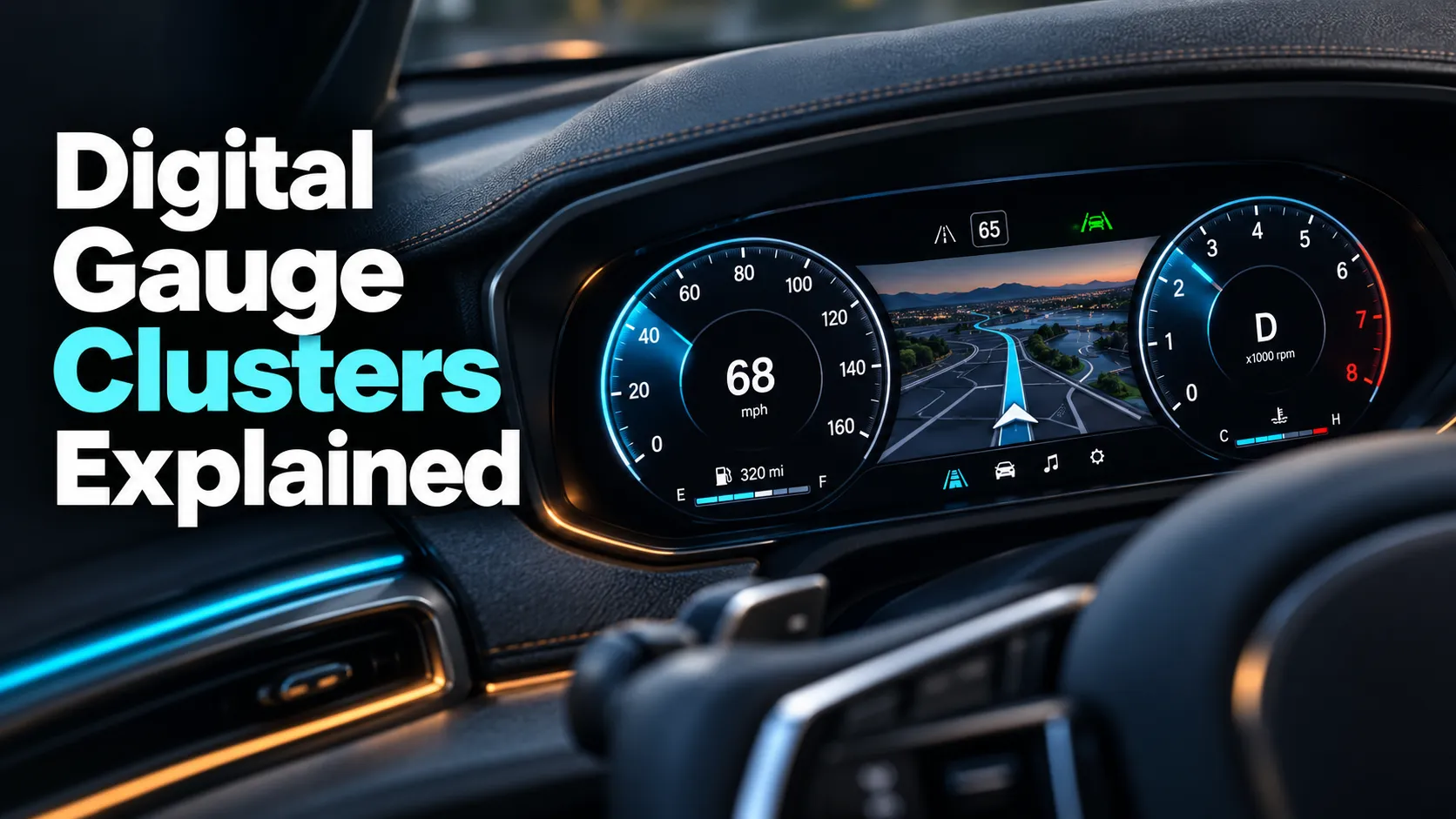
A digital gauge cluster is the instrument panel behind the steering wheel that uses a screen instead of traditional analog needles and dials. It shows speed, RPM, fuel level, warning lights, and other driving data in a digital format that can often be customized for the driver.
If you have been wondering what is a digital gauge cluster, the short answer is that it is a modern dashboard display that replaces some or all of the old-style gauges with a digital screen. I see these systems in more vehicles every year, from compact cars to full-size trucks and EVs.
In this article, I’ll break down how a digital gauge cluster works, what it displays, how it compares with analog gauges, and what to know if your vehicle has one.
What a Digital Gauge Cluster Is and How It Works
Digital Gauge Cluster Definition
A digital gauge cluster is the driver information display mounted in front of the steering wheel that uses LCD, TFT, or OLED technology to show vehicle data. Instead of physical needles moving across printed dials, software creates the speedometer, tachometer, fuel gauge, and warning icons on a screen.
Some vehicles use a fully digital cluster. Others use a hybrid setup with a screen in the middle and real gauges on the sides.
What Replaces Traditional Analog Dials
In a traditional cluster, each gauge has its own mechanical or electromechanical part. A digital cluster replaces those separate pieces with one display and a graphics interface. That means the same screen can show a round speedometer one moment and a navigation map the next.
This flexibility is one of the biggest reasons automakers keep moving toward digital instrument panels.
How the Screen Receives Speed, RPM, Fuel, and Warning Data
The cluster does not guess your speed or fuel level. It receives data from sensors, control modules, and the vehicle’s computer network. The engine control unit, transmission module, ABS system, and fuel level sender all feed information into the system, which then converts that data into readable graphics.
That process happens very fast, so the display updates in real time. For a deeper look at how vehicle data is shared across modern systems, I like to point readers to the National Highway Traffic Safety Administration for safety-related vehicle information and standards.
Some digital clusters can change layout based on drive mode, so the same vehicle may show a sport-style tachometer in one mode and a simpler commuting layout in another.
Key Components Inside a Digital Gauge Cluster
Display Screen and Backlighting
The display screen is the visible part you look at every day. It may be an LCD or OLED panel with backlighting that keeps the graphics bright and readable in daylight and at night.
Vehicle Sensors and Control Modules
The cluster depends on input from sensors and modules throughout the vehicle. These parts measure speed, engine RPM, fuel level, coolant temperature, tire pressure, and warning conditions. The cluster then turns that raw data into icons, numbers, and alerts.
Software, Graphics, and Driver-Selectable Layouts
Software is what makes the cluster feel modern. It controls the graphics, animations, menu options, and layout changes. In many vehicles, the driver can choose different themes, rearrange information, or switch between simple and detailed views.
Integration With the ECU and Infotainment System
A digital gauge cluster often works closely with the ECU and infotainment system. That connection lets it display turn-by-turn directions, media info, driver-assistance alerts, and vehicle status messages. In some cars, the cluster and center screen even share design language so the cabin feels more unified.
| Component | What It Does | Why It Matters |
|---|---|---|
| Display screen | Shows gauges and graphics | Creates the visual interface |
| Backlighting | Illuminates the screen | Improves visibility in all lighting |
| Sensors and modules | Send vehicle data | Feed the cluster accurate readings |
| Software | Builds layouts and alerts | Enables customization and updates |
| ECU integration | Shares system data | Keeps the display in sync with the car |
Digital Gauge Cluster vs. Analog Instrument Cluster
Readability and Customization Differences
Analog gauges are familiar and easy to scan because the layout rarely changes. Digital clusters can be easier to tailor to the driver, but the learning curve may be higher at first. If you like a fixed layout, analog can feel simpler. If you want flexibility, digital wins.
Information Display Differences
Analog clusters usually show the basics: speed, RPM, fuel, and temperature. Digital clusters can show far more, including navigation, lane guidance, tire pressure, audio info, and driver-assistance alerts. That extra data can be useful, but only if it is organized well.
Reliability and Repair Differences
Analog clusters often have straightforward mechanical or electrical issues that a technician can diagnose quickly. Digital clusters rely more on software, circuit boards, and display hardware. When they fail, the fix may be more complex and sometimes requires module replacement.
Cost and Replacement Differences
Analog repairs are often cheaper, especially when the issue is a single gauge or bulb. Digital clusters can cost more to replace because the screen, electronics, and programming may all be tied together. That does not mean they are fragile, but it does mean repair bills can be higher.
- Clear, customizable display
- More information in one place
- Modern look and strong integration
- Useful navigation and safety alerts
- Higher repair costs
- Possible glare or glare-related visibility issues
- Software bugs or lag
- More dependence on electronics
Common Features Found in a Digital Gauge Cluster
Speedometer, Tachometer, and Fuel Readouts
These are the core functions. Even the most advanced digital cluster still needs to show your speed, engine RPM, fuel level, and basic status information clearly.
Navigation Prompts and Driver Assistance Alerts
Many clusters can show turn-by-turn directions right in front of the driver. Some also display lane-keeping alerts, adaptive cruise status, blind-spot warnings, and other driver-assistance messages.
Warning Lights and Safety Notifications
Digital clusters still use warning symbols for low oil pressure, charging issues, engine faults, and other important problems. The difference is that the graphics can be larger, brighter, and easier to notice.
Theme Switching and Reconfigurable Displays
Some systems let you choose between multiple themes or layouts. You may be able to move widgets, enlarge the speed readout, or switch to a performance-focused display when driving more aggressively.
Night Mode, Brightness Control, and HUD-Like Views
Digital clusters often include automatic dimming, manual brightness control, and night mode. A few even mimic a head-up display by placing key data near the top of the screen to reduce eye movement.
If the cluster offers multiple layouts, set up your preferred driving view before you leave the driveway. That keeps you from digging through menus while moving.
Benefits of a Digital Gauge Cluster for Drivers
Easier-to-Read Information at a Glance
A well-designed digital cluster can make key data easier to read, especially when numbers are large and high contrast. That can help drivers focus on the road instead of hunting for small needles or tiny markings.
More Customization for Different Driving Styles
Drivers who commute, tow, road trip, or enjoy spirited driving may all want different information. Digital clusters can adapt to those needs better than fixed analog gauges.
Cleaner Dashboard Design and Modern Appearance
Automakers like digital clusters because they support a cleaner cabin design. Fewer separate gauge faces and more screen-based design can make the dash look more modern and less cluttered.
Better Integration With Advanced Vehicle Technology
As vehicles add more driver-assistance features, the cluster becomes a central place to show alerts and status updates. That makes it easier to keep important information in one spot. For examples of how manufacturers describe these systems, I recommend checking a brand’s own product pages, such as Ford’s official vehicle technology pages.
Not every digital cluster is the same. Some are simple and easy to use, while others pack in a lot of menus and graphics that can take time to learn.
Drawbacks and Limitations of a Digital Gauge Cluster
Higher Repair and Replacement Costs
If the display panel or control board fails, repair costs can be higher than with a basic analog cluster. In some vehicles, the cluster may need coding or calibration after replacement.
Screen Glare, Lag, or Software Glitches
Bright sunlight can make some screens harder to see. A laggy interface or occasional software bug can also be frustrating, especially if the display takes a moment to update.
Dependence on Electronics and Sensors
Because the cluster depends on electronic inputs, a bad sensor or communication issue can affect what you see. A mechanical gauge might still work in some cases where a digital display would not.
Potential Distraction From Too Much On-Screen Information
Too many graphics, menus, or pop-up alerts can pull attention away from the road. A good digital cluster should inform the driver, not overwhelm them.
If your digital cluster starts showing incorrect speed, missing warning lights, or random shutdowns, do not ignore it. Those symptoms can point to a deeper electrical or communication problem.
How to Tell If Your Vehicle Has a Digital Gauge Cluster
Look for a Fully Screen-Based Dash Behind the Steering Wheel
If the area behind the wheel is one large screen with no traditional needles, you likely have a digital cluster. Some vehicles still use a mix of screen and physical gauges, so look closely.
Check the Vehicle’s Trim Level and Feature List
On many models, the digital cluster is reserved for higher trims or option packages. The window sticker, brochure, or manufacturer website often lists it as a feature.
Compare the Cluster Layout With the Owner’s Manual
The owner’s manual can show whether the cluster is fully digital, partially digital, or analog. It also explains the icons, menus, and display modes specific to your vehicle.
Spot Hybrid or Fully Customizable Display Modes
If the cluster changes appearance when you switch drive modes or press steering-wheel buttons, that is another sign you are looking at a digital system. Some designs are so flexible that they can look almost like several different clusters in one vehicle.
Look for a full screen or a display with changing graphics instead of fixed analog dials.
Check the sales sheet, build sheet, or manufacturer listing to see whether the cluster is digital.
Use the manual to confirm the display type and learn what each icon or menu does.
If the layout changes with drive mode, you are probably using a digital or semi-digital cluster.
Maintenance and Troubleshooting Tips for Digital Gauge Clusters
Keeping the Screen Clean and Protected
Use a soft microfiber cloth and a cleaner that is safe for screens. Avoid harsh chemicals, paper towels, and abrasive pads that can scratch the surface or damage anti-glare coatings.
What to Do if the Cluster Goes Blank
If the display goes dark, check whether the issue is limited to the cluster or affects other systems too. A blown fuse, low battery/” title=”8 Best Cordless Inflators Battery Operated for Fast, Convenient Inflation”>battery voltage, or loose connection may be the cause, but a blank screen can also signal a failed module.
Signs of Software or Electrical Problems
Watch for flickering, frozen graphics, incorrect readings, random resets, or missing icons. Those symptoms often point to a software fault, communication issue, or power problem.
When to Visit a Dealer or Auto Electrician
If the cluster is showing wrong information or losing power repeatedly, I would have it diagnosed by a dealer or qualified auto electrician. On many vehicles, the cluster needs specialized scan tools and programming after repair.
- Keep brightness set high enough for daylight, but not so high that it causes eye strain at night.
- Learn the warning symbols in your owner’s manual before you need them.
- Use the simplest display mode if you want less distraction during daily driving.
- Keep the vehicle battery in good condition, since low voltage can trigger cluster glitches.
- If software updates are available from the manufacturer, ask whether they apply to the cluster system.
the cluster is blank, the readings are clearly wrong, warning lights are missing, or the display keeps rebooting. Those are not issues to guess at, because the cluster is tied to important vehicle systems.
A digital gauge cluster is a screen-based instrument panel that replaces some or all analog gauges with software-driven displays. It can improve customization and information access, but it also brings more electronic complexity, which can mean higher repair costs and occasional software issues.
Common Questions About What a Digital Gauge Cluster Is
Not always. A digital gauge cluster is the display behind the steering wheel. A digital dashboard can refer to the cluster, the center infotainment screen, or both together.
They can be very accurate, but accuracy depends on the vehicle’s sensors and software, not just the screen type. A digital display is only as good as the data it receives.
Some problems can be repaired, such as power supply faults or loose connections. But if the screen, circuit board, or internal module fails, replacement may be the better option.
Under normal use, no. They are designed to operate within the vehicle’s electrical system. A battery drain issue usually points to a fault, not the cluster itself.
Most are designed to be readable in daylight, but some perform better than others. Brightness, anti-glare coating, and screen quality all affect how well the display holds up in sun.
- A digital gauge cluster is a screen-based instrument panel behind the steering wheel.
- It replaces traditional analog dials with software-driven graphics and vehicle data.
- It can show speed, RPM, fuel, warnings, navigation, and driver-assistance alerts.
- Digital clusters offer customization, but they can cost more to repair.
- If yours malfunctions, have it diagnosed by a qualified technician.
If you want to compare digital clusters with other modern vehicle tech, I also suggest checking the vehicle maker’s own technology pages and the safety guidance from the NHTSA. Those sources help you understand what your car is actually equipped to do, not just what the brochure says.

1 thought on “Digital Gauge Clusters Explained: What Drivers Need to Know”