
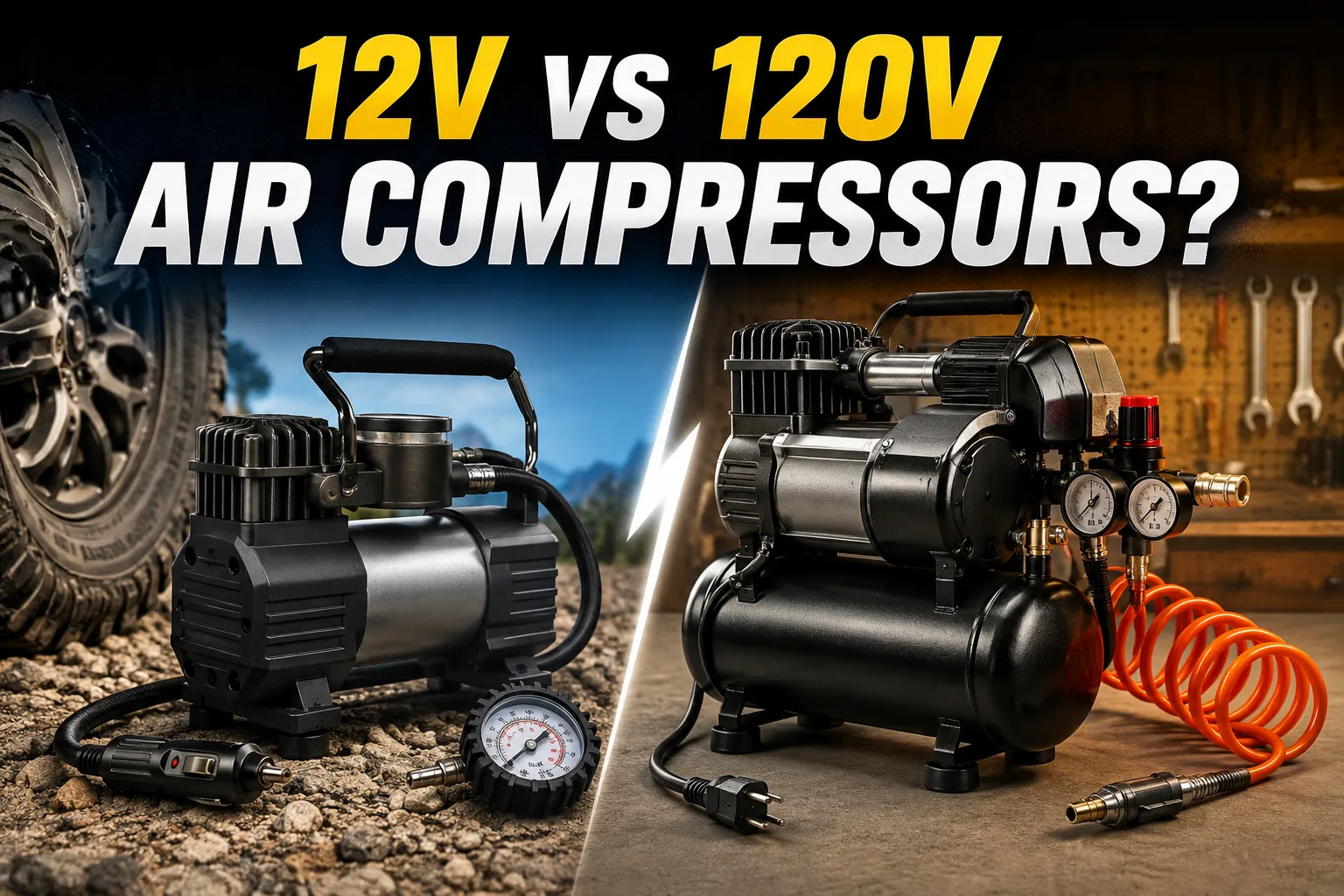
If you want portability and emergency tire inflation, I’d pick a 12V air compressor. If you want faster inflation, better runtime, and a better fit for garage use or air tools, a 120V air compressor is usually the stronger choice.
In simple terms: 12V is best for the road, 120V is best for the garage.
When people ask me about 12v vs 120v air compressor models, they usually want one thing: the right balance of power and convenience. I’ve found that the best choice depends less on the compressor itself and more on where you plan to use it.
Here’s a quick way to think about it:
- 12V compressors plug into a vehicle.
- 120V compressors plug into a wall outlet.
- 12V models travel easily.
- 120V models usually inflate faster.
- 12V works well for roadside emergencies.
- 120V is better for garages and tools.
In this guide, I’ll break down the real differences, show where each type shines, and help you choose the one that makes sense for your car, truck, or home setup.
12v vs 120v Air Compressor: What’s the Real Difference?
How 12V and 120V compressors get power
A 12V air compressor runs from your vehicle’s electrical system, usually through the 12-volt accessory outlet or battery clamps. That makes it easy to carry in the trunk, glove box, or cargo area.
A 120V air compressor uses standard household power. That means you need a wall outlet, generator, or inverter to run it. Because it has access to more power, it can often support larger motors, bigger tanks, and stronger airflow.
Why voltage affects portability, speed, and use cases
Voltage affects how much electrical power a compressor can draw and how it is used in the real world. A 12V unit is built for convenience and mobility. A 120V unit is built for more consistent performance.
That difference shows up in a few ways. 12V models are easier to carry and store, but they usually inflate slower. 120V models are less portable, but they often fill tires faster and handle repeated use better.
Many 12V compressors are designed for short bursts of use, while 120V garage compressors are often built for longer sessions and bigger jobs.
The quick answer: which one fits which driver or homeowner
If you mainly want to top off tires, handle roadside emergencies, or keep an emergency kit in the vehicle, I’d lean toward 12V. If you want to work in a garage, inflate multiple tires often, or use light air tools, 120V is usually the better pick.
For tire pressure guidance, I also like checking trusted sources such as the National Highway Traffic Safety Administration tire safety page. It’s a good reminder that the right compressor matters, but correct tire pressure matters even more.
12v vs 120v Air Compressor Comparison Chart
| Feature | 12V Air Compressor | 120V Air Compressor |
|---|---|---|
| Power source | Vehicle outlet or battery | Wall outlet or generator |
| Inflation speed | Usually slower | Usually faster |
| Airflow and PSI capability | Good for basic tire inflation | Better for higher-demand tasks |
| Portability and storage | Excellent | Moderate to low |
| Noise level | Varies, often compact and loud | Varies, often steadier but larger |
| Duty cycle and runtime | Usually more limited | Usually better for longer use |
| Cost and value | Often lower entry cost | Often better value for garage use |
Power source
The biggest difference is simple: one runs from your vehicle, the other from your home power. That changes where you can use it and how often you’ll reach for it.
Inflation speed
120V compressors usually win here. They can move more air more easily, which matters when you’re filling larger tires or using the compressor back-to-back.
Airflow and PSI capability
PSI tells you pressure, but airflow matters just as much. A compressor with better airflow can inflate tires?”>inflate tires faster and support some air tools more reliably. Many 120V units have the edge, especially once you move beyond simple top-offs.
Portability and storage
12V models are easier to stash in a vehicle and bring out when needed. 120V units are often bulkier, especially if they include a tank, wheels, or a larger motor.
Noise level
Noise depends on the design, not just the voltage. Still, many 120V garage compressors are louder in a more powerful way, while compact 12V units can sound sharp and high-pitched. If noise matters to you, check the decibel rating before buying.
Duty cycle and runtime
Duty cycle is a big deal, and it is easy to overlook. A 12V compressor may need cool-down time after a short run, while a 120V compressor often handles longer inflation sessions better. If you plan to fill several tires in a row, this matters a lot.
Cost and value
12V compressors often cost less up front, which makes them attractive as emergency gear. But if you’ll use the compressor often at home, a 120V model can offer better long-term value because it does more jobs more comfortably.
12v Air Compressor Pros and Cons
- Easy to carry in a vehicle
- Great for roadside tire inflation
- Simple to store in small spaces
- Works without household power
- Slower inflation on larger tires
- Limited runtime on some models
- Less suited to repeated use
- Not ideal for most air tools
Advantages of a 12V air compressor
I like 12V compressors for one reason above all: they travel well. You can keep one in the car and have it ready when a tire pressure warning pops up.
They also make sense if you do not have garage power nearby. For drivers who park on the street, camp, or head off-road, that flexibility is hard to beat.
Limitations of a 12V air compressor
The main tradeoff is speed. Many 12V compressors take longer to fill tires, especially on trucks, SUVs, and larger off-road tires. Some also get hot quickly if pushed too hard.
Best situations for a 12V compressor
Use a 12V compressor if you want emergency inflation, occasional tire top-offs, or a compact inflator for travel. It’s also a smart fit for overlanding and off-road kits where portability matters more than speed.
Common buying mistakes with 12V models
One common mistake is buying a tiny unit and expecting it to fill big tires quickly. Another is ignoring hose length, clamp quality, and duty cycle. A cheap compressor with poor connections can be frustrating when you need it most.
Don’t run a 12V compressor for long periods without checking the duty cycle. Overheating can shorten its life and make roadside use less reliable.
120v Air Compressor Pros and Cons
- Faster inflation for most tasks
- Better for repeated use
- Useful for light air tools
- Strong garage and workshop value
- Needs wall power
- Less portable than 12V units
- Usually takes more storage space
- Not ideal for roadside emergencies
Advantages of a 120V air compressor
A good 120V compressor gives you more breathing room. It usually inflates faster, handles more frequent use, and can support tasks that go beyond tire filling.
For garage owners, that extra power is often worth the larger size.
Limitations of a 120V air compressor
The biggest drawback is portability. If you need air on the road, a wall-powered compressor is not very helpful unless you have an inverter or generator.
Some 120V units are also noisy and heavy, which makes them less convenient for small spaces.
Best situations for a 120V compressor
I recommend 120V for home garages, workshops, and anyone who inflates tires often. It is also a better choice if you want to use accessories like blow guns or small brad nailers.
Common buying mistakes with 120V models
People often buy based on tank size alone. That is a mistake. You also need to look at airflow, recovery time, and whether the compressor can actually support the job you want to do.
Another common miss is forgetting about power access. A great compressor is not much help if the outlet is too far away or the cord is too short.
Which Is Better for Car Tires, Truck Tires, and Off-Road Use?
12V air compressor for emergency roadside inflation
For roadside emergencies, 12V usually wins. You can keep it in the vehicle and use it without hunting for a power outlet. That makes it a practical backup when a tire is low and you need to get back on the road.
12V air compressor for trucks, SUVs, and off-road rigs
For larger tires, 12V can still work, but it may take patience. If you air down for trails and need to air back up often, choose a stronger 12V model with better airflow, a solid duty cycle, and long enough cables to reach all four tires.
120V air compressor for garages and repeated tire top-offs
If your vehicle lives at home and you top off tires often, 120V is easier to live with. It is faster, less tiring to use, and more comfortable for regular maintenance.
Recommended use cases by vehicle type
For compact cars, a basic 12V inflator is often enough. For SUVs and trucks, I prefer either a stronger 12V unit for travel or a 120V compressor for home use. For off-road rigs, many owners keep both: a 12V for the trail and a 120V in the garage.
If you air down off-road, choose a compressor with a real duty-cycle rating and enough hose length to reach all tires without moving the unit each time.
Which Is Better for Air Tools, DIY Projects, and Garage Use?
Why 120V compressors usually outperform 12V for tools
Air tools need steady airflow. That is where 120V compressors usually pull ahead. Even small tools like blow guns, staplers, and brad nailers tend to work better when the compressor can keep up.
If you want to run impact tools or heavier equipment, you may need an even larger compressor than a basic 120V portable unit. The point is that 12V is rarely the right starting place for tool use.
When a 12V compressor is enough for light inflation tasks
A 12V compressor is still useful for simple jobs like bike tires, sports gear, air mattresses, and topping off car tires. It just is not built for high-demand garage work.
Portable garage setups versus stationary home use
If you need a compressor you can move around a driveway or bring to a job site, a compact 120V unit can be a nice middle ground. But if you want true convenience in a garage, a stationary 120V compressor usually makes more sense.
What to expect for nailers, blow guns, and small tools
For light pneumatic tools, look for a 120V compressor with enough CFM for the tool you plan to use. That spec matters more than the label alone. For a deeper look at compressor basics and safety, the OSHA compressed air safety guidance is worth a read.
How to Choose Between a 12v and 120v Air Compressor
Match compressor type to your power access
Start with where you’ll use it. If you need air in a car, truck, or campsite, 12V makes sense. If you have a garage outlet, 120V opens the door to more power and convenience.
Decide based on inflation speed and PSI needs
For small passenger tires, either type can work. For larger tires or repeated inflation, I’d lean toward 120V at home and a stronger 12V unit on the road.
Consider tank size, duty cycle, and runtime
Tank size helps with burst tasks, but duty cycle and runtime tell you how long the compressor can work before cooling down. If you plan to use it often, these specs matter a lot more than the box size.
Factor in portability, noise, and storage space
A compressor that is easy to grab gets used more often. If you have limited storage, a 12V model may be the better everyday fit. If noise is a concern, check reviews and product specs before you buy.
Check hose length, accessories, and chuck quality
These details are easy to ignore, but they affect real-world use. A short hose or flimsy chuck can make even a good compressor feel awkward. I always look for a solid connector, readable gauge, and a hose long enough for the job.
- Choose 12V for vehicle-based use
- Choose 120V for garage and tool use
- Check PSI and airflow specs
- Review duty cycle and runtime
- Measure hose length and storage space
- Look for a quality chuck and gauge
Cost, Maintenance, and Reliability Differences in 12v vs 120v Air Compressor Models
Upfront price comparison
12V compressors are often cheaper to buy. That makes them appealing if you just want emergency coverage. 120V compressors usually cost more, especially once you move into better airflow, larger tanks, or quieter designs.
Long-term maintenance and wear
Any compressor lasts longer when it is used within its limits. 12V units can wear out faster if they are pushed too hard. 120V units also need care, but they are often built for more regular use.
Power draw, battery drain, and energy use
A 12V compressor can pull a lot from your vehicle battery if the engine is off. That is why I like running it with the engine on when possible. A 120V compressor draws from household power, so battery drain is not the same concern.
Repairability and replacement part availability
Some 120V compressors have better parts support because they are more common in garage settings. With either type, it helps to buy from a brand that offers replacement hoses, chucks, filters, or pressure switches when needed.
- Keep a 12V compressor inflated and tested before road trips.
- Use the engine on when running a 12V unit for long enough to matter.
- Match 120V compressor airflow to the tool or tire job, not just the tank size.
- Store the hose and chuck neatly so the compressor is ready when needed.
your tire keeps losing pressure after inflation, or you notice repeated compressor failures, it may be worth checking for a puncture, valve issue, or electrical problem before buying a new unit.
12v vs 120v
Here’s my simple rule: choose 12V if you need portability and emergency use, and choose 120V if you want speed, regular garage use, or light air-tool support. The best compressor is the one that fits how you actually live, drive, and work.
For most drivers, 12V is the better travel companion. For most homeowners and DIY users, 120V is the better all-around workshop choice.
Yes, for most passenger car tires it is strong enough. It may just take longer than a 120V model, especially if the tire is very low.
It can, but it may be slow. For larger truck tires, I prefer a stronger 12V unit or a 120V compressor for home use.
Usually yes. A 120V compressor is generally better for light air tools because it can deliver steadier airflow and longer runtime.
A 12V compressor is usually the better choice because it runs from your vehicle and is easy to keep in the car.
Look at PSI, airflow, duty cycle, hose length, chuck quality, and how the compressor gets power. Those details matter more than the headline price.
You can, but it may drain the battery if the compressor runs for long enough. I usually recommend running the engine if the job takes more than a quick top-off.
- 12V compressors are best for travel and emergencies.
- 120V compressors are usually faster and better for garage use.
- 12V works well for light inflation and off-road kits.
- 120V is better for repeated tire top-offs and air tools.
- Check duty cycle, airflow, hose length, and chuck quality before buying.