
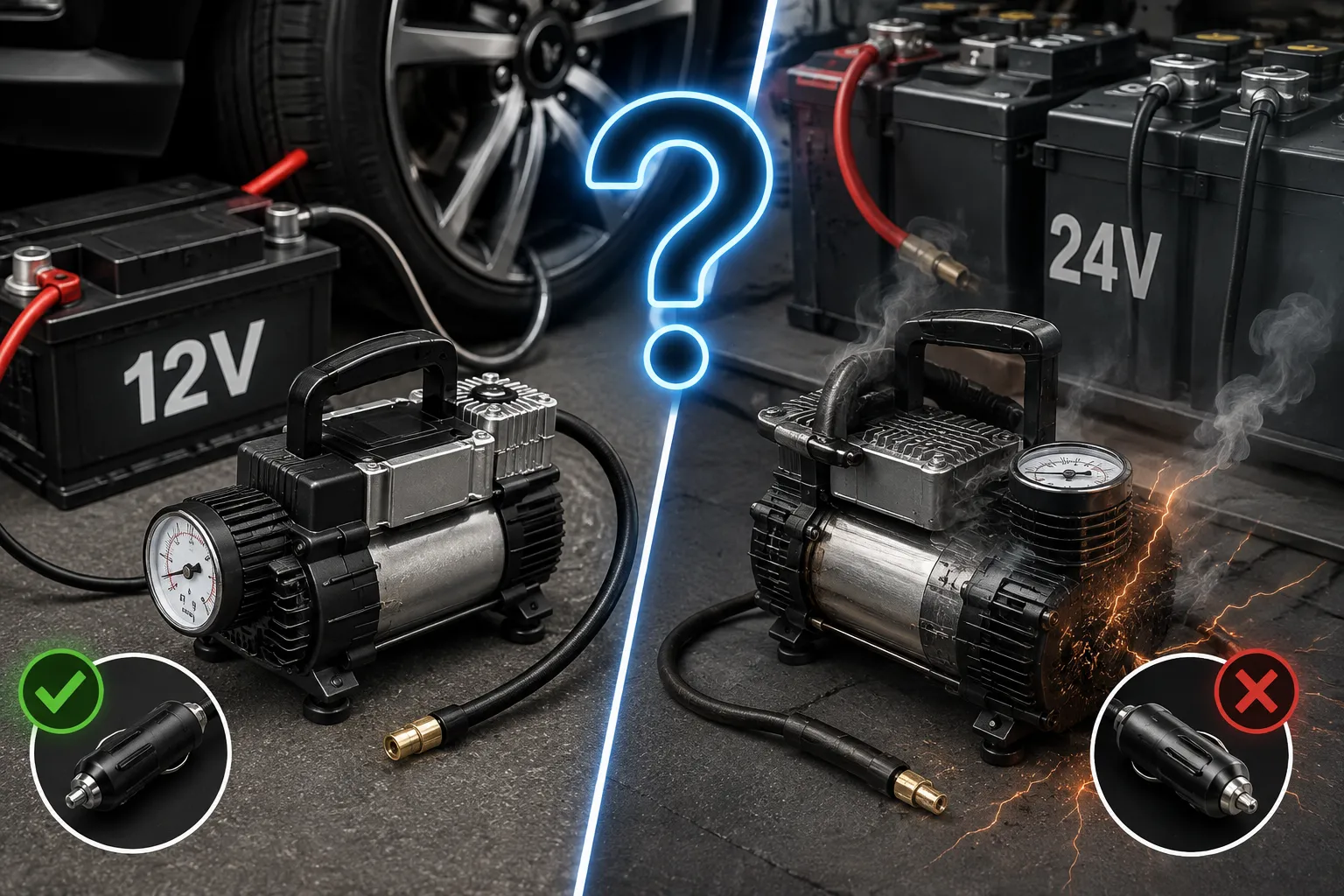
No, I would not run a standard 12V air compressor directly on 24V. In most cases, it can overheat the motor, blow the fuse, or damage the compressor fast. If you need to use it on a 24V system, step the power down to 12V first or buy a compressor made for 24V.
If you’ve got a 24V truck, RV, or battery setup, this question comes up a lot. I’m Jake Morrison, and I’ll walk you through what really happens when a 12V compressor sees 24V, what signs to watch for, and the safer ways to get the job done.
Can You Run a 12V Air Compressor on 24V? The Short Answer and What It Means
The short answer is no for regular use. A 12V air compressor is built for about 12 volts, not 24, so feeding it double the voltage can make it spin too fast and draw too much power. Some heavy-duty units may survive a very brief hit, but that does not mean they are safe or meant for it.
Think of it like water pressure in a hose. A little extra pressure may seem fine at first, but too much can strain the whole system. With a compressor, that strain can show up in the motor, wiring, fuse, and switch all at once.
If the compressor manual does not clearly say it supports 24V, assume it does not. A quick startup does not prove the unit is safe for long-term use.
Why 24V Can Damage a 12V Air Compressor
Most 12V compressors use a small electric motor designed around a specific voltage range. When you double the voltage, the motor can try to run much harder than intended. That extra speed and heat is where the trouble starts.
Voltage vs. current: why double the voltage is a big deal
Voltage pushes electricity through the motor. Current is the amount of electricity the motor draws while working. When voltage rises too far, the motor may try to pull more current than the wiring and internal parts can handle.
That is why a compressor that seems fine for a few seconds can still be getting damaged inside. The motor windings, brushes, and bearings all feel the stress.
What happens to the motor, fuse, and wiring when overvolted
The motor may run hotter, louder, and faster than normal. If the compressor has a fuse, that fuse may blow, which is a good sign that the system is trying to protect itself. If the fuse does not blow, the wiring or switch may still overheat.
For reference, many vehicle electrical standards and accessory ratings are built around the system voltage for a reason. If you want to understand battery and charging basics, I also like the guidance from the Bosch automotive systems information pages, which explain why matching electrical components matters.
Signs a 12V compressor has been hit with 24V
After an accidental overvoltage, I look for a few common warning signs:
- Burnt smell from the motor or wiring
- Fuse blown right away or repeatedly
- Compressor runs unusually fast or noisy
- Weak pressure output after the event
- Housing feels hotter than normal in a short time
If you smell burnt insulation or see melted plastic, stop using the compressor. Internal damage can turn into a fire risk if you keep testing it.
When a 12V Air Compressor Might Survive Brief 24V Use
There are a few exceptions, but they are narrow. Some compressors are built with enough margin to survive a short overvoltage event, especially if they have strong thermal protection. Still, “survive” is not the same as “safe to use this way.”
| Situation | What May Happen | Risk Level |
|---|---|---|
| Brief accidental 24V hit | May start, then shut down or blow a fuse | High |
| Heavy-duty compressor with wide input range | May tolerate more voltage if manufacturer allows it | Medium |
| Standard consumer 12V compressor | Likely overheats or fails early | Very high |
Heavy-duty compressors with wide voltage tolerance
Some commercial or off-road compressors are built to handle a broader input range. If a manufacturer clearly lists 12V to 24V operation, then the unit is designed for that. If it does not say that, do not guess.
Built-in thermal protection, fusing, and overload shutdown
Better compressors often include thermal cutoffs or overload protection. These features can help prevent immediate failure, but they are not a free pass. They protect the unit from damage; they do not make overvoltage a good idea.
Why “it powered on” does not mean it is safe
A compressor can turn on and still be under stress. That is why I never judge safety by startup alone. A unit may seem fine for 30 seconds and still suffer shortened life, worn brushes, or heat damage that shows up later.
Many 12V accessories are rated with a duty cycle, which tells you how long they can run before they need a rest. Overvoltage can push a compressor past that limit much faster than expected.
How to Check Whether Your 12V Air Compressor Can Handle 24V
If you are not sure about your compressor, I would check the label and paperwork before plugging it in. That takes a few minutes and can save you from a costly mistake.
- Find the voltage rating printed on the compressor
- Look for a range such as 12V to 24V, not just 12V
- Read the owner’s manual for input limits
- Check the fuse size and plug type
- Look for thermal or overload protection notes
- Confirm the duty cycle and max run time
Read the compressor label and owner’s manual
The label is the first place I check. If it says 12V DC only, that is your answer. If the manual mentions a wide input range, then you may have a model designed for more than one system voltage.
Look for voltage range markings and duty cycle limits
Some compressors list a range like 10V to 15V or 12V to 24V. Others list a duty cycle, such as 10 minutes on and 20 minutes off. If you exceed either limit, the compressor can overheat even when the voltage is correct.
Inspect the plug, fuse rating, and internal protection
The plug and fuse can tell you a lot. A small fuse does not make a compressor 24V-safe. It only means the circuit may open before worse damage happens. For battery and vehicle electrical systems, the U.S. Department of Energy has useful background on how electric power and conversion work at energy.gov’s battery and power resources.
If the compressor came with a cigarette-lighter style plug, that does not mean it can handle any vehicle voltage. Plug style and voltage rating are two different things.
Safer Ways to Use a 12V Air Compressor on a 24V Vehicle or Battery System
If you already own a good 12V compressor, you do not have to throw it away just because your vehicle is 24V. There are safer ways to make the setup work.
Use a 24V-to-12V DC-DC converter
This is usually my first choice. A proper DC-DC converter steps 24V down to 12V so the compressor sees the voltage it was built for. Just make sure the converter is rated for the compressor’s startup and running current, not just its average draw.
Use a proper 12V accessory outlet or auxiliary battery
Some 24V trucks and equipment have a separate 12V outlet or an auxiliary 12V battery bank. That can work well if it is wired correctly and protected with the right fuse. The goal is always the same: give the compressor clean, correct 12V power.
Choose a 24V-rated compressor instead
If you use the compressor often, buying a 24V model may be the simplest fix. It removes the need for a converter and reduces the chance of voltage mismatch. For frequent use, that can be the more reliable choice.
If you are shopping for a converter, look for continuous current rating and surge capacity. Compressors often pull more power at startup than they do while running.
Pros and Cons of Using a 12V Air Compressor on 24V Power
There is a right way and a wrong way to think about this. The right way is to compare direct 24V use with a proper step-down setup.
Potential advantages of stepping down voltage properly
- Compressor gets the voltage it was designed for
- Less risk of overheating or motor damage
- More consistent performance
- Longer compressor life
- Converter undersized for startup load
- Poor wiring causes voltage drop
- Cheap parts may fail under vibration or heat
Risks of direct connection to 24V
Direct connection is where I see the biggest risk. The compressor may work for a moment, but the motor can overheat, the fuse may blow, and the wiring can take more current than expected. That is a lot of stress for a small tool.
Cost vs. reliability tradeoffs
A converter costs money, and a 24V compressor can cost more too. But replacing a damaged compressor, or dealing with a dead battery and blown fuse, usually costs more in the long run. Reliability matters when you need air on the road.
- Never assume a 12V plug means 24V compatibility.
- Check startup current, not just running amps.
- Keep compressor duty cycles short on hot days.
- Use short, thick wiring to reduce voltage drop.
- Replace any heat-damaged plug or cord before reuse.
How to Wire a 24V System for a 12V Air Compressor Safely
If you want to run a 12V compressor from a 24V source, safety starts with the electrical setup. I always treat this as a power-delivery problem first, not just a plug-in problem.
Confirm compressor amperage draw
Look at both the running amps and any startup surge listed by the manufacturer. If the numbers are not listed, find a model manual or contact the maker before you buy a converter. The converter must handle the peak load, not just the average load.
Size the converter, fuse, and wiring correctly
Use a converter rated above the compressor’s maximum draw. Match the fuse to the circuit, not the compressor alone. Then use wiring heavy enough for the current and the distance from the power source to the compressor.
Test voltage at the compressor before running it
Before you switch the compressor on, check the output with a multimeter. You want to see a stable 12V supply at the compressor terminals or plug. If the voltage is too high or drops too low under load, fix that before you run the unit.
You are unsure how to size a converter, wire a fused circuit, or diagnose heat damage after a 24V mistake. A qualified auto electrician can test the system safely and save you from chasing electrical faults.
What to Do If You Accidentally Ran a 12V Air Compressor on 24V
If it happened once, do not keep testing it. Shut it down and inspect it carefully before you use it again.
Stop use immediately and let it cool
Disconnect the compressor and let it cool completely. Heat can hide damage, and a hot motor is not safe to inspect closely right away.
Check for blown fuse, burnt smell, or motor noise changes
Look at the fuse first. Then smell for burnt wiring or plastic. When you test it later on the correct voltage, listen for rough bearings, weak output, or a motor that sounds different from before.
When the compressor is repairable vs. needs replacement
If only the fuse blew and the unit still runs normally on proper 12V power, you may be okay. If the motor struggles, trips protection again, or smells burnt, replacement is often the safer call. Internal motor damage is not always worth repairing on a small compressor.
Do not bypass the fuse or keep “testing” a damaged compressor. That can turn a simple electrical fault into a bigger failure.
FAQ About Running a 12V Air Compressor on 24V
Sometimes it will turn on, but that does not mean it is safe. A brief startup can still damage the motor or wiring. I would not use it directly on 24V unless the manufacturer says it is rated for that input.
A fuse can help protect the circuit, but it does not protect the compressor from every kind of damage. The motor can still overheat or wear out early before the fuse opens.
It can be okay if the inverter is sized correctly and the compressor’s AC power supply matches the inverter output. But that adds conversion losses and complexity. A DC-DC converter or a 24V compressor is often the cleaner solution.
If the label clearly lists both voltages, then the unit is designed for both. Still check the manual for current draw, duty cycle, and any limits for each voltage.
Common signs include a burnt smell, a blown fuse, weak pressure, strange motor noise, or a compressor that shuts off too soon. If you notice any of those, test it carefully on proper 12V power or have it checked by a pro.
Running a normal 12V air compressor directly on 24V is a bad bet. If you need that compressor on a 24V system, step the voltage down properly or buy a 24V-rated unit. That is the safest way to protect the compressor, the wiring, and your time.
- Most 12V compressors should not be run directly on 24V.
- Overvoltage can damage the motor, fuse, and wiring.
- Some heavy-duty units may tolerate brief exposure, but that is not a safe plan.
- A DC-DC converter is the best way to use a 12V compressor on 24V.
- If the compressor smells burnt or acts strangely after a mistake, stop using it.