
Choose the tool for the job
Amazon affiliate disclosure: As an Amazon Associate, we earn from qualifying purchases.
For a compatible roadside starting problem, compare a portable jump starter. For planned charging at home, compare a smart charger. Confirm your vehicle and battery requirements first.
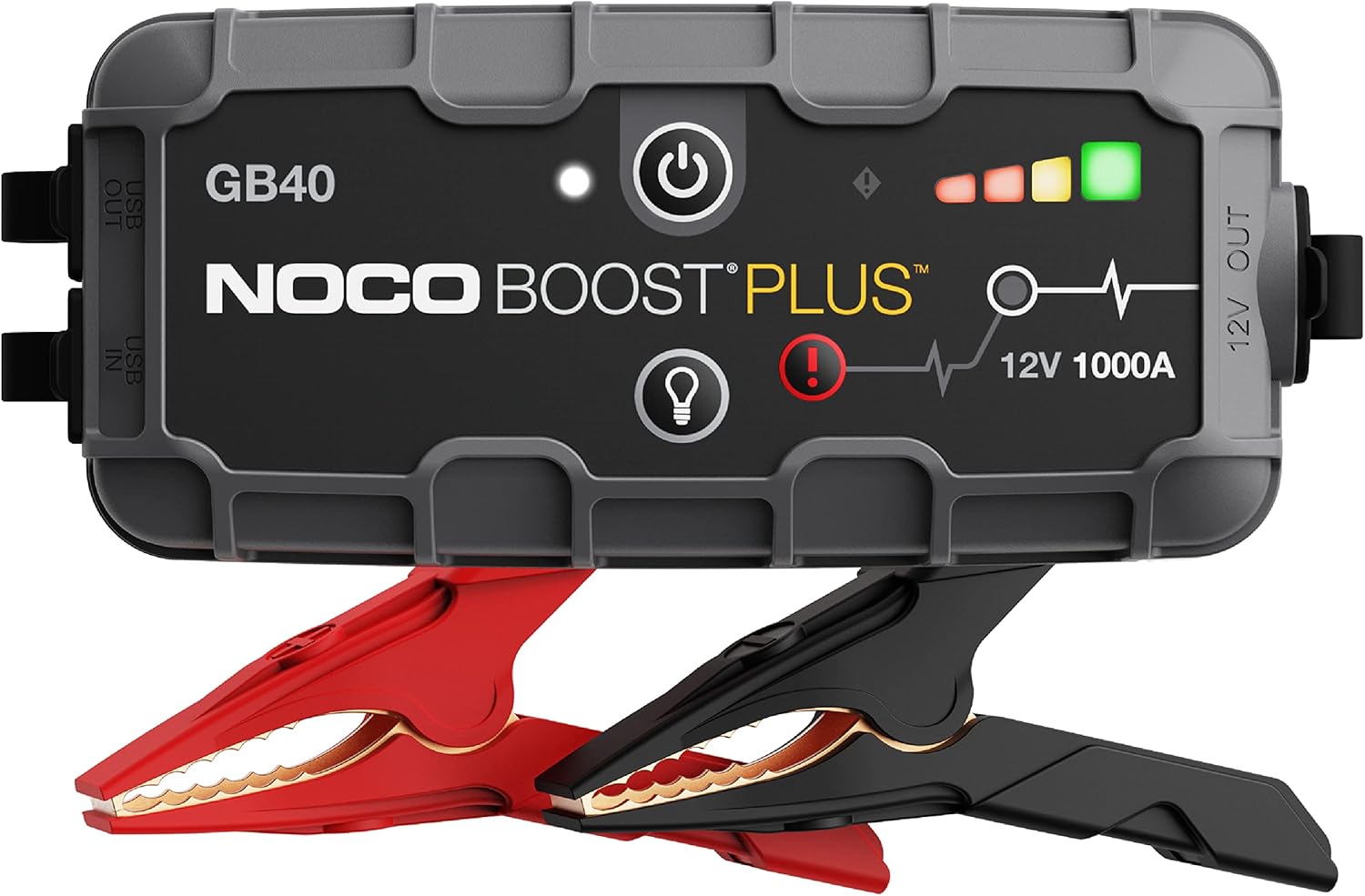
View the NOCO GB40 jump starter on AmazonView the NOCO GENIUS5 charger on AmazonA jump starter supplies a short burst of power to help a compatible engine start. A battery charger replenishes a compatible battery over time, usually from a wall outlet. A maintainer manages a charged battery during storage. For roadside recovery, start with a jump starter; for home charging, start with a charger. Neither tool fixes a damaged battery or a faulty charging system.
The difference between a jump starter and a battery charger is easy to miss when both have red and black clamps. Their jobs are different, though, and buying the wrong one can leave you without a useful solution when your car will not start.
This guide explains how to choose between the two, what to check before buying, and when battery service is the better next step. The recommendations below use manufacturer specifications. We have not performed hands-on testing for this article and do not assign product scores.
Jump starter vs battery charger: the main differences
| Question | Portable jump starter | Smart battery charger |
|---|---|---|
| Main job | Help a compatible engine crank and start | Restore charge to a compatible battery |
| Power source during use | Its charged internal battery | Usually an AC outlet |
| Typical decision | Roadside backup without another vehicle | Planned battery charging at home |
| Time expectation | A starting attempt, subject to the manual | A charging session that may take hours |
| Storage care | Check charge level and storage limits | Protect cords and select the correct mode |
| Does it repair every battery? | No | No |
Use this table as a buying filter, not as a connection procedure. The vehicle, battery, and tool manuals determine whether a product is compatible and where its clamps belong. Some vehicles provide designated jump points that are separate from the battery terminals.
What a portable jump starter does
A portable jump starter is a self-contained source of starting assistance. Its internal battery is charged before the emergency happens. That makes it useful when there is no second vehicle available, but only if the pack is ready and suitable for the application.
A successful start does not prove the vehicle battery is healthy. It also does not establish that the alternator, wiring, connections, or starter are in good condition. Think of starting assistance as a way to address one immediate symptom, followed by an appropriate inspection or charging plan.
What a battery charger does
A charger puts energy back into a battery using a controlled charging process. A smart charger may offer several modes, so the user must select the one that matches the battery. More modes do not make a charger universal.
A compact charger with a modest charging-current rating should not be treated as an engine-starting device. Some larger products combine charging and starting functions, but those functions must be explicitly specified. The word “charger” in a product title does not establish engine-start capability.
What a maintainer adds
A maintainer is intended to manage charge during storage when used with an approved battery and setup. Many smart chargers include maintenance behavior after charging. This can be useful for a seasonal car or another vehicle that spends long periods parked.
Maintenance is different from leaving an unsuitable basic charger connected indefinitely. Follow the product’s monitoring instructions and the battery manufacturer’s guidance. “Automatic” is a feature description, not permission to ignore damage, warning lights, ventilation, or electrical hazards.
Which tool should you buy first?
Roadside backup
Consider a jump starter if you want a portable option for a compatible vehicle when another vehicle or wall outlet is unavailable. Check engine rating, battery voltage, clamp access, and pack-care requirements before choosing.
Home battery care
Consider a charger if you have suitable AC power and time to recharge the battery correctly. Compare chemistry support and capacity guidance rather than choosing solely by the largest amp number.
These are editorial buying recommendations, not a guarantee that either tool will resolve a no-start event. If the vehicle repeatedly needs assistance, the priority is diagnosis. A tool that helps once can still be the wrong long-term response to an ongoing fault.
If you drive daily and park away from home
A jump starter can be the more practical first purchase when your main concern is getting assistance without borrowing another car. Your buying checklist should include how the device will be stored and checked. A pack forgotten until the day it is needed is a weak emergency plan.
Keep the manual accessible and learn the approved procedure before a stressful roadside event. If you would not feel comfortable identifying the vehicle’s approved connection points, roadside assistance may be a better plan than attempting a jump in an unfamiliar or unsafe location.
If your car sits for weeks
A compatible charger with a maintenance function may be a more useful first purchase for a storage problem. First confirm that the vehicle and battery instructions permit the planned arrangement. Consider where the cord will run, how the setup will be monitored, and whether the outlet is suitable.
A charger cannot make unsafe wiring, an exposed outdoor connection, or a damaged battery acceptable. If you park somewhere without suitable power, do not improvise a permanent charging arrangement. Ask a qualified professional about a safe storage plan for that vehicle.
If you want both
Owning both can make sense because the jobs complement each other. One supports a starting emergency; the other supports planned charging. Buy them for those separate jobs rather than expecting either product to be an all-purpose fix.
A sensible order is to solve the problem you actually have first. Someone maintaining a seasonal car in a garage may prioritize a charger. Someone whose main concern is a remote parking lot may prioritize a suitable jump starter. Repeated failures should move professional testing ahead of another accessory purchase.
Two products to compare for different jobs
The following models illustrate the two tool categories. We selected them to make the decision concrete, not to claim they outperform every alternative. Read the current manufacturer information and check the exact model, seller, included accessories, and return terms before ordering.
NOCO GB40: an example for starting assistance
NOCO lists the GB40 as a 12V jump starter for lead-acid batteries, rated at 1,000 peak amps, with engine guidance up to 6.0L gasoline and 3.0L diesel. Those are manufacturer ratings, not a promise that every vehicle within those limits will start.
Why consider it: a portable starting tool may suit a driver who wants emergency backup independent of another vehicle.
Limitations: it needs to be charged, must match the vehicle’s requirements, and is not a substitute for a charger or a battery-health test. Its internal lithium battery does not mean it is approved to jump-start every lithium vehicle battery.
Check the GB40 specifications and manufacturer operating guidance.
Check the exact NOCO GB40 model on AmazonNOCO GENIUS5: an example for planned charging
NOCO specifies 5A charging current, 6V and 12V charging modes, 120–240V AC input, and a charging-capacity range up to 120Ah for the GENIUS5. Chemistry and mode compatibility still matter. It is a charger and maintainer, not an engine-start booster.
Why consider it: a compact smart charger may suit planned charging where suitable AC power is available.
Limitations: charging takes time. Select the approved mode for the specific battery. NOCO’s 12V lithium mode requires a battery management system; that does not make every lithium pack suitable.
Check the GENIUS5 specifications and mode guidance.
Check the NOCO GENIUS5 charger on AmazonRead these specifications before buying
Battery voltage and chemistry
Start with the battery label and vehicle manual. A 12V tool is not interchangeable with a 24V system. AGM, flooded lead-acid, and lithium batteries may require different charging behavior. Do not guess the chemistry from the case shape or the vehicle’s age.
If the battery label is unreadable, identify the installed battery through reliable documentation or a qualified shop. Buying a charger first and choosing a mode later is the wrong order. Confirm the battery, then compare compatible tools.
Engine guidance versus charging current
A jump starter’s peak-current headline and a charger’s amp rating describe different tasks. Comparing 1,000 peak amps with 5A charging current does not tell you which product is “stronger” for your needs. One is marketed for brief starting assistance; the other for a controlled charging process.
For a jump starter, use the manufacturer’s vehicle and engine guidance. For a charger, use battery capacity and approved charging-rate guidance. Engine size alone is not a charger-selection method, and a charging-current rating alone is not a jump-starter-selection method.
Connections and practical access
Check whether the clamps and cables can reach the approved connection points without being pulled tight. Consider hood clearance, moving components, and where the tool will sit. A device that is awkward to position may be a poor choice even when its headline rating looks suitable.
Do not add improvised adapters or extend high-current starting cables simply to solve an access problem. Use accessories approved for the product and application. If a permanent charging lead is proposed, follow its installation instructions and the vehicle’s guidance.
How long does charging take?
There is no useful single answer for every car battery. Battery capacity, how much charge is missing, the charger’s behavior, temperature, and battery condition all affect the session. A displayed completion stage also needs to be interpreted using the charger’s manual.
As a rough arithmetic illustration, replacing 30Ah at a constant 5A would take six hours before allowing for losses or changes in current. Real charging is not a constant-current stopwatch calculation, so that example is not a promised GENIUS5 charging time. Use the manufacturer’s estimates for the relevant capacity and starting condition.
If speed is your main concern, check the battery’s permitted charge rate before choosing a higher-current charger. Faster is not automatically appropriate. If you need the car immediately and the battery is otherwise suitable, starting assistance and planned recharging are separate decisions.
What to do after a successful jump-start
Do not assume a short drive has fully recharged a depleted battery. Interstate Batteries notes that a battery requiring a jump may not return to full charge without a charger. The practical next step is to assess battery condition and follow an appropriate charging or service plan.
If the vehicle starts and then stalls, or repeatedly will not restart, arrange professional testing. AAA explains that a jump cannot fix a failed battery and recommends battery evaluation after starting problems. Avoid repeatedly attempting starts without understanding the cause.
Tell the technician what happened: whether lights were left on, whether the car had been parked, what warnings appeared, and whether it restarted later. Those observations are more useful than a guess that the battery or alternator must be bad.
Safety checks before connecting either tool
This is a buying guide, not a universal connection procedure. Follow the vehicle, battery, and exact tool instructions. Do not charge or jump a damaged or frozen battery. Use appropriate eye protection and ventilation, and keep ignition sources away.
NOCO’s GENIUS5 user guide warns about explosive battery gases, heat, electrical shock, and incompatible batteries. Keep cords clear of damage and moving components, do not cover the charger, and follow its monitoring requirements. A protective feature does not remove the need for correct setup.
Special modes deserve particular care. NOCO says Force Mode disables safety features. Its 12V Repair mode is for lead-acid batteries and uses elevated charging voltage that can affect electronics. Do not use either as a casual workaround for an unexplained fault; follow the full manual and seek help if uncertain.
For a hybrid or electric vehicle, consult the exact vehicle manual before any low-voltage starting assistance. Do not connect these tools to a traction battery. A familiar-looking terminal is not proof that a generic procedure applies.
Common buying mistakes
- Choosing by the biggest number: compare specifications that relate to the job, not unlike amp ratings.
- Ignoring battery chemistry: verify compatibility before buying and again before selecting a mode.
- Expecting a jump to repair the battery: starting assistance is not a battery-health result.
- Buying a maintainer for immediate starting: confirm whether engine-start capability actually exists.
- Ignoring readiness: include pack charging and inspection in the emergency plan.
- Using warning modes blindly: an error should prompt checking the manual, not overriding protection.
Build a practical vehicle emergency kit
Battery backup is only one part of preparation. Keep your roadside-assistance details accessible and know what to do if the location is unsafe. If you cannot safely reach the vehicle or identify the correct connections, stop and request assistance.
For tire-related preparation, our tire-pressure checklist covers a separate maintenance task. If you are adding a pump, read the cordless inflator buying guide. A jump starter’s USB output should not be assumed capable of powering a tire inflator; verify the equipment’s actual electrical requirements.
Frequently asked questions
Can a jump starter charge a car battery?
A portable jump starter is intended for starting assistance, not a complete charging session. Do not leave it connected as a makeshift maintainer unless the manufacturer explicitly supports that function.
Can a smart charger jump-start my car?
Only if the exact product has an approved engine-start function. The GENIUS5 example in this guide is a charger and maintainer, not a jump starter.
Do I need both tools?
Possibly, if you need roadside starting backup and planned home charging. Choose the first purchase around your real use case, available power, and battery compatibility.
Does a successful jump mean the battery is good?
No. It confirms that the vehicle started under those conditions. Arrange testing if the problem repeats or the battery does not hold charge.
Can I leave a smart charger connected all winter?
Use only an approved battery, mode, and setup, and follow the charger’s monitoring and storage instructions. Maintenance capability does not permit ignoring warnings or damage.
Can these tools charge an EV traction battery?
No. The examples here are low-voltage automotive tools. Any assistance for an EV’s auxiliary battery must follow that vehicle’s instructions; never connect them to the high-voltage traction system.
Final buying recommendation
Choose a compatible jump starter for portable starting backup, and a compatible charger for planned recharging or approved maintenance. Buy both only when both jobs matter to you. If starting problems keep returning, spend time on diagnosis before spending more on accessories.
Research references: GB40 specifications; GENIUS5 specifications; GENIUS5 operation and modes; GENIUS5 user guide; Interstate battery FAQ; AAA starting guidance.

1 thought on “Jump Starter vs Battery Charger: Which Do You Need?”