
Amazon affiliate disclosure: As an Amazon Associate, we earn from qualifying purchases.
Want starting backup without relying on another vehicle? Compare the NOCO GB40 only after checking your vehicle, battery type, and engine requirements.
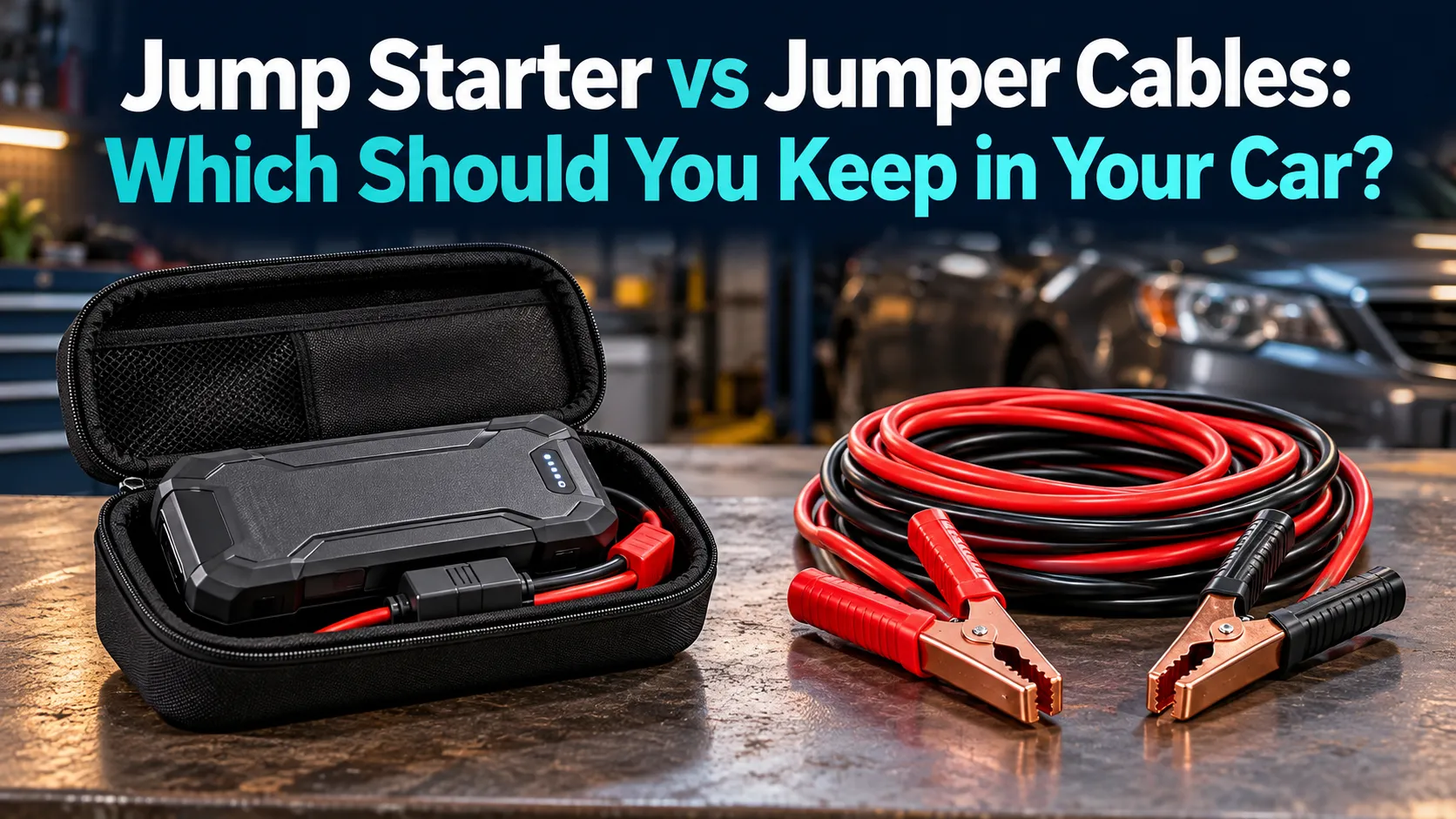
View the NOCO GB40 jump starter on AmazonA portable jump starter carries its own stored energy; jumper cables need a suitable external power source, commonly another vehicle. A compatible, charged jump pack is convenient when you are alone. Suitable cables can be a useful backup when an approved donor vehicle and safe working space are available. Neither option fixes a failed battery, and the vehicle manuals take priority over a generic connection sequence.
Choosing between a jump starter and jumper cables is really a decision about your emergency plan. Can you count on another suitable vehicle being nearby? Will you remember to check a rechargeable pack? Can you safely reach the approved jump points?
This buying guide focuses on those practical questions. It compares the tools without promising that either will start every car. Product discussion is based on manufacturer documentation, not our own hands-on testing. We do not assign a tested product rating.
Jump starter vs jumper cables at a glance
| Buying question | Portable jump starter | Conventional jumper cables |
|---|---|---|
| Where does power come from? | A charged internal battery | A suitable external battery or approved donor vehicle |
| Do you need another car? | Generally not for the starting attempt | Commonly yes in a vehicle-to-vehicle setup |
| What needs checking in storage? | Charge level, condition, cables, and temperature limits | Insulation, clamps, condition, and storage |
| Main practical limitation | An unsuitable or unready pack may not help | No donor, poor access, or unsafe positioning may prevent use |
| How do you choose? | Vehicle voltage, battery compatibility, engine guidance, and access | Application rating, conductor specification, length, and clamp access |
| Can it repair a failed battery? | No | No |
The table compares tool categories. It is not permission to connect any two vehicles, and it is not a universal jump-start procedure. Some vehicles have designated terminals or restrictions that change the appropriate setup.
When a portable jump starter makes more sense
You often park without another vehicle nearby
A jump pack can be a useful option if you park in an isolated lot, arrive before other drivers, or do not want your plan to depend on finding a suitable donor vehicle. Its main benefit is independence from that donor, not a guarantee of a successful start.
Think through a typical day. If the car fails to start after work, is help nearby? Would another vehicle be able to park safely beside it? If the answer is uncertain, a compatible pack may solve a practical problem that cables alone cannot solve.
Parking position makes vehicle-to-vehicle access awkward
A compact pack may be easier to position than a second car. That can matter in a garage, a tightly marked parking bay, or a driveway with limited maneuvering room. The pack’s own cables still need to reach the approved points.
Do not assume that “portable” means easy access on every vehicle. Check where the tool can sit, whether its clamps fit the terminals, and whether the hood can remain safely supported. Short leads or bulky clamps can be a poor fit even with a suitable electrical rating.
You can commit to keeping the pack ready
A jump starter becomes useful emergency gear only when it is maintained. Include it in a recurring vehicle-kit check, and follow the manufacturer’s instructions for recharging after use and during storage. A box that looks ready may have insufficient charge.
Before buying, decide who will maintain it and where its charging cable will be kept. If nobody will check it, a rechargeable device should not become the only backup plan. Roadside-assistance details should remain accessible regardless of the tools you carry.
When jumper cables still make sense
You have a realistic donor-vehicle plan
Cables can be useful when a suitable donor is available and both vehicle manuals permit the intended arrangement. They do not contain a battery that needs recharging. That makes them a different kind of backup, with different dependencies.
Availability is more than having a neighbor with a car. The donor must be suitable, the connection points must be accessible, and the vehicles must be positioned safely. Do not assume a hybrid or EV can act as a donor just because it has a low-voltage battery.
You want a second option in your kit
Some drivers carry cables alongside a pack. This can make sense when storage space permits and there is a genuine use case for both. For example, cables may be available if the pack is unready and an approved donor vehicle is safely accessible.
Carrying both does not double your certainty. They still require a suitable vehicle battery and correct setup. It also adds equipment to inspect and learn. Keep each tool’s instructions with it rather than assuming one generic procedure covers both.
You understand cable specifications
Choose cables using the manufacturer’s application guidance. Look for a clear conductor specification, appropriate length, sound insulation, and clamps that can securely reach the approved points. A thick outer jacket does not prove the cable contains an adequate conductor.
Do not turn one advertised gauge number into a universal rule for every engine and cable length. A longer run changes the electrical considerations. Compare documented suitability for your application and ask the manufacturer if its rating is unclear.
Three sensible buying routes
Start with a pack
Consider this route when you want donor-independent backup and will maintain the charge level. Verify voltage, chemistry, engine guidance, and physical access first.
Start with cables
Consider this route when a suitable donor and safe positioning are realistic. Buy a documented, suitable cable set and inspect it regularly.
Carry both
Consider this route when each tool has a defined role and you have room to store and inspect both. Keep a roadside-assistance plan too.
These are editorial decision routes, not a ranking from best to worst. Someone with a shared driveway has different needs from someone who parks alone on overnight shifts. The best tool for you is the one that fits your vehicle and a plan you will actually follow.
A portable jump starter to compare: NOCO GB40
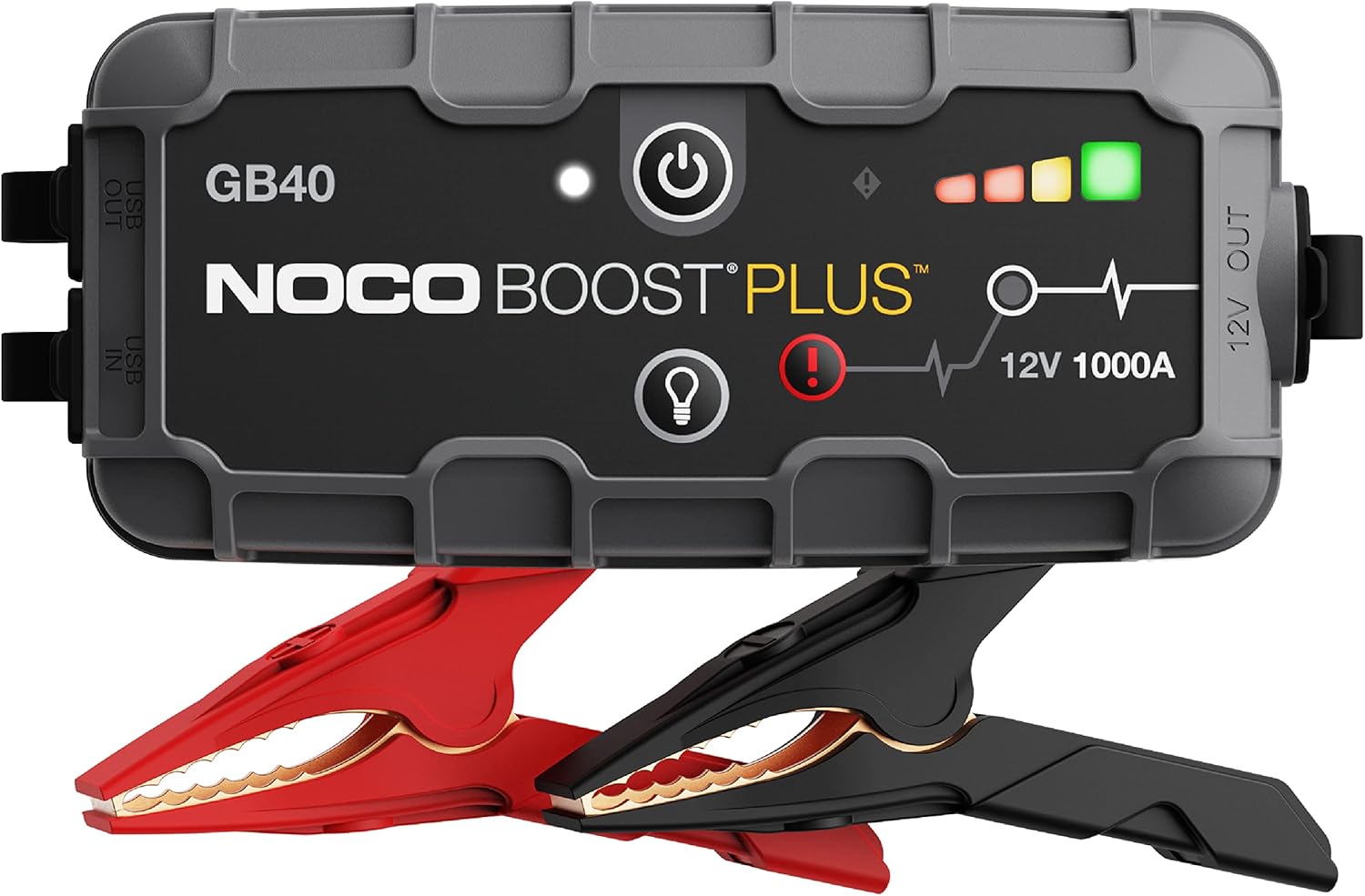
NOCO GB40 — check compatibility first
NOCO lists a 12V lead-acid battery application, 1,000 peak amps, and engine guidance up to 6.0L gasoline or 3.0L diesel. These manufacturer ratings do not guarantee a successful start in every condition.
Why consider it: a self-contained pack may suit drivers who do not want to rely on a donor vehicle.
Limitations: it must be charged and correctly matched to the vehicle. It is not a battery charger. Its lithium internal battery does not make it suitable for jumping a lithium vehicle battery.
Read NOCO’s specifications and operating guidance.
Check the exact NOCO GB40 model on AmazonWe use this model as a concrete example, not as a universal recommendation. If its ratings do not match your vehicle, compare an appropriate alternative. Check the exact model, seller, included accessories, and current documentation. We do not make price, discount, or best-seller claims.
What to check before buying either option
Read the vehicle manual before shopping
Find the jump-start section and identify any designated terminals, restrictions, and warnings. Your battery may be hidden or remote from the approved points. A photo of an engine bay on a sales page is not evidence that the clamps fit your vehicle.
Write down the system voltage and battery requirements. If you cannot identify them reliably, ask a qualified technician. Do not guess from engine size, the battery’s shape, or the color of a terminal cover.
Check the battery and tool instructions together
A tool’s vehicle category does not override the installed battery’s requirements. Battery chemistry matters, and some applications have special restrictions. Confirm that the battery and tool documentation support the planned use.
For a hybrid or EV, follow the exact vehicle manual for any auxiliary-battery assistance. Never connect the tools discussed here to a high-voltage traction battery. Do not assume that instructions for another model year or powertrain are interchangeable.
Plan physical access before an emergency
Locate the approved points while the vehicle is safely parked and no starting assistance is being attempted. Consider where you would place the pack or donor vehicle. Is there room to work without leaning into traffic or pulling a lead tight?
If access is awkward, solve it through approved equipment or professional guidance. Do not improvise high-current adapters, strain a terminal, or attach a clamp to a convenient-looking component. Physical convenience does not establish a safe electrical connection.
Safety comes before an attempted jump
Follow the vehicle, battery, and tool manuals. Do not attempt a jump if you cannot identify the correct points or safely position the equipment. Request roadside assistance when the location or setup is unsafe.
AAA’s jump-start guidance emphasizes personal safety, battery inspection, and appropriate equipment. Do not work in a position exposed to passing traffic. A nearby donor vehicle does not make a dangerous roadside location suitable for a jump attempt.
NOCO’s GB40 manual warns against jumping a damaged or frozen battery and requires appropriate ventilation and protection. Keep clamps and cables away from moving parts and avoid ignition sources near batteries. Follow the manual’s attempt and cooling limits rather than repeatedly cranking.
A warning indicator is a reason to stop and consult the manual. Manual Override is not a routine beginner step: NOCO explains that it disables safety measures. Do not override a fault simply because the engine has not started.
Do not infer battery health from a clicking sound alone. A no-start event can have several causes. If the tool reports a fault, the vehicle behaves unexpectedly, or you are uncertain about polarity, stop the attempt and seek help.
Keep the equipment usable between emergencies
For a portable jump pack
Follow its charge-level checks, recharging instructions, and temperature limits. For the GB40, NOCO recommends periodic charging during storage; consult the current care guidance for the exact schedule and conditions. There is no schedule that applies to every brand and chemistry.
Protect the pack from crushing, impact, moisture exposure beyond its rating, and direct sunlight. A parked car can be a harsh storage environment. Read the manufacturer’s storage limits rather than assuming the trunk is always suitable.
For jumper cables
Check for exposed conductor, damaged insulation, loose or damaged clamps, and contamination before use. Store the set so the clamps and leads do not get crushed by loose cargo. Damaged equipment should be replaced or assessed according to manufacturer guidance.
Uncoil and inspect the cables during a routine kit check. If they are tangled, inaccessible under luggage, or missing instructions, they may be difficult to use when needed. A storage bag is useful only if the equipment remains easy to retrieve.
For either option
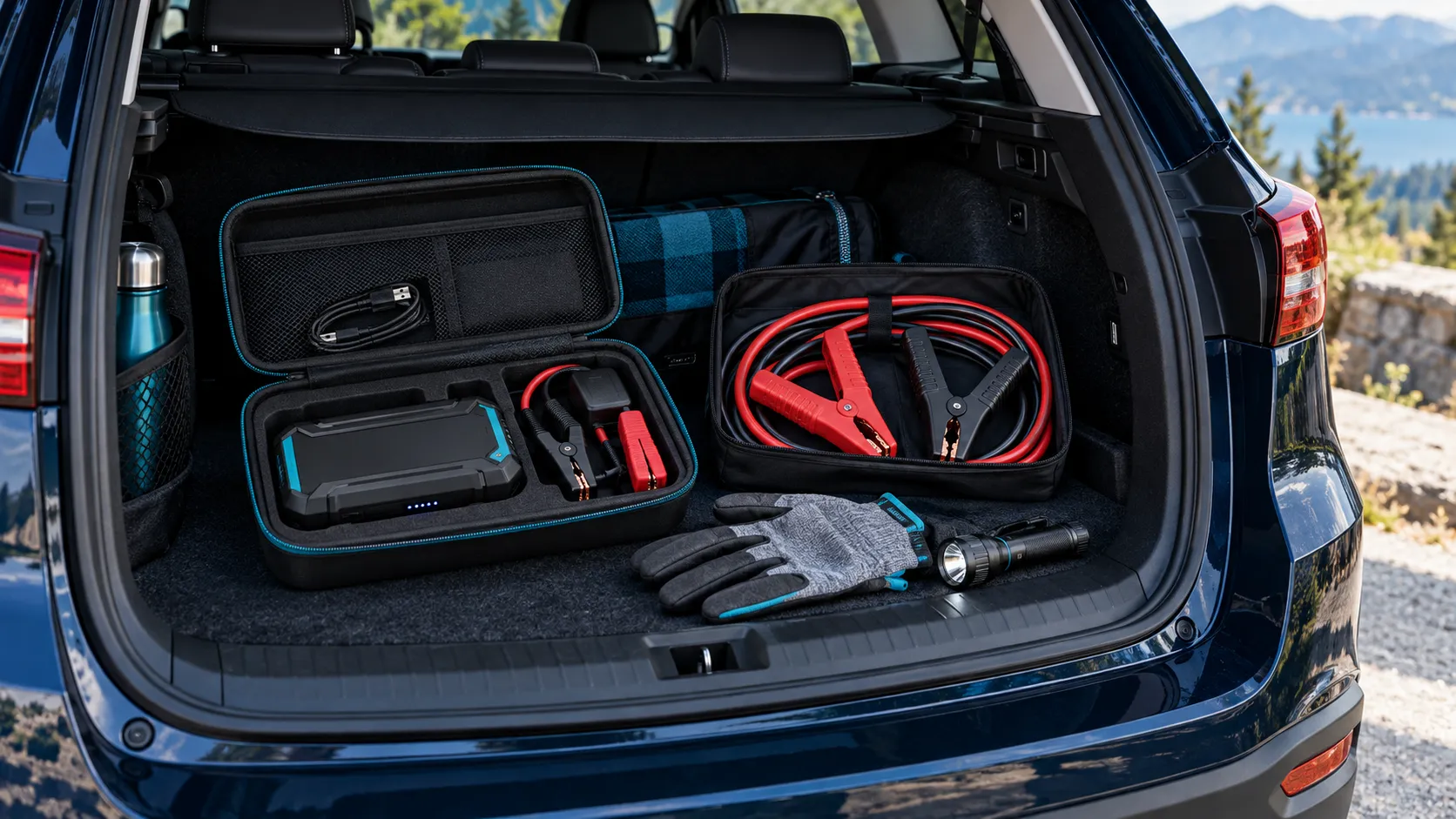
Keep the instructions available offline where practical. Save your roadside-assistance contact details and know how to describe your location. Include a flashlight and appropriate protective equipment in the kit, but do not treat accessories as a substitute for safe working conditions.
AAA includes jumper cables or a jump pack in its emergency-kit recommendations. The broader lesson is to prepare before a breakdown, with equipment matched to the vehicle and a plan for situations where you should not attempt the work yourself.
After the engine starts, investigate the cause
A successful jump is a result under that set of conditions, not a battery-health certificate. If the car repeatedly needs assistance, arrange professional testing of the battery and charging system. Repeatedly relying on a pack or donor can hide an unresolved issue.
Keep useful observations: how long the car was parked, whether accessories were left on, any dashboard warnings, and whether it restarts later. Share these with the technician rather than deciding that one particular component must be at fault.
If your goal is planned recharging, use our jump starter vs battery charger guide. A starting tool is not a replacement for a compatible charger or an approved maintenance plan.
Build a kit around separate jobs
Starting assistance and tire inflation solve different problems. If you are adding a pump, our cordless inflator guide for car tires explains that buying decision. Our tire-pressure checklist covers routine pressure checks.
Do not assume a jump pack’s phone-charging output can run an inflator. Check the voltage, current, connector, and approved accessory support for both devices. Combining jobs in your kit does not make their power requirements interchangeable.
Frequently asked questions
Are jump starters better than jumper cables?
A compatible, charged pack is more independent of another vehicle. Cables can be useful with a suitable donor and safe access. Choose around your circumstances and maintenance habits.
Should I keep both in my car?
You can if you have a clear role for each and suitable storage. Inspect both, follow the pack’s charge checks, and keep a roadside-assistance plan.
Can jumper cables work without another car?
They need a suitable external power source. They do not store starting energy themselves. Follow approved equipment and vehicle instructions rather than improvising a source.
Can a hybrid or EV be used as a donor?
Do not assume it can. Check the donor vehicle’s exact manual and the receiving vehicle’s requirements. Some vehicles restrict this use.
Will either tool fix a bad battery?
No. Starting assistance does not repair a failed battery or establish battery health. Repeated starting trouble requires diagnosis.
What if the jump pack will not detect the battery?
Stop and consult its manual. Confirm compatibility and approved connections. Do not casually enter an override mode that disables protections.
Final recommendation
For donor-independent roadside backup, consider a compatible jump starter that you will keep ready. For a realistic donor-vehicle setup, suitable jumper cables remain useful. Carry both only when both have a practical role, and request help when safety or compatibility is uncertain.
Research references: NOCO GB40 specifications; GB40 operation and care; GB40 user guide; AAA jump-start guidance; AAA safe starting advice; AAA emergency-kit recommendations.