

As an Amazon Associate, Best Auto Products earns from qualifying purchases. We may also earn a commission from Walmart links.
The best dual action polisher for beginners is the one you can equip properly, control comfortably and learn to use on the work your car actually needs. Our starting shortlist is the Griot’s Garage G9 for a first garage setup, the Meguiar’s MT300 for buyers following its documented pad-and-product process, and the RUPES LHR15 Mark V for committed learners considering a premium long-throw machine.
Our first-buy recommendation: Compare a complete G9 setup before spending more on a specialist machine. Consider the MT300 when its compatible consumables and instructions suit your plan. Move to the LHR15 Mark V when you have room in the budget for suitable pads, lighting and training as well as the machine. These are recommendations by buying scenario, not results from a hands-on competition.
How we selected: We reviewed manufacturer product information and Meguiar’s published MT300 process guide on November 22, 2026. We compared the buying decisions a new owner must make: working size, setup complexity, accessory compatibility and complete cost. We have not tested these tools side by side or measured correction speed, vibration or durability. Illustrations are AI-generated concepts, not photographs of our testing.
Jump to: Three picks · G9 · MT300 · RUPES · Starter kit · First session · FAQ
Best dual action polisher for beginners: 3 buying choices
| Model | Useful starting point | Who should consider it | Purchase check |
|---|---|---|---|
| Griot’s Garage G9 | 9 mm orbit; standard 6-inch backing plate | A first full-size machine for a home garage | Confirm 10901, voltage and included accessories |
| Meguiar’s MT300 | Documented process using DBP5 5-inch backing plate | A learner who wants to follow the compatible Meguiar’s system | Check whether the selected offer includes the plate and pads |
| RUPES LHR15 Mark V | 15 mm orbit; 125 mm / 5-inch backing pad | A committed beginner planning regular polishing | Match the US version and exact kit suffix |
Start by choosing a role, then a model. A first machine should match the broad painted areas you expect to maintain. A compact precision polisher can be useful later, but buying one first may leave the hood, roof and doors poorly matched to the setup. A beginner kit also needs consumables; an expensive bare tool is only part of the purchase.
Griot’s Garage G9: our first-setup starting point
The G9 is the first model we would put on a new garage owner’s comparison list. Its role is straightforward: a full-size corded machine for the open sections of a vehicle. That makes it a practical starting point when the buyer has yet to build a polishing system and wants to direct part of the budget toward pads and instruction.
Griot’s identifies the G9 as item 10901 and lists a 9 mm orbit with a standard 6-inch backing plate. The manufacturer also describes its compatible 5-inch plate as an option. Verify the exact regional electrical version and supplied contents on the official G9 product page. An optional plate is not automatically included in every retailer kit.
Why it belongs on this shortlist: You can build the purchase around one main machine and a modest pad supply. If you are learning on a family car, the important early decision is whether the complete setup fits your panels and storage. You do not need a second machine, several aggressive pad types and a large collection of compounds before you understand your first test area.
Reasons to compare another option: You may prefer a different grip or a different pad system. Try the tool in a supported working configuration at a dealer or training event if possible. We cannot declare it more comfortable than the alternatives without testing. A conventional specification table cannot tell you how your arms and wrists will feel during a session.
Read our Griot’s Garage G9 review for the model’s buying considerations. If you have seen the smaller G8 while shopping, the G8 vs G9 comparison explains why the two machines serve different jobs.
Meguiar’s MT300: consider it for a documented system
The MT300 is worth considering when you want to choose the machine alongside a compatible, documented pad-and-product process. A beginner can find that structure helpful because it reduces the temptation to mix unrelated advice from several product listings. The value is in understanding the whole process rather than buying a machine because one headline specification looks larger.
Meguiar’s published MT300 paint correction process guide refers to its DBP5 5-inch backing plate and gives different product pathways for different paint conditions. It also directs users to read the owner’s manual. That process document is a planning reference, not a guarantee that a seller includes the plate, pads or liquids shown in it.
Why choose it: You already intend to use compatible Meguiar’s consumables, can obtain replacement pads locally, and find the instructions easy to follow. Being able to identify the exact plate and matching pads is useful for a first order. It is easier to plan a repeatable test when you know which part each item is supposed to play.
What to check: Read the actual contents list. Some offers emphasize the machine; others bundle accessories. Do not infer the box contents from an example photograph or from a process PDF. Check the electrical specification, seller, returns and parts availability too. A bundle is attractive only when its useful contents compare favorably with buying the required items separately.
Our Meguiar’s MT300 review explores the alternative in more detail. Choose the G9 or MT300 after comparing complete usable setups and the support you can obtain; we have no controlled test establishing a correction-speed winner between them.
RUPES LHR15 Mark V: a premium option for committed learners
The LHR15 Mark V can make sense for a beginner who has already decided to learn properly and expects to polish regularly. Its price and professional positioning do not make it an automatic first recommendation. The relevant question is whether purchasing the machine still leaves enough budget for compatible pads, preparation products, inspection and suitable instruction.
RUPES lists a 15 mm orbit and a 125 mm backing pad for the LHR15 Mark V. Its documentation lists multiple packages, while US listings use regional model codes. Check the manufacturer’s LHR15 Mark V specifications and the exact offer rather than treating every “LHR15” listing as the same generation or kit.
Why consider it: You want to build around this system, can get the correct consumables, and value the available training or dealer support. A premium machine is easier to justify when there is a clear plan for learning and ongoing use. That is a stronger reason than assuming the longest throw will automatically produce the best finish for an inexperienced operator.
Reasons to wait: If the machine consumes the entire budget, you may be better served by a less expensive complete setup. Do not buy a large kit for the accessory count alone. Value each supplied item against the jobs you intend to do. We have not measured the Mark V’s vibration or compared its finish quality against the G9 and MT300.
See our RUPES LHR15 Mark V review before choosing a package. The FLEX vs RUPES comparison is useful if you have already narrowed your purchase to premium 15 mm machines.
What a beginner polisher kit really needs
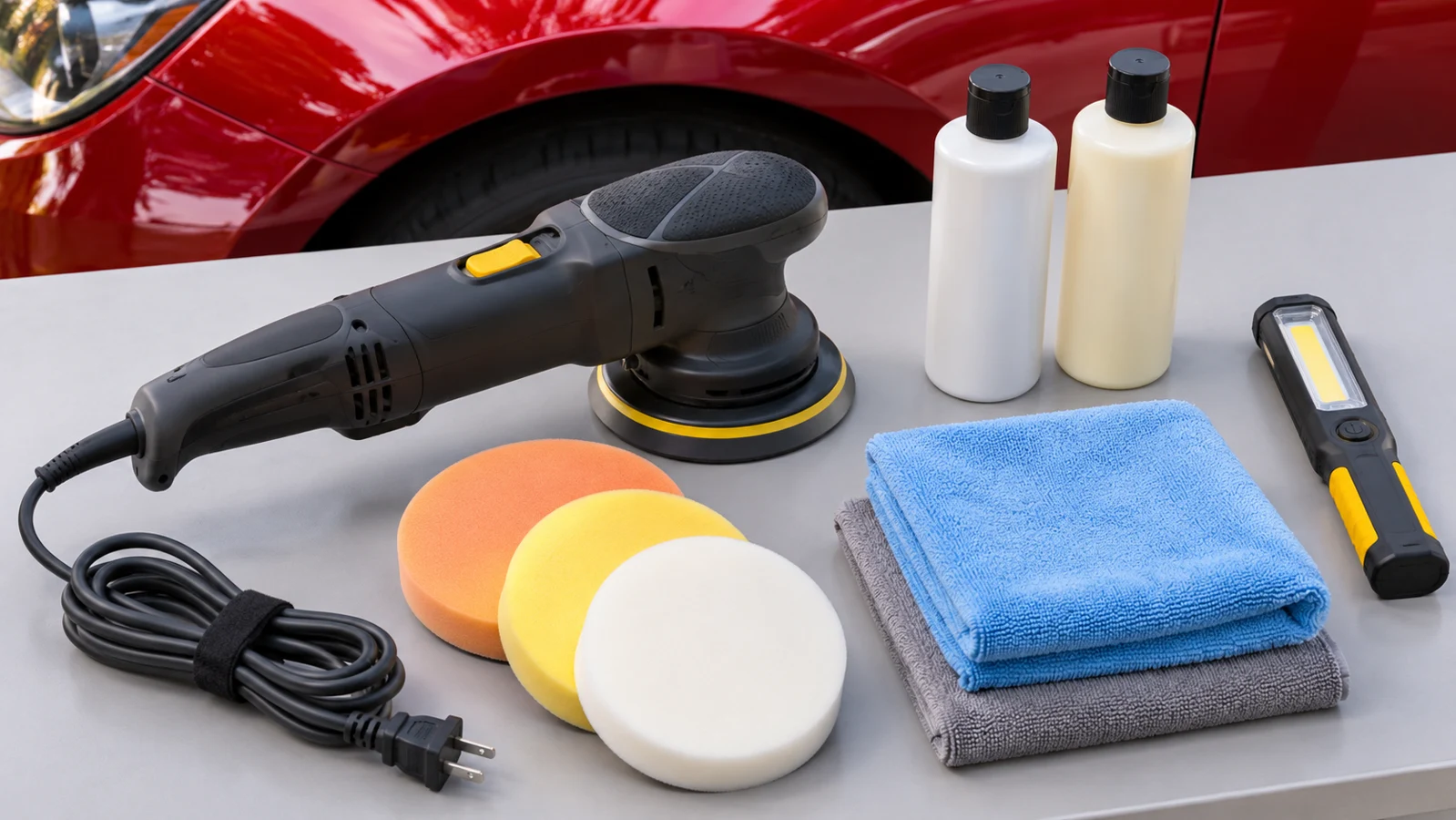
| Item | What to verify before ordering |
|---|---|
| Machine and power arrangement | Correct regional voltage, plug and manufacturer-approved supply arrangement |
| Backing plate | Exact approved fitment and whether it is supplied |
| Pads | Compatibility with plate and polish; enough clean replacements for the planned session |
| Polish and protection | Products appropriate to the finish and intended result |
| Preparation supplies | Wash, drying and any condition-appropriate preparation |
| Inspection light and towels | Ability to inspect consistently and remove residue with clean equipment |
Calculate the delivered total for that list using the same address and delivery assumptions for every model. Include shipping and tax. If you already own a compatible item, count it only after verifying its fitment and condition. If a kit contains duplicate or unwanted products, do not treat their advertised retail values as money you have necessarily saved.
For an illustrative budget exercise, a $200 tool plus $100 of supplies totals $300; a $280 package that covers all the same useful items would cost less to start. Those figures are hypothetical arithmetic, not current product prices. Make your own comparison from the actual contents and checkout totals on the day you order.
5-inch vs 6-inch pads: what should a beginner choose?
Select a supported plate and pad combination around the vehicle’s shapes. The pad face can be larger than the backing plate, and the orbit adds movement around the working position. Check the full arrangement rather than matching the nominal number printed on two packages. Avoid fitting an unsupported small plate merely because it appears to screw onto the tool.
A broad open panel and a narrow section beside trim are different tasks. If the main machine cannot sit in a controlled position, reassess the approach or leave that area for appropriate hand work. You can evaluate a specialist later with our mini polisher buying guide. It is usually sensible to learn the main machine before expanding the collection.
Your first polishing session: plan the test before the whole car
1. Decide what improvement is enough
Choose a realistic result for the vehicle and its finish. A daily driver does not necessarily need every visible mark removed. Identify uncertain repairs, chips, exposed edges and damaged areas before selecting a process. When the condition is unclear, a qualified detailer can assess the finish in person; a buying guide cannot establish how much material is safe to remove.
2. Prepare and inspect a manageable area
Follow the vehicle, machine and chemical instructions for the surface and working conditions. Wash and dry appropriately, inspect under consistent light, and carry out further preparation only where needed. Start with a small accessible test area and a conservative compatible pad-and-polish combination. Do not transfer speed, pressure or pass-count advice from an unrelated tool and product system.
3. Inspect the result before repeating it
Remove residue as the product directs and compare the area under the same light. Decide whether the improvement is sufficient before increasing aggressiveness. Watch the pad condition and follow its cleaning or replacement instructions. Disconnect the relevant power source before accessory changes. Stop if the setup behaves unexpectedly or the surface condition gives you reason to doubt the process.
Pads and lighting can matter more than the next tool upgrade
The pad is part of the working system, so match it deliberately. Our foam vs microfiber vs wool pad guide explains the material choices. A beginner does not need to start with the most aggressive option. Buying enough appropriate clean pads can be more useful than buying a second machine before completing the first planned session.
Organize cleaning before you start. Keep used pads separate from clean ones and follow the relevant care instructions; our polishing pad cleaning guide covers the workflow. Inspection lighting also makes your decisions more consistent. The SUNMATCH 4 review discusses a handheld light if you are considering a dedicated option.
A coating gauge needs careful interpretation. On supported materials, a common gauge reports total coating thickness rather than isolated clear coat, and many do not measure plastic panels. Read our paint thickness gauge guide before treating a reading as permission to keep polishing. Equipment helps you gather information; it does not remove uncertainty about previous repairs or finish condition.
Shopping checks that prevent an expensive first-order mistake
Our retailer buttons open searches, so confirm the selected result carefully. A search can return accessories, older models or different electrical versions. Match the full model code, generation, kit contents and seller. Compare returns and warranty eligibility for that specific offer. We have not verified live stock or a like-for-like lowest delivered price, and neither retailer is declared the cheapest here.
Keep the first order tied to your actual plan. If the offer is unclear about a required plate, ask the seller before paying. If training or local support is important, assess that alongside the delivered total. A purchase that saves a little on the tool but makes the required pads difficult to obtain may be inconvenient throughout ownership.
Frequently asked questions
What is the best dual action polisher for beginners on this shortlist?
The G9 is our first comparison point for a conventional home-garage setup. The MT300 makes sense for a buyer following its compatible documented system, while the LHR15 Mark V is worth considering when regular use and a full equipment budget justify a premium purchase. These are research-based buying judgments.
Can a dual action polisher damage paint?
Yes. Tool type alone does not guarantee a safe result. Finish condition, accessories, technique and the selected process matter. Read the supplied instructions, learn on an appropriate test area and seek qualified help when paint condition or previous repair history is uncertain.
Should a beginner buy a long-throw polisher immediately?
Only when the complete setup, learning plan and intended work justify it. A longer orbit is a configuration difference, not a promise of an easier first session. Preserve a budget for pads, preparation, inspection and instruction rather than treating the machine as the entire project.
Do I need a mini polisher in my first kit?
Usually assess your main machine first. Add a mini when recurring small-area work reveals a clear gap. Hand finishing can remain appropriate for some awkward sections. A compact tool is an additional access choice and may cover large open panels less efficiently.
Should I choose an Amazon or Walmart bundle?
Choose the verified offer that supplies the exact equipment you need with acceptable seller, return and support terms. Add missing items before comparing totals. Search results and bundle photographs do not establish current availability or complete box contents.
Our final buying recommendation
Begin by pricing a complete G9 setup and a comparable MT300 setup. Choose the one whose supported accessories, handling and available guidance fit you best. Consider the LHR15 Mark V when you have a clear reason for a premium system and enough remaining budget to equip and learn it properly. Buy the process you can complete, rather than the largest accessory count.
Sources checked November 22, 2026: Griot’s Garage G9 product information; Meguiar’s MT300 paint correction process guide; RUPES LHR15 Mark V documentation, linked above. Confirm current US specifications and exact seller packages before ordering.

1 thought on “Best Dual Action Polisher for Beginners: 3 Smart Picks”