
A cooler can make a road trip easier, but the wrong one becomes an awkward piece of luggage. A large chest may swallow the space needed for an overnight bag. A small shoulder bag may be comfortable to carry yet leave little room for lunch once you add ice packs. The useful question is how the cooler fits your actual travel routine.
This soft cooler vs hard cooler guide compares the tradeoffs that matter in a car: usable space, carrying, access, cleaning, and the plan for keeping food cold. It also includes two practical product examples. Recommendations are editorial judgments based on published product information; we have not performed hands-on or ice-retention testing.
Quick answer: which type fits your trip?
Choose a soft cooler when you regularly carry a modest lunch or drinks from the parking lot to a picnic spot. Choose a hard cooler when a defined cargo footprint and a rigid compartment suit your packing routine. Either type needs an appropriate cold source and temperature checks for perishable food.
For many drivers, the best starting point is the smallest cooler that holds the planned food plus cooling supplies and still opens easily in the loaded car.
Affiliate disclosure: As an Amazon Associate I earn from qualifying purchases. If you buy through the links below, we may earn a commission at no additional cost to you.
View Titan 30 Can Navy cooler on AmazonSoft cooler vs hard cooler at a glance
| Decision | Soft cooler | Hard cooler |
|---|---|---|
| Typical appeal | Bag-style carrying and smaller outings | A rigid compartment for planned cargo |
| Storage shape | Some fold; models with rigid liners may not | Usually keeps its full external footprint |
| Carrying | Check strap, handles, and loaded comfort | Check handle reach and loaded lifting |
| Food organization | Pockets or a shelf may help, depending on model | Containers and dividers can organize a deep chest |
| Cleaning | Inspect liner, corners, seams, and drying access | Inspect corners, lid, and any drain |
| Cold performance | Depends on the specific cooler and conditions | Depends on the specific cooler and conditions |
Start with your route and meal plan
Before comparing brands, write down what the cooler needs to do between reliable opportunities to restock ice or refrigerate food. A morning drive with a picnic lunch is different from a remote itinerary with several overnight stops. Count the food you intend to carry, rather than assuming every trip needs a larger cooler.
For a day outing, think about the journey on foot as well as the journey by car. If you carry everything to a beach, a manageable bag may be more useful than spare interior volume. If the cooler remains beside the car during planned stops, lifting it briefly may matter more than a shoulder strap.
For an overnight drive, decide what happens at the destination. Check whether you can refrigerate the food and refreeze packs. If you cannot, include a realistic resupply stop. Buying a different shell does not replace a plan for cold storage.
Consider the passengers, too. Two adults carrying separate water bottles may need very different cooler space from a family bringing several lunch containers. Lay out those containers at home. Their shapes often tell you more than the advertised can count.
Why a soft cooler can work well in a car
A soft cooler is worth considering when portability drives the decision. Bag-style handles and straps can suit a short walk from a parking area to a table. That is an editorial use case, not a promise that every soft cooler is comfortable when fully loaded.
Look closely at how the bag stays open while you pack it. A narrow opening can make it frustrating to arrange rectangular meal containers. Outside pockets may be convenient for napkins or utensils, but do not assume they provide the same cooling as the main compartment.
Do not assume that a fabric exterior means the bag folds flat. Some soft coolers contain rigid liners. Those liners can help organize the interior while also making the bag less flexible to store. Decide whether you want a collapsible bag or a structured bag before paying for either.
Check the closure carefully. A zipper, flip-open lid, or roll-top creates a different daily routine. Think about carrying the cooler upright, putting it down, opening it, and removing one container. A design that seems clever online should still match those ordinary movements.
When a hard cooler makes more sense
A hard cooler is a reasonable choice when you want a fixed shape that can be planned into your cargo layout. Its outer dimensions are less likely to change as you add soft packages, although the exact lid, handle, and fittings still determine whether it fits your car.
A deep chest may suit a small group sharing one supply of drinks and meal containers. The tradeoff is reaching the items at the bottom. Pack by the order in which you expect to use the contents, or divide them into clearly organized containers.
Look at the lifting motion rather than judging the empty cooler on a store shelf. You may need to lift it over a trunk lip with a loaded bag beside you. Choose a size you can handle safely, and ask for help when the loaded weight is awkward.
A rigid lid is not automatically a seat or a step. Only use a cooler for sitting or standing if its manufacturer specifically allows that use and provides the applicable limits. The product’s appearance is not enough evidence.
Two cooler options to compare
These examples illustrate two buying routes rather than a laboratory ranking. Check the selected size and color at the retailer before ordering; the same listing can include several capacities. Availability and specifications may change.

Titan by Arctic Zone 30 Can Zipperless HardBody Cooler
Consider it for: a structured soft cooler with a shoulder-carrying option. The manufacturer lists a removable HardBody liner, SmartShelf, and flip-open Zipperless lid.
Useful benefit: the shelf can separate delicate food from harder items. Limitation: the rigid liner means you should not assume this bag stores flat. Confirm the current Navy 30 Can variant.
The current manufacturer page and the Amazon title differ on advertised ice-retention duration. We do not treat either duration as a food-safety guarantee or as a tested result.
Check Titan Navy 30 Can details on Amazon
Coleman Chiller 30-Quart Portable Cooler
Consider it for: a straightforward rigid chest. Coleman lists TempLock insulation, a large-grip bail handle, and a smooth top for wiping clean.
Useful benefit: the fixed shape is easy to measure into a cargo plan. Limitation: it occupies its external footprint even when empty; the listed model has no wheels.
Coleman’s stated capacity is up to 25 cans with 15 pounds of ice. This is a packing specification, not a promise that your food containers will fit the same way.
Check Coleman Ocean Blue 30qt details on AmazonMeasure the car before choosing capacity
Measure the usable cargo area with the seats in their normal travel positions. Account for the trunk opening, not only the space beyond it. A cooler that fits inside may still be difficult to pass through the opening or rotate around other bags.
Allow room for the lid to open and the handle to move. Make a simple cardboard footprint or arrange empty boxes to represent the cooler. Try your regular suitcase beside it. This is an inexpensive way to discover that a seemingly small size difference changes the entire packing arrangement.
Check access after loading. If every lunch stop requires unloading the car, you may prefer a smaller day cooler plus a separate supply container. That approach uses more than one item, so compare the combined footprint before assuming it saves space.
Place cargo so it does not interfere with pedals, controls, seat adjustment, seat belts, or visibility. Follow your vehicle owner’s manual for cargo placement and restraint. A carry handle or shoulder strap is not automatically a rated vehicle tie-down point.
Can count is not a complete packing plan
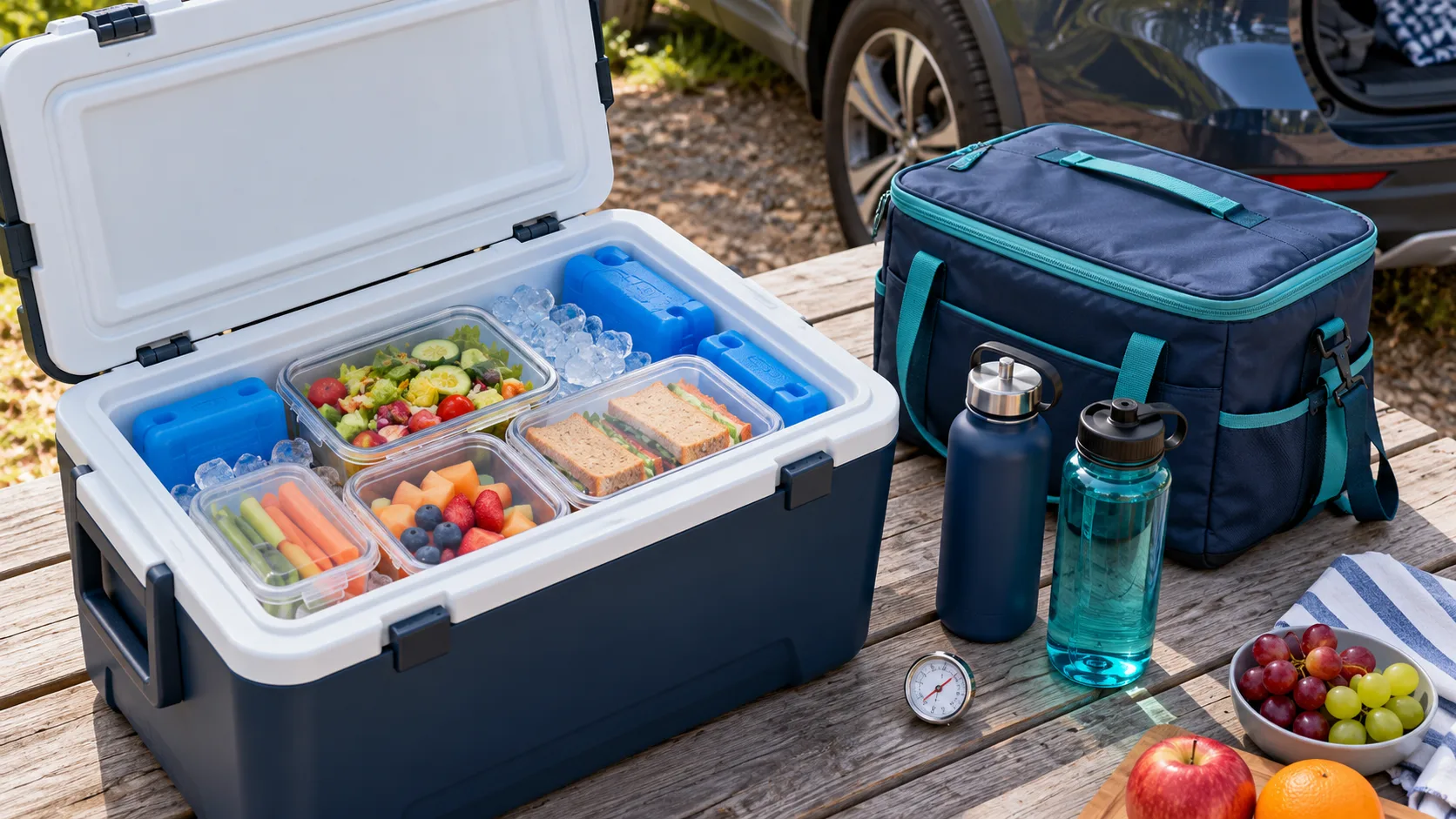
Can ratings are useful only when you understand the stated packing conditions. Do not equate a 30-can bag with a 30-quart chest. Those numbers describe different things, and ice, shelves, bottles, and lunch containers all compete for usable room.
Try a realistic layout using the actual containers you plan to bring. Include cooling supplies at the beginning, rather than filling the space with food and hoping a small pack will fit at the end. Leave enough clearance to close the lid properly without forcing it.
Keep weight in mind as well as volume. Water bottles and ice add up quickly. If the cooler becomes inconvenient to lift when packed, a larger model is unlikely to improve the travel experience. Change the load or carrying plan instead.
Keep perishable food cold: temperature matters
Food-safety baseline: FDA guidance says to keep cold perishable food at 40°F or below. Use a suitable thermometer rather than relying on how cold the bag feels. Food left unrefrigerated should not remain out longer than two hours, or one hour when the outdoor temperature is above 90°F. Follow the linked guidance for the food you carry; when safe temperature control is uncertain, discard it.
Use chilled food and sufficient ice or frozen packs. Separate raw items from ready-to-eat food in secure containers, keep the cooler closed between uses, and consider separate drink storage to reduce repeated opening of the food compartment. These steps follow FDA outdoor food-handling guidance.
Make the thermometer easy to read at stops. Decide before leaving where you can obtain more ice or move food into reliable refrigeration. Treat a disappointing temperature reading as a reason to act, not a reason to search for a more reassuring marketing claim.
Cleaning and storage after the drive
Choose a cooler you are willing to clean after every trip. Inspect how easily you can reach corners and remove any permitted liner or shelf. Follow the manufacturer’s cleaning instructions, especially for fabric, insulation, closures, and removable components.
Empty the cooler promptly at home. Check under removable parts and around the closure for forgotten packaging or residue. Dry it thoroughly as directed before closing it for storage. A clean interior is less useful if hidden moisture remains trapped for weeks.
Keep a separate cleanup cloth for food-area spills and avoid reusing a dirty automotive cloth inside the cooler. Our microfiber vs cotton towel guide discusses separating towels by task. Road-trip food cleanup deserves its own clean supplies.
Buying checklist for your next road trip
- Write the load: list people, meals, bottles, containers, and cold sources.
- Measure the route through the car: check the opening, final footprint, and lid clearance.
- Plan the carry: consider the walk, loaded weight, and handle position.
- Read the exact variant: confirm size and color rather than trusting a shared listing title.
- Check the full routine: packing, access at stops, cleaning, drying, and storage.
- Budget for the system: include suitable cold packs, containers, and a thermometer.
Keep your broader preparation separate from cooler shopping. A food-storage upgrade does not address a weak starting battery or missing roadside equipment. If you are deciding what battery emergency gear belongs in the car, read our jump starter vs jumper cables comparison before adding another bulky accessory.
Frequently asked questions
Does a hard cooler always keep food colder?
No general shell label proves that. Compare the specific design and published test conditions, then monitor your own food-storage temperature. This guide does not rank the examples by measured cooling performance.
Can I leave a cooler in a parked car all day?
Do not assume the contents remain safe for that period. Plan for actual conditions and verify temperature. For extended unattended storage without reliable monitoring and cold replenishment, choose a different food plan.
Do all soft coolers fold flat?
No. Some have rigid liners, frames, or shaped bases. Check the manufacturer’s storage instructions and collapsed dimensions, if provided, before treating a bag as a space-saving choice.
Should I buy one large cooler or two small ones?
Choose based on your cargo layout and access routine. Separate food and drink storage can be convenient, but two containers may occupy more total space. Measure the combined arrangement.
Is a shoulder strap enough reason to choose a soft cooler?
It is one factor. Consider how the packed load sits against your body, whether handles are also available, and the distance you carry it. Avoid choosing capacity beyond what you can comfortably manage.
Which of these two should I choose?
Consider the Titan if a structured bag and shelf match your meal routine. Consider the Coleman if a simple rigid chest fits your cargo layout. If your existing cooler already meets those needs, keep it and improve your packing and temperature-check routine first.
Sources and how we selected these options
We checked the Titan manufacturer product page, the Coleman Chiller product page, the linked retailer variants, and FDA guidance. Product features are attributed to their sources. The trip scenarios and buying advice are editorial recommendations, not results from a comparative test. Prices, stock, and shared-listing selections should be checked when purchasing.

1 thought on “Soft Cooler vs Hard Cooler for Road Trips”