
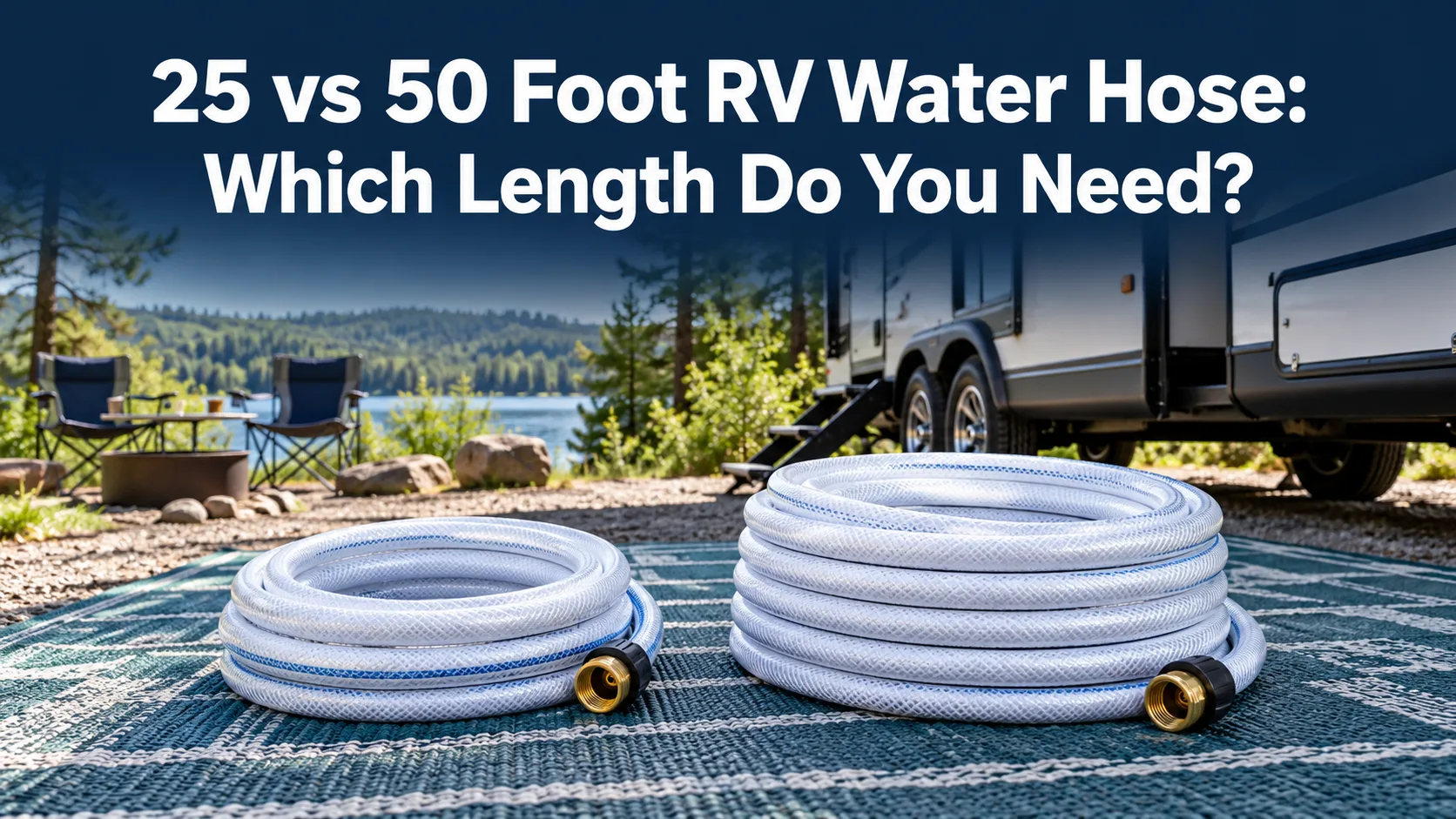
A 25 vs 50 foot RV water hose decision sounds simple until the campground faucet is on the wrong side of the site. A short hose can leave you unable to reach the connection. A long hose can leave an extra coil to handle and store every time you pack up. The right length starts with your actual route from the water supply to the RV inlet.
This guide explains how to measure that route, compare one long hose with two shorter sections, and choose a practical storage plan. It includes two Camco TastePURE examples with verified model numbers. We have not performed hands-on testing, measured flow rates, or tested these hoses for contaminants. Product specifications come from published sources; the buying recommendations are editorial judgments.
Quick answer: choose by usable reach
Choose 25 feet when your measured campsite route fits comfortably within that length and a compact setup is your priority. Choose 50 feet when the route genuinely needs more reach or you regularly visit unfamiliar sites with distant connections.
Consider two compatible 25-foot drinking-water hoses if you want to deploy a short section most of the time and add reach occasionally. The tradeoff is an extra joint to connect, inspect, and keep clean.
Affiliate disclosure: As an Amazon Associate I earn from qualifying purchases. We may earn a commission from purchases through the links below, at no additional cost to you.
View Camco 25-foot TastePURE hose on Amazon25 vs 50 foot RV water hose comparison
| Buying question | 25-foot hose | 50-foot hose |
|---|---|---|
| Best starting use case | Measured routes with comfortable spare reach | Longer routes and more distant hookups |
| Handling | Less hose length to deploy and gather | More hose length to manage at short hookups |
| Storage planning | Check the actual coiled dimensions | Allow space for the longer coil |
| Connection count | One section between accessories | One section between accessories |
| Occasional extra reach | May need another compatible section | May cover the route without an extension |
| Pressure control | Use the RV manufacturer’s requirements | Extra length does not replace a regulator |
Measure the hose route, not the straight-line gap
Start at the supply connection and follow the path the hose can actually take to your RV. A direct line on a campsite map may pass under a wheel, across a walkway, or around a piece of equipment. Those obstacles change the usable route.
Use a tape measure or a measured piece of string for planning. Include turns and enough slack to avoid pulling on the inlet or faucet. Do not choose a hose that reaches only when stretched tight between fittings. Leave room to make and undo connections without forcing the hose into a sharp bend.
Check where the RV’s city-water inlet sits relative to the parking space. A connection near the rear of one vehicle can be far from the inlet on another. The vehicle’s overall length alone does not tell you the hose length required.
For example, an 18-foot planned route may make a 25-foot hose a reasonable starting option. A 32-foot route cannot be served by one 25-foot section. These are simple planning examples, not claims that a particular campground or RV always needs that length.
Before buying for a reservation, ask the campground about the water hookup location if the listing is unclear. A quick clarification can be more useful than buying the longest hose available and hoping it solves every layout.
When a 25-foot hose is the practical choice
A shorter hose is worth considering when you normally return to known campsites or already know the route between your inlet and the supply. It reduces the amount of hose you need to lay out and gather during an ordinary setup.
Think about the person who handles the equipment. If one person manages arrival and departure, a smaller section may be easier to organize alongside the other jobs. That is a workflow preference rather than a tested claim about any specific hose’s weight or flexibility.
A 25-foot option can also suit an owner with a limited storage compartment, but check the real coil size. Material, diameter, couplings, and minimum bend requirements affect the stored shape. Do not assume every 25-foot model fits the same bag or shelf.
The limitation is reach. If you repeatedly need to reposition equipment or strain a connection to make a short hose work, the setup needs changing. A smaller purchase is not a saving when it fails to serve the route safely.
When a 50-foot hose earns its storage space
A longer hose is useful when the measured route exceeds the shorter option or when your travel routine regularly includes unfamiliar hookup locations. It provides more routing options within its usable length, without adding a mid-hose coupling.
It can be a sensible choice for a traveler who would rather handle one longer section than join two shorter ones. The value is convenience for that person’s routine. It is not evidence that a 50-foot hose is universally better or more durable.
At close hookups, the spare length still needs a sensible place to go. Plan a route that keeps connections accessible and does not create a trip hazard. Follow the hose manufacturer’s routing and use instructions rather than assuming a tightly twisted coil is acceptable under every condition.
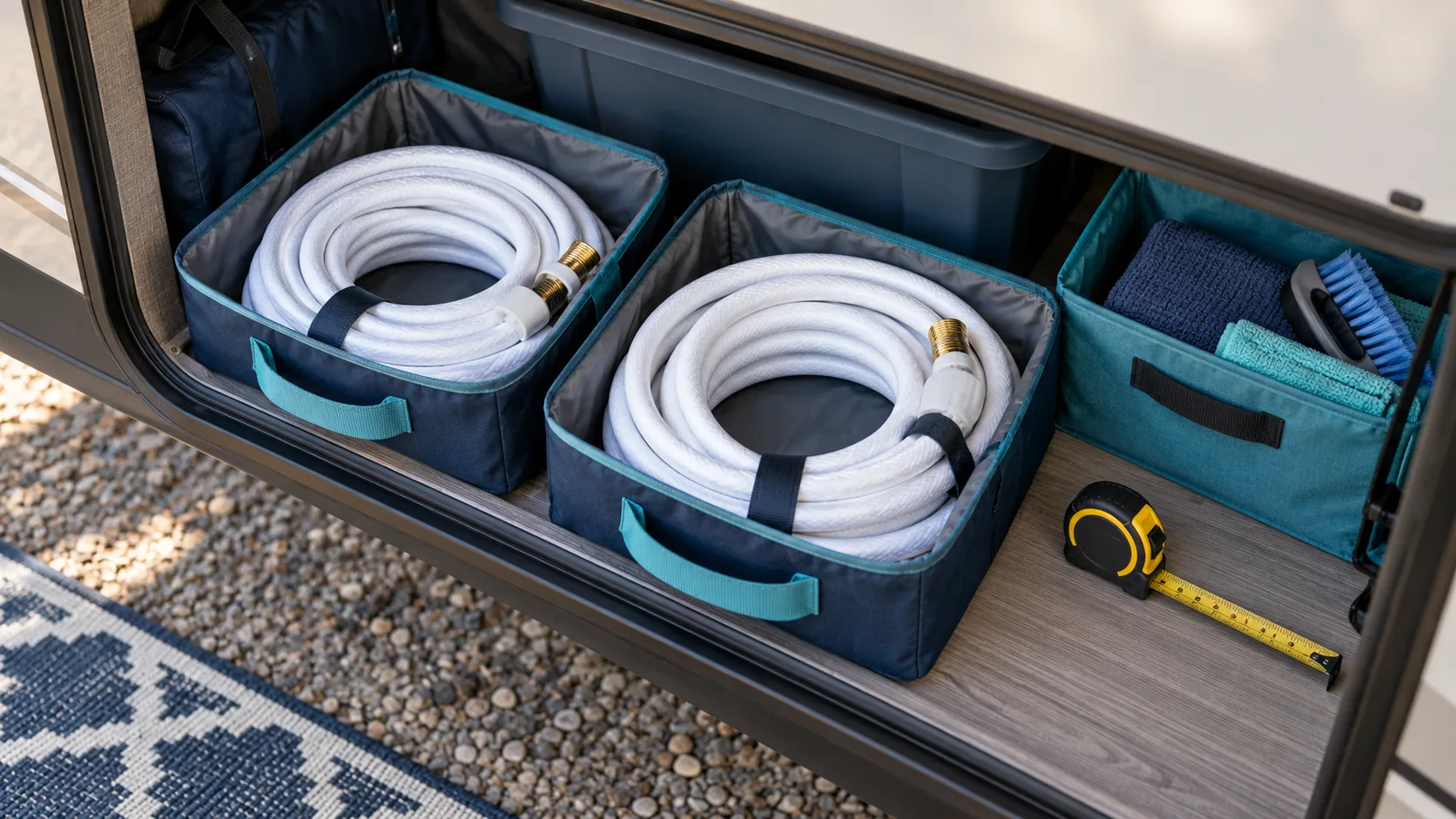
Consider departure as carefully as arrival. You will need room to drain, gather, inspect, and store the equipment according to its instructions. If your compartment is already full, measure before committing to a larger coil.
Two verified Camco options
These are length choices within the standard TastePURE family. Check the precise model number when buying: similarly named listings may include different diameters, premium versions, heated hoses, or bundles. We do not provide a universal pressure or temperature rating for these products.

Camco TastePURE 22783: 25 feet
Verified specification: 25-foot length and 5/8-inch inside diameter, listed for drinking-water use.
Why consider it: a straightforward starting length when your measured route fits. Limitation: it cannot cover a longer route without another suitable section.
Our recommendation is based on reach and handling needs, not a hands-on comparison.
Check Camco 22783 25-foot details on Amazon
Camco TastePURE 22793: 50 feet
Verified specification: 50-foot length and 5/8-inch inside diameter, listed for drinking-water use.
Why consider it: more reach in one continuous section. Limitation: the extra length still has to be routed and stored at short hookups.
Confirm the model and selected variant before ordering; retailer listings and availability can change.
Check Camco 22793 50-foot details on AmazonOne 50-foot hose or two 25-foot hoses?
Two shorter sections create a modular setup. Use one when it reaches comfortably, then add the other when needed. This can make sense if most of your trips need a short run but a few require more reach.
The extra joint is the main tradeoff. It is another connection to assemble, check for leaks, disconnect, and protect during storage. Use compatible components intended for drinking water, and follow their connection instructions. Do not force mismatched threads or use an adapter merely because it can be made to attach.
Two sections do not remove the need to measure the route. Their combined nominal length still has to cover turns, clearance, and comfortable slack. Likewise, one long section does not remove the need to inspect both end connections and any accessories in the system.
If you already own a suitable 25-foot hose in good condition, consider whether a second compatible section meets the occasional need before replacing it. If you need the full reach almost every trip, one 50-foot section may better match your routine.
Length does not set the RV’s safe water pressure
Choose pressure-control equipment according to your RV manufacturer’s instructions and the ratings of every component in the hookup. Do not use extra hose length as a substitute for the specified regulator. Do not copy a pressure setting from another owner’s vehicle without checking your own requirements.
If water flow is disappointing, first review the setup instructions and inspect for obvious routing problems, damaged fittings, or a kink. A filter or another accessory may also have its own service requirements. Do not increase a regulator setting simply to compensate for an unexplained restriction.
This article does not promise a particular flow rate from either length. Actual performance depends on the water supply, internal diameter, fittings, accessories, routing, and the RV system. A measured problem needs diagnosis rather than a guess based on the length printed on the package.
Keep drinking-water equipment separate and identifiable
Water-safety baseline: CDC advises confirming with the campground manager that the water is safe to drink before connecting. Follow your RV maker’s instructions for draining, disinfecting, and flushing the water system. A hose sold for drinking water does not make an unsafe source safe.
The CDC RV water guide also explains that many taste-improving filters do not remove germs. Check the filter’s specific claims and replacement instructions. Do not infer treatment capability from a filter’s appearance or a cleaner taste.
For an organized travel routine, give drinking-water equipment its own clearly identified storage location, separate from wastewater and dirty cleanup gear. Keep the equipment history clear so that a helper can tell which hose belongs to which task.
If a hose has an unknown history or has been used for a different job, do not assume a quick rinse makes it suitable for drinking-water use. Consult the manufacturer about safe reuse or replacement. Avoid improvising chemical concentrations or disinfection procedures.
Storage, inspection, and seasonal limits
Read the hose’s preparation and storage instructions before its first trip. Check how it should be flushed, drained, coiled, and protected between uses. Follow specified bend limits and avoid crushing couplings under other cargo.
At each setup, inspect the fittings and hose for visible damage. Check the seals specified for that connection and replace damaged parts with the correct type. If a connection leaks, shut off the supply before investigating rather than repeatedly forcing it tighter.
A standard hose is not automatically a heated hose or a cold-weather water system. For freezing conditions, consult the RV and hose manufacturers’ instructions and plan the entire hookup, including exposed fittings. Buying a longer standard hose does not solve freezing risk.
When organizing the rest of your travel equipment, apply the same measure-first approach. Our soft cooler vs hard cooler guide explains how a product’s footprint and access needs affect a loaded vehicle. Reserve space for the water equipment before adding another bulky accessory.
A simple buying checklist
- Measure: trace the usable route and include comfortable slack.
- Confirm the use: select equipment explicitly intended for drinking water.
- Check the exact version: match length, inside diameter, model, fittings, and instructions.
- Plan pressure control: use the RV maker’s requirements and component ratings.
- Choose the arrangement: compare one long section with two compatible shorter sections.
- Check storage: allow room to keep the equipment organized and protected.
Frequently asked questions
Is a 25-foot RV water hose long enough?
Only if it covers your actual route with appropriate slack and clearance. Measure your inlet-to-supply path or ask the campground about the hookup position. There is no single length that fits every RV site.
Should a beginner buy 50 feet just in case?
It is a reasonable option when uncertain reach is a recurring concern and you have storage space. If you mainly use known close hookups, a shorter hose or modular setup may fit your routine better.
Can two 25-foot hoses replace one 50-foot hose?
They can provide similar nominal total reach when the connections are compatible and suitable for the use. You gain flexibility but add a joint to maintain. Check the instructions for all components.
Does a longer hose act as a pressure regulator?
No. Select pressure-control equipment according to the RV manufacturer’s requirements. Hose length is a routing choice and does not establish a safe regulator setting.
Does drinking-water-safe mean the campsite water is safe?
No. Product suitability and source-water quality are separate checks. Confirm the supply is safe and maintain the RV system according to its instructions.
Do I need to replace a working hose to upgrade?
Not if it remains suitable, undamaged, and practical for your route. Buy additional reach or a replacement to solve a clear limitation, rather than treating a longer hose as an automatic upgrade.
Sources and selection method
We checked Camco’s fresh-water catalog for model identification, the linked Amazon product variants, and CDC’s RV water guidance. The two models are practical examples of the lengths discussed, not winners of a laboratory test. Check current packaging and manufacturer instructions for operating limits before use.