
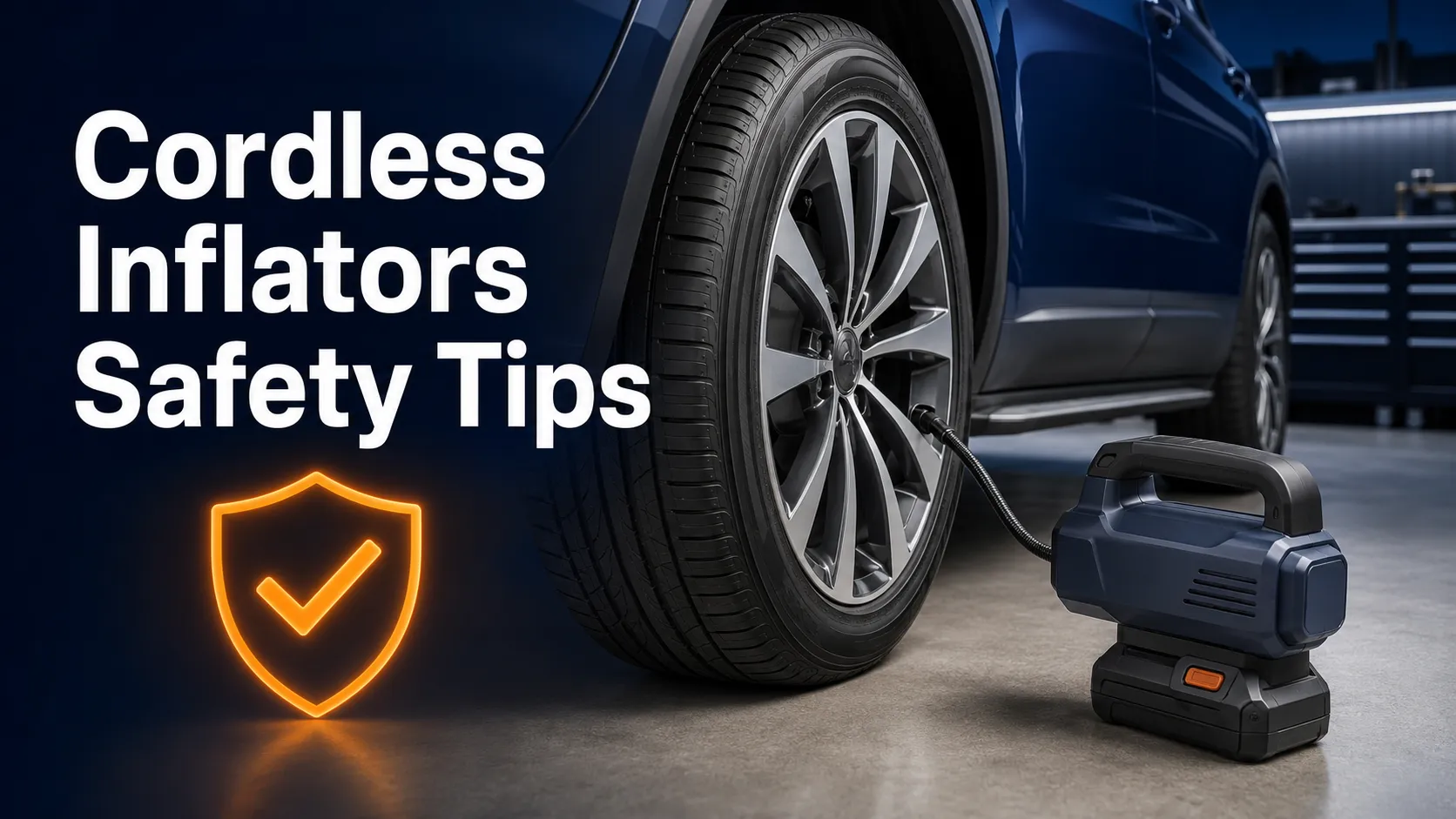
These cordless inflators safety tips can help you avoid overinflation, battery damage, overheating, unstable roadside working conditions, and incorrect tire-pressure settings. Before using an inflator, inspect the tool and tire, find the vehicle’s recommended cold tire pressure, secure the hose correctly, and follow the operating limits in the product manual.
A cordless inflator is useful for restoring tire pressure, but it cannot determine whether a damaged tire is safe to drive. Stop if you see tire sidewall damage, a badly damaged valve, smoke, sparks, battery swelling, exposed wiring, melted plastic, severe heat, or repeated pressure loss.
Use a cordless inflator on a stable surface away from traffic. Follow the inflator, battery, tire, and vehicle manuals; use the pressure shown on the vehicle’s tire-information placard; keep the unit ventilated; observe its duty cycle; and verify the final pressure. Never operate or charge a visibly damaged, swollen, leaking, smoking, or unusually hot battery.
Use the recommended cold pressure on the vehicle’s tire-information label or in the owner’s manual—not the maximum pressure shown on the tire sidewall.
Portable compressors produce heat. Follow the manufacturer’s maximum runtime and required cooling period instead of running the inflator continuously.
Do not charge or operate a battery that is swollen, cracked, punctured, leaking, corroded, smoking, or producing an unusual odor.
Adding air does not repair a puncture, damaged valve, broken bead seal, bent wheel, or structural tire damage.
Why Cordless Inflator Safety Matters
A cordless inflator combines a rechargeable battery, electric motor, compressor, pressure sensor, hose, and controls in a small housing. These components make the tool portable, but they also introduce several risks when the unit is damaged, incorrectly connected, overworked, or used with an unsuitable tire.
One common mistake is treating the pressure molded into the tire sidewall as the normal inflation target. That sidewall number is not generally the vehicle manufacturer’s recommended everyday pressure. The correct target is normally listed on the tire-and-loading label near the driver’s door or in the vehicle owner’s manual.
The National Highway Traffic Safety Administration uses the vehicle manufacturer’s recommended cold inflation pressure from the vehicle placard in its tire-pressure guidance and testing procedures. You can review NHTSA’s information in its official tire-pressure monitoring test procedure.
Another safety issue is heat. Compressing air naturally generates heat in the motor, pump, hose, and connector. Some compact inflators are designed for only a limited period of continuous operation. Ignoring the specified duty cycle can activate thermal protection or contribute to premature damage.
Prepare Before Using a Cordless Inflator
What to Have Ready
- The inflator’s instruction manual
- The vehicle owner’s manual
- A reliable tire-pressure gauge
- The correct hose or valve adapter
- The approved battery and charger
- A flashlight for low-light conditions
- Reflective roadside safety equipment
- A clean, stable working area
Before starting, park on firm, level ground and apply the parking brake. If you are near a road, move the vehicle as far away from moving traffic as safely possible. Turn on the hazard lights and use reflective safety equipment when appropriate.
Do not place yourself between the vehicle and passing traffic. If the location is unsafe, visibility is poor, the vehicle is in an active travel lane, or the tire appears structurally damaged, contact roadside assistance instead of attempting inflation.
Cordless Inflators Safety Tips: Step-by-Step Use
Read the instructions for your exact model
Confirm the inflator’s intended applications, pressure limit, acceptable battery, approved charger, duty cycle, cooling period, operating-temperature range, and instructions for attaching the hose.
Inspect the tire and valve
Look for cuts, bulges, exposed material, embedded objects, severe cracking, wheel damage, or a bent valve. Do not remove a deeply embedded object at the roadside because it may be slowing the air loss.
Inspect the inflator
Check the housing, battery, terminals, hose, connector, charging port, and controls. Do not continue if you find exposed wiring, melted plastic, crushed parts, loose fittings, severe corrosion, or battery damage.
Find the recommended pressure
Read the vehicle’s tire-information placard, commonly located on the driver-side door jamb. Use the recommended cold pressure for the relevant front or rear tire. Do not automatically use the number molded into the tire sidewall.
Confirm the pressure unit
Make sure the display is set to the unit you intend to use, such as PSI, bar, or kPa. Entering a number while the inflator is displaying a different unit could create an unsafe target.
Attach the hose securely
Remove the valve cap and connect the chuck squarely. A screw-on fitting should be secure without being forced. A lever-style connector should be fully seated and locked as described in its instructions.
Place the inflator where it can ventilate
Set the unit on a stable, dry surface where its ventilation openings remain clear. Do not hold it against clothing, place it in loose dirt, cover it, or operate it inside a closed storage compartment.
Start the inflator and remain nearby
Watch the pressure reading and listen for escaping air or unusual mechanical noise. Keep children, pets, loose clothing, and other people away from the tool, hose, and tire while inflation is underway.
Stop within the stated duty cycle
Do not assume that the compressor can run continuously. Stop for the cooling period required by the manual, especially when inflating a large truck or SUV tire or working in warm weather.
Check the final pressure
After the compressor stops, allow the reading to stabilize. Verify the pressure with the inflator gauge or a separate dependable gauge. Release excess air carefully if the tire is above the vehicle’s specified target.
Disconnect and inspect again
Switch off the inflator before disconnecting it. The hose fitting may be warm, so avoid touching any part that feels excessively hot. Reinstall the tire’s valve cap after confirming the pressure.
Let the tool cool before storage
Place the inflator on a stable, nonflammable surface with adequate ventilation. Do not immediately seal a hot unit inside a bag, trunk organizer, drawer, or storage case.
Cordless Inflator Safety Decision Table
| Situation | Recommended action | Do not continue when |
|---|---|---|
| Tire is slightly below its recommended pressure | Inspect it, connect the inflator correctly, and inflate to the vehicle placard pressure | The tire has a bulge, severe cut, exposed cords, or major wheel damage |
| Tire is completely flat | Inspect the tire before adding air and consider professional roadside service | The tire was driven while flat or will not hold pressure |
| Inflator becomes warm | Check the duty cycle and allow the required cooling period | Heat is excessive or accompanied by smoke, odor, melting, or unusual noise |
| Battery is low | Recharge it using the manufacturer-approved charging equipment | The battery is swollen, leaking, cracked, unusually hot, or damaged |
| Pressure does not increase | Stop and check the connector, hose, valve, and tire for leaks | The hose or connector is damaged or the tire loses air rapidly |
| Gauge reading seems incorrect | Confirm the pressure unit and compare with a reliable separate gauge | A large or inconsistent difference continues |
Battery and Charging Safety
Use only the battery, charger, cable, and power adapter approved for the inflator. Similar-looking connectors do not guarantee compatible voltage, current, temperature monitoring, or charging control.
Charge the tool in a dry, ventilated location on a stable surface. Keep the charging area away from flammable materials, direct sunlight, standing water, and places where the cable may be crushed or create a trip hazard. Follow the manufacturer’s permitted charging-temperature range.
Keep metal objects such as keys, loose hardware, and tools away from removable battery terminals. Metal contact can create a short circuit. Do not open, puncture, crush, modify, or attempt to rebuild a sealed lithium-ion battery pack.
Preventing Overheating During Inflation
Compact compressors may become warm during normal operation, especially when moving a large volume of air or raising pressure substantially. Tire size, starting pressure, ambient temperature, airflow around the tool, battery condition, and compressor design can all affect heat buildup.
Follow the exact duty cycle in the manual. If the manufacturer specifies several minutes of operation followed by a cooling period, treat that instruction as a limit—not an estimate. An automatic thermal shutdown does not make continuous operation appropriate.
Never try to cool the inflator with water, ice, a refrigerator, or a freezer. Rapid or inappropriate cooling could introduce moisture or cause other damage. Switch the tool off and allow it to cool naturally in a dry, ventilated location.
Common Unsafe Situations and Better Solutions
Move to a safer location if possible. Use hazard lights and reflective equipment, and contact roadside assistance when you cannot work without entering an active traffic area.
Use the vehicle manufacturer’s recommended cold pressure from the tire placard or owner’s manual instead of treating the tire’s maximum sidewall marking as the normal target.
Remain close enough to monitor pressure, sound, heat, hose position, and automatic shutoff. Stop immediately if operation becomes abnormal.
Repeated pressure loss indicates that the tire, valve, wheel, or bead seal needs inspection. Adding air repeatedly is not a permanent repair.
Stop within the manufacturer’s stated runtime and allow the complete cooling period before restarting the compressor.
Use only manufacturer-approved charging equipment. A connector that physically fits may still have incompatible electrical characteristics.
Tire pressure changes as tire temperature changes. Whenever practical, check and adjust pressure under the cold-tire conditions specified by the vehicle manufacturer. Recheck the pressure later if an emergency roadside adjustment was made while the tire was warm.
When to Stop Using the Inflator
Turn the inflator off and discontinue use if you notice any of the following:
- Smoke, sparks, flames, or a burning or chemical odor
- A swollen, cracked, punctured, leaking, or unusually hot battery
- Melted plastic, exposed wiring, damaged terminals, or severe corrosion
- A crushed, cracked, leaking, or detached pressure hose
- Abnormal grinding, rattling, or electrical noises
- Repeated overheating during normal, manual-compliant operation
- A pressure display that remains substantially inaccurate
- Controls or automatic shutoff that do not operate correctly
- Air escaping from the housing rather than the hose outlet
- Damage caused by impact, water exposure, or improper charging
Perform only the inspections and user-service procedures authorized in the manual. Battery, motor, wiring, pressure-sensor, control-board, and internal compressor repairs should normally be handled by the manufacturer or an approved technician.
Essential Tire Inflator Safety Rules
- Read the inflator, battery, charger, tire, and vehicle instructions.
- Work on stable ground away from moving traffic.
- Inspect the tool, battery, hose, valve, wheel, and tire before use.
- Use the vehicle manufacturer’s recommended cold tire pressure.
- Confirm whether the display is using PSI, bar, or kPa.
- Use only approved batteries, chargers, cables, hoses, and adapters.
- Keep the tool dry and its ventilation openings clear.
- Remain near the inflator while it is running.
- Observe the stated maximum runtime and cooling period.
- Do not touch a hose or connector that has become excessively hot.
- Keep children, pets, and loose clothing away during operation.
- Never short, open, puncture, crush, or modify the battery.
- Verify the final tire pressure before driving.
- Do not drive on a tire that cannot retain pressure.
- Obtain professional inspection for serious tire or wheel damage.
Frequently Asked Questions
Are cordless tire inflators safe to use?
Cordless tire inflators are generally safe when used on a suitable tire according to the tool, battery, tire, and vehicle instructions. Inspect the equipment, use the correct pressure, observe the duty cycle, and stop for damage, smoke, odor, swelling, or excessive heat.
Can I leave a cordless inflator running unattended?
No. Stay close enough to monitor pressure, heat, sound, hose position, and automatic shutoff. Turn the inflator off immediately if it behaves abnormally.
Which tire pressure should I use?
Use the vehicle manufacturer’s recommended cold tire pressure shown on the tire-information placard or in the owner’s manual. Do not automatically use the maximum pressure molded into the tire sidewall.
Is it normal for a cordless inflator to get hot?
Some warmth is expected because compressing air generates heat. Follow the stated runtime and cooling period. Stop if heat is excessive or accompanied by smoke, odor, melting, unusual noise, or repeated shutdowns.
Can I use a cordless inflator on a completely flat tire?
Inspect the tire first. A completely flat tire may have a puncture, broken bead seal, valve failure, or internal damage, especially if it was driven while flat. Seek professional service if it will not hold pressure or appears damaged.
Can I charge an inflator with any USB charger?
No. Use only the charging cable, adapter, and power source approved by the manufacturer. A connector that fits does not necessarily provide compatible voltage, current, temperature monitoring, or charging control.
When should I stop using a cordless inflator?
Stop for smoke, sparks, swelling, battery leakage, burning odor, melted plastic, exposed wiring, excessive heat, major hose damage, abnormal noise, or unreliable pressure readings. Contact the manufacturer or an approved technician.
Final Thoughts on Cordless Inflators Safety Tips
The most important cordless inflators safety tips are straightforward: inspect the equipment, choose a safe working location, use the vehicle placard pressure, confirm the pressure unit, attach the hose correctly, remain nearby, observe the duty cycle, and verify the final reading.
A portable inflator can restore air pressure, but it cannot repair or certify a damaged tire. Stop using the tool when you find battery damage, smoke, odor, exposed wiring, hose failure, persistent overheating, or unreliable pressure readings. When the problem involves internal components or serious tire damage, use manufacturer-approved service or a qualified tire technician.
Use the correct cold tire pressure, monitor the inflator throughout operation, respect its cooling limits, and never ignore battery or tire damage. When either the location or equipment is unsafe, stop and call for professional assistance.