
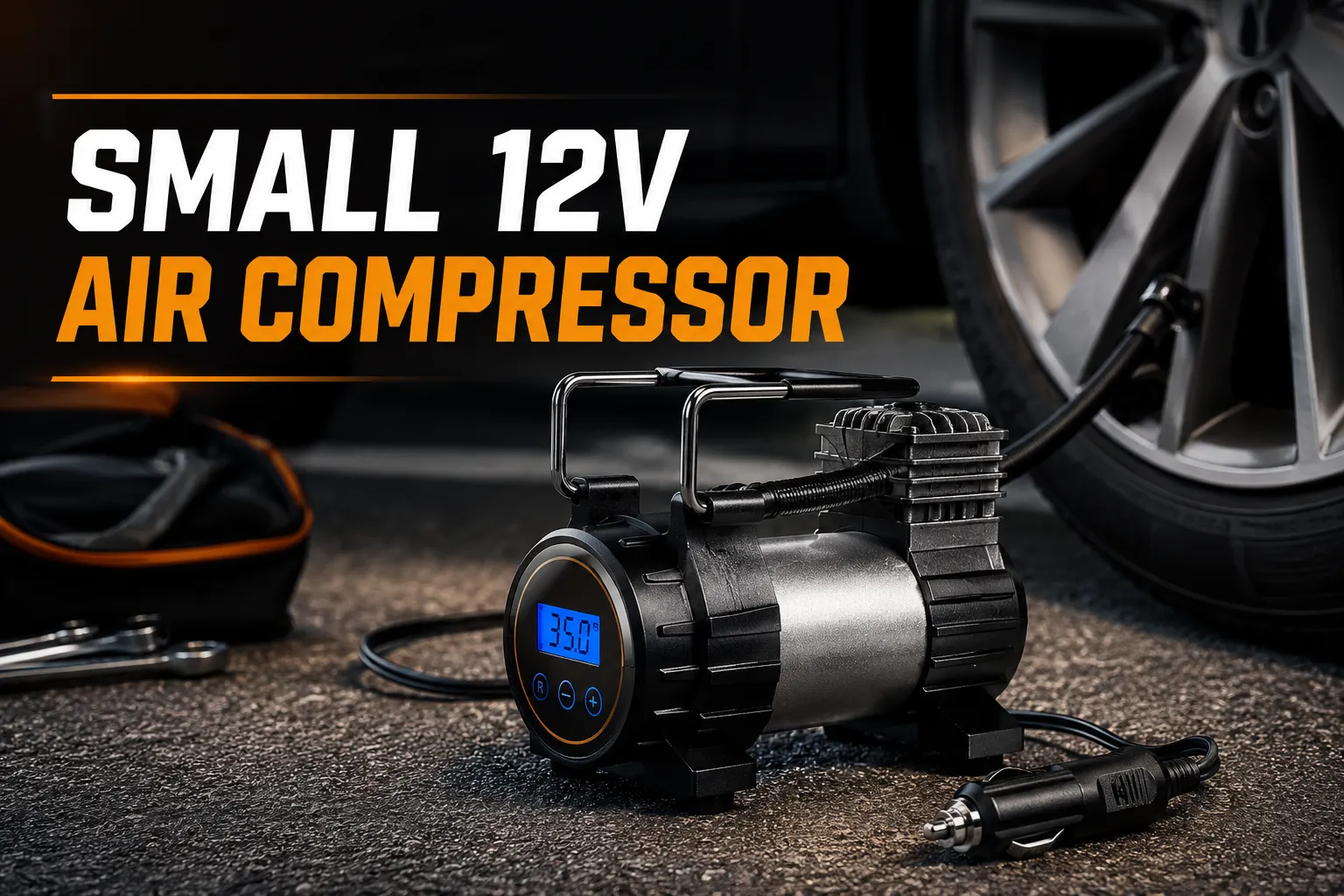
A small 12V air compressor gives you portable tire inflation without taking over your trunk.
For commuters, families, and road-trip drivers, a compact compressor can be one of the easiest tools to keep on hand for routine tire-pressure top-offs and roadside situations. The key is choosing a model that stays small without giving up the airflow, runtime, hose reach, and electrical compatibility your vehicle needs.
A small 12V air compressor is usually best for drivers who want compact storage and convenient tire top-offs. Before choosing one, check its intended tire applications, airflow, duty cycle, power requirements, cord and hose reach, and pressure gauge. A compact compressor can be ideal for many passenger cars, while larger truck, SUV, and oversized tires may need a higher-capacity unit.
Small compressors can fit easily into a trunk, cargo organizer, emergency kit, or limited garage storage area.
A properly matched compact compressor can be convenient for correcting moderately low pressure in everyday passenger-car tires.
Compact construction may mean shorter duty cycles, so always follow the manufacturer’s operating and cooling instructions.
Check tire-size guidance and electrical requirements instead of assuming every small compressor works equally well with every vehicle.
What Is a Small 12V Air Compressor?
A small 12V air compressor is a portable electric compressor designed to operate from an appropriate 12-volt DC power source. Automotive versions are commonly designed for tire inflation and are compact enough to keep in a vehicle.
Depending on the design, the compressor may connect to a vehicle’s 12V accessory outlet or another manufacturer-approved power connection. Its electric motor drives a small pump that compresses air and delivers it through a hose to the tire valve.
Compact automotive compressors are different from large shop compressors. Most do not use large air-storage tanks, and many are designed for intermittent rather than continuous operation.
The word “small” does not describe a standardized performance category. Two compressors with similar physical dimensions can have very different airflow, duty cycles, electrical demands, and intended tire applications. Compare specifications rather than dimensions alone.
Who Should Consider a Small 12V Air Compressor?
Compact compressors make the most sense when storage space and portability are important. They can be useful for commuters, families, road-trip drivers, and anyone who wants a basic tire-inflation tool without carrying bulky equipment.
Daily Commuters
A compact compressor can remain in the trunk so it is available when a tire needs a pressure correction before or after a commute.
Small-Car Owners
Drivers with limited cargo space may prefer a compressor that fits beside other roadside essentials without occupying much room.
Road-Trip Drivers
A portable compressor can form part of a broader roadside kit with a pressure gauge, flashlight, emergency supplies, and vehicle-specific equipment.
Beginner DIYers
Simple controls and compact dimensions can make a basic 12V compressor approachable for drivers who mainly need routine tire-pressure maintenance.
Small 12V Air Compressor: Features That Matter Most
When choosing a small 12V air compressor, it is easy to focus on physical size first. Size matters, but performance, electrical compatibility, and ease of use are more important once you actually start inflating a tire.
| Feature | Why It Matters | What to Check |
|---|---|---|
| Intended tire size | Helps determine whether the compressor is suitable for your vehicle | Manufacturer vehicle and tire recommendations |
| Airflow | Affects how quickly the compressor can move air | Published airflow specification and inflation guidance |
| Duty cycle | Defines how long the compressor can operate under specified conditions | Operating time and required cooling period |
| Power requirements | Must be compatible with the available 12V power source | Current draw, connection type, fuse guidance, and vehicle manual |
| Hose and cord reach | The compressor needs to reach all tires comfortably | Total usable reach on your vehicle |
| Pressure gauge | Helps monitor inflation pressure | Readable display and useful pressure range |
| Storage design | Keeps the compressor compact in real-world use | Cord, hose, accessory, and carrying-case storage |
How to Choose the Right Compact Compressor
Start With Your Tires
Identify the type and size of tires you expect to inflate. A compressor intended for routine passenger-car use may not be ideal for oversized truck or off-road tires.
Check the Electrical Requirements
Confirm how the compressor receives power and compare its electrical requirements with your vehicle owner’s manual. Do not assume every 12V accessory outlet supports every compressor.
Compare Airflow, Not Just Maximum PSI
Maximum pressure is only one specification. Airflow and manufacturer tire recommendations can give you a better idea of how useful the compressor will be for real tire inflation.
Check the Duty Cycle
Find out how long the compressor can operate before it requires a cooling period. Small compressors can generate considerable heat while running.
Measure the Reach You Need
Consider the location of the vehicle power outlet and the distance to the farthest tire. A very compact compressor is not useful if its cord and hose cannot comfortably reach every wheel.
Consider Real Storage Size
Include the hose, electrical cable, adapters, and carrying case when comparing size. A small pump with poorly managed accessories may occupy more space than expected.
Do not choose the smallest compressor simply because it takes up less trunk space. First make sure it matches your tires and vehicle electrical requirements. Then compare storage size, hose reach, cord management, and controls. A slightly larger compressor may be much more convenient if it completes the job with fewer compromises.
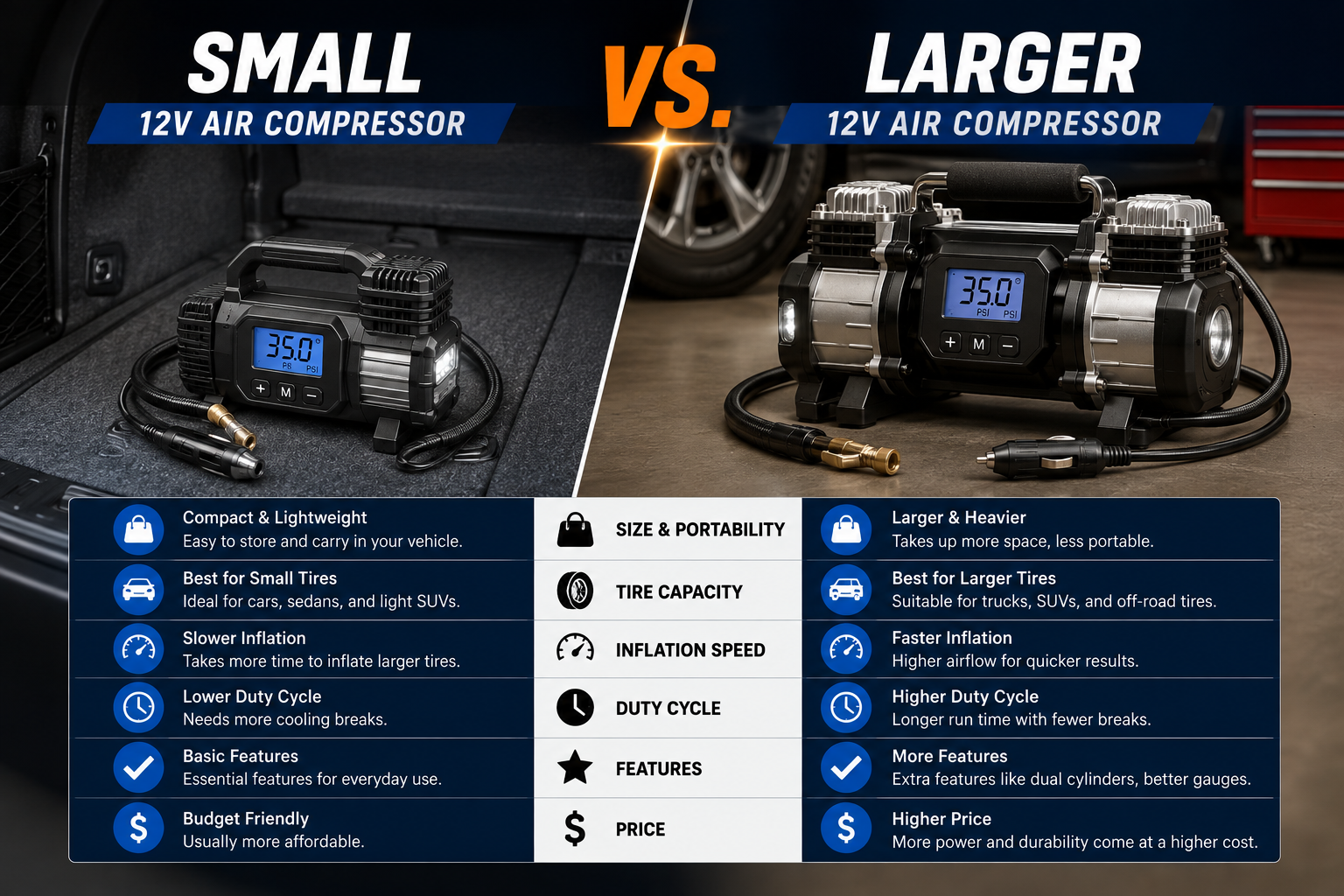
Small vs. Larger 12V Air Compressor
Neither size is automatically better. A compact compressor favors portability, while a larger 12V model may offer capabilities that are more useful for demanding inflation jobs.
| Consideration | Small 12V Compressor | Larger 12V Compressor |
|---|---|---|
| Trunk storage | Usually easier to store | May require more cargo space |
| Portability | Generally easier to carry | Can be heavier or bulkier |
| Passenger-car top-offs | Can be a good fit when properly matched | Usually capable but may be more than necessary |
| Large tire inflation | May take longer or require cooling breaks | Higher-capacity models may be better suited |
| Continuous runtime | Often more limited | Depends on design and published duty cycle |
| Emergency-kit use | Convenient because of compact dimensions | Useful if additional capability is required |
Physical size alone cannot tell you how a compressor will perform. Use the manufacturer’s airflow, duty-cycle, tire-size, and electrical specifications to judge capability. A properly matched compact compressor can be entirely adequate for routine car-tire use.
Is a Small Compressor Good for Car Tires?
Yes, it can be. Many drivers mainly need to correct small pressure changes rather than inflate a completely flat tire from zero. For that type of routine use, a properly matched compact compressor can be very convenient.
Always inflate tires according to the vehicle manufacturer’s recommended cold tire pressure. This information is commonly found on the tire-information placard in the driver’s door area or in the owner’s manual.
The maximum pressure molded into a tire sidewall is not automatically the correct everyday inflation pressure for your vehicle.
When a Small Compressor May Not Be the Best Choice
Oversized Tires
Larger-volume tires require more air. Check the compressor manufacturer’s tire-size recommendations before depending on a compact unit.
Frequent Off-Road Inflation
Repeatedly airing several tires back up after off-road use creates a much heavier workload than an occasional pressure correction.
Multiple Vehicles
If you regularly inflate several vehicles, greater airflow and a longer duty cycle may save considerable waiting and cooling time.
Long Continuous Jobs
A small portable compressor should not be assumed to support continuous operation. Always follow its published duty-cycle limits.
Useful Features for Everyday Drivers
- Readable digital or analog pressure gauge
- Automatic shutoff at a preset pressure when available
- Built-in storage for the power cord and air hose
- A carrying case that keeps accessories together
- Enough cable and hose length to reach every tire
- Secure valve connector that is easy to attach
- Useful work light for low-light roadside situations
- Additional inflation adapters when genuinely needed
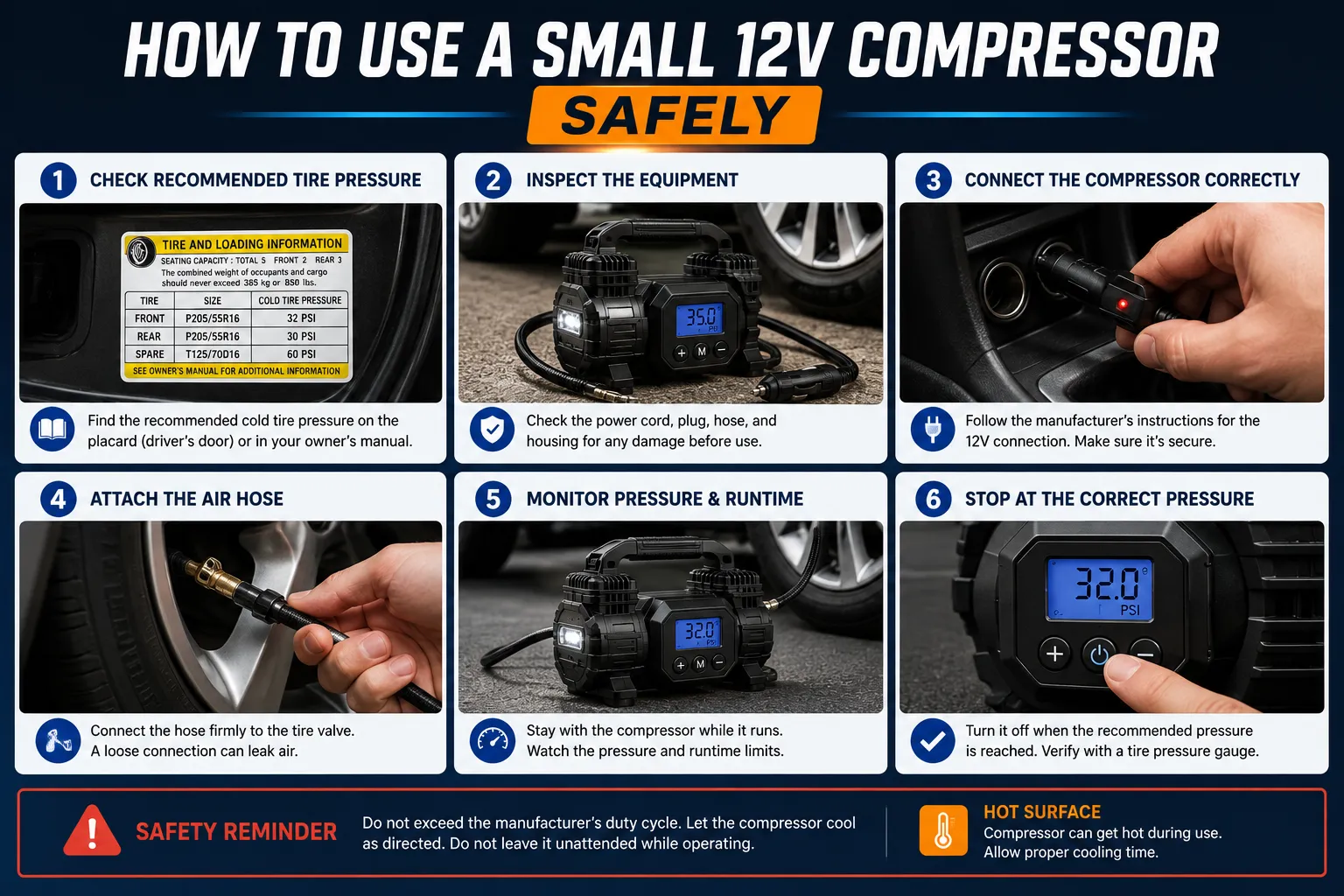
How to Use a Small 12V Compressor Safely
Check the Recommended Tire Pressure
Find the vehicle manufacturer’s recommended cold tire pressure before you begin. Do not guess the correct pressure.
Inspect the Equipment
Check the power cord, plug, hose, valve connector, and compressor housing for visible damage.
Connect the Compressor Correctly
Follow the manufacturer’s instructions for the 12V connection and verify that the vehicle power source is suitable for the compressor.
Attach the Air Hose
Connect the hose securely to the tire valve. A poor connection can leak air and extend inflation time.
Monitor Pressure and Runtime
Stay with the compressor while it operates. Monitor tire pressure and observe the manufacturer’s runtime limits.
Stop at the Correct Pressure
Turn the compressor off when the recommended pressure is reached. If necessary, verify pressure with a suitable tire-pressure gauge.
Stop using the compressor if you notice smoke, a burning smell, damaged wiring, a melting connector, severe vibration, or unusual mechanical noise. If a fuse repeatedly blows or an electrical connection overheats, do not install a larger fuse just to keep operating the compressor. Follow the vehicle and compressor manuals and seek qualified service when necessary.
Common Small-Compressor Problems
Inflation Feels Too Slow
Confirm that the compressor is intended for your tire size and that the valve connection is secure. A low-airflow compressor may simply require more time on a larger tire.
The Compressor Gets Hot
Compressing air generates heat. Follow the published duty cycle and required cooling instructions.
The Compressor Will Not Start
Turn it off and check the connection, vehicle outlet guidance, and compressor instructions. Replace a fuse only with the specified type and rating.
The Hose Will Not Reach
Do not stretch or sharply pull the hose or electrical cable. Use only compatible extensions or accessories when permitted by the manufacturer.
After use, let the compressor cool as directed, wipe away dirt, inspect the hose and cable, and store the unit in a dry location. Avoid tightly kinking the hose or wrapping the power cable in a way that strains the connections.
Small 12V Compressor Buying Checklist
- Is the compressor recommended for your vehicle and tire size?
- Does the manufacturer publish useful airflow information?
- Is the duty cycle clearly explained?
- Is the power connection compatible with your vehicle?
- Will the cord and hose reach all four tires?
- Is the pressure gauge easy to read?
- Does it fit your available storage space with all accessories?
- Are the operating and cooling instructions clear?
- Can the hose and cable be stored without damage?
- Does it meet your needs without unnecessary bulk?
Frequently Asked Questions
Is a small 12V air compressor good for car tires?
Yes, a properly matched small 12V air compressor can be useful for routine passenger-car tire top-offs. Check the manufacturer’s tire-size guidance, airflow, duty cycle, power requirements, and hose reach before choosing one.
What should I look for in a small 12V air compressor?
Look for suitable tire compatibility, adequate airflow, a documented duty cycle, vehicle-compatible electrical requirements, enough cord and hose reach, a readable gauge, and compact storage for the hose and power cable.
Can a small 12V compressor inflate SUV tires?
Some compact compressors may be suitable for certain SUV tires, but tire size and air volume vary. Check the compressor manufacturer’s tire recommendations, airflow, duty cycle, and power requirements before relying on it for an SUV.
Does a small compressor take longer to inflate a tire?
Not always. Physical size alone does not determine inflation speed. Airflow, pump design, tire size, starting pressure, and operating conditions all affect inflation time.
Can I keep a small 12V air compressor in my car?
A compact compressor can be convenient to keep in a vehicle if the manufacturer permits that storage environment. Protect it from moisture, physical damage, and temperatures outside the manufacturer’s stated storage limits.
Can a small 12V air compressor run continuously?
Do not assume it can. Many portable compressors have a limited duty cycle and require cooling periods. Follow the operating-time and cooling instructions supplied by the manufacturer.
Related Guides
Conclusion
A small 12V air compressor can be an excellent fit for drivers who value portability, easy storage, and convenient tire-pressure maintenance. For everyday passenger-car use, you may not need a large compressor if a compact model provides the airflow, runtime, reach, and electrical compatibility your vehicle requires.
Do not choose based on physical size or maximum PSI alone. Check the manufacturer’s intended tire applications, airflow, duty cycle, power requirements, hose length, cable length, and operating instructions. Drivers with large truck tires, oversized off-road tires, or frequent inflation needs may be better served by a higher-capacity compressor.
The best compact compressor is not necessarily the smallest one you can buy. Choose a 12V compressor that is small enough to store conveniently while still matching your tires, vehicle electrical system, and expected workload. For many everyday drivers, that balance delivers more practical value than choosing maximum portability or maximum power alone.