
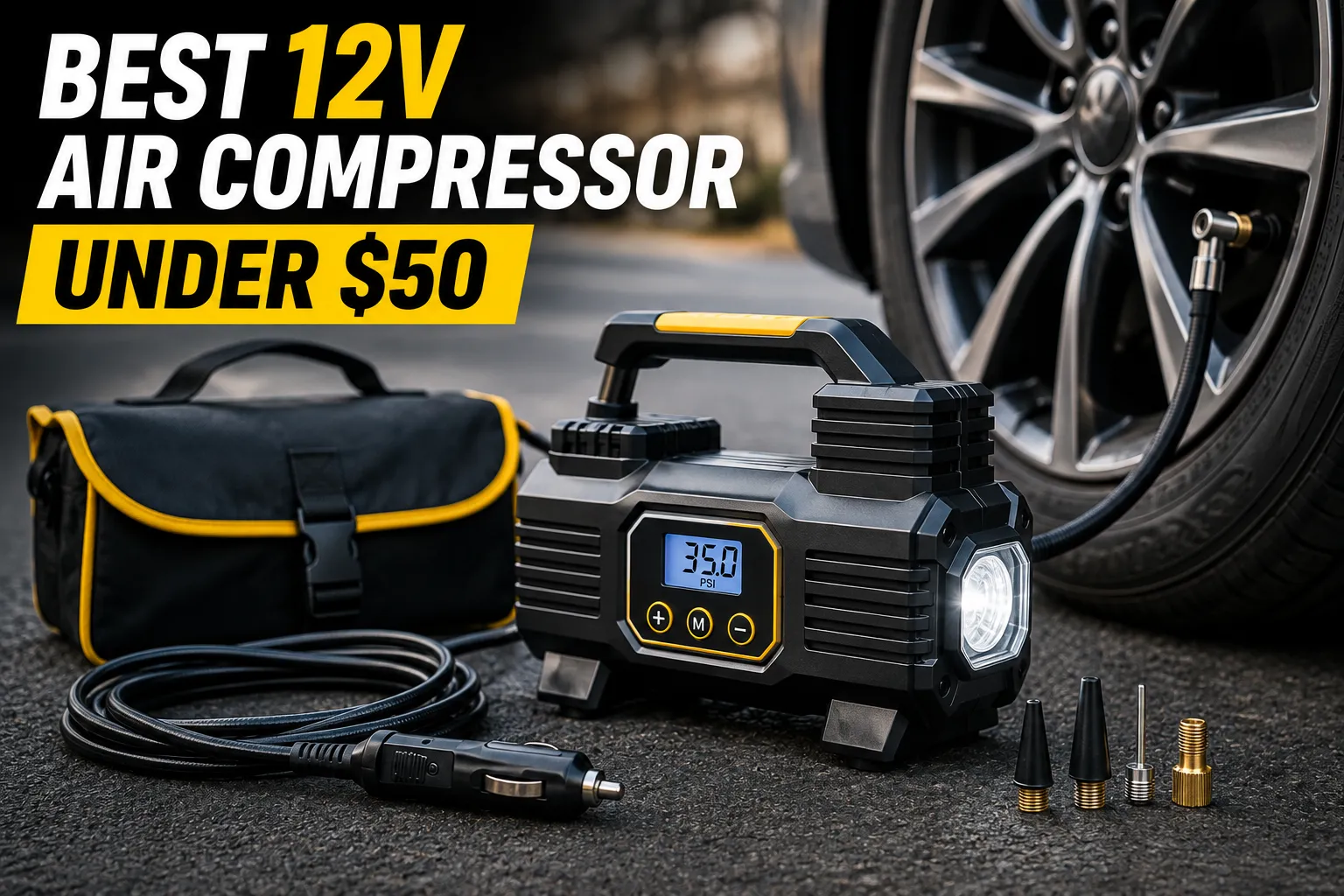
A 12v air compressor under $50 can be a practical choice if you mainly need to top off passenger-car tires, correct pressure after temperature changes, or keep an emergency inflator in the trunk. At this price, the goal should not be maximum power. Instead, look for dependable basic inflation, a usable gauge, enough cord and hose length, and compatibility with your vehicle’s 12-volt power source.
Budget compressors do come with compromises. They may inflate more slowly, have shorter duty cycles, use simpler housings, or include fewer convenience features than more expensive models. Still, spending more is not automatically necessary for a driver who only needs occasional tire-pressure adjustments.
A 12V air compressor under $50 can be worth buying for routine tire top-offs and emergency use. Prioritize vehicle compatibility, useful airflow, an adequate duty cycle, a readable gauge, enough cable length to reach every tire, and clear manufacturer instructions. Avoid choosing only by the highest advertised PSI. Prices change frequently, so confirm the current selling price before purchasing.
Budget 12V compressors are usually most practical for passenger-car tire top-offs and occasional roadside inflation.
A high maximum-pressure claim does not tell you how quickly the compressor moves air into a real tire.
Compact compressors may require cooling breaks, especially when inflating a very low tire or working on multiple tires.
The compressor’s current requirements must be compatible with the vehicle outlet or other approved 12V power connection.
Is a 12V Air Compressor Under $50 Worth Buying?
For many drivers, yes. A budget compressor can make sense when your main goal is convenience rather than heavy-duty performance. If a tire is a few PSI low, having a compressor in your trunk lets you correct the pressure without searching for a service-station air pump.
It can also be useful before road trips, during seasonal temperature changes, and as part of a basic roadside kit. The important point is to keep your expectations realistic. A compact unit designed for car tires should not automatically be expected to perform like a larger garage compressor.
Drivers with large pickup tires, oversized off-road tires, frequent airing-down needs, or repeated inflation jobs may benefit from a stronger compressor with greater airflow and a longer duty cycle. In those situations, staying below a strict $50 budget can become less important than choosing equipment matched to the workload.
The price printed on a product page can change because of discounts, seller changes, promotions, and availability. Treat $50 as your shopping ceiling and verify the current total price rather than assuming a model will always remain in this range.
What Can You Expect for Less Than $50?
A lower price does not automatically mean a compressor is unsuitable. It usually means you need to pay closer attention to the essentials and accept fewer premium features.
12V Vehicle Power
Many budget units use a 12V accessory plug. Some designs may use another approved connection method, so check the manufacturer’s electrical requirements before use.
Basic Pressure Gauge
You may find digital or analog gauges. Readability and reasonable consistency are more useful than an elaborate display you do not need.
Compact Housing
Lower-cost compressors are often small enough for a trunk, cargo area, or emergency kit, which can be an advantage for everyday drivers.
Limited Continuous Runtime
Small compressors can build substantial heat. Always follow the manufacturer’s duty-cycle and cooling instructions instead of assuming continuous operation is safe.
Features That Matter Most on a Budget Compressor
When shopping with a limited budget, focus your money on the features that affect whether the compressor can actually do the job.
| Feature | Why It Matters | What to Check |
|---|---|---|
| Airflow | Influences how quickly the compressor can move air | Look for a manufacturer airflow specification and tire-use guidance |
| Duty cycle | Determines how long the unit can operate before cooling | Check the manual for operating and rest periods |
| Power requirements | Must match the vehicle’s available 12V power source | Check amperage, plug type, fuse requirements, and vehicle manual |
| Cord and hose reach | The compressor must physically reach all four tires | Compare total reach with your vehicle size |
| Gauge | Helps you monitor tire pressure during inflation | Choose a display that is easy to read in your expected conditions |
| Auto shutoff | Can simplify routine pressure adjustments | Useful, but not required if the compressor otherwise fits your needs |
| Storage design | Protects cords, hoses, and adapters in the vehicle | Look for organized cord storage or a suitable carrying case |
How to Choose a 12V Air Compressor Under $50
Start With Your Vehicle and Tire Size
A compact sedan and a large pickup do not place the same demand on an air compressor. Check the manufacturer’s recommended tire applications and make sure the unit is appropriate for your vehicle rather than choosing only by price.
Check the Power Connection
Confirm whether the compressor uses a 12V accessory outlet or another connection method. Compare its electrical requirements with your vehicle owner’s manual. Never assume every 12V socket can safely power every compressor.
Look Beyond Maximum PSI
Maximum PSI is only one specification. For car tires, airflow, actual tire compatibility, and duty cycle can tell you more about how useful the compressor will be in normal operation.
Check Cord and Hose Length
Estimate the distance from the vehicle’s power outlet to the farthest tire. A compressor that cannot comfortably reach all four wheels can become frustrating even if its pump performs well.
Read the Duty-Cycle Instructions
Check how long the manufacturer permits the compressor to run and how long it should cool afterward. This is especially important with small budget units that may heat up quickly.
Prioritize Useful Features
If your budget is tight, put pressure accuracy, electrical compatibility, hose reach, and inflation capability ahead of cosmetic features. An LED light or auto-stop function can be helpful, but only after the fundamentals are covered.
For an emergency trunk compressor, I would rather have a simple unit that clearly matches the car’s tires and electrical system than a feature-heavy model with unclear specifications. Check the manual before you need the compressor on the roadside, and test the setup at home so you know where the power outlet, valve connector, cord, and controls are.
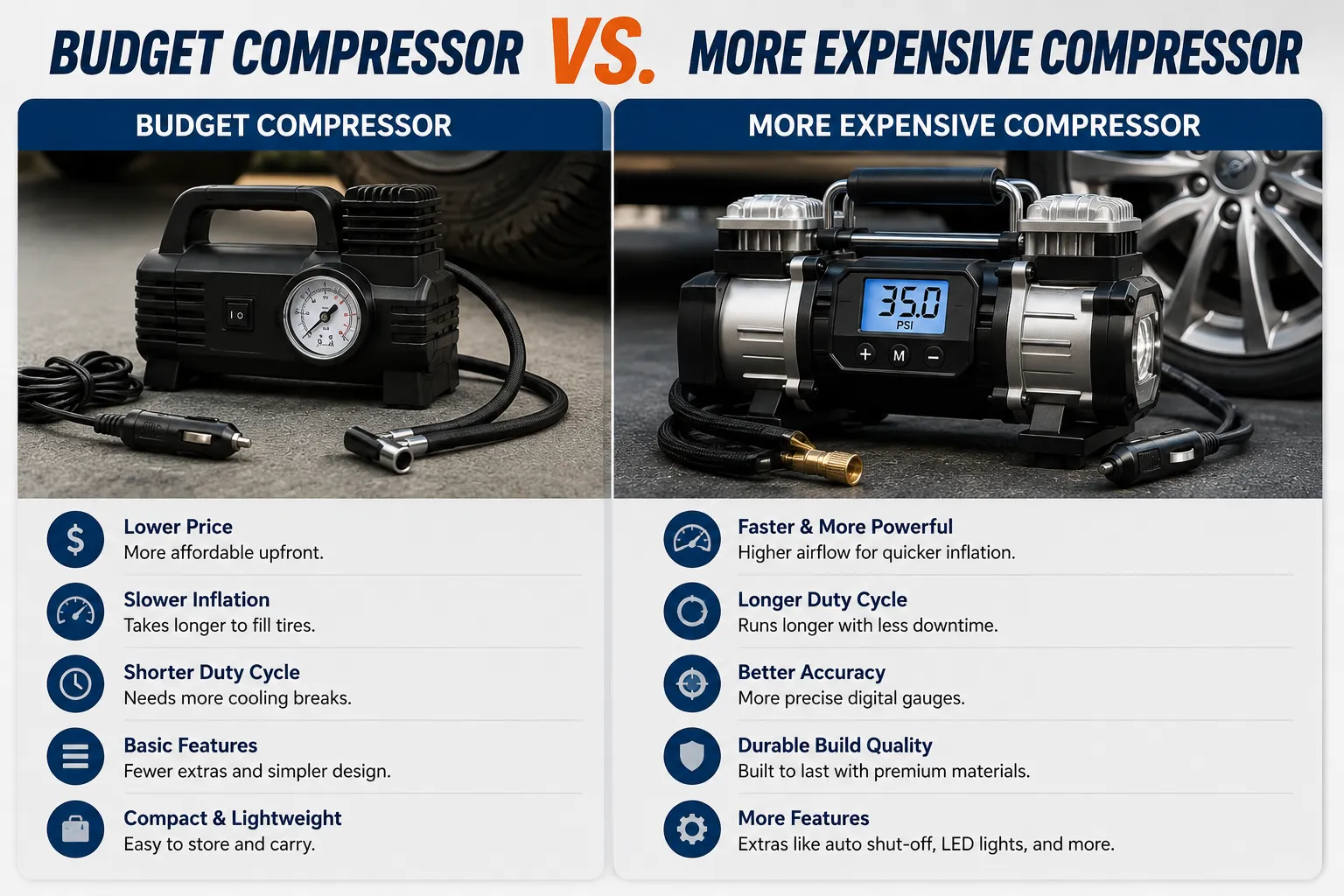
Budget Compressor vs. More Expensive Compressor
A higher price can buy more capability, but the value of those improvements depends on how you plan to use the compressor. Occasional top-offs and frequent large-tire inflation are very different jobs.
| Consideration | Budget 12V Compressor | Higher-Capability Compressor |
|---|---|---|
| Routine car-tire top-offs | Often a practical fit | Usually capable, but may be more than necessary |
| Emergency trunk storage | Compact size can be useful | May be larger or heavier |
| Large tires | May be slower or reach thermal limits sooner | Higher airflow and longer runtime may be available |
| Repeated inflation | Cooling breaks may be more important | Better suited if designed for heavier workloads |
| Convenience features | Usually basic | May include better displays, controls, storage, or accessories |
| Purchase cost | Lower initial expense | Higher initial expense |
A $40 compressor that comfortably handles your normal tire top-offs can be better value for you than a much more expensive unit. The opposite is also true: buying too little compressor for large tires can create long inflation times, overheating, and frustration.
Features You Should Not Sacrifice Just to Save Money
There are areas where saving a few dollars is less important than having a compressor you can use properly.
- Clear manufacturer instructions and electrical requirements
- A power connection suitable for your vehicle
- A hose connector that attaches securely to the tire valve
- Enough cord and hose reach for all four tires
- A readable pressure gauge
- A documented duty cycle or operating-time limit
- Ventilation that can remain unobstructed during operation
- Manufacturer guidance showing the compressor is suitable for your intended tire size
A carrying case, multiple inflation nozzles, decorative display, or extra lighting may be convenient, but these should come after the basic inflation and safety requirements.
When an Under-$50 Compressor May Not Be Enough
A budget compressor is not automatically the right tool for every driver. Your workload may justify stepping up to a stronger unit.
Large Truck or Oversized Tires
Large tires contain more air volume. A small compressor may take significantly longer or require cooling breaks. Match the compressor to the manufacturer’s recommended tire range.
Frequent Off-Road Airing Up
Repeatedly restoring pressure to several large tires is a heavier workload than correcting a few PSI on one passenger-car tire.
Regular Multi-Vehicle Use
If you routinely service several vehicles, faster airflow and a stronger duty cycle may save enough time to justify a higher purchase price.
Need for Continuous Air
Many portable 12V units are not designed for continuous operation. If your application requires sustained airflow, choose equipment specifically rated for that job.
How to Use a Budget 12V Compressor Safely
Low price does not change the basic safety rules. Read the compressor manual, vehicle owner’s manual, and tire information before use.
Find the Vehicle’s Recommended Tire Pressure
Use the vehicle manufacturer’s tire-pressure information, commonly shown on the driver’s door-area placard or in the owner’s manual. Do not automatically use the maximum pressure molded into the tire sidewall as your normal target.
Inspect the Compressor and Power Cord
Do not use equipment with exposed wiring, melted connectors, severe housing damage, damaged hoses, or other obvious defects.
Connect the Compressor as Directed
Use only the power connection approved by the compressor manufacturer. Make sure the vehicle’s outlet and electrical system can support the required load.
Attach the Hose Securely
Connect the air chuck firmly to the valve stem so unnecessary leakage does not extend inflation time or create misleading pressure readings.
Monitor Inflation
Stay with the compressor while it is running. Monitor pressure, operating temperature, unusual sounds, and the manufacturer’s stated runtime limit.
Stop and Let the Unit Cool When Required
Follow the stated duty cycle. If the manual requires a cooling period, give the compressor enough time to cool before resuming inflation.
Stop using the compressor if the plug or wiring becomes unusually hot, a fuse repeatedly blows, the unit produces smoke or a burning smell, or you hear severe grinding or abnormal mechanical noise. Do not install a larger fuse simply to keep the compressor running. Follow the vehicle and compressor manufacturer’s specifications and seek qualified service when an electrical or mechanical fault is suspected.
Common Budget-Compressor Mistakes
Buying by PSI Alone
A large maximum-PSI number can look impressive, but it does not tell you how quickly the compressor can add air to your particular tire.
Ignoring Outlet Limits
A compressor can be labeled 12V and still have power requirements that are unsuitable for a particular accessory socket.
Running It Too Long
Ignoring the duty cycle can lead to excessive heat. Follow the operating and cooling intervals in the manual.
Expecting Heavy-Duty Performance
A compact emergency inflator and a high-airflow compressor are designed for different jobs. Match your expectations to the equipment.
Never Testing It Before a Trip
Finding out that a cord is too short or a plug does not work is much easier in your driveway than on the side of the highway.
Storing It Carelessly
Crushed hoses, tightly kinked cords, moisture, dirt, and loose accessories can reduce the usefulness of a compressor when you need it.
After use, allow the compressor to cool, wipe away dirt, inspect the cord and hose, and store the unit in a dry location. Avoid sharp bends in the hose and power cable. For a more complete care routine, see our 12V compressor maintenance guide in the Related Guides section below.
What to Check Before You Buy
If you are comparing several compressors around the same price, this short checklist can help you avoid focusing on marketing language.
- Is the current price actually below your $50 budget?
- Does the manufacturer identify appropriate tire or vehicle applications?
- Is airflow specified?
- Is the duty cycle explained?
- Will the power connection work with your vehicle?
- Will the cord and hose reach every wheel?
- Can you easily read the pressure gauge?
- Does the manual explain fuse and electrical requirements?
- Is the compressor compact enough for your intended storage location?
- Are replacement instructions, support information, or troubleshooting resources available?
You do not need every premium feature. You do need a compressor that matches your car and has enough documented information for you to operate it correctly.
Frequently Asked Questions
Is a 12V air compressor under $50 good enough for car tires?
It can be. A budget 12V compressor can work well for routine passenger-car tire top-offs and occasional emergency use if its airflow, duty cycle, power requirements, and tire compatibility match your vehicle.
What should I look for in a budget 12V air compressor?
Prioritize suitable airflow, a documented duty cycle, vehicle-compatible power requirements, enough cord and hose reach, a readable gauge, secure valve connection, and clear manufacturer instructions.
Is maximum PSI important on a cheap air compressor?
Maximum PSI matters, but it should not be your only buying criterion. Airflow, tire compatibility, inflation time, duty cycle, and electrical requirements can be more useful for judging everyday car-tire performance.
Can a budget 12V compressor inflate SUV or truck tires?
Some can, but larger tires place greater demands on the compressor. Check the manufacturer’s tire-size recommendations, airflow, duty cycle, and power requirements before using a small budget model on SUV or truck tires.
Why does a small 12V compressor get hot?
Compressing air creates heat, and compact compressors have limited space for heat management. Follow the manufacturer’s duty cycle and required cooling periods, and stop using the unit if heat is accompanied by smoke, a burning smell, damaged wiring, or abnormal noise.
Should I spend more than $50 on a 12V compressor?
Consider spending more if you regularly inflate large tires, need faster airflow, expect repeated use, or need a longer duty cycle. For occasional passenger-car top-offs, a properly matched budget compressor may be sufficient.
Related Guides
Conclusion
A 12v air compressor under $50 can be a smart purchase when you need a compact tool for routine car-tire top-offs, seasonal pressure adjustments, or an emergency kit. You do not necessarily need a premium compressor for these light-duty jobs.
The key is choosing by capability rather than price alone. Verify tire compatibility, airflow, duty cycle, power requirements, hose reach, gauge readability, and operating instructions. If you drive a vehicle with large tires or expect frequent, demanding inflation work, increasing the budget for a stronger compressor may be the better long-term decision.
For most budget shoppers, the right 12V compressor is not the model with the longest feature list or biggest PSI number. Choose one that safely matches your vehicle’s electrical system, reaches all four tires, provides enough inflation capability for your tire size, and has clear duty-cycle instructions. Under $50 can be enough for light car-tire use—but only when the compressor fits the job.