
The benefits of cordless inflators center on convenience, portability, and easier routine tire care. With a charged unit, you can add air at home, at work, in a parking lot, or during a trip—without searching for an outlet or stretching a cable around the vehicle.
Important LimitAn inflator only adds air. It cannot repair a puncture, damaged valve, bent wheel, broken bead seal, or unsafe tire. Always use the pressure listed by the vehicle manufacturer.
Cordless inflators give drivers portable, cable-free access to tire inflation. Many combine a pump, pressure display, work light, and automatic shutoff in one compact tool. They are useful for routine top-ups and travel, but battery charge, tire size, heat, gauge accuracy, and the condition of the tire still matter.
What Are the Main Benefits of Cordless Inflators?
The greatest advantage is not simply that the tool can move air. It is that the pump, power source, hose, and controls travel together. This removes several small barriers that can make drivers delay a pressure check.
1. Use It Away From an Outlet
A charged battery lets the inflator operate where an extension cord or vehicle power socket is unavailable. This is useful in apartment parking areas, office lots, driveways, campsites, and roadside locations where conditions are safe enough to work.
2. Move Easily Around the Vehicle
You do not need to route a power cable around doors, bumpers, or wheels. The inflator can move from tire to tire, which can make checking all four tires and the spare less awkward.
3. Store a Complete Tool in One Place
Many units keep the pump, battery, display, hose, and adapters together. A carrying case or organized trunk compartment can help prevent parts from being buried under cargo or lost in the garage.
4. Correct Small Pressure Losses Promptly
A tool that is ready at home can make it easier to address a slightly low tire before a commute or trip. Prompt correction is more practical than planning a separate stop at a service-station air pump.
5. Monitor Pressure While Adding Air
Built-in digital or analog gauges let you follow the pressure at the tire. Many cordless models also allow a target to be selected, although the final result should still be verified after airflow stops.
6. Support Routine and Emergency Preparation
A cordless inflator can be part of a home-maintenance kit or road-trip setup. It is especially useful when a sound tire needs a modest top-up and reaching another air source would be inconvenient.
7. Handle More Than One Type of Item
When the manufacturer supplies the correct adapter, one tool may inflate car tires, bicycle tires, sports balls, and some low-volume recreational items. Always confirm the supported pressure and intended use.
8. Share a Battery Platform
Some tool-brand inflators accept the same removable battery used by other compatible tools. This can reduce the number of chargers you need, but only batteries and chargers approved for that exact platform should be used.
Automatic shutoff can make a routine top-up easier, but it is not a reason to leave the inflator unattended. A wrong pressure unit, poor hose connection, or inaccurate reading can still produce the wrong result.
How Portability Helps in Everyday Driving
Drivers often notice low pressure at inconvenient times. A tire-pressure warning may appear before work, after a cold night, or while preparing for a family trip. A cordless unit lets you respond in the place where you discover the problem, provided the tire is safe to inflate.
This can be particularly helpful for households with more than one vehicle. Instead of moving cars near an outlet, you can carry the inflator to a sedan, crossover, SUV, or pickup. The same convenience applies to a compact spare, but spare-tire pressure can differ greatly from the road tires, so always check its label or the owner’s manual.
| Situation | How a Cordless Inflator Helps | What You Must Check |
|---|---|---|
| Morning commute | Adds a small amount of air without a service-station stop | Cold pressure on the vehicle placard |
| Family road trip | Provides a portable air source away from home | Battery charge, hose, adapters, and tire condition |
| Multiple vehicles | Moves easily between driveways or parking spaces | Different pressure requirements for each vehicle |
| Cold-weather pressure drop | Makes a routine seasonal top-up more convenient | Battery and charging limits in the product manual |
| Bicycle or sports gear | May reduce the need for a separate pump | Correct adapter, pressure range, and item instructions |
Practice with the inflator at home before depending on it during a trip. Confirm that the hose reaches every tire, the connector fits, the display is easy to read, and the battery can be charged with the equipment you plan to carry.
Can a Cordless Inflator Make Tire Care Easier?
Yes. Ease of access can encourage a more consistent routine. The National Highway Traffic Safety Administration advises drivers to use the vehicle manufacturer’s recommended cold tire pressure. That value is normally shown on the driver-door placard or in the owner’s manual.
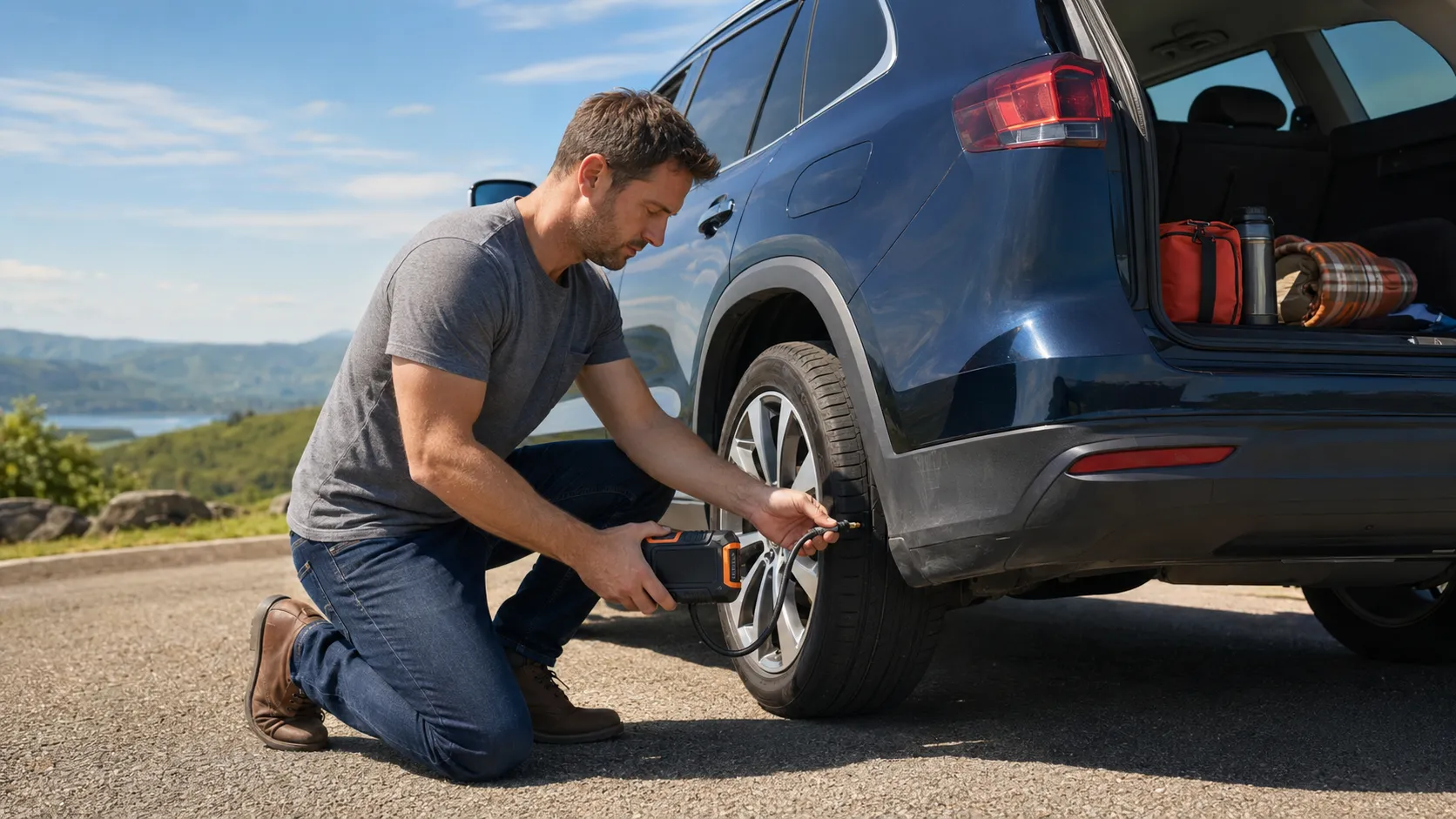
A cordless inflator places the gauge and air source beside the tire. This reduces the need to drive on a low tire just to reach a public pump. It also lets you recheck the pressure after the airflow stops and make a small correction in the same place.
Do not use the maximum pressure molded into the tire sidewall as the normal target for your vehicle. Use the cold pressure specified on the vehicle placard or in the owner’s manual. Front, rear, spare, and loaded-vehicle pressures may differ.
Convenience does not replace inspection. If a tire repeatedly loses air, the cause may involve a puncture, valve, wheel, bead seal, or internal damage. Adding air can provide temporary pressure, but it does not remove the problem.
Cordless vs. 12-Volt and AC Inflators
No power type is best for every driver. Cordless models prioritize freedom of movement. A 12-volt inflator can keep running as long as the vehicle power source and tool instructions allow, while an AC model suits a garage with reliable access to a wall outlet.
| Inflator Type | Main Benefit | Main Limitation | Often Best For |
|---|---|---|---|
| Cordless | Portable and cable-free during use | Depends on battery charge and temperature | Home top-ups, travel, and multiple vehicles |
| 12-volt | Draws power from a suitable vehicle socket | Cable reach and outlet capacity matter | Drivers who prefer vehicle-based power |
| AC portable | Uses steady household power | Cannot operate far from an outlet | Driveways and garages |
| Shop compressor | Supports frequent and higher-volume work | Large, heavy, and less portable | Workshops and repeated service tasks |
Some cordless inflators also accept a 12-volt or AC backup source. That can provide flexibility, but only use the cables, adapters, battery packs, and power sources approved in the tool manual.
How to Get the Most From a Cordless Inflator
-
Match the Inflator to the Tire
Check the manufacturer’s intended tire sizes, pressure range, airflow information, hose reach, run-time limit, and cooling period. Large SUV and pickup tires hold more air than typical passenger-car tires.
-
Keep the Battery Ready
Recharge it as directed and check the charge before long trips. Do not use or charge a swollen, leaking, cracked, unusually hot, or otherwise damaged battery.
-
Find the Correct Cold Pressure
Read the vehicle placard or owner’s manual. Select the matching unit on the inflator, such as PSI, and confirm whether the front and rear tires require different values.
-
Inspect Before Adding Air
Look at the tread, sidewall, wheel, and valve stem. Do not inflate a tire with a bulge, exposed cord, split sidewall, badly damaged wheel, or other signs of structural failure.
-
Watch and Verify the Result
Stay beside the tool, keep its vents clear, and follow its duty cycle. Check the pressure again after airflow stops, ideally with a reliable separate gauge from time to time.
Battery chemistry, charging temperature, storage temperature, and long-term charge recommendations vary. Follow the battery and charger manuals instead of using one universal schedule. Let the inflator cool before storing it in a case or vehicle compartment.
Limitations to Consider Before Relying on One
The benefits are real, but they come with tradeoffs. A battery can be discharged when needed. Compact pumps create heat. A unit that reaches a high pressure may still move air slowly into a large tire. Gauge accuracy and automatic shutoff performance can also vary.
Battery Is Not Always Ready
A stored inflator may lose charge over time. Add it to your pre-trip check and follow the manual’s recharge and storage instructions.
Heat Limits Continuous Use
Compact pumps may require cooling breaks. There is no single safe run time for every model, so follow its stated duty cycle.
Larger Tires Need More Air
An inflator suited to a sedan may be slow or unsuitable for a large pickup tire. Confirm the supported tire type, not only maximum PSI.
It Cannot Repair Damage
An inflator cannot seal a puncture or make a damaged tire roadworthy. Repeated pressure loss requires diagnosis and proper service.
Stop using the inflator if you notice smoke, sparks, melting, a burning smell, severe vibration, extreme heat, battery swelling, or leaking material. Stop inflation and move away if the tire develops a bulge, cracking sound, or visible change in shape. Follow the product, battery, tire, and vehicle manuals, and seek qualified service when damage is present.
Who Benefits Most From a Cordless Inflator?
A cordless model is especially practical for commuters who want a quick home top-up, families preparing for road trips, apartment residents without a convenient outlet, and households that maintain several vehicles. It can also suit cyclists and recreational users when the correct adapters are supplied.
Truck and SUV owners can benefit too, but they should be more careful about capacity. Tire volume, target pressure, and inflation time can be much greater. The tool maker should clearly list the intended vehicle or tire range. Maximum pressure alone does not prove that the pump is a good match for a large tire.
- Charge the approved battery and pack the correct charger.
- Inspect the hose, connector, housing, vents, and battery.
- Confirm that the unit displays the pressure unit you use.
- Locate the vehicle placard and check the spare-tire instructions.
- Carry any needed valve adapters in the storage case.
- Keep a reliable separate tire gauge available.
- Store the inflator securely so cargo cannot crush it.
Frequently Asked Questions
What is the biggest benefit of a cordless inflator?
The biggest benefit is portable, cable-free operation. A charged inflator can add air where a wall outlet or suitable vehicle socket is unavailable, which makes routine top-ups and travel preparation more convenient.
Are cordless inflators good for car tires?
They can be good for routine car-tire top-ups when the manufacturer supports the tire size and pressure. Check the tool’s run-time limit, cooling period, hose reach, gauge, and battery requirements before relying on it.
Can a cordless inflator fill a completely flat tire?
It may be able to add air, but a completely flat tire may have a puncture, broken bead seal, damaged sidewall, or hidden internal damage. Inspect it first and seek professional service if it was driven while flat or will not hold pressure.
Do cordless inflators stop automatically?
Many models can stop at a selected pressure, but the feature is not universal. Stay with the tool while it runs and verify the final pressure after airflow stops, because the setting or gauge may not always be exact.
Are cordless inflators useful for road trips?
Yes, they can provide a convenient portable air source during a trip. Check the battery charge, hose, adapters, supported tire size, and storage condition before leaving, and never treat the inflator as a repair for a damaged tire.
Can I use one cordless inflator for an SUV or pickup truck?
Possibly, but only if the inflator manufacturer supports that tire size, pressure, and intended use. Larger tires need more air and may require longer runs or cooling breaks, so maximum PSI alone is not enough.
What are the main disadvantages of cordless inflators?
The main disadvantages are limited battery charge, heat during operation, model-specific duty cycles, slower performance on large tires, and possible gauge variation. A cordless inflator also cannot repair a puncture or structural tire damage.
Related Guides
Conclusion: Benefits of Cordless Inflators
The benefits of cordless inflators include portability, cable-free operation, easier access to routine pressure correction, compact storage, and useful built-in controls. For commuters, families, road-trip drivers, and multi-vehicle households, those advantages can make tire care more convenient.
Choose a unit that matches your tire size and intended use. Keep the battery charged, use the vehicle manufacturer’s cold-pressure value, supervise the tool, follow its duty cycle, and verify the final reading. Most importantly, remember that adding air does not repair a leak or make a damaged tire safe.
A cordless inflator is most valuable because it puts a portable air source beside the tire when and where you need it. Its convenience supports better tire-care habits, but safe results still depend on the correct pressure, a sound tire, a charged battery, and strict use of the vehicle and tool instructions.