
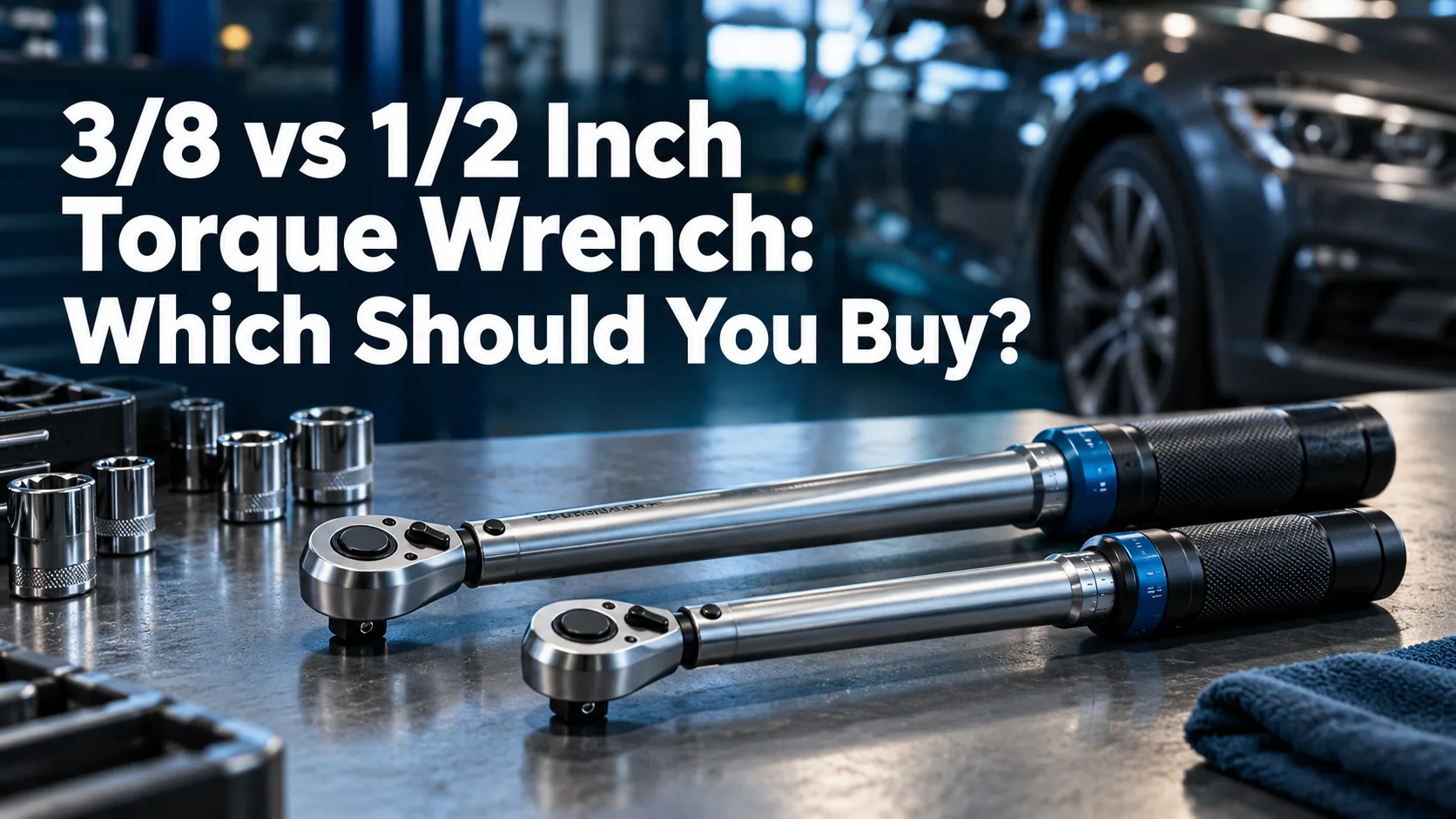
Buy for the torque specification, not just the square drive
Choosing a 3/8 vs 1/2 inch torque wrench starts with the work you plan to do. The drive size tells you which sockets connect directly. The wrench’s measurement range tells you whether it can handle the required torque. You need both to match.
Choose a 3/8-inch torque wrench when its range, reach, and socket fit suit your lower-to-middle torque jobs. Choose a 1/2-inch wrench when you need the higher range offered by a specific model and have room to use it correctly. Neither drive size has one universal range. Read your vehicle’s service procedure before buying.
As an Amazon Associate, we earn from qualifying purchases. This is a manufacturer-researched buying guide, not a hands-on test. Check the exact model, units, torque range, seller, and package before ordering.
View TEKTON TRQ52402 1/2-inch wrench on Amazon3/8 vs 1/2 inch torque wrench: what changes?
The fractions describe the square drive that connects the wrench to a socket. They do not describe the fastener’s head size. For example, the same socket opening can be available with different drive connections. Read both the socket size and its drive size when checking your existing tools.
Manufacturers commonly offer larger torque ranges in larger-drive tools, but the relationship is not a rule you can use without reading specifications. Two 1/2-inch wrenches can have different minimum and maximum settings. A 3/8-inch model may overlap substantially with a particular 1/2-inch model.
Handle length and head dimensions also matter. A tool that reaches the required setting on paper may be awkward where surrounding components prevent a controlled pull. Buying the biggest wrench in the catalog is not a substitute for checking access and following its operating instructions.
| Buying question | 3/8-inch drive | 1/2-inch drive |
|---|---|---|
| Socket connection | Directly fits 3/8-inch-drive sockets | Directly fits 1/2-inch-drive sockets |
| Torque capability | Read the exact model’s range | Read the exact model’s range |
| Typical shopping priority | Coverage of lower-to-middle settings and usable access | Coverage of higher settings and sufficient working room |
| Will it fit every car job? | No | No |
| What decides? | Required torque, measurement direction, units, socket fit, and the service procedure | |
Start with a short list of actual jobs
Before shopping, write down two or three jobs you expect to perform. Find the correct service information for your vehicle, model year, component, and fastener. Record the specification and its units. Also note any tightening sequence, angle stage, replacement-fastener requirement, or special tool instruction.
This small list is more useful than a generic label such as “car maintenance.” A wheel-fastener job and a delicate component can have very different requirements. You should not assume that a wrench bought for one automatically suits the other.
For wheel work, use the vehicle or wheel manufacturer’s applicable instructions. Do not borrow a torque number from a similar-looking vehicle. This article deliberately provides no universal lug-nut torque value and is not a wheel-removal, lifting, or vehicle-support procedure.
Lower settings
Check whether a smaller-range tool is required, including a 1/4-inch option.
Overlapping settings
Compare access, socket fit, and the exact wrench’s instructions.
Higher settings
Choose a model whose stated range covers the job without exceeding its limit.
Two current TEKTON models that show the difference
The following tools are examples, not a claim that one brand is the only suitable choice. We selected current TRQ-series models rather than the discontinued 24330 and 24335. Verify the model number carefully because older listings and reviews can describe different ranges and features.
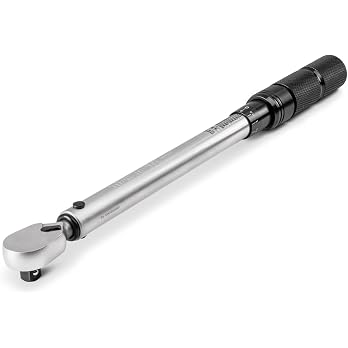
Retailer image; check the package you select.
TEKTON TRQ51402: 3/8-inch, 10–100 ft-lb
TEKTON lists this model with a 10–100 ft-lb range, a 15.6-inch overall length, and 0.5 ft-lb scale increments. It measures in both clockwise and counterclockwise directions and includes a case and serialized calibration certificate.
Why consider it: Our editorial preference for a buyer whose documented jobs fit this range and whose sockets and working space suit the tool.
Limitations: It does not cover settings below 10 ft-lb or above 100 ft-lb. A small fastener is not automatically safe to tighten at its minimum setting. Use the actual specification.
Check TRQ51402 range and package on Amazon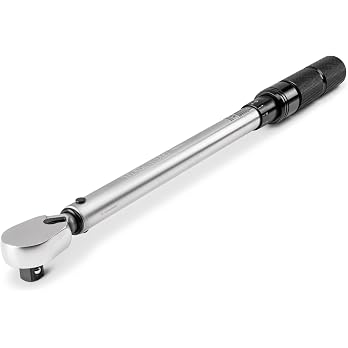
Retailer image; check the package you select.
TEKTON TRQ52402: 1/2-inch, 40–200 ft-lb
TEKTON lists this model with a 40–200 ft-lb range, a 19.1-inch overall length, and 1 ft-lb scale increments. It also offers measurement in both directions and includes a case and serialized calibration certificate.
Why consider it: A candidate when your documented work needs a setting above the smaller model’s maximum and remains within this model’s range.
Limitations: It cannot replace a lower-range tool for a setting below 40 ft-lb. Its longer body also requires suitable access and controlled handling.
Check TRQ52402 range and package on AmazonBoth product pages state a manufacturer accuracy specification within ±3% in both directions. That is a published tool specification, not our measurement, and it does not establish the accuracy of a dropped, damaged, or improperly used wrench.
| Verified specification | TRQ51402 | TRQ52402 |
|---|---|---|
| Square drive | 3/8 inch | 1/2 inch |
| Range | 10–100 ft-lb | 40–200 ft-lb |
| Scale increment | 0.5 ft-lb | 1 ft-lb |
| Overall length | 15.6 inches | 19.1 inches |
| Measurement direction | Clockwise and counterclockwise | Clockwise and counterclockwise |
| Feedback | Mechanical click | Mechanical click |
Use the overlapping range to think clearly
These two examples overlap from 40 to 100 ft-lb. If your documented target falls inside that interval, range alone does not settle the purchase. You still need to compare whether the head, socket combination, and handle can be positioned as the instructions require.
For a purely illustrative shopping example, a 60 ft-lb target is within both listed ranges. A 120 ft-lb target is outside the TRQ51402’s range but within the TRQ52402’s. A 5 ft-lb target fits neither. These are range examples, not recommended settings for any vehicle component.
This approach avoids two common buying mistakes: assuming that a larger drive always makes the better first purchase, and assuming that a smaller drive is automatically the right tool for every low-torque job. The correct tool is the one that covers the real procedure.
Check units before comparing numbers
A wrench marked in foot-pounds is not displaying the same values as one marked in inch-pounds. One foot-pound equals twelve inch-pounds. A number copied without its unit can therefore create a serious mismatch. Newton-meters are a separate unit as well.
Prefer a scale that matches the service information when practical. If conversion is necessary, use a reliable conversion and confirm it before setting the tool. Do not round a value casually or select a nearby number just because it is easier to see on the handle.
The two featured models use ft-lb scales. TEKTON also sells other variants, including metric models with different ranges. Confirm the item number and units in the listing rather than treating an image of a similar handle as sufficient identification.
Adapters do not turn one wrench into every wrench
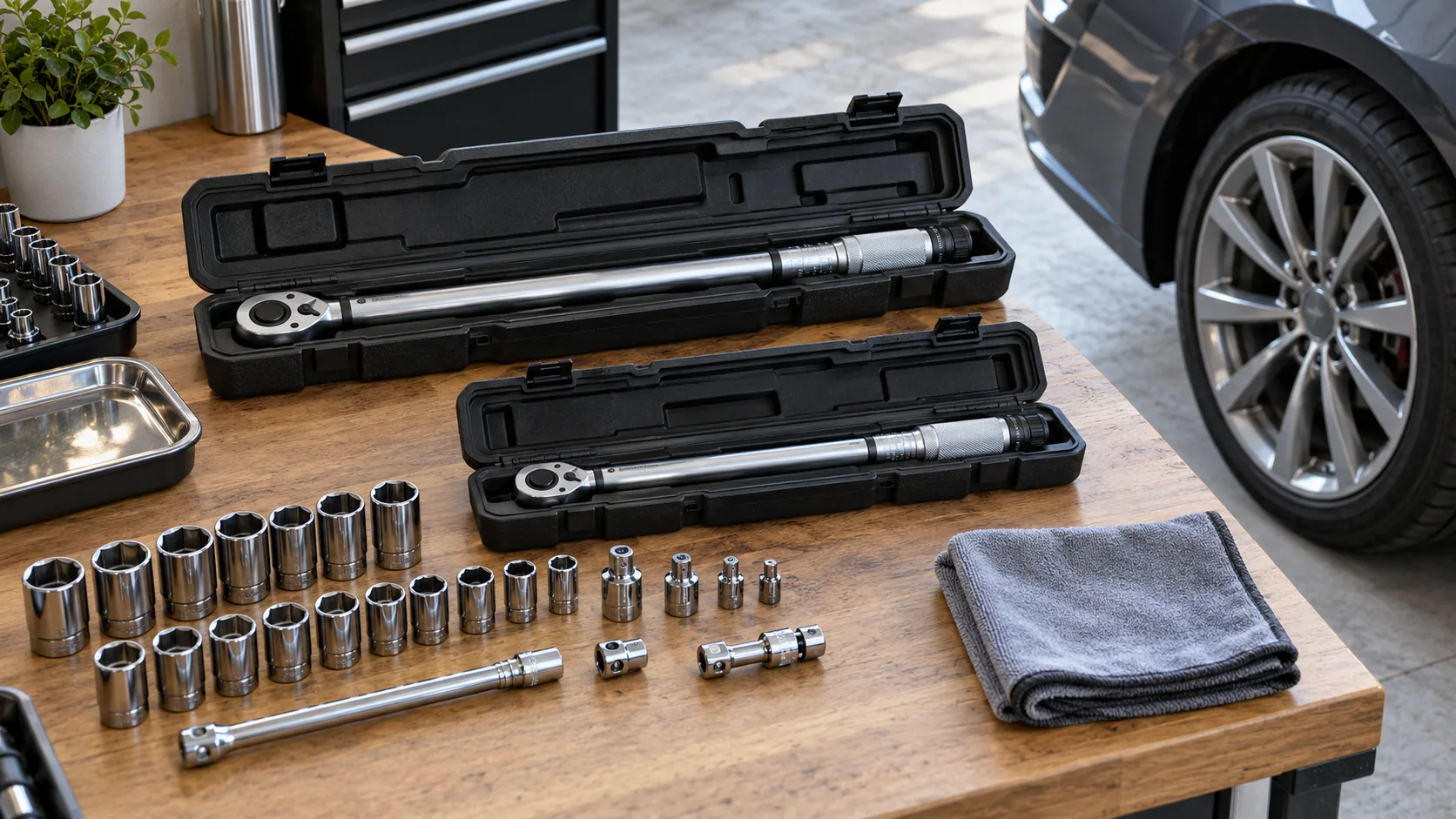
A drive reducer changes the socket connection. It does not increase the wrench’s measurement range or make the smaller connected accessory suitable for an unlimited load. Check the ratings and instructions for every part of the setup.
Off-axis attachments, such as a crowfoot, can change effective leverage. TEKTON’s manual explains when a setting correction is required. Do not apply a generic adjustment from memory. If your job needs an unusual arrangement, work through the manufacturer’s instructions before using the tool.
Also distinguish a socket extension from an extension placed over the wrench handle. They are different arrangements. The featured wrench manual prohibits extending the handle for leverage. A torque wrench is a measuring tool, not a solution for a fastener that is too difficult to loosen.
What a click means—and what it does not
Follow the exact wrench manual for setting, locking, hand position, and applying torque. For these models, TEKTON instructs the user to pull slowly and stop when the click is heard or felt. Continuing to pull can overtighten the fastener.
The click does not diagnose the fastener, prove the threads are in good condition, or confirm that you used the correct service specification. It reports the tool’s preset threshold under the conditions in which it is being used. Preparation and procedure still matter.
Do not add repeated extra pulls as a personal reassurance habit. If the service procedure calls for a particular verification or tightening sequence, follow that procedure. If the result seems abnormal, stop and investigate rather than compensating with more force.
Use the correct vehicle service instructions, fastener condition, tightening sequence, and supporting equipment. A torque wrench purchase does not establish that a repair is safe to perform. Obtain qualified help when the procedure or result is uncertain.
Make calibration and storage part of the purchase
A calibration certificate is useful documentation, but it is not a lifetime promise that a tool cannot change. Keep the certificate with the correct wrench and check the identifying information. Follow the manufacturer’s verification and service guidance throughout ownership.
TEKTON instructs owners of these micrometer models to store them at the lowest marked setting, without turning below it. Its manual also says to verify accuracy after a drop or damage. These are model-specific instructions; do not transfer them automatically to a different torque-wrench design.
Decide where the tool will live before buying it. A clean, dry location and its protective case are more suitable than a loose pile of heavy workshop tools. Store it where another person is unlikely to mistake it for a breaker bar.
For cleaning, use the wrench manufacturer’s instructions. Do not assume a garage degreaser or immersion is acceptable for a measuring mechanism. Our microfiber vs cotton towel guide explains task separation; keep precision-tool cleaning cloths separate from oily utility rags.
A first-purchase checklist
- List the jobs: identify the exact components you plan to work on.
- Read the service data: record torque, units, direction, sequence, and any angle stage.
- Check the range: include both the minimum and maximum, not just the maximum.
- Check physical access: allow room for the head, socket, handle, and proper hand position.
- Review your sockets: confirm drive size and any accessory limitations.
- Read the tool manual: check operation, storage, verification, and support before ordering.
If your planned tasks genuinely span both ranges, owning two appropriately selected wrenches can make sense. If you only have one clear job, buying for that job first may be the better use of your budget. Avoid buying a set solely because the packaging makes it look complete.
There is no need to invent an exact price-per-use calculation before your workload is known. Compare the complete package, support, documentation, and suitability. Current prices, discounts, and customer ratings are intentionally omitted from this guide.
Frequently asked questions
Is a 1/2-inch torque wrench better for lug nuts?
It can be suitable when the exact model covers the vehicle’s specified torque and the correct socket and procedure can be used. Drive size alone is not approval. Check the vehicle and wheel instructions.
Can a 3/8-inch torque wrench do everything?
No. Every model has a limited range and physical dimensions. The TRQ51402 example covers 10–100 ft-lb, so work outside that interval requires another suitable tool.
Does a reducer increase torque capacity?
No. It changes the connection size. Stay within the wrench and accessory limits, and follow any attachment-specific correction instructions.
Can I use the torque wrench to loosen a stuck bolt?
The featured TEKTON manual says not to use these tools as ratchets for breaking fasteners loose. Use the appropriate separate loosening tool and procedure.
Do I always need to store a torque wrench at its minimum?
Follow the exact model’s instructions. That is the storage requirement for the micrometer models featured here; other designs can have different requirements.
Which should a beginner buy first?
Buy the model that fits your documented first jobs, including range and access. If those jobs are not defined yet, find the service specifications before choosing a drive size.
Our recommendation
Compare a 3/8-inch tool first when your jobs fit its lower-to-middle range and physical layout. Compare a suitable 1/2-inch model when higher required settings justify it. For the two featured tools, check the 10–100 and 40–200 ft-lb ranges against your own service information.
The useful buying order is simple: procedure, torque range, access, then socket connection. That gives you a reason for the purchase and avoids choosing a precision tool by drive size alone.
Review TEKTON TRQ52402 specifications on Amazon