
As an Amazon Associate, Best Auto Products earns from qualifying purchases. We may also earn commissions from Walmart links.
Choosing between the Griot’s Garage G9 vs RUPES LHR15 Mark V comes down to your complete polishing setup, how often you will use it and whether you have a specific reason to choose a 15 mm machine. Our starting recommendation is to price a complete G9 system for an occasional home garage. Consider the RUPES when you intend to build a regular polishing routine around its long-throw platform and can still afford the supporting supplies.
Quick decision: Choose the G9 if its delivered setup cost leaves more room for the pads, lighting and instruction you need. Choose the LHR15 Mark V if you have evaluated its handling and supported accessories and can explain how it fits your ongoing work. Neither recommendation implies a measured winner for finish quality, correction speed or durability.
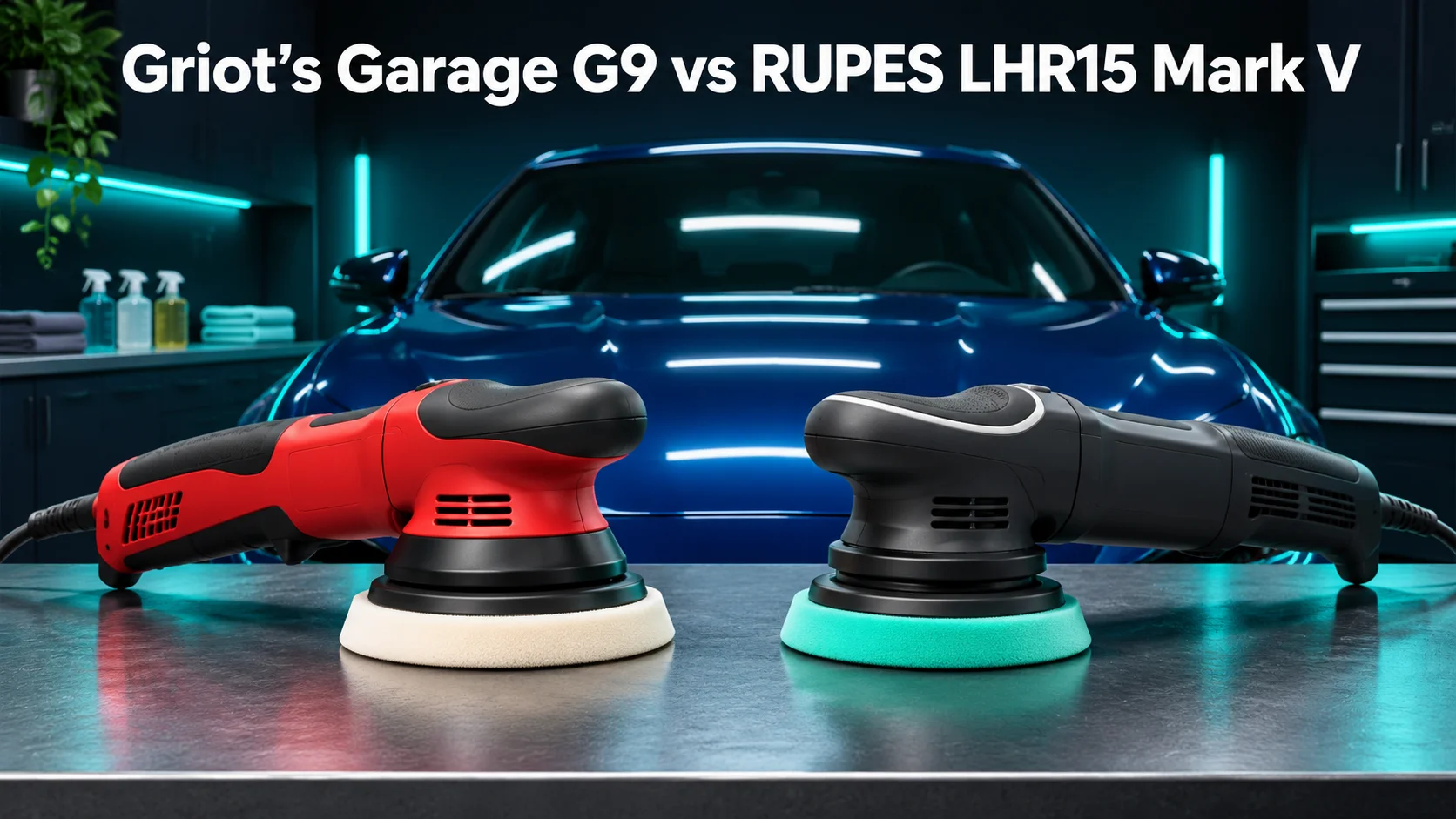
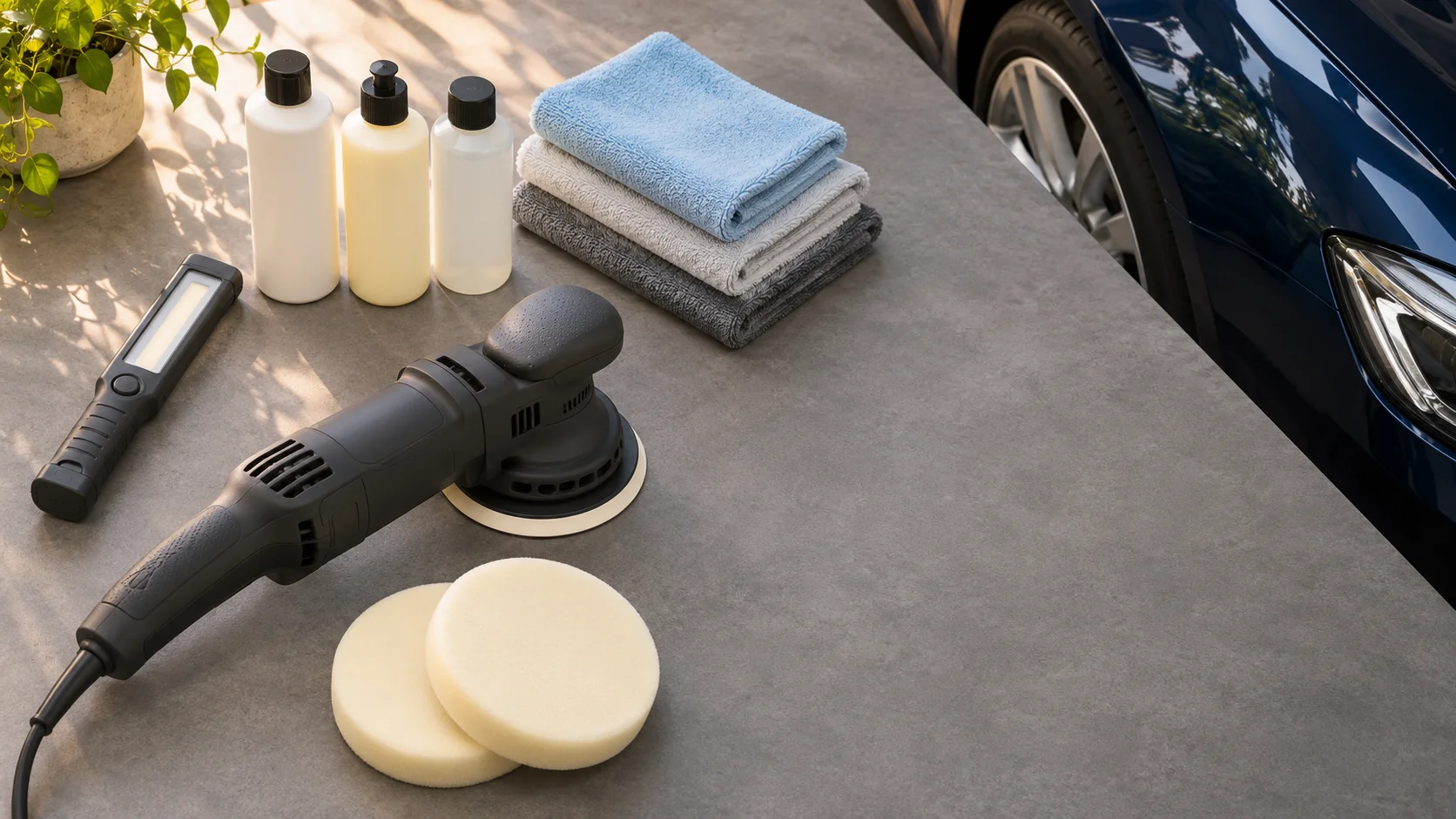
Research method: Manufacturer specifications checked November 23, 2026. This is an editorial buying comparison; we have not performed a controlled, hands-on test of these two machines. Recommendations below are our judgment from the documented configurations and practical purchase scenarios. Images are AI-generated concepts showing generic equipment, not accurate branded product photographs or evidence of testing.
Jump to: Comparison table · Why choose G9 · Why choose RUPES · Complete cost · Buying scenarios · FAQs
Griot’s Garage G9 vs RUPES LHR15 Mark V: key differences
| Buying point | Griot’s Garage G9 | RUPES LHR15 Mark V |
|---|---|---|
| Documented orbit | 9 mm | 15 mm |
| Standard backing plate / pad | 6-inch vented plate; manufacturer offers an optional 5-inch plate | 125 mm / 5-inch backing pad |
| Published motor input | 1,000 W | 500 W |
| Our buying role | First full-size garage setup to price | Premium system to evaluate for regular use |
| Essential listing check | Item 10901; regional electrical version; accessories | Mark V generation; regional model; exact kit contents |
| What this table cannot prove | Correction time, comfort or finish on your paint | Correction time, comfort or finish on your paint |
Sources: Griot’s Garage G9 specifications and RUPES LHR15 Mark V technical data. Confirm the actual US listing before ordering. Published electrical input figures describe different tool designs; dividing them does not establish relative polishing performance.
Treat the table as the start of a decision, not a league table. A larger number can describe a different operating configuration without making the machine more useful for every owner. Ask what you are trying to achieve: maintain one family car, learn a repeatable polishing process, or establish a setup you expect to use on several vehicles. Your answer should determine which features deserve attention.
Choose the G9 when the whole setup matters most
For a buyer assembling a garage from scratch, we would start with a G9 shopping list and compare its complete delivered cost with the RUPES alternative. This is a budget-allocation recommendation, not an assertion that the G9 is always cheaper at every retailer. Discounts, kit contents and shipping can change the result. The useful comparison is what you will have ready for your first planned job.
A sensible reason to choose the G9 is that the exact package fits your needs while leaving money for consumables and learning. A weak reason is that a bundle contains the largest number of bottles. Before ordering, identify which pads you actually need, how you will inspect the finish and where you will work. Unused accessories do not make a purchase better value.
The standard plate configuration and the manufacturer’s optional smaller plate provide a clear accessory question to investigate. Decide which supported configuration suits your vehicle before buying pads in quantity. Do not assume that an optional part is in the box, or that an unrelated plate is suitable because its thread appears to fit. Our Griot’s Garage G9 review covers the model separately.
G9 strengths and limitations for this purchase
Reasons to shortlist it: a straightforward main-machine role, an identified optional plate route and the opportunity to build your own useful kit. Reasons to reconsider: you have tried another machine and prefer its handling, your desired accessory system points elsewhere, or the complete delivered quote does not provide the expected saving. We do not have measured vibration data to settle that choice for you.
Choose the RUPES when you have a plan for its system
The LHR15 Mark V belongs on the shortlist when you want this particular long-throw platform and expect to use it regularly. The strongest buying case is specific: you have tried the tool in a suitable setting, understand the supported consumables and have compared a complete quote. Paying for a premium machine is easier to justify when it solves an identified need in your workflow.
Keep the generation precise. A listing that simply says “LHR15” deserves a closer look; the model name needs to match the Mark V you are researching. Compare the supplied accessories line by line rather than inferring them from a lifestyle image. Different regional offers and kit codes can contain different items. Ask the seller to confirm anything the listing leaves unclear.
Our recommendation is to preserve the rest of the budget after choosing the machine. Owning a premium tool while postponing the supplies or instruction necessary to use it is a poor start. If the RUPES quote requires that compromise, either revise the shopping list or wait until the complete purchase is comfortable. There is no requirement to start with a premium platform to learn a careful process.
Read the RUPES LHR15 Mark V review for the individual model. If your shortlist already consists of premium 15 mm machines, the FLEX XFE 7-15 150 vs RUPES LHR15 Mark V comparison addresses that separate decision.
RUPES strengths and limitations for this purchase
Reasons to shortlist it: a deliberate preference for its documented configuration, a suitable training or dealer relationship, and a clear plan for repeated use. Reasons to wait: an uncertain kit description, no opportunity to evaluate handling, or a quote that squeezes the budget for the rest of the system. We cannot establish a financial payback from unmeasured time savings.
9 mm vs 15 mm: what the orbit tells you
Orbit size describes an aspect of the machine’s movement. It is useful when identifying the configuration you intend to buy, but it is not a complete explanation of the result you will achieve. Avoid using the 15-to-9 ratio as a predicted speed increase. It would ignore the pad, abrasive, surface, technique and operating conditions involved in actual work.
Instead, assess the vehicle in front of you. List the broad panels, the curved sections and the areas where trim or nearby features limit access. Then ask whether the supported plate and pad combination is appropriate for each planned area. A full-size machine does not become a precision tool because the owner chose an expensive model. Some areas may call for another approach.
Do not buy either machine expecting one tool to address every awkward shape. If a smaller specialist later becomes necessary, our mini polisher buying guide is a separate starting point. For someone still learning the main machine, expanding the collection can usually wait until a real access problem has been identified.
Compare complete cost before comparing discounts
Build two shopping lists for the same job. Include the machine, required compatible plate, an appropriate pad supply, selected polish, preparation products, towels and inspection arrangements. Add tax and delivery using the same destination. Remove an item only when you already own a compatible version in usable condition. This prevents the bare-tool offer from appearing artificially attractive.
| Budget line | How to compare fairly |
|---|---|
| Machine and supported plate | Record the exact model and what the seller actually includes |
| Pads and polish | Price the consumables needed for the same intended process |
| Preparation and inspection | Include missing supplies, towels and lighting |
| Delivery, tax and returns | Use the same address and check return conditions |
| Training and support | Consider the guidance you can actually access |
| Unused bundle items | Count useful value, not a claimed total retail value |
Here is a hypothetical example, not a price quote: a $200 tool with $150 of missing supplies costs $350 to put into service. A $300 package containing the same useful supplies costs less for that scenario. Conversely, a larger package offers poor value if half its contents will remain unused. Apply this arithmetic to the actual offers instead of treating the example as a market price.
For recurring use, calculate a separate ownership budget. Think about consumable replenishment, obtaining support and the inconvenience of a return. Do not invent a cost per vehicle from assumed tool life. Until you have your own purchase price, usage history and replacement spending, that figure would be speculation disguised as precision.
Which polisher fits your situation?
You maintain one daily driver
Begin by pricing the G9 setup. Keep the goal proportionate to the vehicle and to the time you will realistically devote to maintenance. A complete, understandable process is a stronger first investment than buying additional equipment for jobs you have not planned. If the RUPES feels better during a demonstration and fits the complete budget, it remains a reasonable preference.
You expect to polish several vehicles regularly
Evaluate the RUPES alongside the G9 in a demonstration or training environment if available. Compare grip positions, access to controls and your ability to maintain a controlled working position. Those observations are more relevant to your purchase than our unsupported declaration that one tool feels better. Record what you liked and whether it justifies the difference in the real quotes.
You already own a working G9
Define the upgrade problem before shopping. Is the current tool unsuitable for a particular task, uncomfortable for you, or simply less exciting than a new release? Write down the limitation and test whether the proposed replacement addresses it. If the issue is uncertain accessory choice or technique, changing the machine may leave the underlying problem unresolved.
You are buying for paid work
Ask for service and warranty information from the actual seller and manufacturer for the region where you work. Keep that documentation with the receipt. Evaluate any claimed productivity benefit using your own repeatable work, including preparation and finishing, rather than assuming a percentage saving from specifications. A purchase decision can be commercially sensible without promising a universal return.
Pads, inspection and the first test area
Select consumables according to the machine and product instructions. Avoid assuming that matching nominal pad diameters proves full compatibility. Our foam vs microfiber vs wool polishing pads guide explains the accessory decision in more detail, while the polishing pad cleaning guide helps plan maintenance between sessions.
Before committing to the whole vehicle, plan a small accessible test area and a realistic stopping point. Follow the machine, chemical and vehicle finish instructions, inspect consistently and decide whether the improvement is sufficient. If the paint condition or previous repair history is unclear, have it assessed in person rather than interpreting a buying guide as permission to remove more material.
Keep your comparison honest if you try both tools. Record the pad and liquid, panel, preparation, lighting and working conditions. Changing several variables at once makes it difficult to attribute an improvement to the machine. Without a controlled method, a memorable result from one session should remain an observation rather than a universal performance claim.
Before you place the order
Confirm the full model name and correct regional electrical specification. Save the included-parts list, verify who sells and ships the machine, and check how returns are handled. Inspect the actual item promptly after delivery, following the supplied instructions. Resolving a missing accessory before the planned polishing day is much easier than discovering the problem after preparing the car.
If you are still comparing your first machine rather than these two specific models, start with our best dual action polisher for beginners guide. It includes another buying route and helps keep this comparison in context. Choose one coherent system before adding specialist machines and multiple overlapping kits.
Frequently asked questions
Is the RUPES LHR15 Mark V worth upgrading from the G9?
It can be worth evaluating when you can identify a limitation in your current setup and confirm the RUPES addresses it. We would not recommend upgrading solely because its orbit is larger. Compare handling, complete cost and the practical difference in your own work before replacing a functional machine.
Can a beginner choose the LHR15 Mark V?
A beginner can consider it with suitable instruction and a budget for the complete system. Our first recommendation is to understand the intended process and accessories before purchasing. Premium positioning does not eliminate the need to learn or make an unsuitable process appropriate for a particular finish.
Does the G9’s higher wattage mean it corrects paint faster?
No direct conclusion follows from the input ratings alone. They describe different machines, not a controlled comparison of work completed. We have not measured correction speed between these models and do not use wattage as a substitute for that testing.
Should I buy the tool alone or a kit?
Choose the offer with the better delivered total for the items you actually need. Verify the exact contents and compatibility. A kit can be useful when it covers your planned process; a bare tool can make sense when you already own suitable supplies. Neither format is automatically better value.
Which one is better for tight detailing areas?
Assess the supported plate and pad arrangement against the actual area before choosing either full-size machine. Do not treat a large tool as suitable for every narrow section. Where access is unsuitable, reconsider the approach or evaluate a specialist tool after identifying the specific need.
Our recommendation: buy around the work you will do
For an occasional home setup, start by comparing the complete G9 purchase. For regular use and a deliberate preference for the RUPES configuration, evaluate the LHR15 Mark V with the accessories and support you intend to use. Let the actual quotes, a handling assessment and your planned work settle the decision. We have no controlled test supporting a blanket winner.
Editorial comparison checked November 23, 2026. Specifications are sourced above; buying scenarios and recommendations are editorial judgments. Retail links open search results and do not guarantee an exact model, seller, price or availability.