
Affiliate disclosure: As an Amazon Associate I earn from qualifying purchases. Buying buttons open Amazon search results; verify the exact model, seller and included items.
Quick verdict: strongest value if you already own M18 batteries
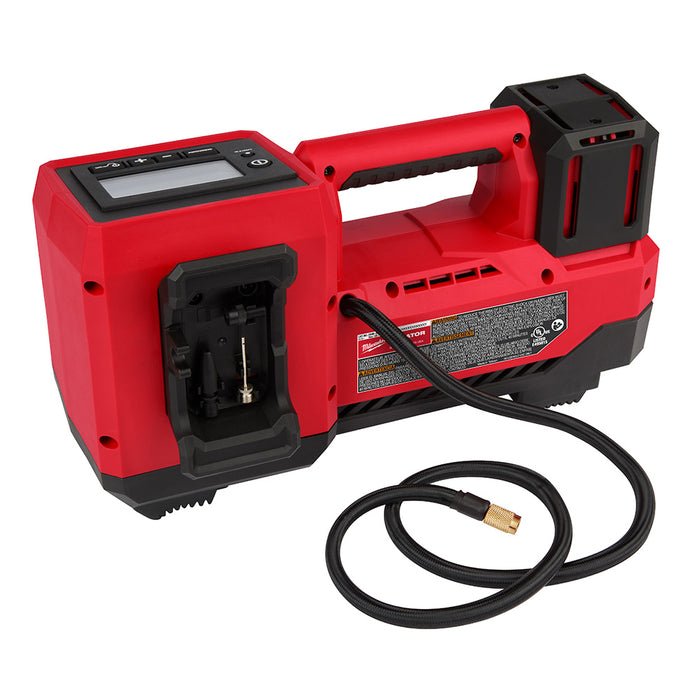
The Milwaukee M18 Inflator 2848-20 belongs on your shortlist for regular car or light-truck tire maintenance, particularly when you already own a compatible battery and charger. Starting from scratch makes the complete purchase harder to justify for occasional top-ups. Compare the full setup cost before ordering.
This Milwaukee M18 Inflator 2848-20 review is a research-based buying assessment using Milwaukee documentation. We have not performed hands-on inflation, noise, runtime or durability tests. Our buying judgments are editorial assessments, and manufacturer performance claims are identified below.
Milwaukee M18 Inflator 2848-20 review: key specifications
| Feature | Published specification | Why it matters |
|---|---|---|
| Battery platform | 18V Milwaukee M18 | Existing battery ownership changes the total cost |
| Maximum pressure | 150 PSI | A tool limit, never a suggested tire pressure |
| Hose | 36 inches, brass Schrader chuck | Consider valve position and where the tool can sit |
| Preset memory | Four pressure slots | Useful for repeat maintenance |
| Target control | TrueFill pressure checks and automatic shut-off | Reduces manual stopping work |
| Intended tires | Passenger, light-truck and other medium-duty tires | Match the tool to your actual vehicle use |
Source: Milwaukee’s official 2848-20 product page. Milwaukee also lists onboard attachment storage and M18 battery compatibility.
Who should buy it?
Our best-fit buyer already uses Milwaukee M18 tools, checks several tires regularly and wants to move around a vehicle without routing a power lead. In that situation, a shared battery platform can make an additional tool easier to own. Keep enough charging capacity available for your other tools as well.
For a household buying its first cordless tool solely for a few tire checks each year, the calculation changes. A lower-cost inflator may meet the need. Put convenience, storage space and how often you will use it alongside the purchase price.
| Your situation | Our buying assessment |
|---|---|
| You already own an M18 battery and charger | A strong shortlist candidate for regular tire care |
| You are buying into M18 from scratch | Compare the complete setup with alternative inflators |
| You need a small occasional-use trunk backup | Check dimensions and battery upkeep before choosing |
| You need sustained air supply for workshop tools | Compare a suitable compressor instead |
| You maintain an RV or unusual tire setup | Verify tire requirements and duty cycle for that application |
How fast is the M18 inflator?
Milwaukee advertises topping off a 33-inch light-truck tire in under a minute. That is a manufacturer claim about a top-up, rather than a promise to fill every flat tire in that time. Starting pressure, target pressure and tire volume matter, so we would not turn that headline into a universal fill-time estimate.
For everyday buying decisions, think about your routine. Adding a little air during scheduled checks is a different job from recovering several heavily deflated tires. We have not measured either scenario, and cannot provide an independent speed ranking.
Milwaukee’s launch specifications list a tool-only weight of 7 lb and dimensions of 13.8 × 6.4 × 7.8 inches. Battery weight is additional. Measure your intended storage space before buying it as permanent travel equipment.
What TrueFill adds to the routine
The tool checks pressure after allowing it to stabilize and can resume inflation to reach the selected target. Automatic stopping is convenient when working through multiple tires, but it still requires a correctly selected target and an attentive operator.
The four memory slots can save repeated input. For example, an owner maintaining two vehicles could keep their different pressure settings ready. That is a convenience example, not an instruction to reuse one vehicle’s settings on another. Recheck the appropriate vehicle guidance whenever your load or tire setup changes.
Battery and charger: price the complete setup
Treat 2848-20 as a tool-only purchase: do not assume a battery or charger comes with it. Retailers may offer separate bundles, so the contents of one listing do not establish what another includes.
Use this shopping calculation: inflator + required battery + charger + delivery and tax = your actual starting cost. If you already own compatible equipment, include only extras you really need. We have not verified live marketplace prices or stock, so no fixed deal price is quoted here.
| Listing type | Verify before checkout |
|---|---|
| Bare tool | Exact 2848-20 model, condition and included attachments |
| Battery bundle | Battery model, quantity, charger inclusion and seller |
| Discounted or open-box item | Missing parts, return terms and warranty eligibility |
Advantages and trade-offs
| Reasons to consider it | Trade-offs to accept |
|---|---|
| Shared platform for existing M18 owners | Battery and charger add cost for new users |
| Cordless movement around a vehicle | A charged, serviceable battery must be ready |
| Pressure presets and automatic target control | Correct pressure selection and supervision still matter |
| Onboard hose and attachment storage | Confirm the complete tool fits your storage area |
We would prioritize convenience over specifications you rarely use. A higher pressure ceiling does not automatically make an inflator better for an ordinary passenger car. Likewise, buying a premium model makes little sense if it stays home because it is inconvenient to store.
Duty cycle and tire-care limits
The 2848-20 operator’s manual specifies a 40-minute cooling period after 20 minutes of continuous use. It also says to supervise operation and prohibits filling air tanks or shocks. Automatic shut-off does not make unattended operation appropriate.
Use the vehicle manufacturer’s recommended cold-tire pressure for the relevant load and configuration. The inflator’s 150 PSI ceiling is not a target. If a tire repeatedly loses pressure, arrange inspection rather than relying on repeated top-ups; an inflator cannot repair the underlying problem. Follow the current instructions supplied with your tool and vehicle.
What to compare before choosing
Choose by the job first. For regular vehicle maintenance, compare a cordless model’s complete battery cost, hose reach and storage needs. For a travel kit, consider what happens when the battery is unavailable. For larger RV work, review the tire setup and the manufacturer’s intended application before deciding.
Our VIAIR 450P-RV review provides another product to investigate for RV-focused use. These products have different ownership requirements; we have not tested them side by side. For another M18 garage tool, see the Milwaukee M18 0880-20 vacuum review.
Frequently asked questions
Does the Milwaukee 2848-20 include a battery?
The standard tool-only model should be budgeted without a battery or charger. Check the exact listing because retailers may sell separate kits and bundles.
Does it work with M12 batteries?
Milwaukee specifies the M18 platform for this model. Buy the correct compatible M18 equipment; do not assume M12 battery compatibility.
Can I leave it running and walk away?
No. The manual requires supervision during operation, even though the tool has an automatic stop function.
Is it worth buying if I have no Milwaukee tools?
Possibly, but compare the full battery-and-charger cost with alternatives. Existing M18 ownership is the clearest value case in our assessment.
Have you independently tested its inflation speed?
No. This review evaluates manufacturer specifications and ownership considerations. It does not claim measured fill times, battery runtime or comparative noise results.
Final buying recommendation
The Milwaukee M18 Inflator 2848-20 is worth shortlisting when cordless tire care fits your routine and you already have M18 equipment. Before ordering, verify the package, budget for any missing battery or charger, and confirm storage space. For occasional use with no existing batteries, compare the complete cost carefully.