
Keep a parked car ready without guessing about its charger
A car that sits for weeks needs a different battery plan from a car that needs an emergency start. This guide explains how to identify a real maintenance function, choose a compatible device, and build a sensible storage routine.
For long-term car storage, choose a compatible automatic battery maintainer with documented maintenance control. A traditional uncontrolled trickle charger can keep supplying current after the battery is full. However, many products called “trickle chargers” are smart maintainers. Read the manual rather than deciding from the name alone.
As an Amazon Associate, we earn from qualifying purchases. Our recommendations are based on manufacturer documentation and editorial suitability, not hands-on testing. Check the seller, model, battery compatibility, and package before ordering.
View NOCO GENIUS2 maintenance charger on AmazonA maintainer makes sense when your battery is healthy, your vehicle is parked, and a suitable outlet is available. It is not a repair for a failing battery or an unexplained electrical drain. Buying a larger charger does not remove those problems.
Battery maintainer vs trickle charger: the real difference
A traditional trickle charger supplies a small charging current without the same ongoing control as a modern smart maintainer. Low current can sound gentle, but it does not by itself prove that a charger is suitable for being connected over a long storage period.
A smart maintainer regulates charging and uses its documented maintenance behavior after the battery reaches full charge. The exact method varies by model. Some devices use a float stage; others monitor the battery and run maintenance cycles. Do not assume every automatic charger follows an identical program.
Battery Tender explains the distinction between its electronically controlled chargers and basic trickle chargers in its manufacturer FAQ. That distinction is useful, but the brand name is not a universal compatibility approval for every battery.
Product listings often use “charger,” “trickle charger,” and “maintainer” in the same title. The words may describe overlapping functions. Before buying, find the section of the manual that explains what happens when charging finishes and whether ongoing connection is permitted.
| Question | Traditional uncontrolled trickle charger | Automatic maintainer |
|---|---|---|
| What happens after full charge? | May continue supplying low current without suitable maintenance regulation. | Uses the model’s maintenance program. |
| Long storage suitability | Do not assume prolonged connection is allowed. | Consider it only when the manual permits it for your battery. |
| Battery matching | Still requires the correct voltage and chemistry. | Still requires the correct voltage and chemistry. |
| Can it fix a bad battery? | No guaranteed repair. | No guaranteed repair. |
| Shopping priority | Check control behavior, not just low amperage. | Check the maintenance stage and instructions. |
Choose the tool for your actual problem
Healthy battery, parked car
Compare maintainers approved for the battery and the storage environment.
Low battery, time to recharge
Choose a charger with a suitable charging capacity and battery-approved current.
Car will not start away from home
Consider an appropriate jump-start method or roadside assistance.
These situations can look similar when the dashboard lights come on but the engine does not crank. The useful purchasing question is what you need to accomplish next. Keeping a charged battery ready for storage is different from restoring a heavily discharged battery before tomorrow’s trip.
If you need immediate starting assistance, our jump starter vs battery charger guide explains the distinction. A plug-in maintainer needs mains electricity and does not provide the same immediate starting function as a jump starter.
Two documented options for light charging and maintenance
The following models are examples of smart charger-maintainers, not a ranked list of every product available. Both need an AC outlet. Neither is selected here for fast recovery of a large, deeply discharged vehicle battery. Confirm the battery maker’s requirements before choosing either one.

Retailer product image; verify the package offered by your seller.
NOCO GENIUS1: a compact maintenance option
NOCO rates the GENIUS1 at 1A, with a charging capacity up to 30Ah. Its documentation lists maintenance of all battery sizes, subject to compatible voltage, chemistry, and operating conditions.
Why consider it: A small charger can be a practical choice when you mainly need compatible battery maintenance and have no need for a quicker recharge.
Limitations: The 30Ah charging rating is not a promise to quickly recharge a typical larger car battery. A direct wall-plug design also makes outlet location and cable routing important.
Check NOCO GENIUS1 model and options on Amazon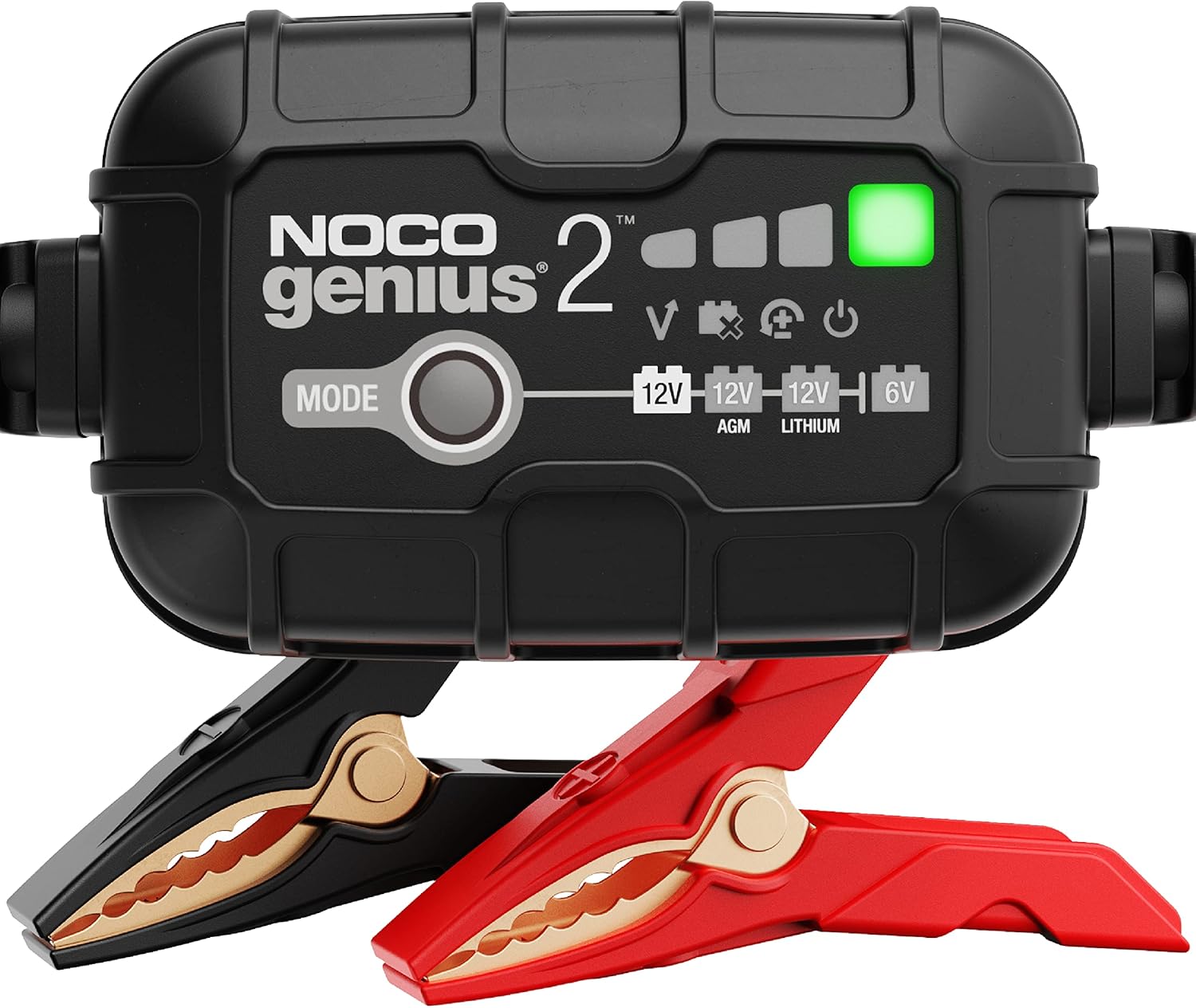
Retailer product image; verify the package offered by your seller.
NOCO GENIUS2: more charging current
NOCO rates the GENIUS2 at 2A, with a charging capacity up to 40Ah and maintenance of all battery sizes. It supports the documented 6V lead-acid and 12V battery modes described in its instructions.
Why consider it: Compared with the GENIUS1, the higher rated current gives more flexibility for compatible small-battery charging as well as maintenance.
Limitations: It remains a low-current charger. Maintenance capability does not turn its 40Ah charging rating into unlimited recharge capacity, and actual charging time depends on battery condition and the charging stages.
Check NOCO GENIUS2 model and options on AmazonOur editorial preference between these two is the GENIUS2 when a buyer wants some small-battery charging flexibility in addition to maintenance. The GENIUS1 remains worth comparing when maintenance is the main job. This is a use-case judgment, not a measured performance result or a claim about today’s price.
| Verified specification | NOCO GENIUS1 | NOCO GENIUS2 |
|---|---|---|
| Rated charging current | 1A DC | 2A DC |
| Published charging capacity | Up to 30Ah | Up to 40Ah |
| Published maintenance capacity | All battery sizes, within compatibility requirements | All battery sizes, within compatibility requirements |
| Input supply | 120–240V AC | 120–240V AC |
| Our suggested role | Mainly compatible maintenance | Maintenance plus compatible small-battery charging |
Specifications are from NOCO GENIUS1 specifications and NOCO GENIUS2 specifications. If you need to recharge a larger battery, compare the charging capacities in our NOCO GENIUS5 vs GENIUS10 guide, then confirm that its current is permitted by the battery manufacturer.
Read your battery label before shopping
1. Confirm nominal voltage
Use the battery label and vehicle manual. Do not choose a mode by vehicle size, appearance, or the color of the battery case. A device that offers several modes still needs the correct mode selected for the battery being charged.
2. Identify the battery chemistry
Flooded lead-acid, AGM, gel, and lithium batteries are not interchangeable charging decisions. Look for the manufacturer’s exact charging instructions. A lithium setting does not mean the device works with every lithium battery or every lithium voltage.
NOCO’s GENIUS1 instructions limit its 12V lithium mode to appropriate batteries with a battery management system. The battery manufacturer’s allowed voltage, current, and temperature limits still apply. If the label is missing or unclear, resolve that uncertainty before connecting a charger.
3. Separate capacity from maintenance
A charger may have a relatively small published charging capacity and a broader maintenance rating. Those figures describe different tasks. Maintaining an already charged compatible battery requires a different workload from restoring a large amount of missing charge.
For example, a buyer with a larger car battery should not read “maintains all battery sizes” as an assurance of a quick overnight recharge. Start with the battery’s capacity and the manufacturer’s charging limits, then decide whether maintenance or substantial recharging is the actual need.
4. Check the vehicle connection instructions
Some vehicles have designated charging points or specific battery-monitoring requirements. Use the vehicle’s instructions for connection locations. Do not assume that the same clamp placement is correct across every car, especially when the battery is hidden or the vehicle has additional electrical systems.
Build a storage routine around the equipment
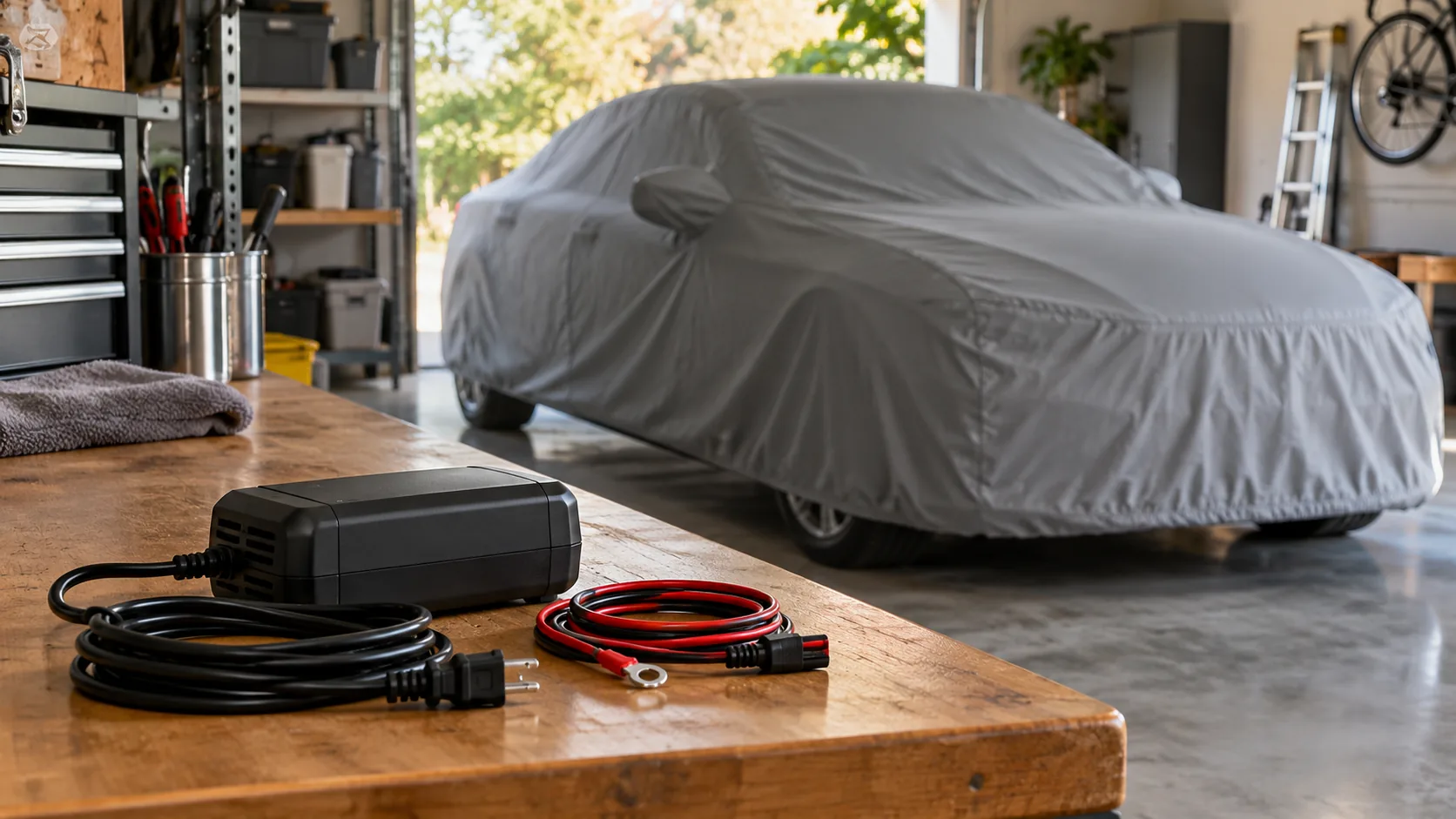
Start the plan while the car is still in normal use, rather than the evening before you leave it parked. Find the battery instructions, check the charger manual, and confirm where the device and cables will sit. A convenient setup is one you can inspect without moving piles of stored items.
Keep the charger uncovered and follow its ventilation and environmental requirements. Route cables so they will not be crushed by the hood, pulled by a garage door, or walked over. A product’s resistance rating should never be treated as permission to ignore its AC plug, outlet, and weather-exposure instructions.
Inspect the battery and charging equipment before use. Do not proceed with a damaged battery, damaged insulation, leaking case, or a setup that shows an unexplained fault. If you notice unusual heat, odor, swelling, or other abnormal behavior, stop using the equipment safely and seek the relevant manufacturer’s guidance.
Automatic maintenance is not a reason to skip inspections. NOCO’s GENIUS1 manual describes ongoing maintenance after full charge, but also contains warnings about monitoring and safe operation. Read both parts together. For a long trip away from home, decide how inspections will happen rather than assuming an indicator light eliminates every risk.
Follow the charger, battery, and vehicle manuals. Use eye protection and appropriate ventilation around batteries. Keep sparks and flames away. Never charge a frozen or damaged battery. This buying guide does not replace the manufacturer’s connection procedure.
When a maintainer will not solve the problem
A battery that repeatedly goes flat can have a battery fault, a charging-system problem, or an excessive electrical load while the car is parked. A maintainer may hide the symptom at home without explaining why it happens. If the problem returns after normal driving or soon after the maintainer is removed, arrange diagnosis.
Do not increase charger amperage simply because a fault light appears. A warning is information to investigate. Check the manual’s description, verify the selected mode, and confirm the connection only as instructed. Avoid repeated attempts to force a charger to work with a battery it does not recognize.
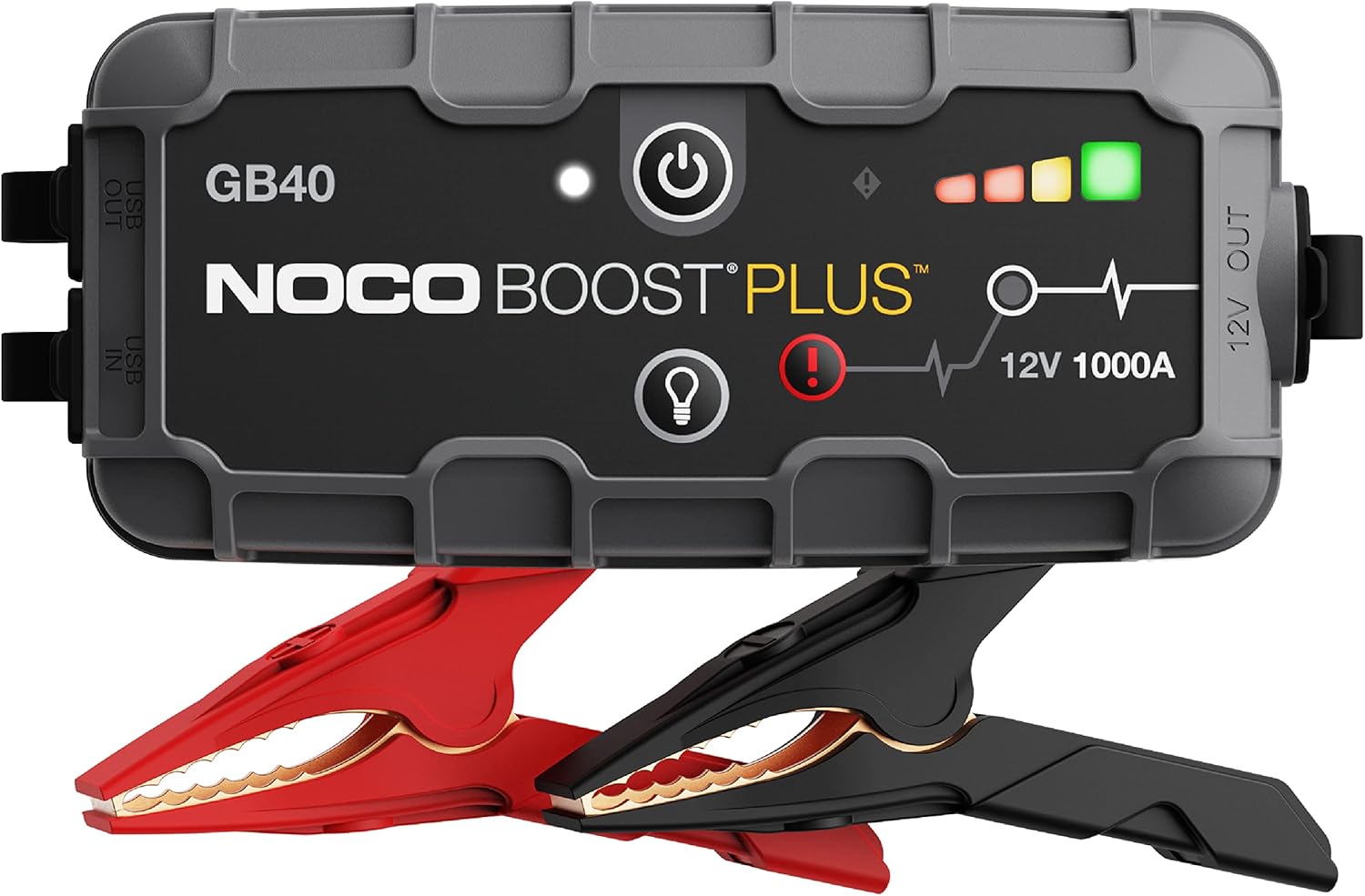
The GENIUS range includes advanced Force Mode, but it is not an everyday maintenance shortcut. NOCO warns that safety features are disabled in that mode. This guide does not recommend using it to rescue an unknown battery. Professional assessment is the more useful next step when the battery’s condition is uncertain.
A maintainer also needs a reliable power source. If your storage location has no permitted outlet, consider another storage plan approved by the vehicle and battery manufacturers. Do not improvise a mains supply or a battery-disconnection routine simply to make a particular purchase fit the situation.
A practical buying checklist
- Write down the job: long-term maintenance, small-battery charging, or substantial recharge.
- Record the battery information: nominal voltage, chemistry, capacity, and any special charging limits.
- Find the maintenance instructions: confirm what the charger does after full charge and what connection duration is permitted.
- Check the location: outlet access, cable reach, ventilation, temperature, and protected routing.
- Check the accessories: buy connectors approved for the charger and vehicle rather than assuming plugs that look similar are interchangeable.
- Review the seller’s exact model: confirm the regional plug, included parts, warranty information, and return conditions.
You do not need to buy the largest charger simply because it has more settings. Extra modes can add useful flexibility, but they also require you to understand when they are appropriate. For one healthy stored battery, clear compatibility and a manageable setup are more valuable than a feature list you will never use.
Before comparing prices, eliminate products whose manuals do not answer your essential questions. Then compare the remaining options on cable layout, maintenance instructions, support, and the specific work you expect them to do. That process is more reliable than shopping by a “best” badge or a low advertised current alone.
Frequently asked questions
Can I leave a battery maintainer connected all winter?
Only when the exact charger’s instructions permit ongoing maintenance for your battery and the setup meets its operating requirements. Continue the required inspections. Do not transfer one manufacturer’s permission to an unrelated charger.
Is every trickle charger unsafe?
No. Many modern products use the name while offering automatic maintenance control. The concern is an uncontrolled charger used beyond its intended duration. Read the full-charge and maintenance instructions before deciding.
Is a 1A maintainer enough for a car?
It may be suitable for compatible maintenance when the manufacturer permits that use. It does not automatically make a 1A device suitable for substantial recharging of every car battery. Check the separate charging-capacity rating and the battery’s requirements.
Will a maintainer repair a worn-out battery?
Do not buy one on that assumption. Maintenance supports a compatible battery’s state of charge, but it does not guarantee recovery from physical damage, a failed cell, or loss of capacity. Persistent problems need diagnosis.
Can I use lead-acid mode on a lithium battery?
Do not substitute modes. Use a charger and mode specifically approved for the exact battery, including its battery-management requirements and allowed charging conditions. Ask the battery manufacturer if compatibility is unclear.
Should I disconnect the battery from the car?
Follow the vehicle and charger instructions. Disconnecting can affect vehicle settings or systems, and connection points vary. This is a vehicle-specific decision rather than a universal storage rule.
What to choose for your parked car
Choose a compatible automatic maintainer when storage maintenance is the job and a safe, inspectable AC setup is available. Compare the GENIUS1 for a compact maintenance-focused option and the GENIUS2 for additional compatible small-battery charging flexibility. Choose a larger appropriate charger if substantial recharging is the actual need.
The buying decision starts with the battery and the manual. The product label comes afterward. That approach helps you avoid both an uncontrolled charger used too long and a small maintainer bought for a recharge job it was never intended to handle.
Review NOCO GENIUS2 package and compatibility on Amazon
1 thought on “Battery Maintainer vs Trickle Charger: Which Is Better for Car Storage?”