
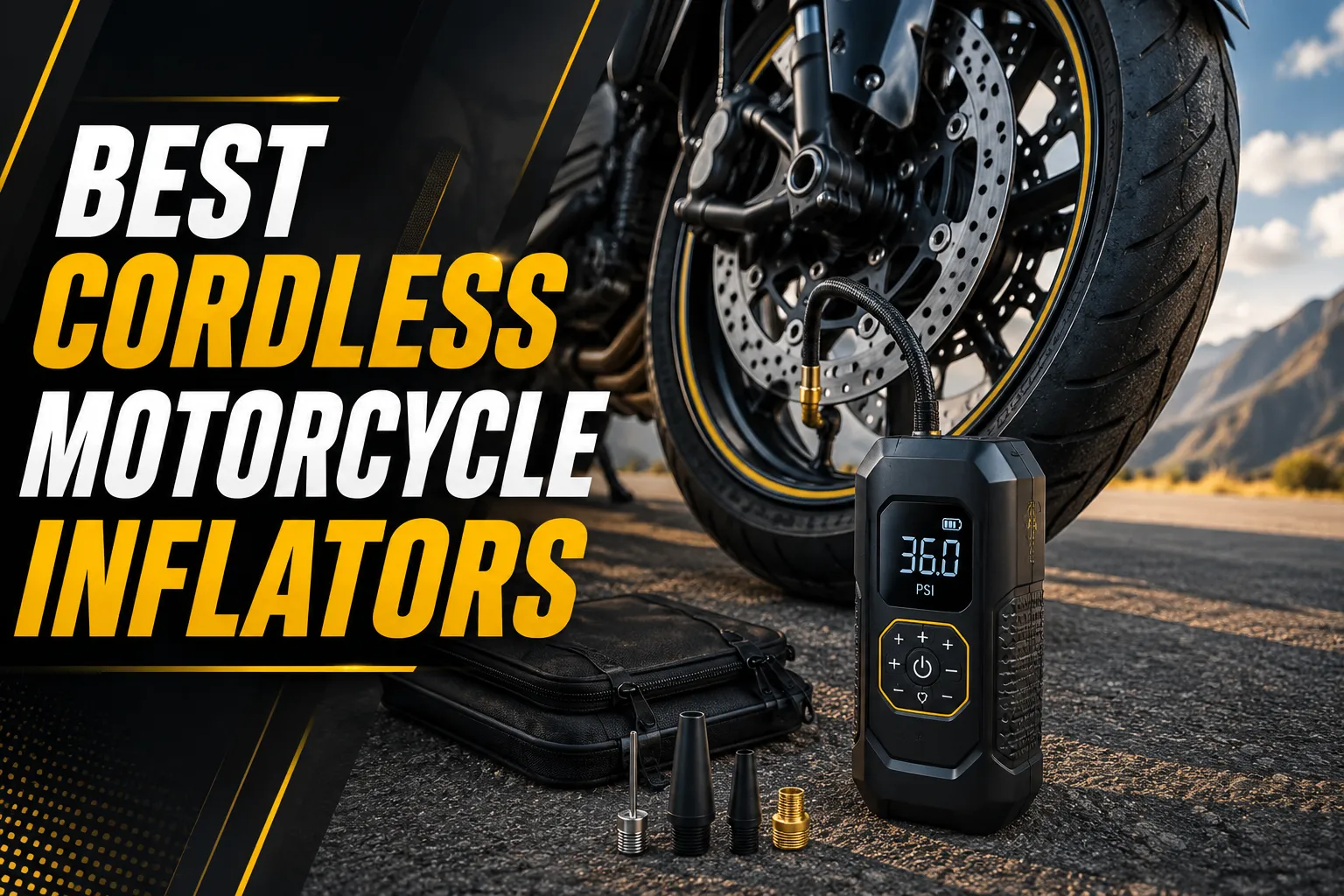
The best cordless inflator for most motorcycle riders is a compact model with accurate Digital Pressure Gauges Matter Most in Turbines”>Digital Pressure Gauges Need Calibration? Here’s the Truth”>Digital Pressure Gauges Work: A Clear Guide”>Digital Pressure Gauges Explained: Uses, Pros, and Buying Tips”>digital pressure control, a secure chuck, and enough battery life to top off both tires on one charge.
Buying the right cordless inflator matters more on a motorcycle than it does on a car. Small tire volumes, narrow valve stems, and limited storage space all change what “best” really means. I’m Jake Morrison, and in this guide I’ll help you choose the Best Cordless Inflators Backpacking: Top Portable Picks for 2026″>Best Cordless Inflators for Kayaks: What to Buy”>best cordless inflators motorcycle riders can actually rely on.
Here’s the short list of what usually works best for riders:
- Compact mini inflators for emergency carry
- Handheld cordless compressors for faster top-offs
- Jump starter and inflator combos for touring
- Digital display models for easier pressure checks
- Auto-shutoff inflators for safer roadside use
- Lightweight units that fit in a saddlebag
Motorcycle tires often run at lower pressures than car tires, so accuracy matters. I’ll walk through the features that matter, the types worth buying, and the models I’d put on a real rider’s shortlist.
What to Look for When Buying Best Cordless Inflators for Motorcycle Tires
- Look for accurate pressure control, not just high max PSI.
- Choose a battery that can handle both tires on one charge.
- Make sure the chuck fits tight valve stems and awkward spoke spacing.
- Pick a unit that stays cool during repeated use.
- Keep weight and storage size low for bike carry.
- Prefer auto shutoff, a backlit gauge, and USB charging.
PSI Range and Accuracy for Motorcycle Tire Pressures
Most motorcycle tires do not need a huge PSI ceiling, but they do need good accuracy. I want a cordless inflator that can reliably set pressure in small increments, ideally within 1 PSI. That matters because a 2 PSI mistake can change ride feel, grip, and tire wear.
For motorcycles, I care more about low-end accuracy than a high max PSI number. A 150 PSI inflator is fine, but only if it reads correctly at 30 to 42 PSI.
Battery Runtime and Recharge Speed for Roadside Use
You do not need a giant battery for one motorcycle, but you do need enough runtime to inflate a front and rear tire without panic. Faster recharge is a bonus if you ride often or want to keep the inflator ready in the garage. Many riders also like USB-C charging because it is easier to top off with the same cable they already carry.
Chuck Design for Small Valve Stems and Tight Spokes
Motorcycle valve stems can be tucked behind brake rotors, chain guards, or tight spoke patterns. A bulky chuck can make a simple job frustrating. I prefer a slim chuck, a flexible hose, or a 90-degree adapter if the bike has limited clearance.
Inflation Speed, Noise, and Heat Control
Speed matters, but only up to a point. For motorcycle tires, a compact inflator does not need to be lightning fast, though it should move air steadily without overheating. Quieter units are easier to use on the roadside, especially late at night or in a parking lot.
Portability, Weight, and Storage in a Motorcycle Bag
Space is precious on a bike. A good cordless inflator should fit in a saddlebag, tail bag, or tank bag without taking over the whole compartment. I like a unit that feels sturdy but still light enough to carry on longer trips.
Extra Features That Matter for Riders: Auto Shutoff, Gauge, Light, USB Charging
Auto shutoff is one of the best features for riders because it helps prevent overinflation. A built-in light helps when you are working at dusk or on the shoulder. USB charging is useful too, especially if the inflator doubles as a power bank or can be recharged from a portable battery pack.
Cordless Inflator Types That Work Best for Motorcycles
| Type | Best For | Main Advantage | Main Trade-Off |
|---|---|---|---|
| Compact mini inflator | Emergency carry | Small size and easy storage | Slower inflation |
| Handheld cordless compressor | Frequent top-offs | Better speed and control | Heavier and larger |
| Jump starter + inflator combo | Touring riders | Two tools in one | Higher cost |
| Digital display inflator | Accuracy-focused riders | Easy PSI setting | Depends on display quality |
| Analog display inflator | Simple backup use | Basic and often durable | Less precise |
Compact Mini Inflators for Under-Seat or Saddlebag Carry
These are the easiest to keep on the bike. They are ideal if you want a backup for emergencies and do not want to sacrifice storage. The downside is slower inflation, so I see them as a top-off tool more than a full roadside rescue machine.
Handheld Cordless Air Compressors for Faster Top-Offs
These are the sweet spot for many riders. They are still portable, but they usually have better motors, better cooling, and more useful controls than the tiniest mini units. If you ride often, this category is where I’d start.
Multi-Function Jump Starter and Inflator Combos
Combo units make sense for touring, adventure riding, and long solo trips. If you want one device that can help with a dead battery and low tire pressure, this can be a smart buy. Just make sure the inflator side is not an afterthought.
Cordless Inflators with Digital vs Analog Pressure Displays
Digital displays are easier to read and usually better for setting exact PSI. Analog gauges can be simple and durable, but they are not as convenient in low light or when you are in a hurry. For motorcycles, I usually prefer digital.
Best Valve Connection Styles for Motorcycle Tubeless and Tube-Type Tires
Most modern street bikes use tubeless tires with standard valve stems, while some older bikes and off-road setups may still use tube-type wheels. A good cordless inflator should work with standard Schrader valves and include a secure clamp or screw-on chuck. If you ride off-road, a more flexible hose helps a lot.
Top Picks for the Best Cordless Inflators for Motorcycle Riders
I’m keeping this section practical. These picks are based on the features that matter most to riders, not just raw air output.
Best Overall Cordless Inflator for Motorcycle Use
HOTO Air Pump Pro — Best for most riders who want a compact, accurate, easy-to-use inflator. It has a clean digital interface, auto shutoff, and a small footprint that fits well in a tank bag or saddlebag. It is a strong choice for street bikes, commuters, and weekend riders who want dependable top-offs.
Key specs: Digital PSI display, auto shutoff, USB charging, compact body, built-in light.
Best Budget Cordless Inflator for Motorcycle Tire Emergencies
Fanttik X8 APEX — Best for riders who want a lower-cost backup without giving up useful features. It is small enough to carry easily and simple enough for roadside use. I like it for riders who want a reliable emergency tool without moving into premium pricing.
Key specs: Portable design, preset pressure control, digital readout, rechargeable battery, flashlight mode.
Best Premium Cordless Inflator for Frequent Riders
DeWalt 20V MAX Inflator — Best for riders who already own DeWalt batteries and want a tougher, more versatile inflator. It is larger than a mini inflator, but it offers strong build quality and good usefulness in a garage or home setup. For riders who also maintain car tires and gear, it is a serious tool.
Key specs: 20V battery platform, high durability, Digital Gauge Displays Explained: What They Show”>Digital Gauge Cluster Explained”>Digital Gauge Clusters Explained for Drivers”>Digital Gauge Clusters Explained: What Drivers Need to Know”>Digital Gauge Clusters: Reliable or a Repair Risk?”>digital gauge, auto shutoff, multiple power options depending on kit.
For battery safety and charging best practices, I also like checking manufacturer guidance from the DeWalt official site and general tire pressure recommendations from the National Highway Traffic Safety Administration.
Best Cordless Inflator for Touring and Long-Distance Trips
Makita 18V LXT Inflator — Best for riders who pack smart and want a tool that can handle repeated use. It is a strong touring option if you already use Makita batteries or want a rugged inflator with good control. It is not the smallest choice, but it is very practical.
Key specs: 18V battery platform, digital pressure setting, auto stop, bright display, solid runtime.
Best Compact Cordless Inflator for Sport Bikes and Minimal Pack Space
Milwaukee M12 Compact Inflator — Best for riders who want a compact tool with a strong reputation for jobsite durability. It is a good fit for sport bikes, naked bikes, and riders who want a small but capable backup. The size makes it easier to carry, and the controls are straightforward.
Key specs: Compact body, digital gauge, preset PSI, auto shutoff, easy storage.
Best Cordless Inflators for Motorcycle Riders by Price Tier
Under $50: Basic Emergency Top-Off Options
In this range, expect a simple mini inflator with basic digital control and limited battery capacity. These can work for emergency top-offs, but they are usually slower and less refined. I would buy here only if budget is the main concern.
$50–$100: Best Value Cordless Inflators for Most Riders
This is the best value zone for many motorcycle owners. You can find compact inflators with auto shutoff, decent battery life, and a usable digital gauge. If you ride regularly but do not want to overspend, this is the range I’d target first.
$100–$200: Higher Performance Models for Frequent Use
Here you start getting better build quality, stronger batteries, and more confidence on long rides. This range makes sense if you ride often, maintain multiple vehicles, or want a tool that feels more durable.
$200+: Premium Cordless Inflators and Combo Units for Motorcyclists
At this level, you are paying for brand ecosystems, stronger construction, and multi-tool convenience. Combo units and higher-end brand inflators live here. If you tour a lot or want one tool for the bike, garage, and roadside kit, the extra cost can make sense.
Brands to Trust (and Avoid)
- Buy from brands with clear PSI specs and warranty support.
- Choose companies known for battery tools or automotive accessories.
- Look for auto shutoff and real customer support in the USA.
- Do not trust no-name inflators with vague pressure claims.
- Do not buy a unit that lacks replacement parts or support.
- Do not assume a high max PSI means good motorcycle performance.
Brands I trust most are the ones that publish clear specs and stand behind their batteries and chargers. For motorcycle use, that usually means established tool brands and reputable auto accessory makers. I’m cautious with ultra-cheap units that promise huge performance but give little detail about accuracy, runtime, or warranty coverage.
Motorcycle tire pressure changes can affect handling fast because the contact patch is small. A few PSI off can change steering feel more than many riders expect.
- Check pressure when tires are cold for the most accurate reading.
- Keep a short valve stem extender in your kit if your bike has tight wheel access.
- Test the inflator at home before you need it roadside.
- Charge the battery every few months if the bike sits for long periods.
Avoid fake reviews, oversized PSI claims, and inflators sold with no real warranty. The biggest mistake riders make is buying the cheapest unit without checking whether the chuck fits their valve stem or whether the battery can finish both tires. Also, do not inflate a hot tire and assume the pressure reading is final.
Our Top Pick & Why
Why This Pick Wins for Motorcycle-Specific Use
If I had to choose one cordless inflator for most motorcycle owners, I’d lean toward the HOTO Air Pump Pro. It hits the balance I want: compact size, easy digital control, auto shutoff, and enough portability to live on the bike without getting in the way. For real motorcycle use, that combination matters more than raw power.
Who Should Buy It and Who Should Skip It
Buy it if you ride a street bike, commuter, naked bike, or sport bike and want a clean, simple inflator for regular use. Skip it if you need a heavy-duty shop tool, already own a battery platform you want to stay inside, or want the fastest possible inflation for larger vehicles too.
Best Use Cases: Commuting, Touring, Off-Road, and Weekend Rides
For commuting, a compact digital inflator is easy to keep in a bag and use before work. For touring, I’d favor a unit with strong runtime and a reliable chuck. For off-road riding, portability and valve access matter most. For weekend rides, the best choice is usually the one you’ll actually carry every time.
Choose a cordless inflator that is compact, accurate, and easy to carry, because those three traits matter most for motorcycle riders.
How to Use a Cordless Inflator on a Motorcycle Tire Safely
Find the correct pressure on the swingarm sticker, owner’s manual, or manufacturer guidance. Front and rear tires often use different PSI numbers, so do not guess.
Line up the chuck carefully and avoid forcing it sideways. On motorcycles, the valve stem can be small and easy to stress if the chuck is bulky or poorly angled.
Use short bursts and let the inflator rest if it starts to warm up. This helps protect the motor and gives you more control over the final pressure.
Check the reading again after each burst. Motorcycle tires can change handling quickly, so I always fine-tune carefully instead of overshooting and bleeding off air later.
Let the unit cool, coil the hose neatly, and recharge it as soon as you can. A ready battery is part of the value you paid for.
Best Cordless Inflators for Motorcycle Riders: Final Buying Takeaways
Best Choice for Most Motorcycle Owners
For most riders, a compact digital inflator with auto shutoff is the right balance of size, accuracy, and convenience.
Best Choice for Tight Budgets
If money is tight, choose a basic cordless mini inflator from a reputable brand and focus on accuracy over speed.
Best Choice for Touring Riders
Touring riders should spend more for better runtime, stronger build quality, and a chuck that is easy to use in tight spaces.
Use the pressure listed by your motorcycle manufacturer, usually found on the swingarm, frame sticker, or owner’s manual. Front and rear tires may need different PSI numbers.
Yes, many can, but the best use is usually topping off or restoring pressure after a slow leak. A compact inflator may take longer than a larger compressor.
Yes. Digital control is easier to read and usually more precise, which helps when you are working with the smaller pressure ranges common on motorcycles.
A compact mini inflator or small handheld cordless compressor is usually the best fit for saddlebags, tail bags, or under-seat storage.
Only if you want both tools and are willing to pay more. Combo units are useful for touring, but make sure the inflator portion is strong enough for your needs.
- Choose accuracy and auto shutoff over max PSI bragging rights.
- Pick a compact size that fits your motorcycle storage.
- Make sure the chuck works with tight valve stem access.
- Buy enough battery runtime for both tires, not just one.
- Touring riders should pay more for durability and convenience.