
Disclosure: As an Amazon Associate, we earn from qualifying purchases. We may also earn a commission through Walmart links, at no extra cost to you.
Editorial comparison · Updated October 21, 2026 · Based on manufacturer guidance; no hands-on durability test is claimed.
Ceramic spray wax vs traditional wax: the quick answer
Choose a ceramic spray protectant if your main goal is a convenient protection routine for a daily driver. Choose a traditional liquid or paste wax if you enjoy applying wax by hand and want a familiar finishing step after washing. Neither category automatically wins every comparison: the actual formula, surface preparation, weather exposure and maintenance matter more than the name on the front label.
For most beginners, the best purchase is the product whose directions fit their available space and time. A rinse-applied product needs water access. A dry-application spray needs suitable towels and careful buffing. A traditional wax needs an applicator and removal time. Read the back label before ordering so the application method matches the way you actually wash your car.
What do these product names actually mean?
Traditional car wax usually describes a liquid or paste protection product, often made with carnauba and other ingredients. It is a blend rather than a block of pure natural wax. Modern products can combine waxes and polymers, so the distinction between natural and synthetic protection is less simple than store categories suggest.
Ceramic spray wax is a broad shopping term for spray products marketed with ceramic-related chemistry. Some are protectants intended for regular maintenance; others are marketed as spray coatings. They do not all have the same application process, concentration or expected service life. A consumer spray should also be evaluated separately from a professional coating service that includes extensive preparation and controlled installation.
Do not confuse wax with polish. Wax is selected primarily as a finishing protection step, while an abrasive polish changes the paint surface to address defects. A product that adds shine does not necessarily remove scratches. If a bottle combines cleaning, polishing and protection, assess it as that specific combination rather than assuming every wax works the same way.
Side-by-side comparison
The useful comparison is between the work each product asks you to do and the result you expect. Packaging alone cannot establish a durability winner. A carefully applied traditional product may suit a sheltered weekend vehicle very well, while a convenient spray may make consistent care easier on a frequently washed commuter.
Use the table as a buying checklist rather than a laboratory ranking. This guide does not report hands-on testing or assign measured protection periods. Product examples below illustrate different application styles, and the final decision should follow the current manufacturer instructions for the bottle you receive.
| Buying factor | Ceramic spray | Traditional wax |
|---|---|---|
| Format | Spray; formula and method vary | Usually liquid or paste |
| Application | Wet/rinse or dry/wipe, depending on label | Applicator and towel removal, per label |
| Best fit | Owners seeking a convenient routine | Owners who enjoy hand waxing |
| Durability | Product and conditions dependent | Product and conditions dependent |
| Key check | First-use and cure directions | Layer thickness and removal timing |
Which is easier for a beginner?
A spray can reduce the number of tools you need, but it still needs an even application. Using too much product, working across an entire hot hood or leaving residue in panel edges can make a quick task frustrating. Start with a small area and check the finish before moving around the car.
Traditional wax has a useful advantage for people who like a deliberate process: an applicator makes it easy to see where they have worked. However, a thick coating can be harder to remove than a thin one. More visible material does not mean better protection, so resist the urge to spread a heavy layer.
Pick one system and learn its directions before building a shelf of products. For a first attempt, leave enough time to wash, dry where required, apply and inspect the finish without rushing. A simple routine repeated consistently is more useful than an ambitious routine you avoid because it takes too long.
Gloss, water beading and the limits of protection
Both approaches can leave a clean car looking glossy. How much better it looks will depend on the paint before application, the lighting and the specific formulation. A protective layer cannot restore missing clear coat or correct deep damage. Paint preparation often changes the visible result more than switching between two reputable finishing products.
Water beading can be satisfying, but it should not be treated as proof that a vehicle is protected from every hazard. Rainwater or sprinkler droplets can dry on the surface and leave marks. Continue drying after washing where practical, and address contamination promptly using methods suitable for the finish.
Neither ordinary wax nor a consumer ceramic spray replaces paint protection film against stone impacts. Avoid buying either one based on the idea that it will make the car scratch-proof. Careful washing, clean towels and sensible handling remain necessary after you apply a protection product.
How long will either product last?
There is no honest category-wide answer in months. A vehicle parked outside, driven daily and washed frequently faces different conditions from a garage-kept car used on weekends. Road film, cleaners, weather and application quality can all change the maintenance schedule. Treat manufacturer durability statements as product-specific claims under the stated conditions.
Instead of waiting for a calendar promise to expire, watch how the finish behaves during normal washing. If cleaning becomes more difficult or the surface response changes, review your maintenance routine. That observation alone does not diagnose the exact condition of the protective layer, so consult the product guidance before adding more material.
Compare the total work across a year rather than only the first application. A convenient product that you can refresh during your usual wash may be a better practical choice than a longer routine you postpone. Conversely, an owner who enjoys hand waxing may prefer the predictable process of a traditional product.
Three product styles worth comparing
Meguiar’s Hybrid Ceramic Wax G190526 is an example of a wet-use ceramic spray product. Its official product information describes a wash-related spray, rinse and drying workflow. The manufacturer also provides separate guidance for the first application. Read that guidance carefully rather than using instructions from a different ceramic spray.
Turtle Wax Hybrid Solutions Ceramic Spray Coating represents a different shopping option: the manufacturer describes a spray-and-wipe application. That makes it worth comparing for owners who prefer working on a prepared, dry vehicle. Verify the directions, any waiting period and surface suitability on the current regional label before applying it.
Meguiar’s Gold Class Carnauba Plus Liquid Wax G7016 represents a traditional liquid wax approach. The official listing describes application with a soft foam applicator. Choose this style if applying a controlled, thin layer by hand appeals to you. These examples are editorial comparisons of documented use cases, not an independent performance ranking.
Compare these exact product names
Wet-use option: Meguiar’s Hybrid Ceramic Wax G190526
Spray-and-wipe option: Turtle Wax Hybrid Solutions Ceramic Spray Coating
Traditional liquid option: Meguiar’s Gold Class G7016
These open retailer searches. Verify the exact item, size, seller and current checkout price.
Amazon vs Walmart: how to compare the real cost
Open both stores for the exact product you want, then match the name, model, bottle size and pack quantity. A smaller bottle with a lower displayed price may cost more per ounce. A kit may include useful towels or an applicator, but it may also include items you already own and do not need.
Check the seller, fulfillment details, delivery date and return terms before deciding. Marketplace results can include several sellers and different package versions. Search links below help you locate listings; they do not guarantee that the first result is the correct item or that either store currently has stock.
Compare the checkout total, including shipping and any membership conditions that apply to you. No fixed retailer price or lowest-price claim is shown here because live prices and stock have not been independently confirmed. The buttons are clearly labeled by store so you can make the final comparison using current listings.
Prepare the paint before choosing a winner
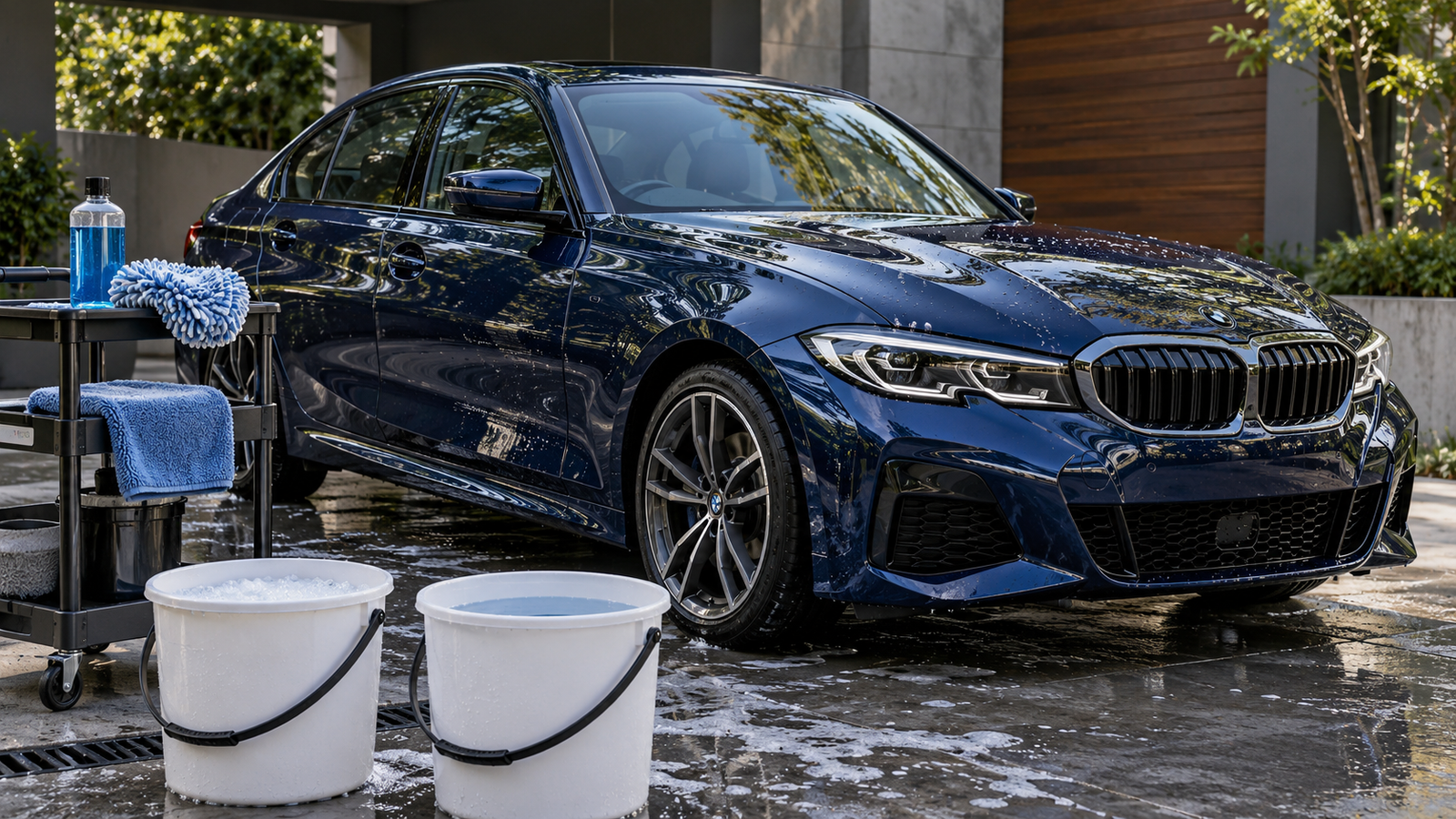
Wash away loose dirt before touching the surface with an applicator or finishing towel. Use tools suited to automotive paint and keep heavily contaminated wheel-cleaning equipment separate from paint-care tools. If a towel falls onto grit, set it aside rather than rubbing it over the panel.
After washing, inspect the finish in good light. Rough contamination, old residue or obvious paint defects may need separate treatment. Do not automatically reach for a clay bar or abrasive polish on every wash; assess what the surface needs and follow the relevant product directions. Extra steps create extra opportunities for mistakes when they are unnecessary.
Work in conditions allowed by the manufacturer. Shade and a cool surface are sensible starting conditions unless the exact product specifically permits something else. Check trim, glass, wraps and matte-finish restrictions individually. A label that permits use on painted panels should not be read as permission to coat every exterior material.
A practical ceramic spray application routine
First identify whether your bottle is designed for wet application, dry application or more than one method. These instructions cannot be interchanged simply because two products both use the word ceramic. Keep the manufacturer directions beside you for the first use and follow the stated sequence.
For a dry spray-and-wipe system, work in manageable sections and use the amount the label specifies. Spread and remove residue as directed, changing towels when necessary. Inspect from more than one angle so streaks do not become visible only when you move the car into daylight.
For a rinse-applied system, follow the stated rinsing and drying process, including any different first-use directions. Do not assume you should leave the product sitting while you complete the entire vehicle. If the maker specifies a waiting or curing period, plan the job so rain, washing or another product will not interrupt it.
A practical traditional wax application routine
Confirm the product is suitable for your paint and that the surface is prepared as directed. Use a clean applicator and apply a thin, controlled layer. Avoid loading the applicator heavily in the belief that a thicker layer will last proportionally longer; the excess usually adds removal work.
Follow the label for the application area and removal timing. Some products call for a haze before removal, while other formulations use different cues. Using a remembered instruction from a different bottle can cause problems. Keep wax away from surfaces the manufacturer excludes and remove accidental residue promptly using an appropriate method.
Use clean microfiber towels for the final removal and inspect seams, badges and panel edges. Turn the towel frequently and replace it when loaded with residue. If the finish looks uneven, pause and review the directions before adding more wax. Layering additional material over a removal problem can make the result harder to correct.
Which should you buy for your situation?
For a daily commuter, start by prioritizing an easy routine that fits regular washes. A ceramic spray protectant is worth considering if its application process fits your water access, available shade and drying habits. The convenience matters because consistent maintenance is easier when the protection step does not require a separate afternoon.
For a weekend vehicle, a traditional wax can be an enjoyable finishing choice when you already wash and dry carefully. You do not need to replace a product that gives you satisfactory results simply because a newer label sounds more advanced. Spend first on clean wash tools and enough suitable towels.
For an already coated vehicle, ask the coating manufacturer which maintenance products are compatible. For matte paint, satin finishes, wraps or repaired panels, follow the finish supplier’s guidance before buying a gloss-enhancing protectant. These are cases where compatibility should decide the purchase before bottle size, scent or promotional claims.
Common mistakes that waste product
The most avoidable mistake is buying several overlapping products without knowing which one is the primary protection step. Keep the routine understandable: cleaning first, any necessary defect correction next, then compatible protection. Add a maintenance product only when its purpose and directions are clear.
Another mistake is treating every change in water behavior as a reason to pile on more protection. Dirt and wash residues can change how water looks on the surface. Clean appropriately and review the maintenance instructions instead of reacting with multiple layers of unrelated chemicals.
Finally, do not compare value using bottle price alone. Consider the number of sensible applications, whether you need extra tools and whether the process fits your schedule. A discounted product that sits unused is poor value. Buy the smallest practical setup that lets you complete the job correctly and maintain it comfortably.
Frequently asked questions
Can ceramic spray replace traditional wax? It can serve as your chosen protection step when the manufacturer specifies that use. You do not automatically need both. Choose one compatible routine and follow its instructions rather than layering products only because their marketing sounds complementary.
Can you apply ceramic spray over wax? Compatibility depends on the exact formula and manufacturer guidance. Existing protection can affect the intended application conditions, so check the instructions for both products. If you cannot confirm compatibility, avoid experimenting across the whole vehicle.
Does wax remove scratches? A finishing wax should not be purchased as a substitute for paint correction. Some combination products include cleaning or polishing functions, but that is a separate product-specific capability. Check the label and assess the defect before selecting a treatment.
Which is cheaper? The answer depends on current store pricing, bottle size, application amount and the equipment you already own. Compare the matched Amazon and Walmart listings and your total setup cost. Neither retailer is presented here as the guaranteed cheapest option.
Our recommendation
Choose by application method first. If you want a practical maintenance step during normal washes, compare ceramic sprays with directions that fit your setup. If you prefer applying a finishing product by hand on a dry car, a traditional liquid wax remains a reasonable option.
Before checking out, confirm the exact bottle, read the current label and compare the delivered price at both stores. The best choice is the one you can apply correctly, maintain consistently and buy without paying for a bundle you will not use.
Manufacturer sources and related guides
- Meguiar’s Hybrid Ceramic Wax G190526: product information
- Meguiar’s: first and subsequent application guidance
- Turtle Wax Hybrid Solutions Ceramic Spray Coating: manufacturer directions
- Meguiar’s Gold Class Liquid Wax G7016
- Gold Class vs Ultimate Wash & Wax
Best Auto Products editorial research compares documented product uses and practical buying factors. Check the instructions supplied with your purchase for the final application method.