
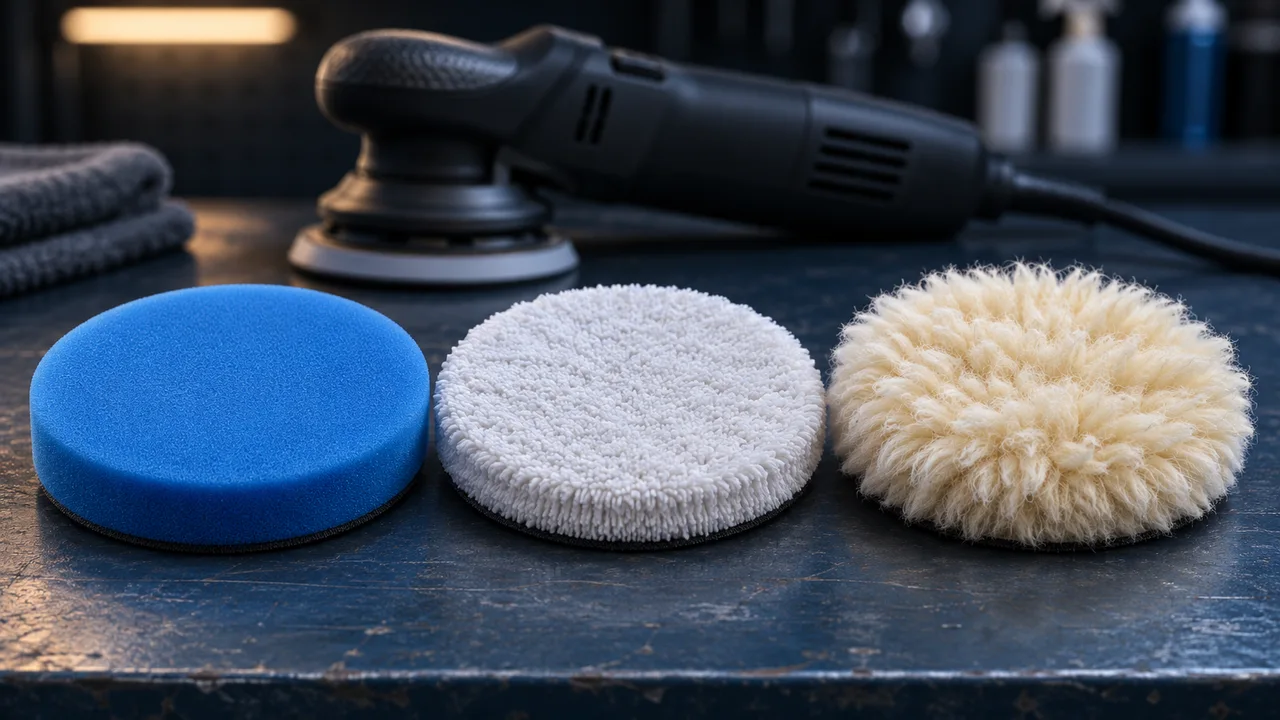
Quick answer. Start with polishing foam and a mild polish on a clean test spot. Step up to a compatible microfiber cutting pad if the foam combination leaves too many swirls. Consider a DA-rated wool pad for more demanding correction when you have assessed the paint and are ready to refine any haze afterward.
As an Amazon Associate, Best Auto Products earns from qualifying purchases. We may also earn a commission from Walmart links.
Shopping for a first set of pads?
Look for the polishing grade that fits your backing plate. Retail links open search results, so confirm the attachment diameter and pack size on the selected listing.
The foam vs microfiber vs wool polishing pads decision starts with the finish you want and the paint in front of you. A daily driver with faint wash marks may only need a gloss pass. A neglected hood with broad swirls might benefit from more cut. A thin-looking edge or failing clear coat deserves a different decision altogether. Use the same inspection light throughout so you can tell whether a change actually helped.
Foam vs microfiber vs wool polishing pads at a glance
| Pad | Where to start | What to check afterward |
|---|---|---|
| Polishing foam | Light wash marks or gloss enhancement | Whether the main defects improved under the same light |
| Microfiber cutting | Broader swirls when a mild test falls short | Fiber loading and any haze that needs refinement |
| DA-rated wool | Demanding correction on suitable paint | Machine compatibility and the finish after the test spot |
Pad grade matters within each material. Foam comes in finishing, polishing and compounding grades. Microfiber comes in several grades too. Wool varies with fiber construction and the backing beneath it. For example, RUPES sells a medium wool pad for several orbital and gear-driven machines, paired with compatible fine products. That example shows why the manufacturer’s cut rating and matching guide tell you more than the material alone. See the Lake Country guide to pad materials and the RUPES medium wool technical sheet.
When to choose foam
A polishing foam pad and mild polish give you a sensible first test on glossy paint with shallow wash marks. Foam also gives you a straightforward way to refine a panel after compounding. A dedicated finishing grade makes sense when the correction is acceptable and all you want is to improve clarity. For gloss maintenance, first decide whether abrasive polishing is needed at all. Good washing and protection may be enough for the look you want.
Foam pads sold under the same color can have different jobs across brands, and even a single manufacturer can sell multiple lines. Read the description for the exact pad series. Check whether the manufacturer calls it finishing, polishing, light cutting or compounding. If you already have a mild polish, start with a foam grade its maker recommends. A very soft pad paired with an unsuitable abrasive may do little, and a stiff foam cutting pad can be stronger than a beginner expects.
When to choose microfiber
Microfiber cutting pads give you another option when fine foam improves gloss but leaves too many swirls. The fiber face and the supporting layer both affect how the pad works. Pick a pad the maker recommends for your machine, then use its approved compound or polish. A clean fiber face lets you judge the combination more consistently across panels. Follow the maker’s directions for priming, cleaning and swapping pads during a job.
Microfiber can leave a finish you are happy with on some paint. On a dark or easily marred finish, you may see a fine veil after the swirls improve. Compare the wiped test spot under an inspection light with the surrounding paint. If a second test with a finishing foam pad improves clarity, plan for two steps on the sections that need them. Keep cutting and finishing pads separate so spent compound does not carry over.
When to choose wool
Start by checking the exact wool pad’s machine compatibility. Some wool pads suit dual-action polishers, and others are intended for different polishing systems. Look at the model number, size chart and compound pairing. A DA-rated wool pad can make sense for more demanding work once you have established that a gentler combination leaves too much of the defect. Keep a finishing combination ready so you can check how much refinement the panel needs.
Wool is especially easy to overbuy if you choose by material alone. A medium orbital wool pad and a coarse wool pad may give different levels of cut with the same machine. A more aggressive combination also adds risk in areas with uncertain paint history. If a mark exposes another layer, the clear coat is peeling, or a narrow edge is difficult to control, leave that section out of the polishing plan. Our paint thickness gauge guide explains how to interpret readings and when to pause.
How to match the pad to the backing plate
The backing plate is the part that attaches to the polisher. The pad attaches to that plate and contacts the paint. Retail listings may give the diameter across the working face, the attachment backing, or both. A tapered pad can have a larger outer face than its attachment diameter. Find the maker’s intended backing plate size and compare it with the plate installed on your actual machine before ordering.
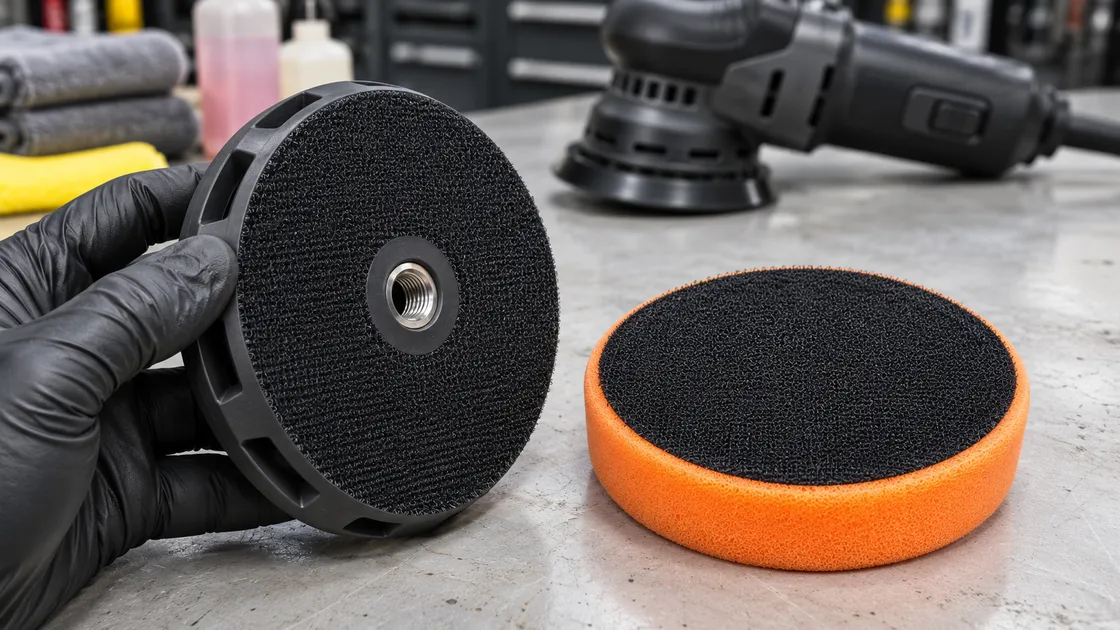
If a product page gives two diameters, look for a diagram showing where each measurement is taken. On a tapered pad, use the attachment-side measurement and the maker’s listed plate pairing during checkout. Save the pad’s model number for reorders so you can buy the same grade even if the retailer changes its listing title or thumbnail.
- Identify the polisher model and installed plate. Used machines and kits can come with a different plate from the standard configuration.
- Find the pad maker’s fit chart and machine type. A matching number on two listings still calls for a check against the exact pad and plate specifications.
- Confirm the center hole and backing style if the system specifies them. Inspect a new pad for flat, even attachment and center it before use.
- Choose a size that stays controllable on the panel. Broad areas and tight contours may call for different tools. Follow the machine instructions before changing plate sizes.
For a full-size machine example, see the Griot’s Garage G9 review. For pillars and smaller sections, the Griot’s Garage G8 guide explains why a mini polisher may be easier to position.
Working on narrow painted sections? Our RUPES iBrid Nano 2 review explains when a precision polisher complements a main machine and how to compare STB and LUX kits.
Use a test spot to choose how much cut you need
- Identify a representative area. Wash and prepare the paint, then inspect a flat section with defects that resemble the rest of the panel. Avoid testing on a sharp edge or on obviously failing paint.
- Begin with a mild match. Use polishing foam and a suitable mild polish. Follow the instructions for the tool and liquid, including how much product to apply and how to work it.
- Inspect with the same light. Remove residue using the product maker’s directions. Compare the look with the adjacent area under the same lighting and from more than one angle.
- Record what changed. Note the pad grade and liquid. If the finish improved enough for your goal, repeat that combination in suitable areas. If broad defects remain and the paint warrants correction, change one variable and test again.
- Check the final finish. If the correction step produces haze, try a dedicated polishing or finishing combination on part of the spot. Inspect it before deciding to do two passes on the whole panel.
Here is how that decision might work on a daily driver. Suppose the doors get visibly clearer with a mild foam pass, while the hood still shows a dense patch of swirls. Keep the mild combination for the doors. Test a compatible cutting combination on a small hood section and decide whether the change justifies the second step there. One stronger combination for the entire car would add work where the mild pass already delivered the result you wanted.
Keep an eye on backing attachment, residue and how the tool feels. Swap to a clean compatible pad when the face loads up and follow the product system’s cleaning directions during and after the job. Put used cutting pads somewhere separate from finishing pads. Our polishing pad cleaning guide covers care for each material.
What to buy for a first polishing job
For a vehicle that mainly needs gloss and minor correction, put most of your budget into several matching polishing foam pads. Add a finishing grade if you plan to refine the result. If you already know your paint needs stronger correction, buy a compatible microfiber cutting pad or a DA-rated wool pad you can test before buying a larger set. Bring enough clean pads to rotate during the work rather than counting on one pad to serve a whole vehicle.
- Match the exact model. Compare pad line, grade and backing plate compatibility across both retailers.
- Calculate the cost per usable pad. Divide the delivered total by the number of pads of the grade you need. A mixed pack can spend part of your budget on grades you will rarely use.
- Review seller and delivery. Check who sells the item, pack count, the delivery date and the return terms. A single pad and a multipack can share similar images, so confirm the selected option.
- Count the other supplies. Include the matched polish, clean towels and an inspection light if you still need them.
This guide draws on manufacturer pad descriptions and compatibility charts. We use example workflows to explain how to make the decision on your own paint. Your test spot supplies the evidence for your vehicle.
Polishing pad FAQ
Is microfiber always more aggressive than foam?
No. A microfiber cutting pad is generally a stronger option than mild polishing foam in the same type of workflow, but the grade, abrasive and paint affect the result. Check the specific product line and compare on a test spot.
Can I use a wool pad on a dual-action polisher?
Yes, if the pad maker lists your machine or machine type and you match the backing plate. Look for explicit orbital or DA compatibility on the technical sheet for that pad.
Can I use the same pad for compound and finishing polish?
Use separate, clean pads for each step. Compound residue left in a used pad can affect the finish. Mark the backs or store the pads separately after they dry.
Do I need all three materials?
A polishing foam setup is enough for many gloss jobs. Buy microfiber or DA wool when the condition of the paint and the result of a mild test give you a specific reason to step up.
Is a 5-inch pad always right for a 5-inch backing plate?
Check the pad maker’s compatibility chart. The visible working face may be wider than the attachment surface, so the diameter printed on a listing can describe a different part of the pad.