
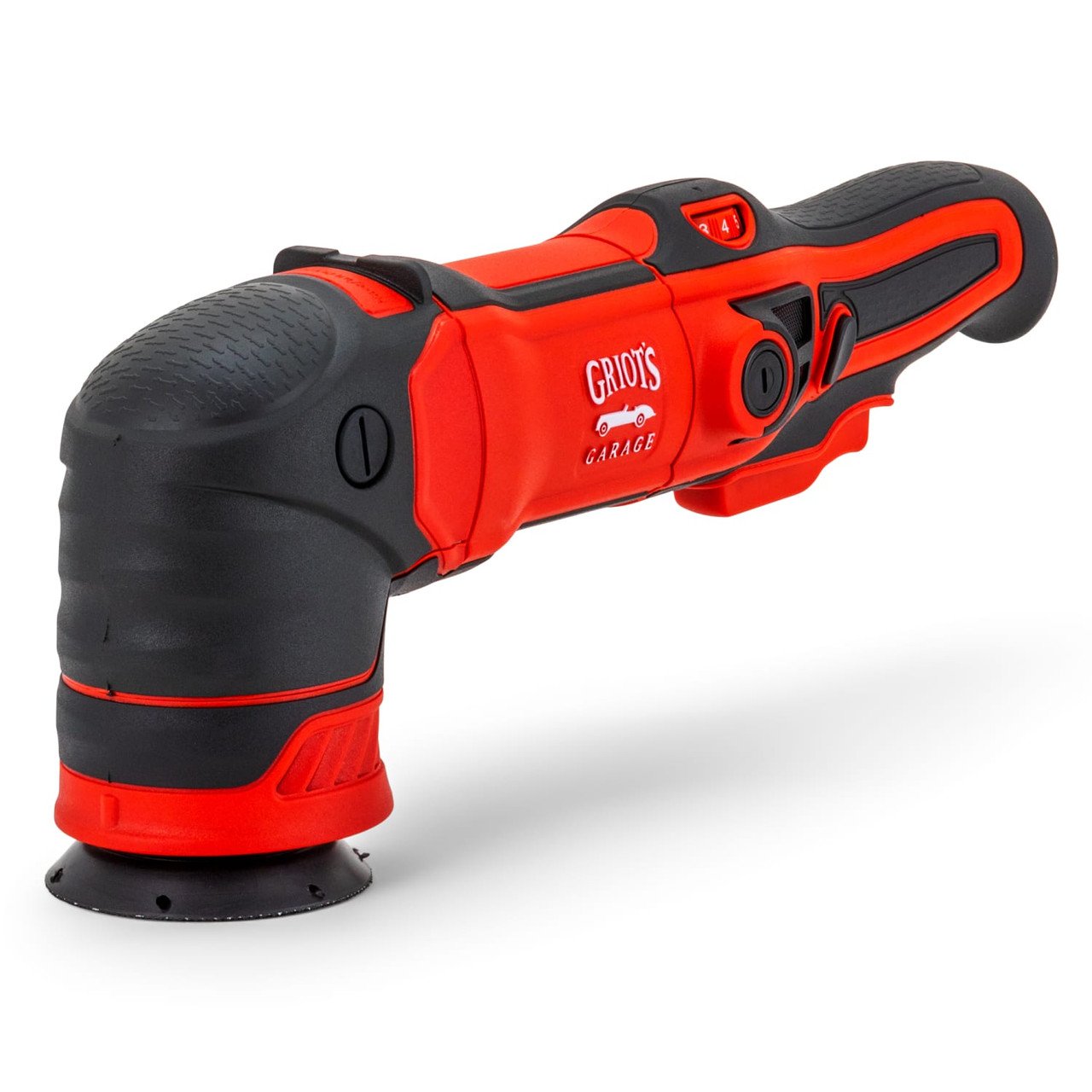
Quick verdict. In the Griot’s Garage G8 vs G9 comparison, buy the G9 first if you want one machine for whole-car polishing. Buy the G8 if your larger polisher repeatedly runs out of room around mirrors, bumper corners and narrow painted strips. If your G9 only feels bulky on moderately curved panels, price its optional 5-inch plate and a matching pad set before buying a second machine.
As an Amazon Associate, Best Auto Products earns from qualifying purchases. We may also earn a commission from Walmart links.
This buying guide compares manufacturer specifications, panel access and the parts you need to finish a job. The examples are planning scenarios based on the published plate sizes and tool designs. We did not perform a head-to-head test or measure correction time, vibration or finish quality.
Griot’s Garage G8 vs G9 specifications
| Feature | G8 Mini 10908 | G9 10901 |
|---|---|---|
| Standard plates | 2 and 3 inches | 6 inches |
| Optional size to consider | Use the included plates with matching pads | Manufacturer-supported 5-inch plate |
| Orbit | 8 mm | 9 mm |
| Rated motor output | 700 W | 1,000 W |
| Published speed range | 2,000–6,400 OPM | 2,000–6,400 OPM |
| Standard cord | 10 ft, removable | 10 ft, removable |
| Weight without cord | 4.6 lb | 5.0 lb |
| Best fit | Tight painted sections | Full panels and whole-car work |
Check the G8 product page, G9 product page and operating manuals for the current manufacturer specifications, package contents and plate instructions. The orbit is the movement of the machine’s head. Pad diameter determines how much paint the pad can contact and how close it can work next to a boundary. For this purchase, the difference between a 3-inch and a 6-inch plate generally matters more than the 1 mm difference in orbit.
Map your vehicle before you buy
Walk around the car with the finish you want in mind. List the surfaces you intend to polish and look at where each panel changes shape. An open door skin and the strip immediately above a door handle may be part of the same panel, yet ask for different pad sizes. Do this for your regular vehicle first. A tool that saves time every time you detail it can be a better purchase than one you might need on a future project.
| Surface | Starting choice | What to look for |
|---|---|---|
| Hood, roof or open doors | G9 with its 6-inch setup | Room for the whole pad and overlapping passes |
| Moderately curved fender or narrow door section | G9 with the optional 5-inch setup | Enough clearance for the tool housing and moving pad |
| Painted mirror cap or bumper corner | G8 with a compatible 3-inch setup | A patch where the pad can stay flat and clear trim |
| Short narrow painted strip | G8 with a compatible 2-inch setup | Clearance from adjacent edges and trim |
| Spot where a machine cannot sit securely | Hand polish if appropriate | Reliable control and a finish suitable for polishing |
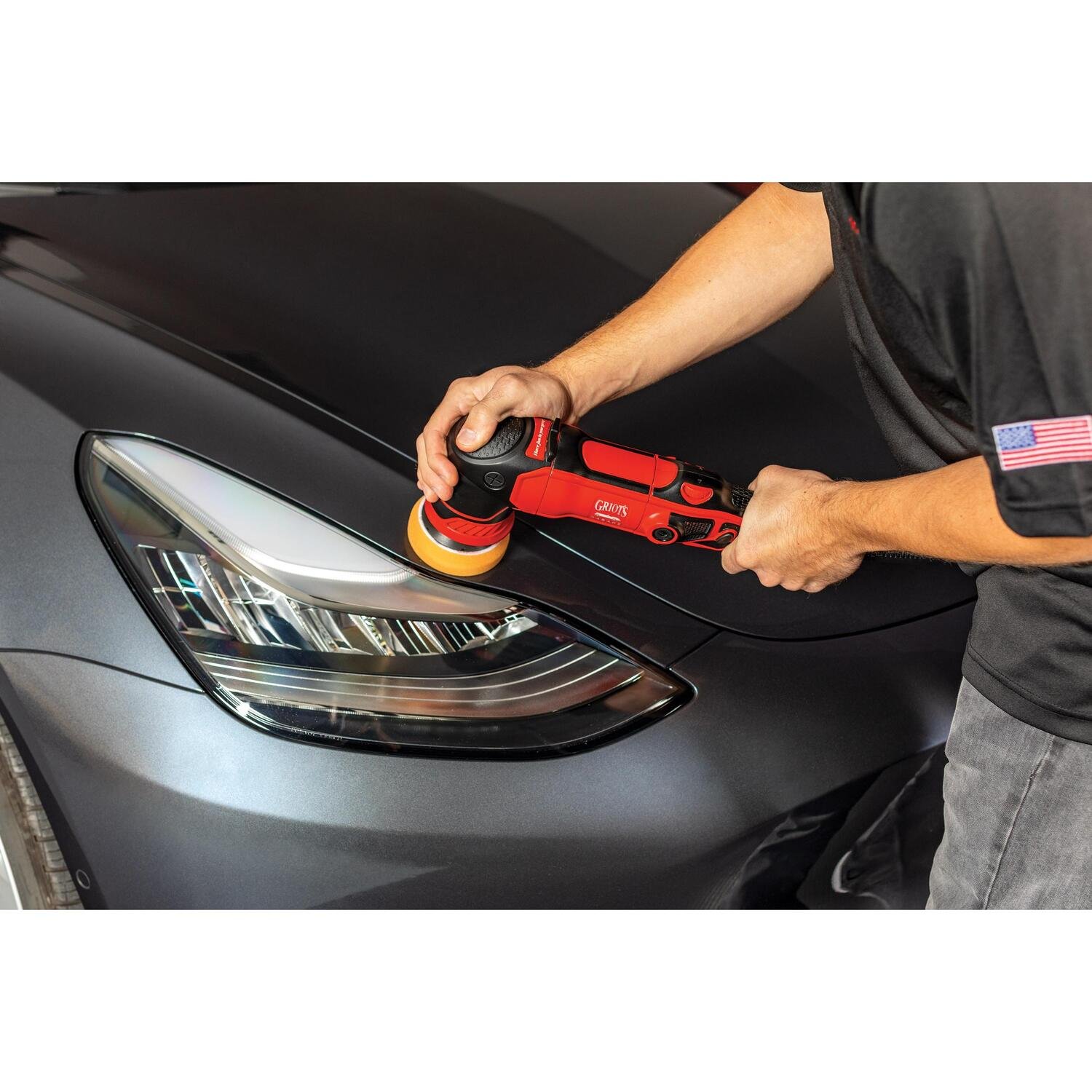
The listed backing-plate diameter alone will give you an incomplete picture. A pad’s face can extend beyond the plate, the head moves during operation and the housing needs room. Compare those three clearances with the available paint. For instance, a 3-inch plate may look right on a mirror cap until you account for the mirror base behind it. Decide whether the smaller setup gives you usable contact before ordering pads.
Three buying decisions by job type
You are polishing a daily driver for the first time
If your goal is to improve gloss across the hood, doors and roof, start with the G9. Its included 6-inch plate gives you broad coverage on open areas. Buy compatible pads for that plate and leave a little room in the budget for a spare. Work smaller details by hand if the larger pad cannot be used with control. After completing a job, note which areas slowed you down. That list tells you whether a smaller plate or a separate mini machine will actually solve a recurring problem.
The Griot’s Garage G9 review covers the standard package and the practical reasons to consider a 5-inch setup. If your vehicle has a broad roof and doors but a sculpted front end, plan the first order around most of the paint you want to improve. You can budget for the tighter sections after you see what the full-size setup can reach.
You already own a full-size polisher
A G8 fills a gap when the same detail work takes a long time by hand. Think of painted mirror caps, a channel in a bumper or a short strip below glass. You can leave the large machine set up for the open panels and keep the mini on a pad suited to the smaller sections. That matters more if you do several vehicles or revisit the same awkward shapes frequently. For one or two small areas on an occasional job, hand polishing can make more financial sense.
Our Griot’s Garage G8 review covers what comes in the 10908 box and when to use the 2-inch plate. Add small pads only for the work you can identify now. Keeping a separate inventory in several sizes adds cost and storage, and it takes time to clean and dry everything after a session.
You are choosing between a 5-inch G9 setup and the G8
The 5-inch option is useful when the 6-inch pad feels wide on a moderately curved fender or a narrower door area. For a short painted strip between two obstacles, the 5-inch pad and G9 housing still need clearance. Measure the area and compare it to the actual pad face. If it is clearly a compact job, the G8 offers a bigger change in working footprint. If most of the car is accessible and the issue is occasional contouring, price the plate swap first.
Changing to a smaller backing plate can also mean buying a second set of pads. Before you compare that setup with the G8, check whether any pads you already own are compatible. Include the pads you would need for the first full job, including replacements or spares, and check the manufacturer’s operating instructions for the plate you choose.
Compare Amazon and Walmart by total setup cost
The retailer links open model searches. Select G8 model 10908 or G9 model 10901 and verify the selected offer. Confirm the seller, shipping timing, return terms and what comes in the box. The base G8 package should include both small plates, while the base G9 package should include its 6-inch plate. Verify the removable cord is included, especially when shopping for used, open-box or returned items.
Build the same working kit in both carts. For a standard G9, include the tool, compatible pads and polish appropriate to the finish. If you plan to start with 5-inch equipment, include the separate plate and matching pads. For a G8, price the pad size you will actually use first. Add the other size only if you already have work that needs it. For a bundle, give each included item credit only if it replaces something you planned to buy.
Compare the checkout totals for your ZIP code after shipping and tax. Check how returns work for the seller you selected and whether you are comfortable with the delivery date. A lower tool price can become a higher first-job total if you still have to order the right pads separately. Prices and inventory vary, so the purchase decision should come from the current offer and your own basket.
Use a test spot to decide how far to go
Clean the panel and inspect it with consistent lighting. Find a small area that represents the finish you want to improve. Use a mild combination suited to the paint and follow the machine, pad and polish instructions. Inspect the test spot again from more than one angle. If gloss improves enough for the way you use the car, carry that approach to similar sections. Reevaluate when the panel material, finish or shape changes.
Pay special attention to sharp lines, exposed edges and signs that a panel was repaired. Leave deeper defects alone when you cannot assess the finish with confidence. Our guide to reading a paint thickness gauge explains how to use readings on compatible surfaces. Common metal-substrate gauges can have limitations on plastic bumper covers, so confirm what your instrument supports.
If your jobs consist mainly of broad surfaces and you already know you want a larger orbit, see the FLEX vs RUPES 15 mm comparison. Both Griot’s models here serve shorter-throw roles. The G9 is the better place to start for most one-tool garages, while a dedicated G8 addition makes sense when access is the recurring bottleneck.
What to put in your first kit
For a single G9 setup, start with pads that fit the included plate and one polish appropriate for the finish. Choose a spare pad of the same type before filling the cart with several grades. When a pad becomes loaded, a like-for-like replacement makes it easier to keep the combination consistent across similar panels. Add a smaller plate only after you can name the surfaces where the standard setup is too wide.
For a G8 addition, choose the small pad size that fits most of the short sections you have already identified. Keep the second plate available for the occasional tighter area, and check its pad fit before buying a multipack. If you manage both tools, organize pads by size and purpose so the right combination is easy to find mid-job. Check the used-pad condition before moving to the next panel. A few well-chosen options make it easier to repeat the results you saw in your test spot.
Frequently asked questions
Can you polish a whole car with the G8?
You can use the G8 on suitable areas throughout a car. On broad panels the narrower pad will require more passes, so the G9 is usually the better first choice for recurring whole-car work.
Does the standard G9 come with a 5-inch backing plate?
Griot’s lists a 6-inch plate in the standard G9 package and offers a compatible 5-inch plate separately. A retailer bundle may include the smaller plate, so check the contents and whether it includes matching pads.
Which machine should a beginner buy first?
Buy the G9 first if you plan to polish complete panels on a daily driver. Buy the G8 first when the job is limited to genuinely small areas. Before buying either, identify how much of the finish you plan to work on and price a compatible pad set.
Does the bigger motor guarantee faster scratch removal?
Motor ratings help describe each model, while the paint, defect depth, pad, polish and working technique determine the result. Choose by panel fit first and use a test spot to find a workable combination.
Final verdict
Buy the G9 for full panels and occasional whole-car detailing. Use its standard 6-inch setup for open paint and consider the optional 5-inch plate if tighter curves are frequent. Buy the G8 as your first tool only if your work is mostly compact, or as a second tool when a larger pad repeatedly runs out of clearance. Before checkout, compare each offer with the exact plates and pads you will put to work.